
Owner-Contractor Payment Transparency Benefits for GCs & Subs
Owner-contractor payment transparency speeds cash collection, cuts days sales outstanding (DSO), reduces disputes, and correlates with higher rates of repeat commercial work — and the research backs every one of those claims. A CFMA member survey found that lien-waiver automation is a primary cash-flow driver, reducing DSO by an average of 12–18 days. The FMI Contractor Market Survey found that contractors with documented waiver compliance programs win repeat commercial work at higher rates than peers. Waiverpilotpro is one example of software that operationalizes these gains through automated waiver generation, audit trails, and integrations with Procore, QuickBooks, JobTread, Buildertrend, and Sage.
The headline benefits at a glance:
- Faster cash collection: Automated waiver packages remove the back-and-forth that delays pay-app approvals.
- Lower DSO: Lien-waiver automation reduces DSO significantly (CFMA member data).
- Fewer disputes: Documented, timestamped payment records close the documentation gaps that most commonly trigger payment disputes.
- Faster retainage release: Earlier retainage release produces measurable working-capital gains for subs and GCs alike.
- More repeat commercial work: Documented waiver programs correlate with stronger owner relationships and higher rebid rates.
This article covers the measurable KPIs, the software features that deliver them, a 90-day implementation checklist, and how to handle the most common objections from your team or procurement.
Table of Contents
- Why does owner-contractor payment transparency matter on a project?
- What measurable benefits can you expect from contractor payment clarity?
- How does financial transparency in contracts actually get delivered?
- What does a 90-day implementation checklist look like?
- How do you handle the most common objections to payment transparency?
- Key Takeaways
- The transparency gap most contractors are still ignoring
- Waiverpilotpro covers the features this checklist requires
- Useful sources and further reading
Why does owner-contractor payment transparency matter on a project?
When payment status is unclear, everyone on the project spends time chasing answers instead of building. Subs call the GC’s office. GCs email owners. Finance teams pull manual reports. That friction compounds fast across a multi-sub project.
Real-time tracking and automated reconciliation reduce manual errors and improve financial planning for every party in the payment chain. When a sub can see their invoice status, the timestamp, and the next step without calling anyone, support load drops and scheduling becomes more predictable because subs can actually forecast their cash.
The commercial upside is just as real. When owners see a clean, documented payment trail, trust builds. That trust translates into referrals and repeat awards. The FMI survey finding is specific: documented waiver programs correlate with higher repeat commercial work rates, not just goodwill.
Pro Tip: When rolling out a new payment transparency workflow, configure recipient-facing status views before you add richer reporting. Showing subs their current payout state, timestamp, and next action reduces inbound calls immediately — and that quick win builds internal buy-in for the broader rollout.
What measurable benefits can you expect from contractor payment clarity?
The four KPIs that move most consistently when transparency is introduced are DSO, approval cycle time, dispute rate, and repeat commercial work rate. Here is how each one typically shifts.
| KPI | Typical Baseline | Expected Improvement | Cash-Flow Impact |
|---|---|---|---|
| Days Sales Outstanding (DSO) | — | Reduced significantly with waiver automation | Direct: faster receivables, lower borrowing need |
| Pay-app approval cycle | 7–14 days | Shortened by standardized, complete packages | Faster funding release per draw |
| Dispute rate | Varies by project size | Reduced by closing documentation gaps | Avoids legal costs and project delays |
| Repeat commercial work rate | Baseline varies | Higher for contractors with documented waiver programs | Revenue stability, lower bid costs |
Key figure: Lien-waiver automation yields the largest ROI among construction workflow automations because it directly accelerates receivables and retainage release — not just labor savings.
Which KPI to measure first: Start with DSO. It is the most direct signal of whether your payment process is working, and it is easy to pull from your accounting system. Set a baseline before you change anything, then measure again at 30 and 60 days after rollout.
Retainage is the other number worth watching early. Accelerating a single retainage release produces a working-capital benefit that is often larger than months of labor-hour savings from reduced admin. That makes it the most persuasive ROI story for ownership or finance.
How does financial transparency in contracts actually get delivered?
Transparency is not a mindset shift. It is a set of specific software features and workflow configurations that create a single source of truth for every party.
The core capabilities to require:
- Automated lien-waiver generation: Conditional and unconditional waivers generated from project data, not typed from scratch each time. This removes the manual errors that stall approvals.
- Audit trail and timestamping: Every waiver, pay-app submission, and status change is logged with a date, time, and user. Owners and lenders can verify the payment chain without asking anyone.
- Auto-calculated balances: The system computes amounts due, amounts paid, and retainage held. No manual math, no reconciliation disputes.
- Multi-subcontractor support: A GC managing 15 subs needs to generate and track waivers in bulk, not one at a time.
- Notarizable output: Some states and lenders require notarized waivers. Professional-grade PDF output that meets those requirements avoids last-minute delays at closeout.
- Recipient-facing payout status: Subs see their current status, the timestamp, and the next action. A payout tracker that answers “where is my money?” without a phone call is the practical minimum for transparency.
Integrations are what make these features stick. When your waiver tool connects to Procore, pay-app data flows directly into waiver generation without rekeying. A QuickBooks or Sage sync means your accounting records and your waiver records match automatically. JobTread and Buildertrend integrations extend that same reconciliation to project management and scheduling data. Manual rekeying between systems is where errors enter and disputes start — accounting integration closes that gap.
Access controls matter too. Subs should see their own payout status. Internal finance teams see the full audit record. Owners and lenders get the documentation they need for draw requests. Keeping those views separate prevents confusion and protects sensitive project data.

What does a 90-day implementation checklist look like?
A phased rollout produces visible KPI improvements without disrupting active projects.
Days 0–14: Quick wins
- Pull your current DSO and approval cycle time as a baseline.
- Standardize your pay-app template across all active projects.
- Enable automated waiver generation for your next pay-app cycle — use free waiver templates to start without a budget commitment.
- Identify your two or three highest-volume subs and run the new workflow with them first.
Days 15–60: Short-term rollout
- Connect your accounting system (QuickBooks, Sage) to your waiver tool.
- Set up recipient-facing payout status for all active subs.
- Define SLAs: how many days from pay-app submission to approval, and from approval to payment.
- Train your PM and finance team — focus on the inbox reduction benefit, not the technology.
Days 61–90: Scale and integrate
- Connect Procore, JobTread, or Buildertrend so project data flows into waiver generation automatically.
- Run your 30-day ROI checkpoint: compare DSO and approval cycle time against your baseline. An accelerated retainage release in this window is a strong signal the workflow is working.
- Expand to all subs and document your payment release process for future projects.
- Review dispute tickets opened during the pilot period versus the prior 90 days.
30-day ROI checkpoint: If your approval cycle time has shortened and at least one retainage release has been accelerated, the workflow is producing cash-flow gains. That is the number to bring to ownership.
How do you handle the most common objections to payment transparency?
Common objections are resolvable with the right framing, phased rollout, and a few specific configurations.
Objection: “This will cost more than it saves.”
- Frame ROI around cash flow first, not labor hours. A 12–18 day DSO reduction on a $2M receivables book is a material working-capital gain.
- Accelerated retainage release often produces a larger one-time benefit than months of admin savings.
- Start with a free or low-cost pilot tier to prove the numbers before committing to a full subscription.
Objection: “Our subs won’t adopt a new system.”
- Start with your two or three most cooperative subs. Early wins create peer pressure in the right direction.
- Lead with the inbox reduction benefit: subs stop calling to ask about payment status because they can see it themselves.
- Keep admin overhead low by choosing a tool that requires no account creation from subs to receive or sign waivers.
Objection: “We’re not sure about the legal side or data security.”
- For waiver types, understand the difference between conditional waivers (rights waived only upon payment clearing) and unconditional waivers (rights waived immediately). A plain-English guide to lien waivers covers the distinction without legal jargon. This article is general information, not legal advice — confirm your state’s requirements with a qualified attorney or your state’s lien law resources.
- For security, require read-only recipient views (subs see their status, not the full project ledger) and a full internal audit trail for finance and legal.
- Verify that your waiver tool produces state-specific templates. Generic forms create compliance risk that outweighs any efficiency gain.
Key Takeaways
Payment transparency delivers its biggest gains through lien-waiver automation, which reduces DSO by an average of 12–18 days and correlates with higher repeat commercial work rates for contractors with documented programs.
| Point | Details |
|---|---|
| DSO reduction | Lien-waiver automation reduces DSO by an average of 12–18 days, per CFMA member survey data. |
| Repeat work correlation | FMI survey data links documented waiver programs to higher repeat commercial work rates. |
| Retainage as ROI signal | Accelerating a single retainage release often produces a larger working-capital gain than months of admin savings. |
| Integration is the multiplier | Connecting your waiver tool to Procore, QuickBooks, Sage, JobTread, or Buildertrend eliminates rekeying errors and speeds reconciliation. |
| Waiverpilotpro as a starting point | Waiverpilotpro provides free automated waiver generation with integrations and notarizable output, covering the core features that drive these KPI improvements. |
The transparency gap most contractors are still ignoring
Most conversations about payment transparency focus on the owner-to-GC relationship. The bigger gap is usually one level down: GC to sub. Subs are the ones calling your office every week asking where their money is, and that call costs both sides time. The CFMA and FMI findings are compelling, but the more immediate payoff is operational: fewer inbound calls, faster approvals, and subs who show up to the next bid because they trust you to pay cleanly.
The 90-day checklist in this guide is deliberately cash-flow-first for a reason. Pilots that start with labor savings as the success metric tend to stall because the numbers are small and hard to attribute. Pilots that start with DSO and retainage release produce a dollar figure that ownership can see in the bank account. That is the argument that gets a transparency workflow funded and expanded.
Waiverpilotpro covers the features this checklist requires
Free, instant lien waiver generation with no account creation required for subs. That is the practical starting point for any transparency rollout, and it is what Waiverpilotpro delivers out of the box.
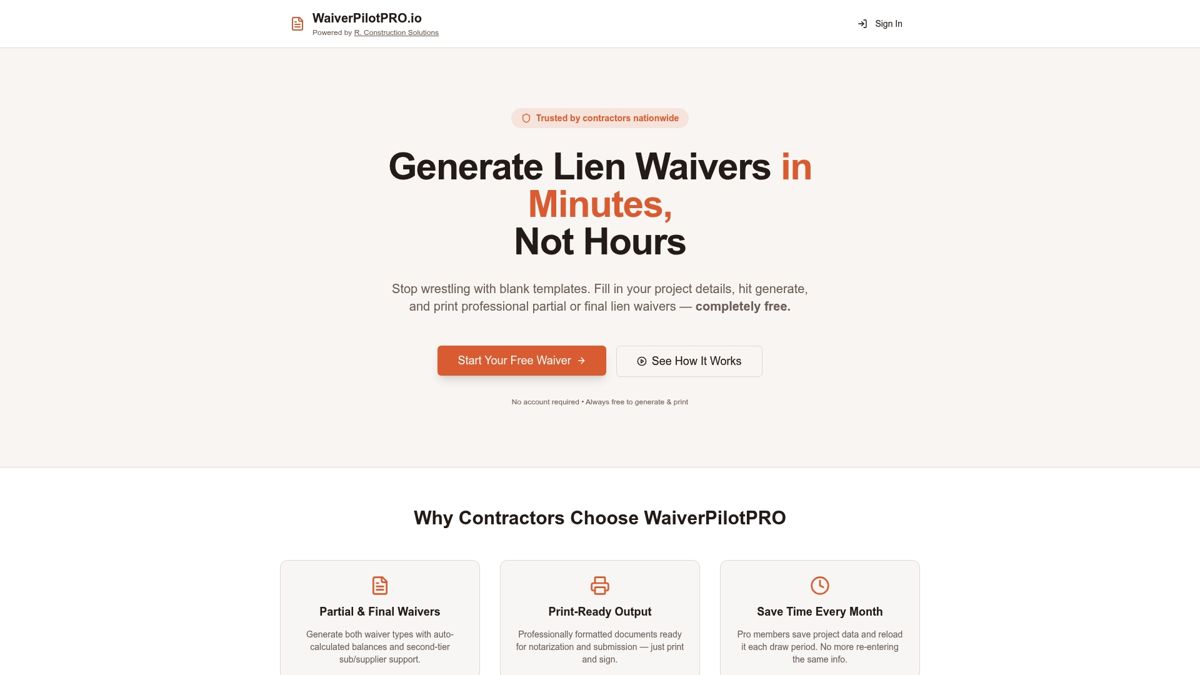
The platform generates conditional and unconditional waivers for all 50 states, auto-calculates payment balances, supports multi-subcontractor batches, and produces notarizable PDF output. For GCs already using Procore, QuickBooks, JobTread, Buildertrend, or Sage, the integrations mean project data flows directly into waiver generation without manual rekeying. The Pro tier adds AI-powered contract field auto-fill, project saving, and bulk management for larger teams.
The entry point is genuinely free: use the free lien waiver generator to generate your first waivers today, run the 30-day pilot from the checklist above, and measure your DSO and approval cycle time against your baseline. The numbers will tell you whether to expand.
Useful sources and further reading
- CFMA and FMI survey findings on lien-waiver automation ROI — US Tech Automations ROI analysis referencing CFMA member data and FMI Contractor Market Survey
- Payout tracker design and recipient-facing transparency — Gruv: practical guidance on status views and support-load reduction
- Construction payment management best practices — NetSuite: cloud dashboards, automation, and dispute reduction
- Mitigating payment disputes in construction — ResearchGate: academic analysis of documentation gaps and dispute causes
- How transparent payment systems transform contractor relationships — Explica: industry overview of digital payment adoption
- What is a lien waiver? A contractor’s plain-English guide — Waiverpilotpro: conditional vs. unconditional waiver types explained
- Construction payment dispute process — Waiverpilotpro: common dispute causes and resolution steps
- Subcontractor cash flow explained — Waiverpilotpro: why timely payments matter for subs