
Subcontractor Cash Flow Explained: Your Practical Guide
Subcontractor cash flow is the timing and movement of money into and out of your business across a construction project. You pay labor, materials, and overhead upfront, but payments from general contractors often arrive weeks or months later. That gap is the core challenge of subcontractor financial management. Subcontractors may wait an average of 51 days after submitting a pay application to receive payment, creating a recurring working-capital need of two to three months of expenses. Understanding this timing gap is the first step toward fixing it.
How does the subcontractor cash flow cycle work?
The cash flow cycle for subcontractors starts before a single invoice goes out. You mobilize crews, order materials, and pay suppliers in the first weeks of a project. None of that spending is recoverable until your first pay application clears.

The first pay application is often delayed 4–6 weeks after mobilization. Add net-30 or net-45 payment terms on top of that, and you are looking at a 10–14 week gap before any cash comes back. When retainage is factored in, the total wait can stretch to three months or more.
The table below shows how cash typically flows on a mid-size subcontract over the first 12 weeks:
| Week | Cash Out | Cash In |
|---|---|---|
| 1–2 | Mobilization, material deposits | None |
| 3–4 | Labor, ongoing materials | None |
| 5–6 | Labor, overhead | First pay app submitted |
| 7–10 | Labor, materials, overhead | None (GC review period) |
| 11–12 | Labor, overhead | First partial payment received |
General contractor payment cycles average 45–60 days from invoice submission. That means your cash outflows run for nearly three months before inflows begin to offset them. Retainage, typically 5–10% held back on each draw, stays locked until substantial completion, which can be months after your work is done.
A 13-week rolling cash flow forecast is the most practical tool for mapping this gap. You update it weekly, projecting every known outflow against expected inflows. That gives you a clear view of when shortfalls will hit before they become crises.
Pro Tip: Track retainage in a separate line from your regular accounts receivable. Many subcontractors leave retainage uncollected simply because no one monitors the contractual release triggers. Set a calendar reminder to request release within five days of reaching substantial completion.
What key financial metrics explain subcontractor cash flow?
Days Sales Outstanding, or DSO, is the single most useful metric for measuring how fast you collect cash after completing work. DSO is calculated by dividing accounts receivable by net credit sales, then multiplying by the number of days in the period. A DSO of 60 means you wait an average of 60 days to collect on completed work.
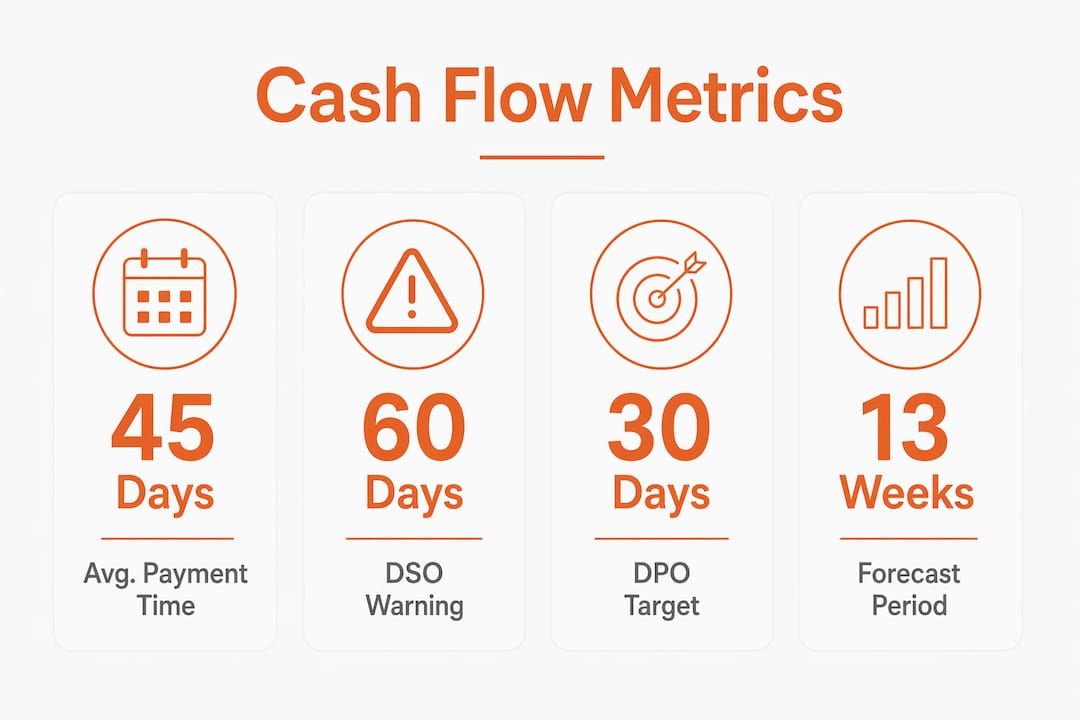
In construction, DSO above 60 days signals a collection problem. High DSO ties up working capital, forces you to borrow more, and increases the risk of missing payroll or supplier payments. Lowering DSO by even 10 days can free up meaningful cash on a project with a large contract value.
Days Payable Outstanding, or DPO, is the flip side. DPO measures how long you take to pay your own suppliers. A higher DPO means you hold cash longer before paying out. The goal is to keep DPO as high as your supplier terms allow while driving DSO as low as possible.
Common causes of slow collections:
- Incomplete or late pay application submissions
- Missing lien waiver documentation required by the GC
- Billing errors that trigger rejection and restart the clock
- Slow GC internal approval processes
- Retainage held past contractual release dates
- Disputes over change orders not resolved before billing
Monitoring both DSO and DPO together gives you a real picture of your cash position. DSO tells you how fast money comes in. DPO tells you how long you can hold money before it goes out. The gap between them is your working capital window.
| Metric | What it measures | Target in construction |
|---|---|---|
| DSO | Days to collect after invoicing | Below 60 days |
| DPO | Days before paying suppliers | Match or exceed supplier terms |
| Net cash gap | DSO minus DPO | As small as possible |
How do contract payment terms and laws affect subcontractor cash flow?
Contract language directly controls when you get paid. Two clauses appear in nearly every subcontract and have very different consequences for your cash flow.
Pay-when-paid means the GC pays you after the owner pays the GC. It sets a timing condition but does not eliminate the GC’s obligation to pay you. If the owner never pays, the GC still owes you, eventually.
Pay-if-paid is more aggressive. It shifts the risk of owner nonpayment entirely to you. If the owner does not pay the GC, the GC has no obligation to pay you at all. Courts in some states refuse to enforce pay-if-paid clauses. Knowing your state’s position before signing is not optional.
State prompt payment laws set hard deadlines that override slow contract language. Here is how two major states handle it:
- Virginia: The GC must pay subcontractors within 60 days of invoice, or within 7 days of receiving owner payment, whichever comes first. The GC must notify you within 50 days if payment is being withheld, along with the reason.
- California: Owners must pay contractors within 30 days. Contractors must pay subcontractors within 7 days of receiving owner payment. Retention must be released within 45 days of project completion. Late payments carry a penalty of 2% per month plus attorney’s fees.
- Negotiate payment timing upfront: Link your payment timing directly to the GC’s draw receipt from the owner. Contract language can be tailored so that you are paid within 10 days of the GC receiving an owner draw, rather than waiting for a separate 30 or 60-day clock to run.
- Know your notice requirements: Missing a notification deadline can waive your right to dispute a withheld payment. Read every contract clause about withholding before you sign.
- Understand retainage release schedules: Some contracts release retainage in stages tied to project milestones. Others hold everything until final completion. Negotiate milestone-based releases whenever possible.
Prompt payment laws are your backstop when contract terms are unfavorable. But the best protection is a well-negotiated contract before the project starts.
What are effective cash flow protection and management strategies?
No single fix solves subcontractor cash flow problems. Building a diverse capital stack with multiple funding sources is the most resilient approach. That means combining your own working capital, a business line of credit, supplier payment terms, and project-specific financing tools like Billd, which advances material costs against future receivables.
Aligning your payment terms with the GC’s draw schedule reduces the risk of acting as an interest-free lender during approval delays. If the GC draws from the owner every 30 days, your billing cycle should match that rhythm exactly. Submitting pay applications one day after the GC’s draw cutoff means waiting an entire extra cycle.
Cash flow protection strategies that work:
- Submit pay applications on the earliest possible date each cycle
- Bill for mobilization costs and material deposits as a separate line item in your first application
- Use a 13-week rolling cash flow forecast, updated every week, to spot shortfalls before they hit
- Model material deposits explicitly in your forecast. Deposits due before invoicing are a common source of surprise shortfalls
- Maintain a minimum cash reserve equal to six weeks of project overhead
- Negotiate shorter retainage periods or milestone-based retainage releases in every contract
Pro Tip: Lien rights are your most powerful legal tool for protecting payment. A conditional lien waiver releases your lien rights only upon actual receipt of payment, not upon promise of payment. Never sign an unconditional waiver before the check clears.
Construction cash flow issues follow predictable timing patterns. That predictability is an advantage. When you know a cash gap is coming in week eight, you can arrange a draw on your credit line in week six instead of scrambling when payroll is due.
Key Takeaways
Subcontractor cash flow management requires forecasting payment gaps early, negotiating favorable contract terms, and using legal tools like lien waivers to protect every dollar you earn.
| Point | Details |
|---|---|
| The cash gap is predictable | Subcontractors typically wait 10–14 weeks before receiving first payment, making early forecasting critical. |
| DSO is your collection benchmark | Keep DSO below 60 days in construction; high DSO signals slow collections and strains working capital. |
| Contract terms control timing | Pay-if-paid clauses shift nonpayment risk to you; prompt payment laws in states like California and Virginia set hard deadlines. |
| Retainage needs separate tracking | Track retainage apart from regular receivables and request release within five days of substantial completion. |
| Lien waivers protect payment rights | Use conditional waivers that release lien rights only after payment is confirmed, not promised. |
What I’ve learned from watching subcontractors manage cash flow
Most subcontractors I have worked with understand that cash flow is a problem. Fewer understand that it is a timing problem, not an accounting problem. The money is usually there in the contract. The issue is the sequence in which it moves.
The subcontractors who handle this best do two things differently. First, they treat their 13-week cash forecast like a job site safety checklist. It gets updated every Monday, no exceptions. Second, they negotiate payment terms before signing, not after a cash crisis hits. By the time you are asking a GC to pay faster, you have already lost the leverage.
The legal side is where I see the most money left on the table. Retainage sits uncollected for months because no one is watching the release trigger. Pay applications get rejected because a lien waiver was missing or used the wrong form. These are not complicated problems. They are process problems. A tool like Waiverpilotpro removes the friction from the waiver side of that equation, which is one less reason for a GC to hold up your payment.
My honest advice: build your cash flow forecast before you mobilize, not after your first pay app comes back short. The pattern is predictable. Use that to your advantage.
— Rowena
Waiverpilotpro’s free lien waiver generator for subcontractors
Lien waivers are a required part of nearly every pay application, and a missing or incorrect waiver is one of the fastest ways to delay your payment. Waiverpilotpro gives subcontractors a free, no-account-required way to generate both conditional and final lien waivers in minutes.
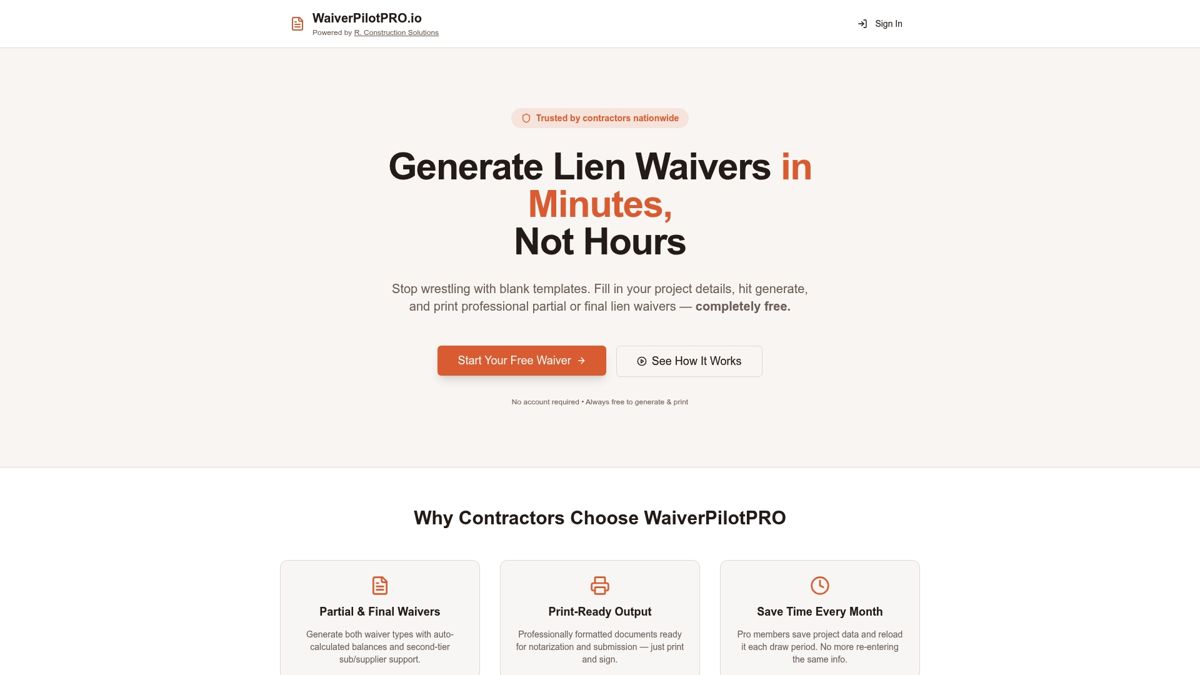
The platform integrates with Procore and QuickBooks, so your project details carry over without manual re-entry. Waivers are notarizable and ready for submission. Waiverpilotpro also supports partial and final waiver types, so you always submit the right form at the right stage of the project. Use the free lien waiver generator to protect your payment rights on every draw, without the paperwork delay.
FAQ
What is subcontractor cash flow?
Subcontractor cash flow is the timing of money moving in and out of your business during a construction project. You pay costs upfront and collect payment weeks or months later, creating a recurring cash gap.
How long do subcontractors typically wait to get paid?
Subcontractors often wait an average of 51 days after submitting a pay application to receive payment, with the total gap from mobilization to first payment reaching 10–14 weeks.
What is the difference between pay-when-paid and pay-if-paid?
Pay-when-paid sets a timing condition but preserves your right to payment. Pay-if-paid transfers the risk of owner nonpayment entirely to you, eliminating the GC’s obligation if the owner defaults.
How does DSO help subcontractors manage cash flow?
DSO measures the average number of days to collect payment after invoicing. A DSO above 60 days in construction signals slow collections and indicates a need to tighten billing and follow-up processes.
Why do lien waivers affect subcontractor payment timing?
GCs routinely require a signed lien waiver before releasing payment. A missing or incorrect waiver stalls the payment process. Using a conditional waiver protects your lien rights until payment is actually received.