
Subcontractor Admin Overhead Reduction Tips for 2026
Subcontractor administrative overhead is defined as the total labor, time, and cost spent managing compliance, payments, documentation, and coordination outside of direct field work. General contractors typically spend $165,000–$210,000 annually on subcontractor admin, with staff losing 37–49 hours monthly to manual tasks. These subcontractor admin overhead reduction tips target the highest-cost areas first: insurance tracking, payment processing, onboarding, and document management. The industry term for this discipline is subcontractor overhead management, and it covers every process that consumes time without directly building anything.
1. What are the most time-consuming subcontractor admin tasks?
Knowing where your time goes is the first step to cutting contractor admin costs. Most construction managers underestimate their true admin burden because self-reported tracking misses 20–30% of actual work due to undocumented exception cleanup. Multiply your observed weekly admin hours by 1.25 to get a realistic baseline.
The highest-cost tasks break down like this:
- Insurance tracking and certificate management: $38,000–$52,000 per year in staff labor
- Payment processing and invoice reconciliation: $25,000–$41,000 per year
- Schedule coordination and change order management: $31,000–$47,000 per year
- Onboarding and documentation: $22,000–$35,000 per year
Each of these categories involves repetitive, manual steps that are easy to automate. The problem is that most teams treat them as unavoidable overhead rather than fixable process failures.
Pro Tip: Run a two-week detailed time audit before making any changes. Have every admin team member log tasks in 15-minute blocks. The results almost always reveal one or two categories consuming far more time than anyone expected.

2. How can automation cut subcontractor onboarding overhead?
Automated onboarding is the single fastest way to reduce administrative overhead in subcontractor management. Automation cuts onboarding time by 50–65% and delivers measurable first-year savings. That translates directly into reclaimed hours your team can spend on coordination and owner relations.
Here is what a fully automated onboarding workflow replaces:
- Document collection: Automated portals replace back-and-forth email chains for W-9s, licenses, and certificates of insurance.
- Insurance verification: Optical character recognition (OCR) reads uploaded certificates and cross-checks coverage dates and limits against your requirements automatically.
- Agreement generation: Subcontract templates populate with project-specific data and route for e-signature without manual drafting.
- Payment profile setup: Banking and tax details feed directly into your accounting system, eliminating duplicate data entry.
The financial impact is real. Contractors who implement automated onboarding report roughly $94,000 in annual admin labor savings. That figure comes from eliminating the staff hours previously spent chasing documents, re-entering data, and following up on expired certificates.
| Task | Manual time | Automated time |
|---|---|---|
| Document collection | 3–5 hours per sub | Under 30 minutes |
| Insurance verification | 1–2 hours per renewal | Near-instant with OCR |
| Agreement generation | 2–3 hours per contract | Under 15 minutes |
| Payment profile setup | 45–90 minutes per sub | Under 10 minutes |
Pro Tip: Start automation with insurance tracking and prequalification. These are the highest-risk areas and the fastest to show measurable ROI. Full system overhauls fail more often than targeted fixes.
3. What techniques cut payment and lien waiver processing time?
Manual invoice processing is one of the most expensive inefficiencies in construction. The average manual payment cycle runs 53 days from invoice submission to payment release. Automation cuts that cycle by more than 50%, which means faster cash flow for subcontractors and fewer disputes for general contractors.
The payment workflow has three points where automation delivers the biggest gains:
- Automated invoice capture: Digital invoice intake with line-item matching eliminates manual data entry and reduces keying errors.
- Compliance-gated payment releases: The system holds payment until all required documents, including lien waivers, are confirmed as received and valid.
- Automated lien waiver collection: Lien waiver requests go out automatically when invoices are approved, and collection time drops by 65–80% with automation.
Lien waivers deserve special attention here. A lien waiver is a document a subcontractor signs to release their right to file a mechanics lien, which is a legal claim against a property for unpaid work. Lost lien waivers and manual data entry errors are the leading causes of payment delays and can expose a project to lien claims ranging from $50,000 to $500,000 per incident. Automating this step is not optional if you want to manage risk seriously.
Tools like Waiverpilotpro generate both conditional and final lien waivers with auto-calculated balances, support multiple subcontractors per project, and produce notarizable documents ready for submission. For teams already using Procore, Waiverpilotpro’s Procore integration connects lien waiver generation directly to your existing payment workflow.
4. How do communication and documentation improvements reduce overhead?
Poor document management creates a hidden tax on your team’s time. Email threads used for critical documents cause major admin bloat because email is a communication tool, not a filing system. When a subcontractor asks for a copy of their executed contract six months into a project, someone spends an hour doing “inbox archaeology” to find it.
The fix is a permanent project file repository where every document lives in one place, organized by project and subcontractor. This single change reduces redundant work, cuts response times, and prevents the version-control errors that come from emailing files back and forth.
Pro Tip: Assign one person to own the document repository for each project. Shared ownership means no ownership. When everyone is responsible, no one is.
Centralized platforms also reduce app switching, which is a real productivity drain. Every time a team member switches between email, a spreadsheet, a PDF viewer, and a project management tool to complete one task, they lose context and time. Platforms that consolidate subcontractor data, documents, and communication in one place cut this friction significantly.
- Permanent file repositories prevent document loss and version conflicts
- Single-platform access reduces the time spent switching between tools
- Structured data entry improves accuracy and speeds up billing cycles
- Better field data quality creates faster billing and improved project margins
5. What best practices support long-term admin overhead reduction?
Automation alone does not fix a broken process. Outsourcing subcontractor bookkeeping fails without standardized internal processes and documented standard operating procedures (SOPs) already in place. If your process is chaotic internally, outsourcing just moves the chaos somewhere else.
The best practices for sustainable administrative efficiency follow a clear sequence:
- Document your current process first. Write out every step in your onboarding, payment, and compliance workflows before changing anything. You cannot improve what you have not mapped.
- Standardize before you automate. Automation locks in whatever process you feed it. A bad process automated at scale creates bigger problems faster.
- Start with highest-risk areas. Insurance tracking and compliance verification carry the most legal and financial exposure. Fix these before tackling lower-stakes tasks.
- Manage change carefully with field teams. Field teams resist change unless the new system makes their daily tasks easier. Show crews the direct benefit to them, not just the benefit to the office.
- Reinvest the time you save. Leading contractors treat admin efficiency as a way to free staff for high-value work like owner relations and project coordination, not just as a cost-cutting exercise.
Automation of subcontractor workflows delivers 25–40% lower admin overhead and a median first-year ROI of 340%. Those numbers only hold when the underlying process is clean before automation begins.
Key takeaways
Reducing subcontractor admin overhead requires targeting the highest-cost manual tasks first, standardizing processes before automating, and treating time savings as capacity to reinvest in higher-value work.
| Point | Details |
|---|---|
| Audit before you act | Multiply self-reported admin hours by 1.25 to get your true overhead baseline. |
| Automate onboarding first | Automated document collection and insurance verification cut onboarding time by 50–65%. |
| Fix payment cycles with automation | Automated invoice capture and lien waiver collection cut a 53-day payment cycle by more than half. |
| Standardize before outsourcing | Document SOPs internally before outsourcing any admin function to avoid transferring inefficiencies. |
| Reinvest time savings strategically | Use reclaimed admin hours for owner relations and coordination, not just headcount reduction. |
What I have learned from watching contractors tackle admin overhead
The contractors who see the fastest results share one habit: they measure before they move. Every team I have worked with that skipped the audit phase ended up automating the wrong things first. They bought software for invoice processing while their real bottleneck was expired insurance certificates holding up job starts.
The other pattern I keep seeing is resistance from field teams that gets misread as a technology problem. It is not. When a crew foreman has to fill out a digital form that takes longer than the paper version it replaced, the system failed them. The best implementations I have observed put the field team’s daily experience at the center of every design decision. When the tool is genuinely easier, adoption happens without a mandate.
One more thing worth saying plainly: the ROI on admin automation is real, but it takes three to six months to show up clearly in your numbers. Contractors who abandon new systems after six weeks never see it. The ones who measure, adjust, and stay patient almost always do.
— Rowena
How Waiverpilotpro can cut your lien waiver admin time today
Lien waivers sit at the intersection of payment compliance and legal risk. Getting them wrong delays payments and can expose a project to a mechanics lien claim. Getting them right, every time, requires a process that does not depend on someone remembering to send a form.
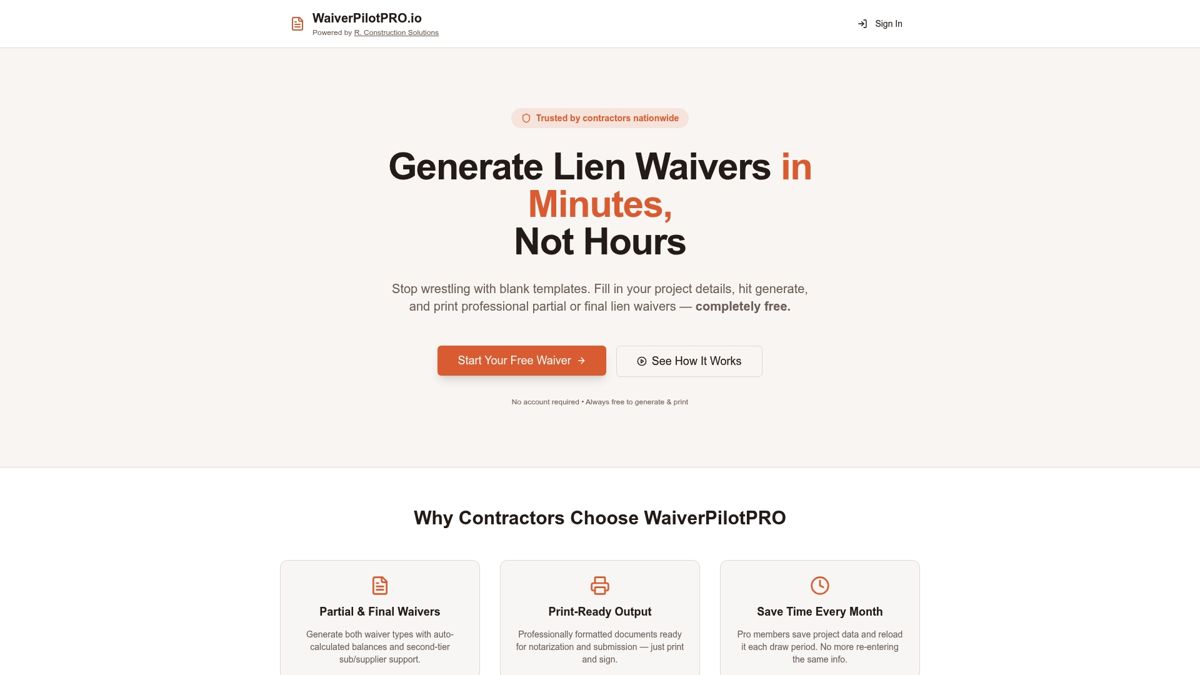
Waiverpilotpro generates both conditional and final lien waivers for free, with no account creation required. You fill in the project details, and the platform produces a professional, notarizable document ready for submission. Auto-calculated balances and multi-subcontractor support mean you can process an entire draw in minutes rather than hours. For teams using Procore or QuickBooks, Waiverpilotpro connects directly to your existing workflow. Use the free lien waiver generator to handle your next draw and see the time difference for yourself.
FAQ
What is subcontractor administrative overhead?
Subcontractor administrative overhead is the total labor cost and time spent managing compliance, payments, onboarding, and documentation for subcontractors. General contractors typically spend $165,000–$210,000 per year on these tasks.
How much time can automation save on subcontractor admin?
Automation cuts onboarding time by 50–65% and reduces lien waiver collection time by 65–80%. Overall admin overhead drops by 25–40% for contractors who implement automated subcontractor workflows.
What is a lien waiver and why does it matter for admin efficiency?
A lien waiver is a document a subcontractor signs to release their right to file a mechanics lien against a property for unpaid work. Automating lien waiver collection removes one of the most common causes of payment delays and legal risk.
Should I outsource subcontractor admin or automate it?
Outsourcing works only after you have documented and standardized your internal processes. Without SOPs in place, outsourcing transfers your existing inefficiencies to a third party rather than fixing them.
How do I fill out a lien waiver correctly?
A lien waiver requires the project name, property owner, contractor, payment amount, and the type of waiver, either conditional or final. Waiverpilotpro’s step-by-step lien waiver guide walks you through each field to prevent errors that delay payment.