
Why Manual Waivers Cause Delays on Construction Projects
Manual lien waivers are the leading cause of payment delays in construction, costing a 10-project general contractor between $48,000 and $96,000 annually in labor, rework, and risk exposure. A lien waiver is a legal document in which a contractor, subcontractor, or supplier releases their right to file a mechanics lien in exchange for payment. When that document is generated by hand, tracked through email, and reconciled manually, the process breaks down fast. General contractors, subcontractors, and accounting teams all feel the impact. This article explains why manual waivers cause delays at every stage of the payment cycle and what you can do about it.
Why do manual lien waiver processes inherently cause delays?
Manual lien waiver processing fails because it depends on too many disconnected steps with no single system of record. A typical manual workflow involves pulling a Word template, filling in project details, emailing the document to a subcontractor, waiting for a signature, receiving the signed copy, filing it, and then manually confirming it before releasing payment. Each step is a potential failure point.
The most common breakdowns in manual workflows include:
- Lost or buried emails. Signed waivers get buried in inboxes or sent to the wrong contact, and no one follows up until payment is already overdue.
- Incorrect or incomplete documents. Manual data entry produces wrong amounts, wrong project names, or missing notarization where required.
- Workflow silos. Project managers track waiver status in one place while accounting tracks payment status in another. Neither system talks to the other.
- No automated reminders. Without a system to escalate outstanding waivers, payments sit on hold indefinitely while someone manually chases signatures.
- Changing requirements. Waiver requirements vary project to project, making static manual checklists obsolete before a billing cycle even ends.
The result is what industry analysts call a hidden “manual processing tax”, consuming up to 16% of operational budgets in error fixes and resource drain. That is not a rounding error. It is a structural cost baked into every project that runs on paper and email.
Pro Tip: Track every outstanding waiver in a shared spreadsheet at minimum. Assign one person ownership of the follow-up process. Even a basic system beats no system when you are managing more than three active projects.

How does payment chain complexity make waiver delays worse?
The construction payment chain is not a simple two-party exchange. A single commercial project can involve a general contractor, multiple prime subcontractors, second-tier subs, material suppliers, and equipment vendors. Construction payment chains average 6–8 tiers and can generate more than 150 waiver cycles per pay period. Manual tracking does not scale to that volume.
The table below shows where manual and automated processes diverge as project complexity increases.
| Factor | Manual process | Automated process |
|---|---|---|
| Waiver generation | Built from Word templates per project | Auto-generated from contract data |
| Distribution | Email to individual contacts | Bulk send with e-signature links |
| Status tracking | Spreadsheet or inbox search | Real-time dashboard |
| Payment hold logic | Manual check before release | System-enforced hold until waiver complete |
| Error rate | High due to manual data entry | Low due to pre-populated fields |
| Scalability | Breaks down above 20–30 waivers | Handles hundreds per pay period |
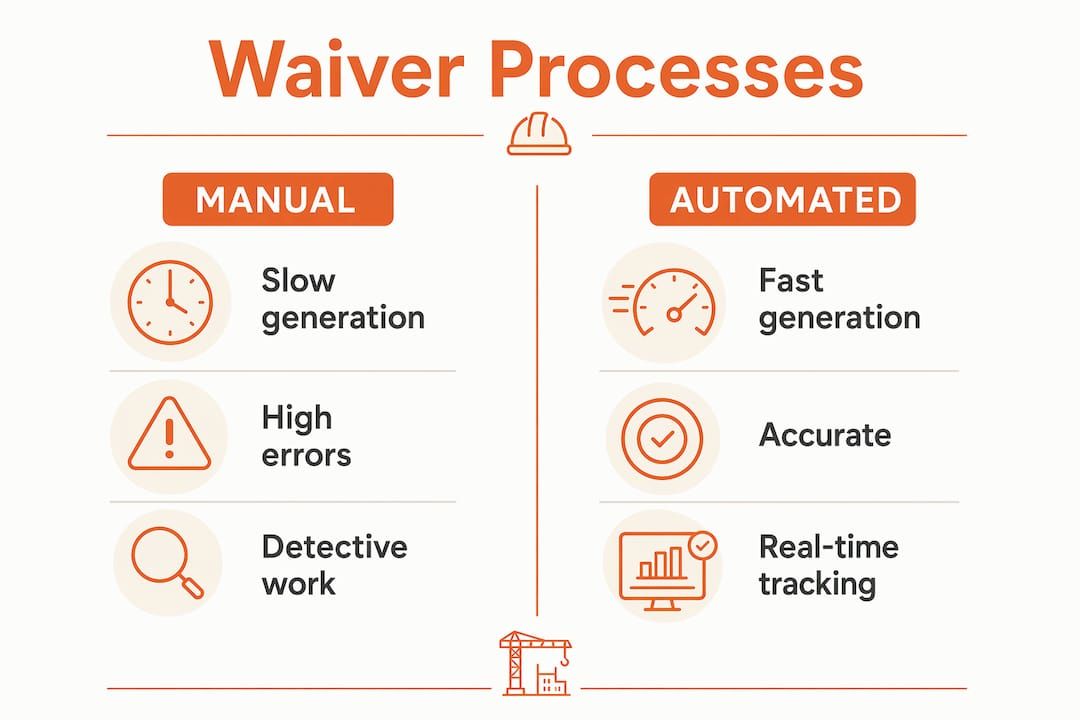
Missing lien waivers are the number one cause of final payment delays, producing a 12–18 day increase in Days Sales Outstanding (DSO). For a general contractor managing five to ten projects simultaneously, that DSO increase compounds across every open project. The cash flow impact is not theoretical. It shows up directly in your ability to pay your own vendors and fund the next phase of work.
Disconnected manual workflows force accounts receivable teams into detective work, chasing down signatures instead of closing out billing. That is time your team is not spending on higher-value tasks.
What legal and compliance risks come with manual waiver handling?
Manual waiver handling creates legal exposure that most contractors do not fully account for until a lien claim surfaces. The two most common compliance failures are skipping unconditional waivers after payment clears and maintaining no audit trail for executed documents.
A conditional waiver releases lien rights only upon receipt of payment. An unconditional waiver releases lien rights outright, regardless of payment status. The critical gap in manual processes is this: unconditional waivers are frequently skipped after payment clears, leaving lien exposure open even when the invoice is settled. That is a legal liability sitting quietly in your project files.
Common compliance pitfalls in manual waiver management include:
- No audit trail. Emails and paper files do not constitute a reliable compliance record. If a lien dispute arises, you need documented proof of every waiver exchanged.
- Informal handling normalized over time. Compliance professionals warn that informal waiver handling leads to governance drift, where non-compliance becomes the default because no one enforces the standard.
- Wrong waiver type used. Using a conditional waiver when an unconditional is required, or vice versa, can invalidate the document entirely and restart the process.
- State-specific requirements ignored. Lien waiver laws vary by state. California, for example, mandates specific statutory forms. Using a non-compliant form in a state with strict requirements creates immediate legal risk.
Pro Tip: After every payment clears, trigger an unconditional waiver request the same day. Do not wait until project closeout. Collecting unconditional waivers in real time is the only way to fully close lien exposure on a rolling basis.
Waiver governance is not an administrative nicety. It is a financial protection mechanism. Treating it as a side task rather than a core workflow is one of the most expensive mistakes a general contractor can make.
What strategies actually reduce delays from manual lien waivers?
The most direct way to cut delays from manual waivers is to remove the manual steps. Automation handles the tasks that break down in human workflows: generation, distribution, tracking, and payment holds. Here is how to approach it practically.
-
Automate waiver generation from contract data. Tools that pull project details, payment amounts, and party information directly from your contracts eliminate the data entry errors that invalidate documents. Waiverpilotpro’s AI lien waiver generator auto-fills from contract inputs, cutting generation time to under a minute.
-
Send e-signature links instead of PDF attachments. E-signature workflows reduce turnaround time significantly compared to printing, signing, scanning, and emailing. The signed document returns to a central system automatically.
-
Use a real-time status dashboard. Knowing exactly which waivers are pending, signed, or overdue at any moment eliminates the inbox search problem. Your accounting team and project managers see the same data.
-
Enforce payment holds at the system level. Configure your payment workflow so that a payment cannot be released until the corresponding waiver is marked complete. This removes the human check that gets skipped under deadline pressure.
-
Integrate with your existing construction management software. Waiverpilotpro connects with platforms like Procore and QuickBooks, so waiver status flows directly into your existing project and financial records. You are not managing a separate system.
-
Handle conditional and unconditional waivers in the same workflow. A conditional waiver of lien is appropriate before payment clears. An unconditional waiver is required after. Your system should trigger the right type automatically based on payment status.
Automated systems reduce DSO by 12–18 days and improve cash flow measurably. For mid-market contractors, reducing documentation delays by 10 days can free millions in working capital. That is the real financial case for moving off manual processes.
Pro Tip: Start with your highest-volume subcontractors first. Automating waiver collection for your top five subs by payment volume will capture the majority of your delay risk before you roll out to the full project roster.
Key Takeaways
Manual lien waiver delays are a structural problem rooted in disconnected workflows, not individual mistakes, and automation is the only solution that scales with project complexity.
| Point | Details |
|---|---|
| Manual waivers carry a real cost | A 10-project GC loses $48,000–$96,000 annually to manual waiver labor, errors, and risk. |
| DSO increases 12–18 days | Missing waivers are the top cause of final payment delays, directly hurting cash flow. |
| Unconditional waivers are routinely skipped | Failing to collect unconditional waivers after payment leaves lien exposure open on closed invoices. |
| Complexity breaks manual tracking | Projects with 6–8 payment tiers and 150+ waiver cycles per period exceed what manual systems can handle reliably. |
| Automation removes the failure points | Automated generation, e-signature, and payment holds cut DSO and eliminate the detective work from AR teams. |
The real reason manual waivers persist (and why that needs to change)
I have spent years watching construction firms absorb the cost of manual waiver processes without ever connecting it to a specific line item. The problem is not that contractors are careless. It is that the cost is invisible until it is not.
Most firms treat lien waivers as administrative paperwork rather than financial controls. That framing is the root of the problem. When a waiver is late or missing, the delay looks like a subcontractor issue or an accounting oversight. The structural cause, which is a workflow with no enforcement mechanism, never gets addressed.
The other misconception I see constantly is that automation is expensive or complicated to implement. Waiverpilotpro generates professional, notarizable lien waivers for free, with no account creation required. The barrier to getting started is genuinely low. What costs money is continuing to run a 150-waiver-per-period process through email and spreadsheets.
The firms that modernize their waiver workflows do not just recover DSO days. They change how their subcontractors and owners perceive them. Consistent, fast waiver processing signals financial discipline. That reputation matters when you are bidding the next project.
— Rowena
Stop losing payment days to paper-based waiver processes
If your team is still chasing signatures through email and reconciling waiver status by hand, you are paying a cost that does not show up on any invoice but shows up every month in your cash flow. Waiverpilotpro was built specifically to eliminate that cost for contractors.
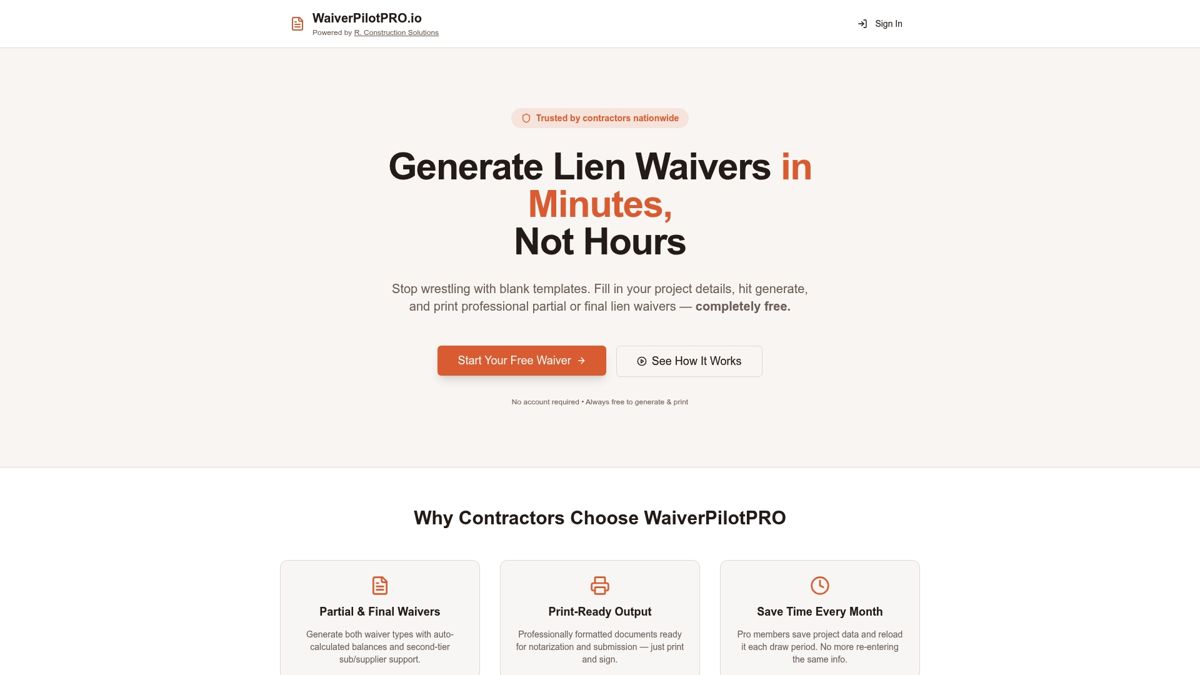
Waiverpilotpro lets you generate conditional and final lien waivers in minutes, with auto-calculated balances and multi-subcontractor support built in. It integrates with Procore, QuickBooks, and other platforms you already use. No templates to manage, no account setup required. Start with the free lien waiver generator and see how much time your team recovers in the first week.
FAQ
Why are lien waivers delayed in most construction projects?
Missing waivers are the top cause of final payment delays, adding 12–18 days to DSO. The root cause is manual workflows with no automated tracking or payment hold enforcement.
What is the financial impact of manual waivers on a general contractor?
A general contractor managing 10 projects can lose $48,000–$96,000 per year to manual waiver costs, including labor, error correction, and payment delays.
What is the difference between a conditional and unconditional lien waiver?
A conditional waiver releases lien rights only upon receipt of payment. An unconditional waiver releases lien rights outright and should be collected after payment clears to fully close legal exposure.
How does automation reduce lien waiver processing time?
Automated systems generate waivers from contract data, send e-signature links, track status in real time, and hold payments until waivers are complete. This removes the manual steps that cause delays and errors.
Do lien waiver requirements change from project to project?
Yes. Waiver requirements vary by project, contract, and state. Static manual checklists become obsolete before a billing cycle ends, which is why project-specific automation is more reliable than a one-size-fits-all paper process.