
The Role of Accounting in Lien Compliance
Accounting is the operational backbone of lien compliance in construction, producing the verifiable financial records that determine whether a mechanics lien claim stands or falls. Without accurate job costing, matched invoices, and payment documentation, your lien rights are difficult to enforce, regardless of how much work you actually performed. The role of accounting in lien compliance goes beyond bookkeeping. It defines the legal strength of every claim you file. Construction professionals who treat lien compliance as a purely legal task, separate from their accounting workflows, consistently face avoidable disputes, missed deadlines, and weakened claims.
How does job costing support lien compliance?
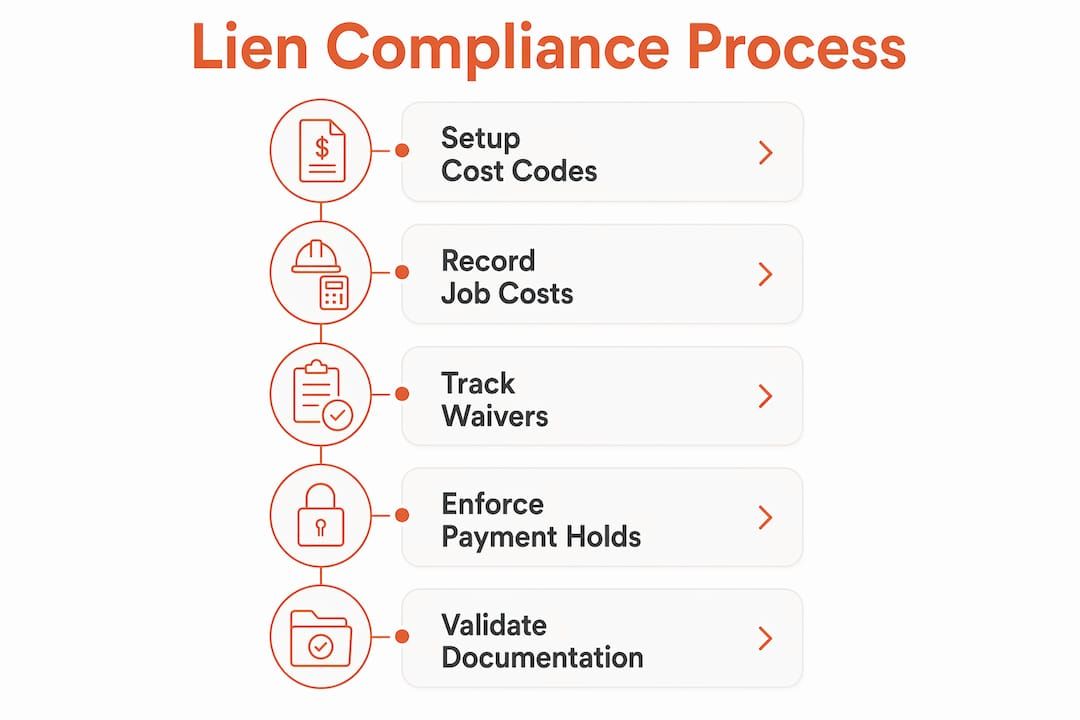
Job costing is the accounting foundation that connects field activity to financial proof, and without it, lien documentation is undermined. Every dollar you spend on labor, materials, and subcontractors must be coded to a specific project and pay period. That level of detail is not optional when a lien dispute reaches a courtroom or arbitration table.
Accounting deliverables that directly support lien claims include:
- Cost codes matched to specific scopes of work, proving what was furnished and when
- Invoices reconciled against purchase orders, creating a clear paper trail for materials delivered
- Subcontractor payment records by pay period, showing what each party is owed
- Job cost reports, documenting the gap between what was billed and what was paid
Inconsistent cost coding is one of the most common ways contractors weaken their own lien claims. If your accounting records show a lump sum for “labor” without project-level detail, a property owner’s attorney can challenge whether the work was actually performed on that specific project. Audit-ready records that prove what was furnished and what remains unpaid are the minimum standard for defensible lien enforcement.
Pro Tip: Never treat job costing as a back-office reporting task. Set up cost codes before a project starts, not after a dispute arises. Retroactive coding is nearly impossible to defend.

What role does payment hold logic play in lien waiver compliance?
Payment hold logic is the accounting control that prevents funds from leaving your system before the required lien waivers are received and verified. This is where accounting for lien compliance moves from passive record-keeping to active enforcement. Without a hold mechanism, payments routinely go out before waivers come in, creating a compliance gap that is difficult to close retroactively.
The process works in four steps:
- A payment is scheduled for a subcontractor or supplier on a specific project.
- The accounting system checks whether the required lien waiver type has been received for that payment period.
- A compliance hold is triggered if the waiver is missing or does not match the payment amount.
- The hold is released only after the correct waiver is submitted and verified.
Oracle TPM’s automatic Lien Waiver Compliance Hold is a well-documented example of this logic in enterprise construction software. The system blocks payment release until unconditional waivers are present, then removes the hold automatically upon receipt. That automation removes the human error that manual tracking introduces.
Hold configurations must align with your project settings. Multiple lien waiver hold types exist, differentiated by whether the waiver is conditional or unconditional and whether it covers the current period or a prior period. Your accounting team must understand which hold type applies to each payment, or the wrong waiver will satisfy the wrong hold, leaving a real compliance gap hidden behind a cleared status.
Pro Tip: Build lien waiver receipt status directly into your payment approval checklist. A payment should not reach the approval stage unless the waiver status field is confirmed, not just pending.
How do accounting processes track lien waivers throughout a project?
Lien waiver tracking is a reconciliation task, not a document collection task. That distinction matters. Matching waivers to payments at the line-item level is the only way to produce an audit trail that holds up in a dispute. Treating waivers as attachments to be filed and forgotten is how compliance gaps accumulate over a project’s life.
The most common failure point is the conditional-to-unconditional conversion. A conditional waiver is exchanged at the time of payment and is contingent on the check clearing. Once payment clears, that conditional waiver must be converted to an unconditional waiver, which permanently releases the lien right for that payment amount. Audits reveal that 20–40% of conditional waivers are never properly converted to unconditional. That failure leaves your lien claim exposure open even after you have paid.
The table below shows the accounting implications of each waiver type:
| Waiver type | When it applies | Accounting implication |
|---|---|---|
| Conditional progress | Exchanged at time of partial payment | Payment can be released; lien rights remain until check clears |
| Unconditional progress | After payment has cleared | Lien rights permanently released for that payment period |
| Conditional final | Exchanged at time of final payment | Final payment can be released; full lien rights remain contingent |
| Unconditional final | After final payment clears | All lien rights permanently released for the project |
Your accounting team should maintain a monthly master report that tracks waiver status by subcontractor, payment period, and waiver type. That report feeds directly into project closeout documentation and provides the audit trail that courts and title companies require.
Key documentation practices that reduce compliance risk:
- Store lien notices, waivers, and payment records together in a single project file
- Record the date each waiver was received, not just the date it was filed
- Flag any conditional waiver that has not converted within 10 business days of payment clearing
- Transfer waiver data into your construction management system, whether that is Procore, QuickBooks, or another platform, so records are not siloed in email
What are the consequences of poor accounting for lien compliance?
Poor accounting controls produce two categories of damage: legal exposure and cash flow disruption. Courts demand evidence of statutory timeline adherence, including proof of delivery for lien notices. If your accounting records cannot demonstrate that notices were sent on time and payments were tracked accurately, your lien claim can be dismissed on procedural grounds alone, regardless of the underlying debt.
Cash flow disruption follows quickly. When lien claims fail due to documentation gaps, contractors lose their most powerful collection tool. A mechanics lien, which is a legal claim against a property for unpaid work or materials, gives you priority over other creditors in many states. Losing that right because of an accounting failure means you are now an unsecured creditor competing for payment through slower, more expensive legal channels.
The operational evidence courts most commonly require in lien disputes includes:
- Proof of preliminary notice delivery, with timestamps and recipient confirmation
- Job cost records showing labor and materials furnished by project and date
- Invoices matched to specific scopes of work, not general billing summaries
- Payment history showing what was paid, when, and by whom
- A complete waiver log showing conditional and unconditional waivers by payment period
Mitigation starts with integrating lien compliance into standard accounting workflows, not treating it as a separate legal checklist. Internal audits at 30-day intervals catch conversion failures and missing notices before they become unrecoverable. Cross-functional coordination between your project managers, accounting staff, and legal counsel closes the gaps that arise when each team manages only their own piece of the compliance puzzle.
Key Takeaways
Accounting controls are the primary defense against failed lien claims, and the quality of your financial documentation determines whether your lien rights are enforceable.
| Point | Details |
|---|---|
| Job costing is lien proof | Detailed cost codes and matched invoices create the evidence base for any lien claim. |
| Payment holds enforce compliance | Blocking payments until waivers are received prevents the most common compliance gap. |
| Conditional waivers must convert | Failing to convert conditional waivers to unconditional leaves lien exposure open after payment. |
| Documentation must be stored together | Lien notices, waivers, and payment records kept in one project file satisfy court evidence requirements. |
| Accounting and legal must align | Integrating lien compliance into accounting workflows reduces errors and protects cash flow. |
Why I think most contractors treat lien compliance as someone else’s problem
Most contractors I have seen hand lien compliance off to their attorney or project manager and assume the accounting team just needs to cut the check. That assumption is the root cause of most lien failures I have observed. The attorney files the lien, but the accountant is the one who can prove it. If the financial records do not support the claim, the legal filing is hollow.
The waiver conversion problem is the clearest example. Accounting teams often collect conditional waivers diligently at payment time and then consider the task complete. Nobody flags the unconditional follow-up as an accounting responsibility. It falls into a gray area between legal and finance, and in that gray area, lien rights quietly expire. Fixing this requires one thing: ownership. Your accounting team needs to own waiver status as a line item on every payment cycle, not as a courtesy task they perform when asked.
Software helps, but only if the configuration matches your actual project structure. Payment hold logic in platforms like Oracle TPM works well when the hold types are correctly mapped to your contract terms. When they are not, holds clear on the wrong waiver type and the gap goes undetected. Reviewing your hold configurations at project kickoff, not mid-project, is the single highest-value process change most accounting teams can make.
Lien laws also change. Several states have updated preliminary notice requirements and waiver form standards in recent years. Your accounting workflows need a scheduled review, at minimum annually, to stay current with the states where you operate.
— Rowena
Waiverpilotpro makes lien waiver compliance faster for accounting teams
Generating and tracking lien waivers manually adds hours to every payment cycle. Waiverpilotpro gives contractors and accounting teams a free tool to create both conditional and final waivers without templates, account setup, or legal fees.
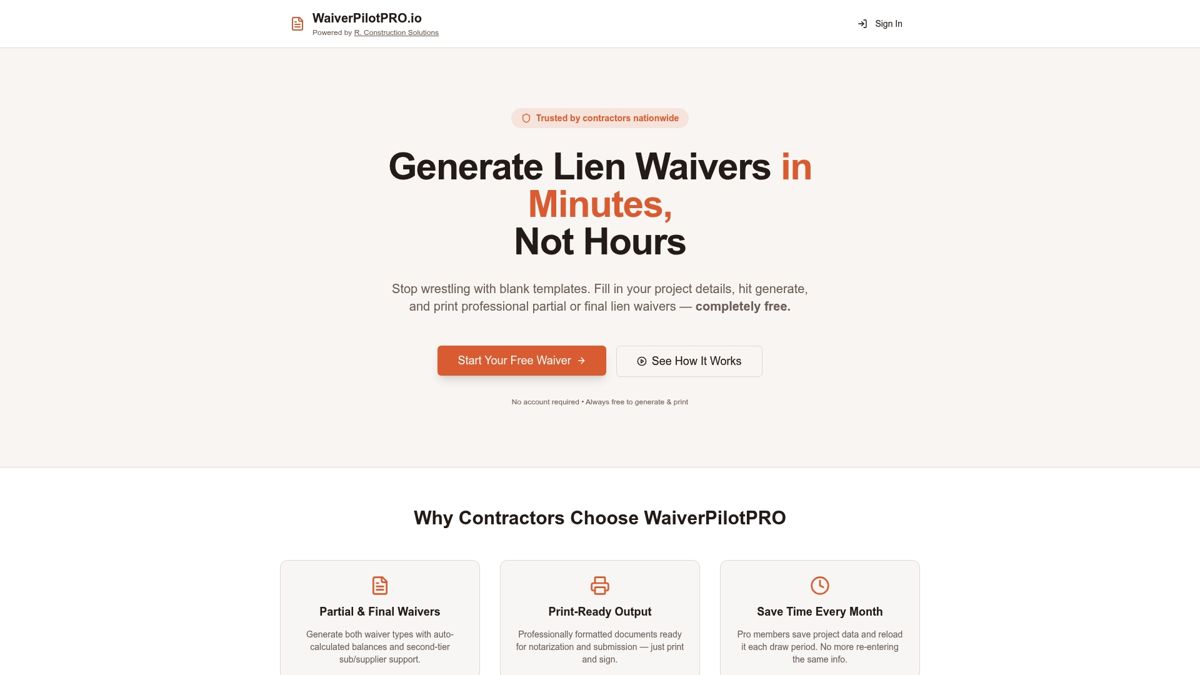
The platform integrates with Procore and QuickBooks, so waiver data flows directly into the systems your accounting team already uses. Auto-calculated balances and multi-subcontractor support reduce the manual entry that causes conversion errors. If you are managing lien waiver generation across multiple projects, Waiverpilotpro produces notarizable, professional-grade documents ready for immediate submission. That means less time chasing paperwork and more time enforcing the payment controls that protect your lien rights.
FAQ
What is the role of accounting in lien compliance?
Accounting produces the job cost records, matched invoices, and payment documentation that prove what was furnished and what remains unpaid, which are the core requirements for a valid lien claim. Without these records, a mechanics lien is difficult to enforce in court.
How do payment holds enforce lien waiver compliance?
Payment hold logic blocks fund disbursement until the required lien waiver type is received and verified for that payment period. Systems like Oracle TPM automate this hold and release it only after the correct waiver is submitted.
What is the difference between a conditional and unconditional lien waiver?
A conditional waiver releases lien rights only if the associated payment clears, while an unconditional waiver permanently releases lien rights for that payment amount regardless of whether the check clears.
Why do conditional waivers need to convert to unconditional?
A conditional waiver leaves lien rights open until payment is confirmed. If your accounting team does not convert it to unconditional after the payment clears, your exposure remains active even though the subcontractor or supplier has been paid.
What documentation do courts require in lien disputes?
Courts require proof of preliminary notice delivery, job cost records tied to specific scopes of work, matched invoices, payment history, and a complete waiver log showing both conditional and unconditional waivers by payment period.