
Construction Lender Payment Requirements Explained for Contractors
Construction lender payment requirements are the specific conditions a lender imposes before releasing any loan funds during a build. These requirements govern everything from your initial down payment to how you document each draw request. Contractors and project managers who understand construction lender payment requirements explained in full gain a real advantage: fewer rejected draws, better cash flow, and fewer surprises at closing. The core documents involved include AIA G702 and G703 payment applications, lien waivers, and approved change orders. Get any one of these wrong, and your payment stops.
What are the typical down payment and loan-to-cost limits?
Construction loans typically require a 20–25% down payment before the first dollar is disbursed. That upfront equity requirement tells the lender you have real skin in the game. It also reduces the lender’s exposure if the project stalls or costs overrun.
Loan-to-cost (LTC) ratios define how much of the total project cost the lender will fund. Most lenders cap LTC at 65–80%, depending on project type and borrower profile. A commercial ground-up build typically sits at the lower end of that range, while a residential custom home may qualify for the higher end.

The table below shows how these figures typically break down across common project categories.
| Project type | Typical down payment | Typical LTC range |
|---|---|---|
| Residential custom home | 20–25% | 75–80% |
| Small commercial build | 25–30% | 65–75% |
| Mixed-use development | 25–35% | 60–70% |
| Multifamily construction | 20–25% | 70–80% |
These ranges are not fixed rules. Regional lenders, credit unions, and private construction lenders each apply their own underwriting standards. The key takeaway is that you need to verify LTC limits with your specific lender before finalizing your project budget.
Pro Tip: Request your lender’s written loan-to-cost policy before you finalize your construction budget. A 5% difference in LTC can mean tens of thousands of dollars in required equity.
How do construction lenders manage progress payments and draw requests?
The construction draw process runs on a parallel billing system. You submit a pay application to the property owner. The owner then assembles a draw request package and submits it to the lender. Both documents must reconcile exactly with the original approved budget and any approved change orders.
Even a one-dollar mismatch across documents triggers automatic draw rejection. That is not an exaggeration. Lenders use software to cross-check totals, and any discrepancy flags the entire package for manual review or outright rejection.
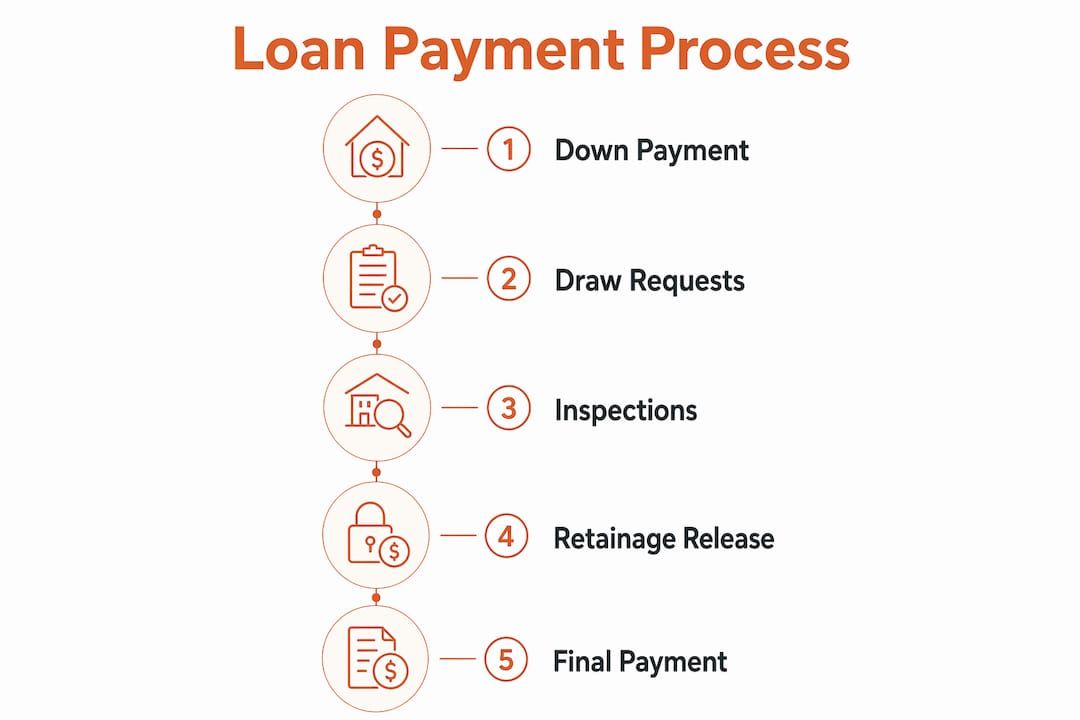
The two standard forms for this process are the AIA G702 Application for Payment and the AIA G703 Schedule of Values. The G702 is the cover sheet summarizing the total amount requested. The G703 breaks that amount down line by line against each cost category in the approved budget. Both forms must be completed accurately and signed.
A complete draw package typically includes:
- AIA G702 and G703 forms, fully completed and signed
- Conditional lien waivers from all subs and suppliers for the current period
- Unconditional lien waivers from all subs and suppliers for prior periods
- Approved change orders affecting the current draw amount
- Copies of invoices matching each line item on the G703
- Stored materials documentation, including proof of ownership and insurance
- Current permits confirming work is authorized before invoicing
After you submit the package, the lender orders a third-party inspection to verify that the work billed actually exists in the field. Inspections typically take 2–5 business days. If the inspector finds that billed work is incomplete or not yet installed, the draw is reduced or denied for those line items.
Pro Tip: Build your draw package as a checklist. Before submitting, verify every line on the G703 has a matching invoice, a matching lien waiver, and a matching entry in the approved budget. One missing document delays the entire package.
What is retainage and how does it affect your payments?
Retainage is a percentage of each draw that the lender withholds until the project reaches substantial completion. Lenders typically withhold 5–10% of each progress payment as retainage. That money sits in a holdback account and is not released until the punch list is complete and the lender’s final inspection passes.
The reason lenders enforce retainage is straightforward. It gives them leverage to ensure the contractor finishes every last item on the scope of work. It also protects against lien claims from unpaid subs and suppliers who might file after the project is otherwise complete.
“Transparency on retainage is critical. Contractors must plan cash flow accordingly since retainage funds are withheld until project completion.” — Autodesk Construction Blog
Retainage release conditions vary by lender. Most require a certificate of substantial completion, a final lien waiver from the general contractor, and a passed final inspection. Some lenders release retainage in two stages: 50% at substantial completion and the remainder after final closeout.
Pro Tip: Factor retainage into your subcontractor payment schedule from day one. If you are holding 10% back from your subs to mirror what the lender holds from you, communicate that clearly in your subcontracts to avoid disputes at closeout.
How do interest payments and reserves influence payment schedules?
Interest on a construction loan works differently than on a standard mortgage. You pay interest only on funds drawn, not on the full loan commitment. If your total loan is $1,000,000 but you have only drawn $300,000, your interest payment is calculated on $300,000.
This structure benefits contractors early in the project when draws are small. As the build progresses and more draws are funded, the interest payment grows each month. By the final stages of construction, you are paying interest on nearly the full loan amount.
Interest reserves are funds built into the loan specifically to cover these monthly interest payments during construction. The lender sizes the reserve based on the projected draw schedule and the expected construction timeline. Underfunded interest reserves create cash flow shortages if the project runs longer than planned.
Key considerations for managing interest payments and reserves:
- Confirm the reserve amount upfront. Ask your lender exactly how many months of interest the reserve covers and what happens if the project extends beyond that window.
- Track your draw pace. Faster draws mean higher monthly interest sooner. Slower draws preserve the reserve but may signal project delays to the lender.
- Build a buffer. Construction timelines commonly run 7–12 months, and delays are frequent. A reserve sized for 10 months may not cover a 14-month build.
- Understand the fallback. If the reserve runs dry, you pay interest out of pocket. Know this before you sign the loan agreement.
- Coordinate with your draw schedule. Align major draw submissions with construction milestones so the lender can verify progress and release funds on a predictable timeline.
What documentation pitfalls delay construction loan payments?
Lien waivers are the single most common cause of draw rejection. Missing or incorrect lien waivers were responsible for up to 85% of draw payment rejections before automation tools improved accuracy. That number reflects how often contractors overlook the difference between conditional and unconditional waivers.
A conditional lien waiver is issued for the current payment period and becomes effective only when payment clears. An unconditional lien waiver covers prior periods and confirms that all previous payments have been received. Lenders require both types. Submitting only one type, or submitting the wrong type for the wrong period, stops the draw immediately.
Stored materials documentation is another area contractors consistently miss. If you are billing for materials stored on site but not yet installed, you must provide proof of ownership, insurance certificates, and photographic evidence. Without that documentation, the lender will not fund those line items.
The top five mistakes that delay draw payments:
- Submitting conditional waivers for prior periods instead of unconditional waivers
- Math mismatches between the G702 cover sheet and the G703 line items
- Missing or expired insurance certificates from subcontractors
- Invoices that reference different amounts than what appears on the G703
- Unsigned or undated lien waivers that cannot be verified
Document consistency across every form in the package is non-negotiable. The G702 total, the G703 subtotals, the invoices, and the lien waiver amounts must all match. A single discrepancy forces a manual review that can delay funding by a week or more.
Pro Tip: Use a lien waiver generator like Waiverpilotpro to produce accurate conditional and unconditional waivers with auto-calculated balances. Errors in lien waiver math are one of the easiest problems to eliminate with the right tool.
Key Takeaways
Construction lender payment requirements demand exact documentation, verified progress, and consistent reconciliation across every draw package to keep funds flowing.
| Point | Details |
|---|---|
| Down payment and LTC limits | Lenders require 20–25% down and fund 65–80% of total project cost. |
| Draw package accuracy | Every invoice, lien waiver, and G703 line item must match to the dollar. |
| Retainage planning | Expect 5–10% withheld per draw; plan subcontractor payments around this holdback. |
| Interest reserve sizing | Interest accrues only on drawn funds; confirm your reserve covers the full build timeline. |
| Lien waiver compliance | Submit conditional waivers for current periods and unconditional waivers for all prior periods. |
What I have learned from watching draw packages fail
The contractors who get paid on time are not necessarily the best builders. They are the best administrators. I have seen excellent work stall for three weeks because one sub submitted a conditional waiver for a period that required an unconditional. The lender did not call to ask. They just rejected the package and waited for a resubmission.
The most underrated skill in construction financing is early communication with the lender’s draw administrator. Most contractors treat the lender as a passive bank. The draw administrator is actually a gatekeeper with a checklist, and building a working relationship with that person pays off every single time. Ask them for their exact submission requirements in writing before your first draw. Some lenders have internal forms that supplement the standard AIA documents. Finding that out on draw one saves you from finding it out on draw three.
Retainage planning is where I see the most cash flow damage. Contractors who do not account for 10% withheld across every draw often find themselves short on payroll by month four. The math is simple, but the discipline to plan for it is not. Build a cash flow projection that removes retainage from every draw total before you calculate what you can spend.
Finally, the shift toward digital tools for lien waiver generation and draw package assembly is not optional anymore. Lenders are processing more packages with less staff. Clean, consistent, digitally generated documents move faster through review. Handwritten or inconsistently formatted waivers get flagged first.
— Rowena
How Waiverpilotpro helps you get draws approved faster
Lien waiver errors are the leading cause of draw rejection, and fixing them manually costs time you do not have. Waiverpilotpro is a free lien waiver generator built specifically for contractors who need accurate, lender-ready documents without the administrative overhead.
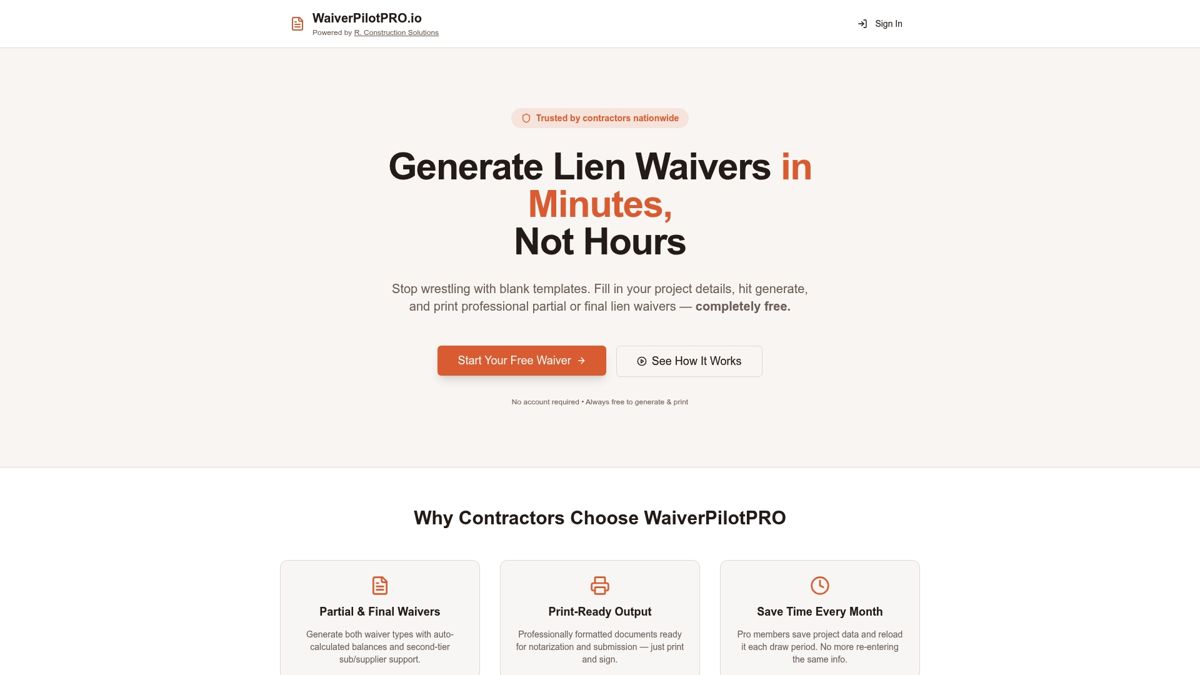
You can generate both conditional and unconditional waivers in minutes, with auto-calculated balances that eliminate math errors. Waiverpilotpro integrates with Procore, QuickBooks, and other construction management platforms, so your waiver data pulls directly from your existing project records. The documents are professional-grade and notarizable, ready to drop into your draw package. Start with the free lien waiver generator and see how much faster your next draw moves through lender review.
FAQ
What documents does a lender require for each draw request?
A complete draw package includes AIA G702 and G703 forms, conditional and unconditional lien waivers, approved change orders, matching invoices, and stored materials documentation where applicable. Every document must reconcile to the same dollar amount.
How much down payment do construction loans require?
Most construction lenders require a 20–25% down payment before the first draw is funded. This upfront equity reduces lender risk and confirms the borrower’s financial commitment to the project.
What is the difference between a conditional and unconditional lien waiver?
A conditional lien waiver applies to the current payment period and takes effect only when payment is received. An unconditional lien waiver covers prior periods and confirms those payments are fully settled. Lenders require both types in every draw package.
When is retainage released on a construction loan?
Retainage is released after the project reaches substantial completion, the punch list is finished, and the lender’s final inspection passes. Some lenders release retainage in two stages, splitting the holdback between substantial completion and final project closeout.
Why do lenders order third-party inspections before funding draws?
Third-party inspections verify that the work billed on the G703 Schedule of Values is actually installed in the field. Inspections typically take 2–5 business days, and any work found incomplete results in a reduced or denied draw for those line items.