
What Does Through-Date Mean on Lien Waivers?
What the through-date on a lien waiver actually means
The through-date on a lien waiver is the cutoff date for the work, materials, or services covered by that waiver. Everything you provided on or before that date falls within the waiver’s scope. Everything after it stays protected. Think of it as the boundary line between what you’re releasing and what you’re keeping.
According to Hunt Ortmann, the through-date “indicates the date through which the claimant has provided labor, services, or materials which are covered by the release.” That’s the industry-standard definition, and it applies across virtually every lien waiver form used in the United States.
Here’s what the through-date governs in practice:
- Labor: Any work performed on or before the through-date is included in the waiver.
- Materials: Supplies delivered through that date are covered and released.
- Services: Any professional services rendered up to the through-date fall within the waiver’s scope.
- Future work: Anything you perform after the through-date remains outside the waiver entirely.
- Progress payments: On partial waivers, the through-date defines the billing period covered by that specific payment.
- Final waivers: These typically carry no through-date because they release all lien rights for the entire project.
The through-date is not the same as the signing date or the check date. Confusing these three is one of the most common and costly mistakes contractors make.

How the through-date shapes your payment coverage and lien rights
The through-date does more than mark a calendar boundary. It defines the period for which your payment corresponds, and that has real legal consequences.
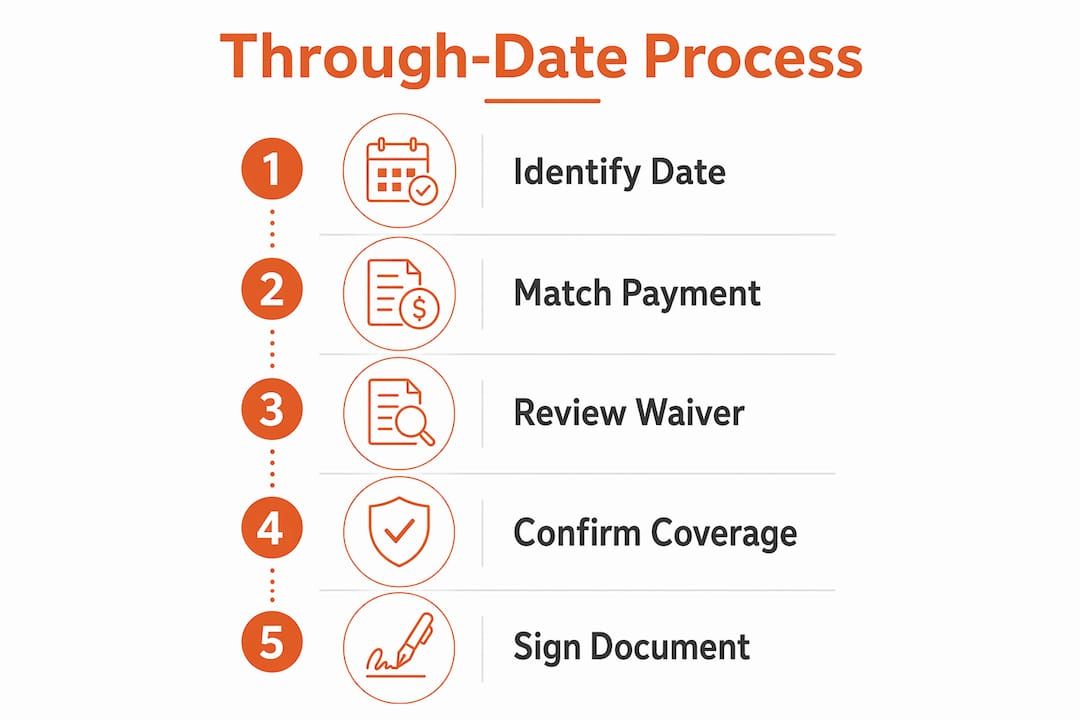
Say you submit a payment application for work completed through the end of a given month. The waiver you sign should carry a through-date matching that billing period. If the through-date and the payment amount don’t line up, you have a problem. As TheLienZone explains, if you submit a release covering work through a specific month but receive less than expected payment, a court will generally rule that the through-date governs the release, not the dollar figure. You agreed that whatever you received was sufficient for that period.
A few practical points to keep in mind:
- Billing period alignment: The through-date should match the end date of the work period covered by your invoice or pay application.
- Legal primacy: When the through-date and the payment amount conflict, the through-date typically carries more legal weight in defining the release’s scope.
- Multiple billing periods: On longer projects with recurring progress payments, each waiver needs its own accurate through-date tied to that specific payment cycle.
- Partial vs. final waivers: A partial waiver covers work through a stated through-date; a final waiver releases all rights for the entire project with no through-date at all.
Pro Tip: Before signing any waiver, confirm that the dollar amount on the check matches the work period defined by the through-date. If they don’t align, stop and negotiate the correction before you sign.

Legal risks when the through-date is wrong or missing
Getting the through-date wrong isn’t just an administrative error. It can permanently cost you money.
The most dangerous scenario is leaving the through-date blank. Courts in many jurisdictions default to interpreting a waiver with no through-date as effective on the signing date. If you sign in january expecting payment for work through december, but the waiver has no through-date, you’ve legally released your lien rights through the date you signed. That’s a much broader release than you intended.
Key legal risks to watch for:
- Blank through-date: A missing through-date can expand your waiver’s scope far beyond the intended billing period.
- Mismatched amounts: If the through-date and payment amount conflict, the through-date controls the waiver’s scope, not the dollar figure.
- Unconditional waivers: Signing an unconditional waiver before payment clears permanently forfeits your lien rights, regardless of whether the check bounces.
- Conditional waivers as protection: Conditional waivers only take effect upon actual receipt and clearance of payment, giving you a critical safety net.
- Mid-project final waivers: Signing a final waiver before receiving all payments, including retainage, releases all your lien rights for the entire project with no recourse.
Pro Tip: If the through-date on a waiver you’ve been handed doesn’t match the billing period you’re being paid for, don’t sign it. Request a corrected document. A five-minute conversation now beats a legal dispute later.
Understanding the difference between conditional and unconditional waivers is one of the most practical steps you can take to protect yourself on any project.
Common mistakes with through-dates and how to avoid them
Most through-date errors come down to carelessness, not complexity. The fix is usually simple: slow down and verify before you sign.
- Copy-paste errors: Reusing a waiver from a previous billing period without updating the through-date is a frequent mistake. Outdated templates with incorrect through-dates can cause unintended lien right relinquishment.
- Leaving the field blank: Never leave the through-date empty. Fill it in explicitly to match your billing period end date.
- Confusing dates: The through-date is not the signing date, the invoice date, or the check date. It marks the end of the work period being paid for.
- Failing to verify payment alignment: Always confirm that the payment amount you’re receiving corresponds to the work period defined by the through-date before signing.
- Signing final waivers too early: A final waiver has no through-date and releases everything. Never sign one until all payments, including retainage, are in hand.
Pro Tip: Use conditional waivers whenever possible. They give you the protection of a waiver that only activates once payment actually clears, which means a bounced check doesn’t leave you without lien rights.
Waiverpilotpro’s step-by-step lien waiver guide walks you through exactly how to fill in each field correctly, including the through-date, so nothing gets left to chance.
For contractors working across the DC, Maryland, and Virginia region, this subcontractor selection guide also covers practical advice on entering through-dates correctly to protect your lien rights in those markets.
What construction law specialists say about through-date management
Legal professionals who work in construction disputes are consistent on one point: contractors routinely underestimate the through-date’s legal weight. Brand Law Chicago notes that contractors often treat lien waivers like administrative paperwork rather than binding legal agreements, and that mishandling the through-date is a major cause of financial loss in construction.
Here’s what the expert consensus looks like in practice:
- The through-date is the anchor of the agreement. It controls the waiver’s scope more than any other field, including the payment amount.
- Final waivers carry the highest risk. Because they omit a through-date entirely, signing a final waiver before all payments are settled, including retainage, can leave you with no legal remedy.
- Conditional waivers add a critical layer of security. Using conditional waivers instead of unconditional ones means your lien rights are only released once payment actually arrives and clears.
- Careful matching prevents disputes. Aligning your through-date with the exact billing period covered by the payment is the single most effective way to avoid waiving rights to unpaid work.
- Review every waiver you receive. Waivers prepared by general contractors or owners may carry through-dates that don’t match your actual billing period. Always read the document before signing.
The bottom line from construction attorneys is straightforward: treat every lien waiver as the legal document it is. The through-date isn’t a formality. It’s the field that defines exactly what you’re giving up.
Key Takeaways
The through-date on a lien waiver is the single most legally significant field on the document, controlling the scope of your lien rights release more than the payment amount itself.
| Point | Details |
|---|---|
| Through-date defines waiver scope | Labor, materials, and services provided on or before this date are released; work after it stays protected. |
| Through-date overrides dollar amounts | When the through-date and payment amount conflict, courts generally rule the through-date governs the release. |
| Blank through-date expands your waiver | A missing through-date can cause courts to treat the waiver as effective through the signing date, broadening your release unintentionally. |
| Conditional waivers protect you | Conditional waivers only activate upon actual payment clearance, protecting your lien rights if a check bounces. |
| Final waivers carry no through-date | Final waivers release all project lien rights; never sign one until all payments, including retainage, are fully received. |
Generate your lien waiver with the right through-date, every time
Getting the through-date right shouldn’t require a law degree. Waiverpilotpro makes it straightforward: fill in your project details, and the platform generates a properly formatted conditional or final waiver with all the key fields, including the through-date, aligned to your payment.
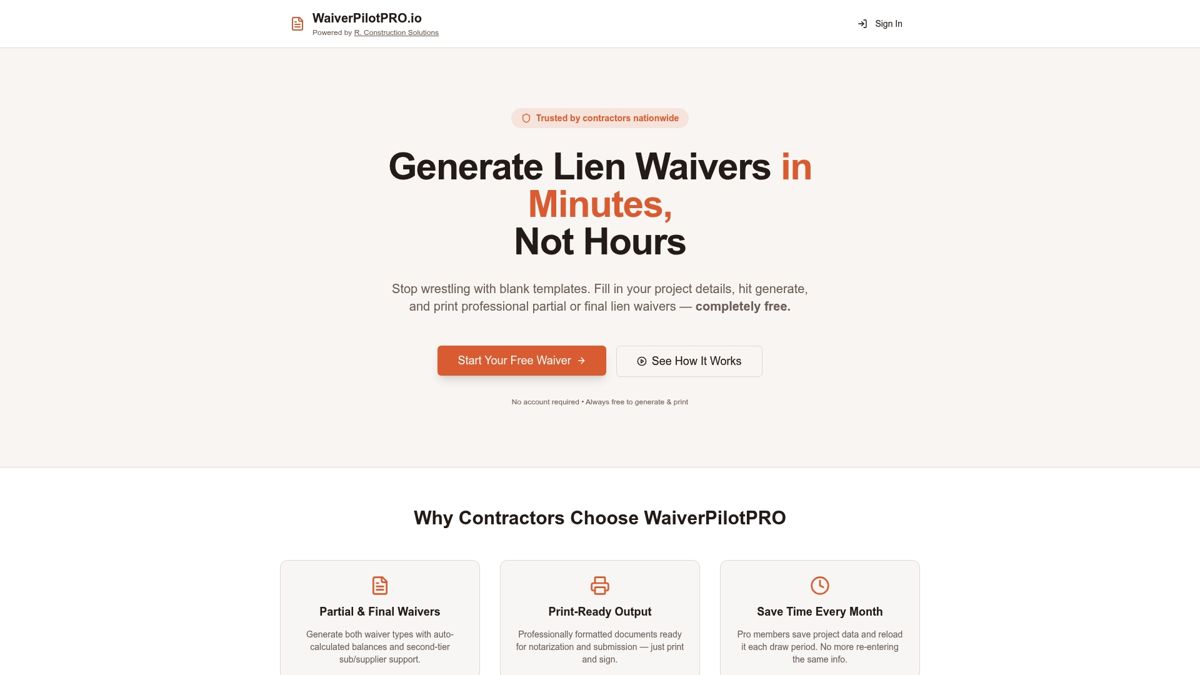
No account required. No complex templates. Just a clean, notarizable document ready to submit. Try the free lien waiver generator and get your next waiver done in minutes.