
Payment Release Documentation Best Practices for Contractors
Payment release documentation is the complete set of records that authorize, verify, and prove a construction payment from approval through disbursement. Done right, it protects your cash flow, satisfies auditors, and prevents mechanics lien disputes before they start. Done poorly, it creates duplicate payments, stalled projects, and legal exposure. These payment release documentation best practices give you a clear framework for every transaction, from a small progress draw to a final contract closeout.
1. What are the essential components of payment release documentation?
Valid payment documentation requires at least seven key data points: a unique transaction ID, the date, payer and payee names, an itemized description of goods or services, the total amount with taxes listed separately, and the payment method. Each element serves a specific purpose. The unique ID prevents duplicate processing. The itemized breakdown lets you reconcile individual line items against your schedule of values.
Remittance advice is the document that links a specific payment to the invoice it covers. Recording remittance advice at the time of the transaction gives you proof of payment purpose during a lien or tax audit. A bank statement alone does not show which invoice was paid. That distinction matters enormously when a subcontractor files a lien claim and you need to prove payment.

Lien waivers belong in every payment package. A lien waiver is a receipt that also surrenders a powerful legal remedy. You can review how partial waivers work on progress payments to understand when conditional versus final waivers apply. Collecting the right waiver type before releasing funds closes the loop between payment and legal protection.
Cash receipts should be sequentially numbered, reconciled daily, and stored in a centralized system. Sequential numbering makes gaps visible immediately. A missing number in your receipt log is a red flag for auditors and a sign that a transaction may have been processed outside your normal controls.
- Unique transaction ID for every payment record
- Date of transaction recorded at the time of payment, not retroactively
- Payer and payee legal names matching contract documents exactly
- Itemized description tied to the schedule of values or purchase order
- Total amount with taxes and retainage shown separately
- Payment method (check number, ACH reference, wire confirmation)
- Remittance advice linking the payment to the specific invoice
- Lien waiver matched to the payment amount and type (conditional or final)
2. How should approval workflows be structured for payment release?
Approval is a control gate, not a final payout signal. A payment can pass approval and still be ineligible for disbursement if lien waivers, completion certificates, or tax compliance checks are outstanding. Treating approval as the finish line is one of the most common and costly mistakes in construction payment management.
A well-structured workflow separates the person who approves a payment from the person who executes it. This segregation of duties is the foundation of financial control. Escalation paths should be defined clearly: finance managers handle standard releases, while controllers or CFOs review large or unusual payments. Without a defined threshold, large payments can slip through at the wrong approval level.
Here is a practical four-step workflow that works for most construction firms:
- Invoice receipt and coding. The project manager codes the invoice to the correct cost code and confirms the work is complete.
- Finance manager review. The finance manager checks the invoice against the contract, verifies the schedule of values, and confirms no prior payment covers the same line items.
- Lien waiver collection. The payment is placed on hold until the conditional lien waiver for the current draw is received and matched to the invoice amount.
- CFO or controller release. For payments above a defined threshold, the controller or CFO performs a final review before funds are disbursed.
For high-risk transactions, automated hold windows can be configured to wait up to seven days for confirmation documents like lien waivers before escalating or failing the payment automatically. This removes the human error of forgetting to follow up.
Pro Tip: Use idempotency keys in your payment processing system. An idempotency key is a unique token assigned to each payment request that prevents the same transaction from being processed twice, even if a system error causes a retry. This single control eliminates duplicate payments in manual workflows.
3. What tools and templates support payment release documentation?
Standardized templates are the fastest way to improve documentation consistency across a project team. When every team member fills out the same form in the same format, reconciliation takes minutes instead of hours. Standardized templates with forced categorization create a single source of truth and prevent the common errors that come from free-form documentation.
Digital lien waiver generators take template consistency a step further. Waiverpilotpro generates both conditional and final lien waivers at no cost, with auto-calculated balances and support for multiple subcontractors on a single project. The platform integrates with construction management software including Procore and QuickBooks, so waiver data flows directly into your existing payment workflow without manual re-entry.
Key tools and templates every contractor should have in place:
- Standardized invoice template with fields for cost codes, retainage, and schedule of values line items
- Remittance advice form that links each payment to its invoice and contract reference
- Conditional lien waiver template for progress payments, matched to the draw amount
- Final lien waiver template for use upon receipt of the last payment
- Payment release checklist that confirms all conditions are met before disbursement
- Centralized document folder structure organized by project, then by payment period
Pro Tip: Store all documentation for a single payment in one folder: the invoice, the approved pay application, the lien waiver, and the remittance advice. When an auditor or lien claimant asks for proof of payment, you can produce the complete package in under two minutes.
Organizing documents by payment period rather than by document type makes retrieval faster. Searching for “Payment 3, Subcontractor A” is faster than searching across separate invoice, waiver, and receipt folders. You can download free lien waiver templates in PDF, Word, and Excel formats to build your template library without starting from scratch.
4. What are common errors in payment release documentation?
The most expensive documentation errors share a common cause: the payment was released before the record was complete. Construction payment must distinguish approval from disbursement, holding funds until lien waivers, completion certificates, and compliance checks are verified. Skipping that verification step is not a time saver. It is a liability.
Common errors that create real financial risk:
- Releasing payment without a lien waiver. The subcontractor gets paid, but you have no document proving they waived their lien rights. A lien claim can follow months later.
- Duplicate payments from manual workflows. Without idempotency controls, a payment submitted twice during a system error gets processed twice.
- Inconsistent payee naming. “Smith Electrical” and “Smith Electrical LLC” look like two different vendors in your accounting system. Inconsistent naming creates reconciliation errors and can trigger duplicate vendor records.
- Retroactive documentation. Recording a payment days after it occurs introduces errors and breaks the audit trail. Auditors look at timestamps.
- Missing escalation on large payments. A $200,000 draw approved by a project manager instead of a controller bypasses the financial controls your firm has in place.
“Delaying reconciliation until tax season causes friction and errors.” — Pro-Ledger
Recording payments consistently with uniform client naming and reconciling weekly reduces errors and speeds audits. The contractors who struggle most at audit time are the ones who treated documentation as an end-of-project task rather than a transaction-time discipline.
5. How to integrate payment release documentation into daily project management
Documentation discipline starts at the transaction, not at the audit. The single most effective habit you can build is recording every payment detail at the moment the payment is made. Timely documentation supports valid proof of payment during lien disputes and tax audits in ways that retroactive records cannot.
Weekly reconciliation is the minimum frequency for active projects. Match every payment in your accounting system to its invoice, lien waiver, and remittance advice every week. Gaps are much easier to close when the transaction is seven days old than when it is seven months old. For projects with high payment volume, daily reconciliation is worth the time.
Tracking waiver status on every project is a project management function, not just an accounting function. Project managers who monitor waiver receipt alongside payment execution catch missing waivers before the next draw is due. That coordination between finance and operations is what keeps payment schedules on track.
Collaboration across your team matters as much as the tools you use. Finance needs to know when work is complete. Operations needs to know when a payment is on hold for a missing waiver. External stakeholders like lenders and owners need documentation packages that match their own reporting requirements. Build a shared checklist that all three groups use before any payment is released.
Pro Tip: Set a calendar reminder for the same day each week to reconcile payments and check waiver status. Consistency in timing builds the habit and prevents the end-of-month scramble that leads to documentation errors.
Key takeaways
Effective payment release documentation requires capturing all required data at transaction time, separating approval from disbursement, and linking every payment to a matching lien waiver before funds are released.
| Point | Details |
|---|---|
| Capture seven data points | Every payment record needs a unique ID, date, names, itemized description, amount, method, and remittance advice. |
| Separate approval from disbursement | Approval is a control gate; lien waivers and compliance checks must be verified before funds move. |
| Use standardized templates | Consistent forms create a single source of truth and cut reconciliation time significantly. |
| Reconcile weekly at minimum | Weekly reconciliation closes gaps while transactions are fresh and prevents audit-time errors. |
| Collect lien waivers before payment | A conditional waiver matched to the draw amount is the legal proof that protects you from future lien claims. |
What I’ve learned after years of watching payment documentation go wrong
The contractors who handle audits and lien disputes with the least stress are not the ones with the most sophisticated software. They are the ones who built simple, consistent habits around documentation. The complexity of a system matters far less than whether your team actually uses it every time.
The insight that changed how I think about this: most payment documentation failures are not knowledge failures. Contractors know they need lien waivers. They know they need invoices. The failure is organizational. Nobody owns the checklist. Nobody checks the checklist. The payment goes out, and the waiver never comes in.
Segmenting your documentation by audience also matters more than most people realize. The project manager needs a quick status view. The controller needs a full audit trail. The lender needs a draw package in a specific format. Segmenting documentation by user type dramatically increases its usefulness for each audience. One document that tries to serve everyone usually serves no one well.
Technology does speed things up, but only after the process is sound. I have seen firms adopt construction management platforms and still produce chaotic payment records because the underlying workflow had no defined ownership. Get the process right first. Then automate it.
The resistance I hear most often is “we don’t have time for all this documentation.” My answer is always the same: you have far less time for a lien dispute, a failed audit, or a duplicate payment that takes three months to recover.
— Rowena
Waiverpilotpro makes lien waiver documentation faster
Generating lien waivers by hand is one of the most time-consuming parts of construction payment administration. Waiverpilotpro removes that friction entirely.
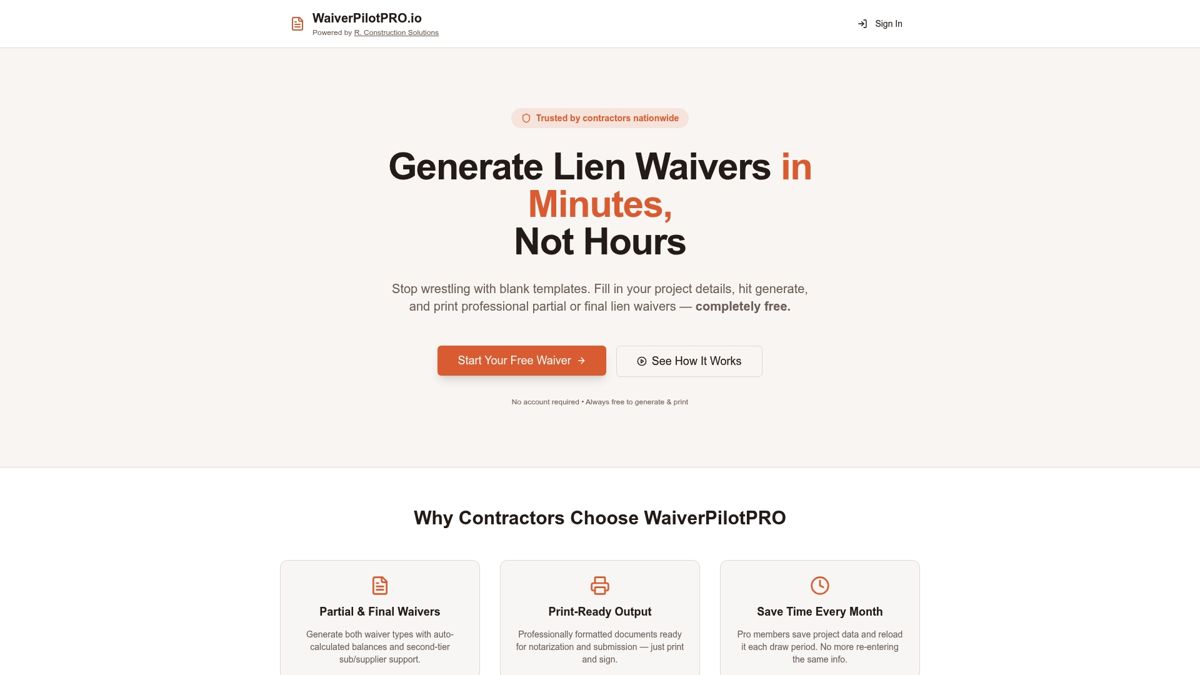
The free lien waiver generator lets you fill in project details and produce professional, notarizable conditional and final waivers in minutes, with no account creation required. Auto-calculated balances and multi-subcontractor support mean you can process an entire draw package without manual math or repeated data entry. Waiverpilotpro integrates directly with Procore and QuickBooks, so your waiver data stays connected to your payment workflow. For contractors and project managers who want audit-ready documentation without the administrative burden, it is the fastest path from payment approval to compliant release.
FAQ
What is payment release documentation in construction?
Payment release documentation is the complete set of records that authorize and verify a construction payment, including invoices, lien waivers, remittance advice, and approval records. It proves that payment was made correctly and that all legal conditions were satisfied before funds were disbursed.
Why must approval and disbursement be kept separate?
Approval confirms a payment passed review, but disbursement requires additional verification that lien waivers, completion certificates, and tax compliance are in place. Releasing funds at the approval stage skips those checks and creates legal and financial risk.
What is a lien waiver and when should you collect it?
A lien waiver is a document in which a contractor or subcontractor surrenders their right to file a mechanics lien against the property in exchange for payment. Collect a conditional vs. unconditional waiver before releasing each payment draw, matching the waiver amount to the payment amount exactly.
How often should construction payment records be reconciled?
Weekly reconciliation is the minimum standard for active projects. Reconciling more frequently on high-volume projects prevents gaps from accumulating and makes audit preparation straightforward rather than stressful.
What is remittance advice and why does it matter?
Remittance advice is a document that identifies which invoice a specific payment covers. It matters because a bank statement alone does not prove payment purpose, and without it you cannot defend against a lien claim or pass a tax audit that questions a specific transaction.