
Why Project Managers Track Waiver Status on Every Project
Tracking waiver status is the process by which construction project managers monitor lien waiver documents to confirm payments are properly matched and lien rights are waived at the right stage. Without this discipline, a single missed or misclassified waiver can block a payment draw, trigger a mechanics lien, or unravel a project closeout. The practice sits at the center of both risk management and financial oversight, making it one of the most consequential administrative controls a project manager owns. Tools like Procore, Vergo, and Waiverpilotpro have made this process faster, but the underlying logic remains the same: no verified waiver, no payment release.
Why project managers track waiver status: the payment control case
Waiver tracking controls payment approval by gating invoice release until the correct waiver documents are collected and matched to the corresponding invoice amount. This replaces manual reminder chasing and spreadsheet checks with a defined, repeatable condition. A payment cannot move forward until the waiver is received, verified for type, and matched to the draw amount.
The financial risk behind this is real. When waiver amounts do not match invoice amounts, double payment exposure opens up. A subcontractor who receives payment without surrendering lien rights retains the legal ability to file a mechanics lien against the property, even after the general contractor has already paid. Oracle’s lien waiver workflow reflects this directly: general contractors disburse funds only after reviewing and approving waivers from sub-tier contractors, linking status changes to payment approval gates.

Waiver tracking also builds the audit trail that IRS compliance and internal controls require. Every approved payment should have a corresponding waiver on file, timestamped and matched to the draw. Without that documentation, an audit becomes a reconstruction exercise, which is expensive and often incomplete.
Key financial controls that waiver tracking enforces:
- Invoice matching: Waiver dollar amounts must equal the invoice amount before approval.
- Payment gating: Accounts payable systems block release until waiver status shows “received and verified.”
- Audit readiness: Each draw cycle produces a documented record linking payment to waiver receipt.
- Double payment prevention: Verified waivers confirm lien rights are surrendered before funds move.
Pro Tip: Set your accounts payable system to flag any invoice where the waiver amount differs from the draw request by more than one dollar. Even small discrepancies signal a document version problem that will compound across future draws.
Why conditional vs. unconditional waiver status matters more than most managers realize
The type of waiver on file is not a formality. It determines whether lien rights are actually released. Conditional waivers take effect only after payment clears; unconditional waivers become effective the moment they are signed, regardless of whether payment has been received. Marking a conditional waiver as “complete” before the check clears creates hidden lien exposure that does not show up until a subcontractor files a claim.
The standard draw cycle follows a specific sequence. A conditional waiver is collected at the time of the draw request. Once payment clears, an unconditional waiver replaces it, confirming that lien rights are fully surrendered. Tracking status means knowing exactly where each subcontractor sits in that sequence for every draw.
| Waiver type | When it takes effect | Risk if misclassified |
|---|---|---|
| Conditional progress | After payment clears | Lien exposure if marked complete early |
| Unconditional progress | Immediately upon signing | Subcontractor loses rights before payment |
| Conditional final | After final payment clears | Closeout blocked if missing or wrong type |
| Unconditional final | Immediately upon signing | Permanent lien release, no reversal possible |
The distinction between waiver types is where most tracking errors originate. A project manager who accepts an unconditional waiver before payment clears has inadvertently forced a subcontractor to surrender legal rights without compensation. That creates a different kind of liability. The main waiver issues arise less from the legal form itself and more from poor tracking discipline around timing and collection.
Pro Tip: Build a two-column status field in your waiver tracker: one column for waiver type received, one for payment cleared date. A row is only complete when both fields are filled. This single habit eliminates the most common timing mistake in construction payment management.
How waiver tracking prevents version drift and closeout delays
Phased projects with rolling monthly draws accumulate waiver documents fast. Mid-size projects may generate over 2,000 waiver documents over 14 months. At that volume, version drift becomes a serious operational risk. Version drift happens when the working tracker used by the project team diverges from the official lender file, usually because updates are made in one place but not the other.
The consequences appear at closeout. Errors surface post-project when rectifying them may be time-consuming or impossible if subcontractors have already demobilized. A lender or title company reviewing the file for final disbursement will flag missing waivers, wrong waiver types, or amounts that do not reconcile. Correcting those gaps after a subcontractor has left the project can take weeks and may require legal intervention.
Consistent tracking also protects against disputes with subcontractors who claim they were not paid for a specific draw. A well-maintained tracker shows the exact waiver received, the amount it covered, and the date payment cleared. That record is far more defensible than an email chain.
Operational risks that version drift creates:
- Lender file discrepancies: Working files and official files fall out of sync, requiring manual reconciliation at closeout.
- Missing final waivers: Subcontractors who demobilize before submitting final unconditional waivers leave open lien exposure.
- Amount mismatches: Draw amounts change through change orders, but waiver amounts are not updated to match.
- Notarization gaps: Some states require notarized waivers; tracking must flag documents that lack this authentication.
- Duplicate submissions: Without version control, the same waiver may be logged twice, inflating the apparent compliance rate.
AI tools now flag waivers where payment has not cleared, automatically detecting the gap between document receipt and payment confirmation. This addresses the most common failure mode in manual tracking systems.
Practical methods project managers use to monitor waiver status
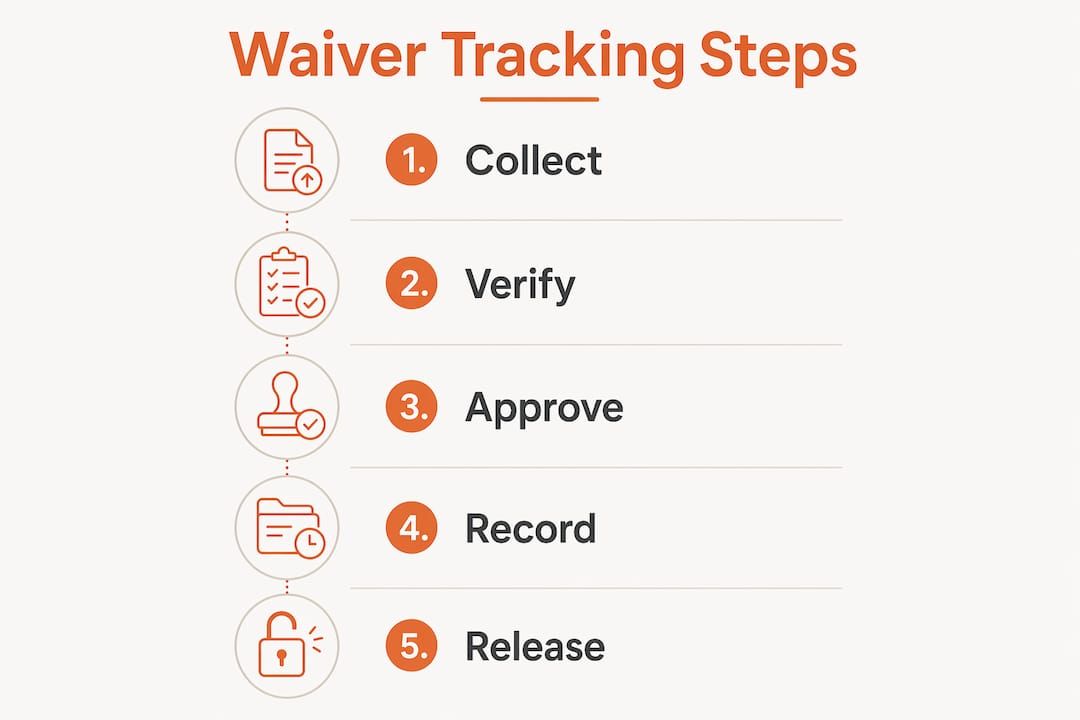
The most effective waiver tracking systems connect document receipt, type verification, payment clearance, and signature authentication into a single auditable process. Each of those four steps must be confirmed before a waiver is marked complete. Skipping any one of them leaves a gap that will surface at the worst possible time.
Here are the methods construction project managers rely on most:
-
Use cloud-based collection tools. Platforms like Vergo and Procore automate waiver requests, send reminders, and store documents in a centralized location. This eliminates the version drift problem by keeping one authoritative file.
-
Build a subcontractor registry. Maintain a list of every subcontractor, their tier, and the waiver type expected at each draw. This registry becomes the checklist that drives collection and prevents any subcontractor from slipping through.
-
Apply diagnostic status flags. Mature waiver trackers use specific flags like “wrong type,” “notarization missing,” and “payment cleared/not cleared” rather than vague notes. This controlled vocabulary makes the tracker auditable and repeatable.
-
Link waiver status to payment release. Automated AP workflows block payment release until waiver status is confirmed. This removes human discretion from the payment gate and prevents payments from slipping through on informal approvals.
-
Schedule proactive follow-ups. Set calendar reminders 10 days before each draw deadline to chase outstanding waivers. Waiting until the draw date creates pressure that leads to accepting incorrect documents.
-
Audit the tracker monthly. Compare the tracker against the lender file once a month on active projects. Catching discrepancies early costs minutes. Catching them at closeout costs weeks.
Pro Tip: Assign one person on your team as the waiver status owner for each project. Shared responsibility for tracking is the same as no responsibility. A named owner with a weekly reporting cadence catches problems before they become payment disputes.
Tracking waiver status also protects the progress payment cycle by ensuring that partial waivers align with each draw amount rather than covering the full contract value prematurely.
Key Takeaways
Tracking waiver status is the single most effective control a project manager can apply to prevent lien exposure, double payments, and closeout delays on construction projects.
| Point | Details |
|---|---|
| Payment gating is non-negotiable | Block every payment release until the correct waiver type is received and verified. |
| Waiver type determines legal effect | Conditional waivers require payment clearance; unconditional waivers take effect immediately upon signing. |
| Version drift compounds at closeout | Reconcile your working tracker against the lender file monthly to catch discrepancies early. |
| Diagnostic flags replace vague notes | Use specific status labels like “notarization missing” or “payment cleared” for an auditable record. |
| Automation reduces manual failure | Cloud-based tools and AI flag gaps automatically, removing the human error that causes most tracking breakdowns. |
Waiver tracking is a financial control, not a paperwork exercise
I have watched project managers treat lien waiver collection as an afterthought, something to clean up before closeout. That approach costs real money. The projects that run into 47-day closeout delays and title company complications are almost always the ones where tracking was reactive rather than built into the payment cycle from day one.
The insight that changed how I think about this: waiver tracking is not about the documents. It is about payment discipline. When you require a verified waiver before every payment release, you force every party in the payment chain to stay current. Subcontractors submit waivers on time because payment depends on it. That discipline prevents the accumulation of unresolved lien exposure that turns a routine closeout into a legal problem.
Automated tools have made this easier than it has ever been. A platform that integrates with Procore or QuickBooks and sends automatic waiver requests removes the manual follow-up burden entirely. The project manager’s job shifts from chasing documents to reviewing exceptions. That is a better use of your time and a more reliable control.
The project managers who champion waiver tracking from the first draw are the ones whose projects close on time, with clean title and no lien disputes. That outcome is not luck. It is the direct result of treating waiver status as a financial control with the same rigor you apply to budget tracking or schedule management.
— Rowena
Waiverpilotpro makes waiver tracking practical for every project
Managing lien waivers across multiple subcontractors and draw cycles is one of the most time-consuming parts of construction administration. Waiverpilotpro removes that burden by letting you generate conditional and unconditional waivers for free, with auto-calculated balances and built-in support for multiple subcontractors on a single project.
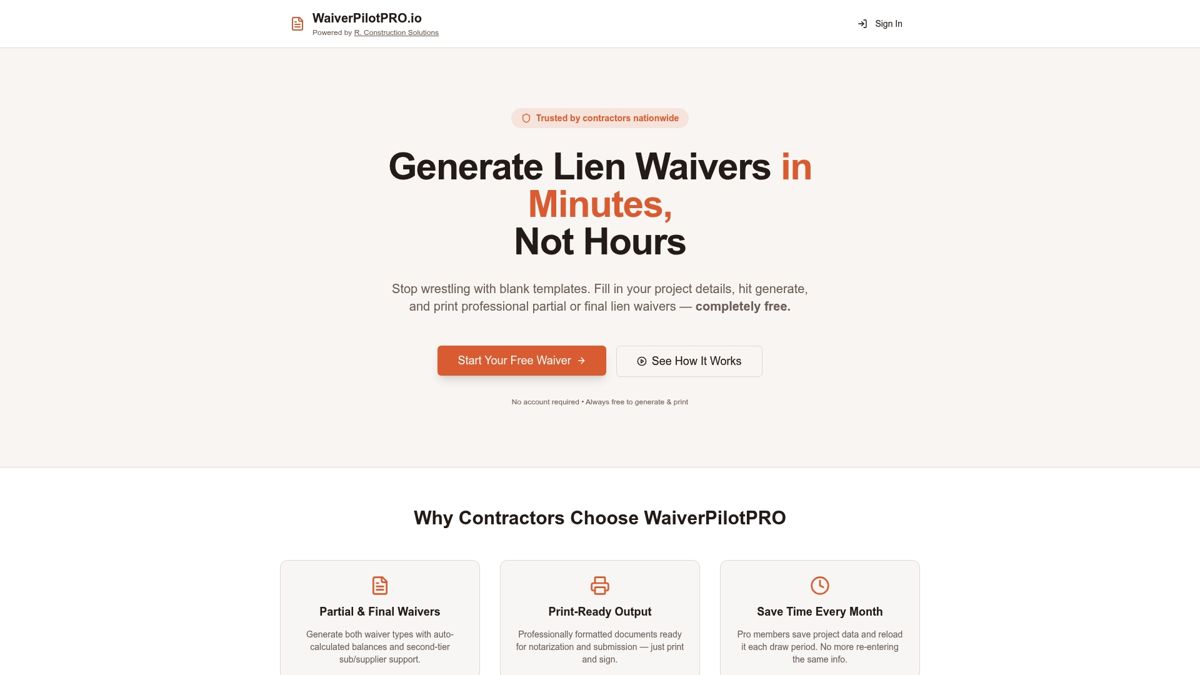
Waiverpilotpro integrates directly with Procore, QuickBooks, and other construction management platforms, so waiver status updates flow into the systems your team already uses. Documents are notarizable and state-specific, meeting the requirements that lenders and title companies check at closeout. Use the free lien waiver generator to start producing professional, trackable waivers today, or explore the AI-powered generator to auto-fill documents directly from your contract data.
FAQ
Why do project managers track waiver status on every draw?
Project managers track waiver status to gate payment approval and prevent lien exposure. A payment released without a verified waiver leaves the property open to a mechanics lien claim, even after funds have been disbursed.
What is the difference between conditional and unconditional waiver status?
A conditional waiver takes effect only after payment clears, while an unconditional waiver becomes legally binding the moment it is signed. Tracking which type is on file for each draw prevents the timing mistakes that create hidden lien exposure.
How does waiver tracking prevent closeout delays?
Missing or misclassified waivers are the leading cause of lender and title company rejections at project close. Consistent tracking ensures every subcontractor’s waiver is verified and on file before the final disbursement request is submitted.
What tools do project managers use to track waiver status?
Construction project managers use platforms like Procore, Vergo, and Waiverpilotpro to automate waiver collection, apply diagnostic status flags, and link document receipt to payment release in accounts payable workflows.
What happens if waiver tracking is neglected on a large project?
Poor tracking discipline leads to version drift between working files and lender files, double payment exposure, and post-demobilization disputes with subcontractors. Projects with unresolved waiver gaps face significant delays in achieving clear title and final funding.