
Lien Waiver vs Lien Release: What Contractors Must Know
A lien waiver is a pre-payment document that prevents a mechanic’s lien from being filed, while a lien release is a post-filing document that removes an existing lien from public property records. These two documents serve completely different purposes in construction payment workflows, yet contractors routinely confuse them. Getting this wrong can cloud a property title, block a sale, or expose you to a dispute you thought was already resolved. Understanding the key differences between these documents is one of the most practical steps you can take to protect your business and your clients’ projects. Waiverpilotpro is built around making this process straightforward for every contractor.
What is a lien waiver and how does it work in construction?
A lien waiver is a written statement in which a contractor, subcontractor, or supplier gives up their right to file a mechanic’s lien in exchange for payment. Think of it as a receipt that also surrenders a powerful legal remedy. You are trading your right to place a claim on the property for the assurance that payment is coming or has arrived.

Lien waivers accompany pay applications, allowing project owners to confirm that lien rights are waived with each payment milestone. Progress waivers cover partial payments made during the project. Final waivers cover the entire contract balance and are signed at project completion.
The four types of lien waivers
There are four standard types used across most states:
- Conditional progress waiver. Covers a partial payment and becomes effective only after the payment clears.
- Unconditional progress waiver. Covers a partial payment and takes effect immediately upon signing, regardless of whether the check clears.
- Conditional final waiver. Covers the full contract amount and becomes effective only after final payment is confirmed.
- Unconditional final waiver. Covers the full contract amount and is effective the moment you sign it.
The distinction between conditional and unconditional is critical. Conditional waivers protect you because they only activate after payment is received. Unconditional waivers activate immediately, which means signing one before your check clears leaves you with no lien rights if the payment bounces.
Pro Tip: Always sign a conditional waiver before payment arrives and switch to an unconditional waiver only after the funds have fully cleared your account. This single habit prevents most payment reversal disputes.
Lien waivers fit naturally into the monthly pay application cycle. A general contractor collects waivers from subcontractors and suppliers before releasing each payment. This gives the project owner confidence that no liens will appear on the property for work already paid. Platforms like Waiverpilotpro support this workflow with auto-calculated balances and multi-subcontractor support, so you spend less time on paperwork and more time on the job.
What is a lien release and why does it matter after a lien is filed?
A lien release is a formal legal document that removes a recorded mechanic’s lien from public property records after the underlying debt has been satisfied. It is the corrective tool in the lien process. You use it when prevention failed and a lien was actually filed.
Here is what makes a lien release different from simply paying the debt: payment alone does not clear title. Lenders and title companies require a recorded release document to confirm that the lien has been resolved. Without it, the lien stays on the public record and can block a property sale or refinancing.
The lien release process
Filing a lien release involves several steps:
- The claimant who filed the lien signs a release document acknowledging that the debt is paid.
- The signed release is filed with the county recorder’s office where the original lien was recorded.
- The county updates the public record to reflect that the lien is no longer active.
- The property owner receives confirmation that the title is clear.
Most states require lien releases within 10–30 days after the lien is satisfied. Missing this deadline can expose the claimant to penalties and continued liability for any damages the property owner suffers because of the unresolved lien.
The consequences of skipping a lien release are real. A satisfied lien that stays on the record can delay or kill a property sale. Title companies will not issue a clean title policy with an active lien on record. Buyers and their lenders walk away. The property owner then comes back to you demanding the release, often with legal pressure attached.
Pro Tip: As soon as you receive final payment on a project where a lien was filed, treat the release as your next immediate task. Do not wait for the property owner to ask.
What are the key differences between a lien waiver and a lien release?
Waivers are forward-looking; releases are retrospective. A waiver prevents a lien from ever appearing on the record. A release cleans up a lien that is already there. Mixing up the two is a costly mistake that construction professionals make more often than you might expect.
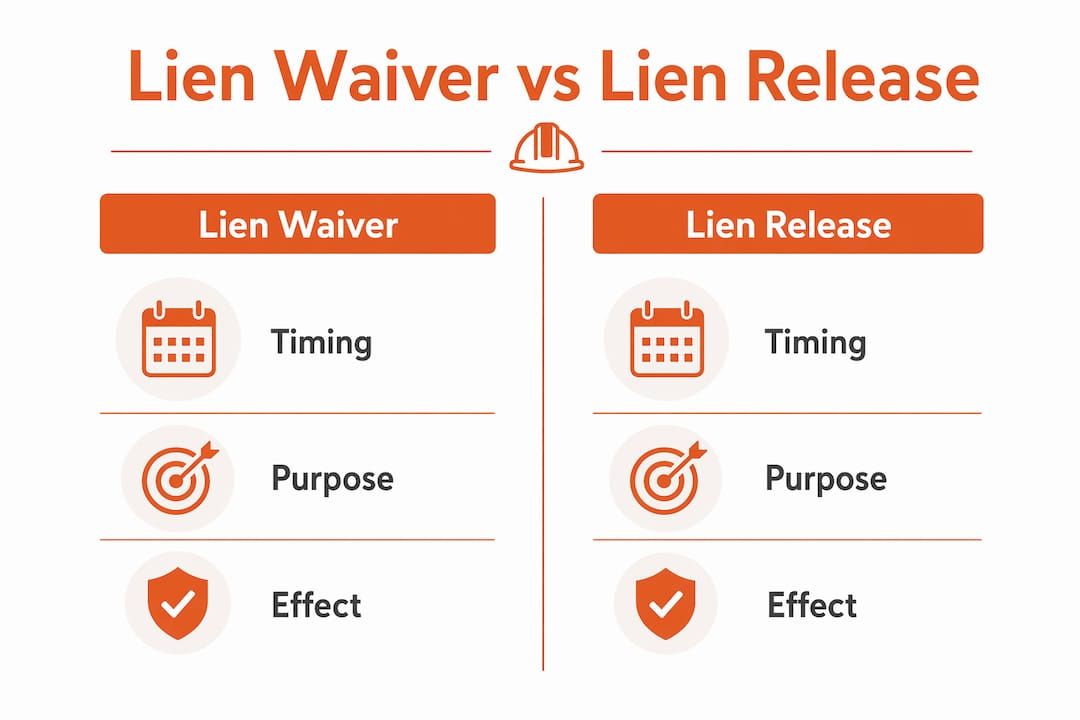
| Category | Lien waiver | Lien release |
|---|---|---|
| Timing | Signed before or at the time of payment | Filed after a lien has been recorded and paid |
| Purpose | Prevents a mechanic’s lien from being filed | Removes an existing lien from public record |
| Legal effect | Waives future lien rights for the payment covered | Clears the lien claim from the property title |
| Who signs | The party receiving payment (contractor, sub, supplier) | The party who filed the lien (claimant) |
| When required | Part of standard pay application workflow | Only when a lien has already been recorded |
The most dangerous misunderstanding is believing that collecting a lien waiver after a lien has already been filed is enough. It is not. A recorded lien remains active until a formal release is filed with the county recorder. A waiver signed after the fact does not substitute for a release. The lien stays on the title until the release is properly recorded.
Another common error is signing an unconditional waiver before payment is confirmed. This hands over your lien rights with no safety net. If the payment fails, you have already given up your ability to file a claim.
How to manage lien waivers and releases in your payment workflow
Effective lien management is not complicated, but it requires consistency. The contractors who avoid disputes are the ones who treat waivers and releases as routine paperwork, not afterthoughts.
-
Collect conditional waivers before releasing payment. Require every subcontractor and supplier to submit a conditional progress waiver with each pay application. This protects the project owner and keeps the payment chain clean.
-
Upgrade to unconditional waivers after payment clears. Once you confirm the funds have cleared, exchange the conditional waiver for an unconditional one. Following conditional and unconditional waiver protocols prevents most payment disputes before they start.
-
Track waiver status for every payment milestone. Use a log or your construction management software to confirm which waivers are outstanding. Missing a waiver from one subcontractor can create a title problem months later.
-
File lien releases promptly after resolving recorded liens. Do not let a paid lien sit on the record. File the release with the county recorder as soon as the debt is confirmed satisfied.
-
Verify state-specific requirements. Lien laws vary by state. California, Nevada, and Texas each have specific form requirements and deadlines. Check your state’s rules before you draft or sign any lien document. Waiverpilotpro covers state-specific requirements and generates compliant forms for your jurisdiction.
-
Use software integrations to reduce errors. Waiverpilotpro integrates with Procore, QuickBooks, and other construction management platforms. Auto-filled forms reduce manual entry errors and produce notarizable documents ready for submission.
Pro Tip: Review the lien waiver process for subcontractors before your next project kickoff. Common mistakes in subcontractor contracts are often the source of title problems that surface months later.
For contractors who want a step-by-step walkthrough of completing these forms correctly, Waiverpilotpro’s lien waiver completion guide covers every field and common pitfall.
Key takeaways
A lien waiver prevents a mechanic’s lien from being filed, while a lien release removes a lien that is already recorded. Both documents are legally distinct and cannot substitute for each other.
| Point | Details |
|---|---|
| Waivers are preventative | Sign conditional waivers before payment and unconditional waivers only after funds clear. |
| Releases are corrective | File a lien release with the county recorder after any recorded lien is paid off. |
| Payment alone is not enough | A paid lien stays on public record until a formal release is recorded with the county. |
| Timing determines document type | Use waivers during the pay application cycle; use releases only after a lien is filed. |
| State rules vary | Deadlines for lien releases range from 10 to 30 days depending on the state. |
What I’ve learned from watching contractors mix these up
Rowena’s perspective
The most expensive mistake I see contractors make is treating a lien waiver as a cure-all. They collect waivers religiously during the project, then a dispute arises, a lien gets filed, and they assume the waiver they already have covers it. It does not. Once a lien is on the public record, only a recorded release removes it. No waiver signed before or after the filing changes that fact.
The second mistake is the reverse: a property owner asks for a lien release on a project where no lien was ever filed. They are actually asking for a final unconditional waiver. Confusing the two wastes time and creates unnecessary legal paperwork. Knowing which document fits the situation saves everyone hours of back-and-forth.
State-specific rules make this harder than it should be. A contractor working across California and Nevada faces two different sets of form requirements and deadlines. The safest approach is to build a checklist into your payment workflow so the right document gets generated at the right time, every time. Tools that auto-generate compliant forms for your state remove most of the guesswork.
The contractors who handle this well share one habit: they treat lien documentation the same way they treat invoicing. It is not optional, it is not something to do when you remember, and it is not something to delegate without oversight. Get the workflow right once, and it runs on its own.
— Rowena
Generate compliant lien waivers with Waiverpilotpro
Waiverpilotpro removes the friction from lien waiver generation. You fill in your project details, and the platform produces professional, notarizable conditional and final waivers at no cost. No account creation required, no complex templates to decode.

The platform integrates with Procore, QuickBooks, JobTread, Buildertrend, and Sage, so your waivers pull directly from your existing project data. If you want to generate your first waiver right now, the free lien waiver generator is ready to use. For teams already using JobTread, the JobTread waiver generator connects directly to your project workflow and handles multi-subcontractor submissions in one pass.
FAQ
What is the main difference between a lien waiver and a lien release?
A lien waiver prevents a mechanic’s lien from being filed by waiving future lien rights at the time of payment. A lien release removes a lien that has already been recorded on the property.
Does paying a contractor automatically clear a lien from the title?
No. Payment alone does not remove a recorded lien from public records. A formal lien release must be filed with the county recorder to clear the title for sales or refinancing.
When should I sign a conditional vs. unconditional lien waiver?
Sign a conditional waiver before or at the time of payment, since it only activates after funds clear. Sign an unconditional waiver only after you have confirmed the payment has fully cleared your account.
How long does a contractor have to file a lien release after payment?
Most states require a lien release to be filed within 10–30 days after the lien is satisfied. Missing this window can result in penalties and continued liability for title encumbrance.
Can a lien waiver substitute for a lien release if a lien has already been filed?
No. A lien waiver does not remove a recorded lien from public records. Once a lien is filed, only a properly recorded lien release clears it from the property title.