
Construction Waiver Without Monthly Subscription: 2026 Guide
A lien waiver is a legal document where a contractor, subcontractor, or supplier gives up the right to file a mechanics lien in exchange for payment. Getting a construction waiver without monthly subscription fees is entirely possible using free templates, state-issued statutory forms, or pay-per-use generators. The industry standard term is “lien waiver,” and the four recognized types cover every payment stage on a project. Subscription-based platforms add recurring costs that make no sense for contractors who only need waivers occasionally. This guide covers the waiver types, legal requirements, and a clear workflow you can follow today without paying a monthly fee.
What are the main types of construction lien waivers?
Four main lien waiver types exist in the industry: conditional progress, unconditional progress, conditional final, and unconditional final. Each type has specific timing rules tied directly to payment status, and using the wrong one at the wrong time creates serious financial risk.
Here is what each type means in plain terms:
- Conditional progress waiver. Waives lien rights for a partial payment, but only once that payment actually clears. Use this when you submit a draw request mid-project.
- Unconditional progress waiver. Permanently waives lien rights for a partial payment. Sign this only after the check has cleared your bank account.
- Conditional final waiver. Waives all remaining lien rights upon receipt of the final payment. Submit this with your final invoice.
- Unconditional final waiver. Permanently closes out all lien rights. Sign this only after the final payment is confirmed in your account.
The sequence matters more than most contractors realize. Collect a conditional waiver before payment approval, and collect an unconditional waiver only after payment clears. Reversing that order can cost you the ability to file a lien if a payment dispute arises later.
Pro Tip: Never sign an unconditional waiver in exchange for a promise of payment. The word “unconditional” means your lien rights are gone regardless of whether the money arrives.

How to get a construction waiver without monthly fees
Twelve or more states mandate specific statutory lien waiver forms for enforceability, including California, Texas, Florida, Arizona, and Massachusetts. Using a non-compliant form in those states risks making your waiver unenforceable, which means you lose payment protection without even knowing it.
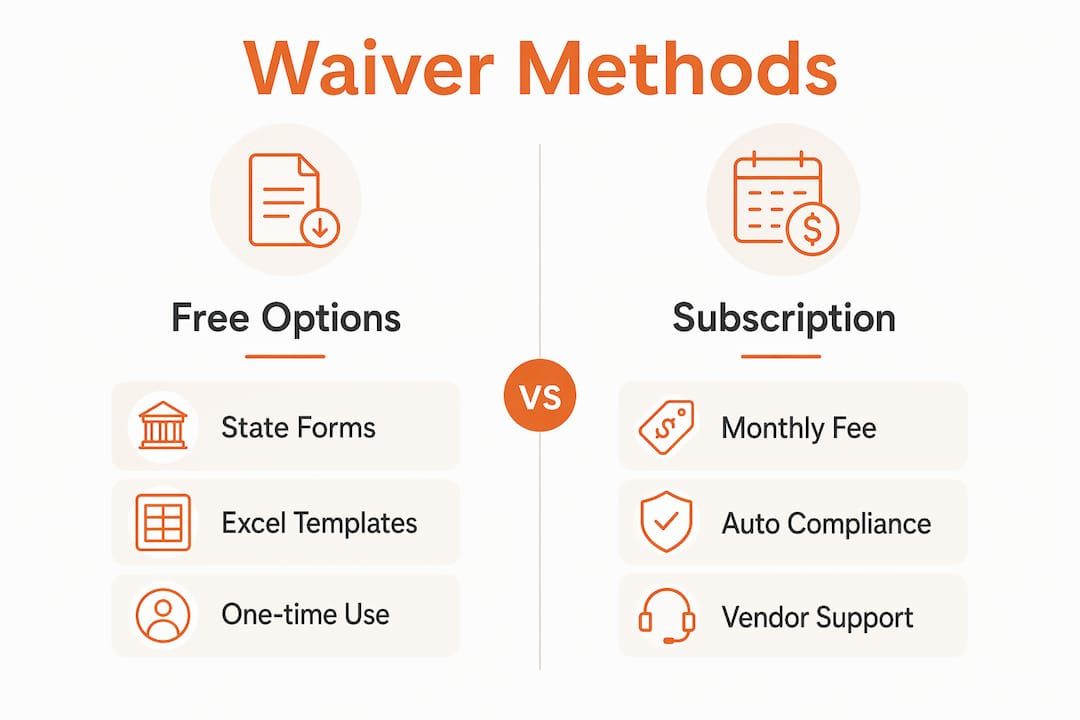
Your practical options for one-time construction waiver generation fall into three categories:
- State statutory forms. Download the official form directly from your state’s legislature or contractor licensing board website. These are free and already compliant.
- Free Excel or Google Sheets templates. These work well for contractors who handle a small volume of waivers and want to customize the document with their own branding. Keep a master template and duplicate it per project.
- Free or pay-per-use online generators. These tools let you fill in project details and produce a formatted waiver without creating an account or paying a monthly fee. Waiverpilotpro operates on this model, generating both conditional and final waivers at no cost.
The table below compares these three approaches across the factors that matter most to contractors:
| Method | Cost | State compliance | Speed | Best for |
|---|---|---|---|---|
| State statutory forms | Free | High (official) | Moderate | High-compliance states |
| Excel/Google Sheets templates | Free | Varies | Slow (manual) | Low-volume projects |
| Free online generator | Free or per use | High (auto-updated) | Fast | Any project size |
Pro Tip: If you work across multiple states, use a generator that auto-selects the correct statutory form by state. Manually tracking which form applies where is a common source of compliance errors.
Fifteen states have statutory waiver form requirements with mandated language. That number is high enough that checking your state’s rules before generating any waiver is non-negotiable.
What are the legal prerequisites before generating lien waivers?
Getting the document right means nothing if your project records are incomplete. Before you generate any waiver, confirm these steps are done:
- Gather all payment documentation. Collect the invoice, pay application, and any change orders tied to the payment period. The waiver amount must match the payment amount exactly.
- Confirm the payment amount in writing. Verbal agreements do not protect you. Get the approved draw amount confirmed by email or in your project management system before you fill in a single field.
- Note any disputed or withheld amounts as exceptions. Signing without listing exceptions waives your right to claim those amounts later. Write disputed sums directly into the exceptions field on the waiver.
- Understand your state’s filing deadlines. Most states require a preliminary notice or lien claim within 60–90 days of last furnishing labor or materials. Missing that window eliminates your lien rights entirely.
- Collect waivers from every tier of the supply chain. Lien waivers signed only by subcontractors do not cover material suppliers. As a general contractor, you need separate waivers from each supplier your subs use.
- Track waiver status on every project. A missing waiver from one sub can stall your entire draw. Tracking waiver status per project is a standard practice among project managers who want to avoid funding delays.
These steps apply whether you use a subscription platform or a free one-time generator. The legal requirements do not change based on the tool you use.
Step-by-step process for executing lien waiver exchange
This workflow applies to each draw cycle on a project. Follow it in order and you will avoid the most common waiver mistakes.
- Prepare the conditional waiver before submitting your pay application. Fill in the project name, owner name, claimant name, and the exact payment amount. Use a free waiver generator or your state’s statutory form.
- Submit the conditional waiver with your pay application. Attach it to your invoice or draw request. Lenders and general contractors expect to see it before releasing funds.
- Wait for payment to clear your bank account. Do not rely on a check being “in the mail.” Confirm the funds are available in your account before the next step.
- Execute the unconditional waiver after payment clears. Fill in the same project and payment details. Sign and return it to the payer promptly.
- Repeat the cycle for each draw or payment stage. Every payment period requires its own set of conditional and unconditional waivers. Do not reuse a prior waiver for a new payment.
- File and store all waivers by project. Keep digital copies organized by project and payment date. You may need them to resolve disputes or satisfy lender audits months later.
Lenders block draw funding until prior unconditional waivers are on file. Most contractors treat waiver collection as post-payment paperwork, but it is actually the gating step for the next draw. A missing waiver from one subcontractor can put your entire project funding on hold.
Incorrect waiver timing and form selection frequently stall draws and increase financial risk for everyone on the project. Getting the sequence right protects your cash flow as much as it protects your lien rights.
One often-overlooked option for speeding up collection: no-login waiver signing via email increases vendor compliance and reduces friction. When subcontractors and suppliers can sign directly from an email link without creating an account, they actually do it.
Key Takeaways
A construction waiver without monthly subscription fees is achievable using free statutory forms, Excel templates, or no-cost online generators, provided you follow the correct conditional-to-unconditional sequence for every payment cycle.
| Point | Details |
|---|---|
| Four waiver types exist | Use conditional waivers before payment and unconditional waivers only after funds clear. |
| State compliance is mandatory | Fifteen states require specific statutory forms; using the wrong form risks unenforceability. |
| Exceptions protect disputed amounts | Always list withheld or disputed sums as exceptions before signing any waiver. |
| Supply chain coverage matters | General contractors must collect separate waivers from subcontractors and their suppliers. |
| Waiver timing drives draw funding | Lenders block draws until prior unconditional waivers are filed, making timing a cash flow issue. |
Why I stopped paying for waiver software after year two
I spent two years paying for a subscription platform before I did the math. The monthly fee added up to more than I was spending on most of my smaller subcontractors’ invoices. The platform had features I never used, and the core task, generating a compliant lien waiver, was something a well-built free tool could do just as well.
The real cost of subscription software is not the fee. It is the dependency. When you build your waiver workflow around a paid platform, your whole team has to log in, learn the interface, and stay current with updates. Free or pay-per-use tools remove that friction entirely.
What I have found actually works is keeping a simple tracking sheet per project and using a free generator for the documents themselves. The tracking sheet tells me which subs have submitted conditional waivers and which unconditional waivers are still outstanding. That visibility is what prevents draw delays, not the software.
The one area where I would not cut corners is state compliance. If you work in California, Texas, or any of the other states with mandatory statutory language, use a generator that knows those requirements. Getting the form wrong is a much bigger problem than paying for a subscription.
— Rowena
Waiverpilotpro generates compliant waivers at no monthly cost
Contractors who need reliable lien waivers without a recurring fee have a direct option in Waiverpilotpro.
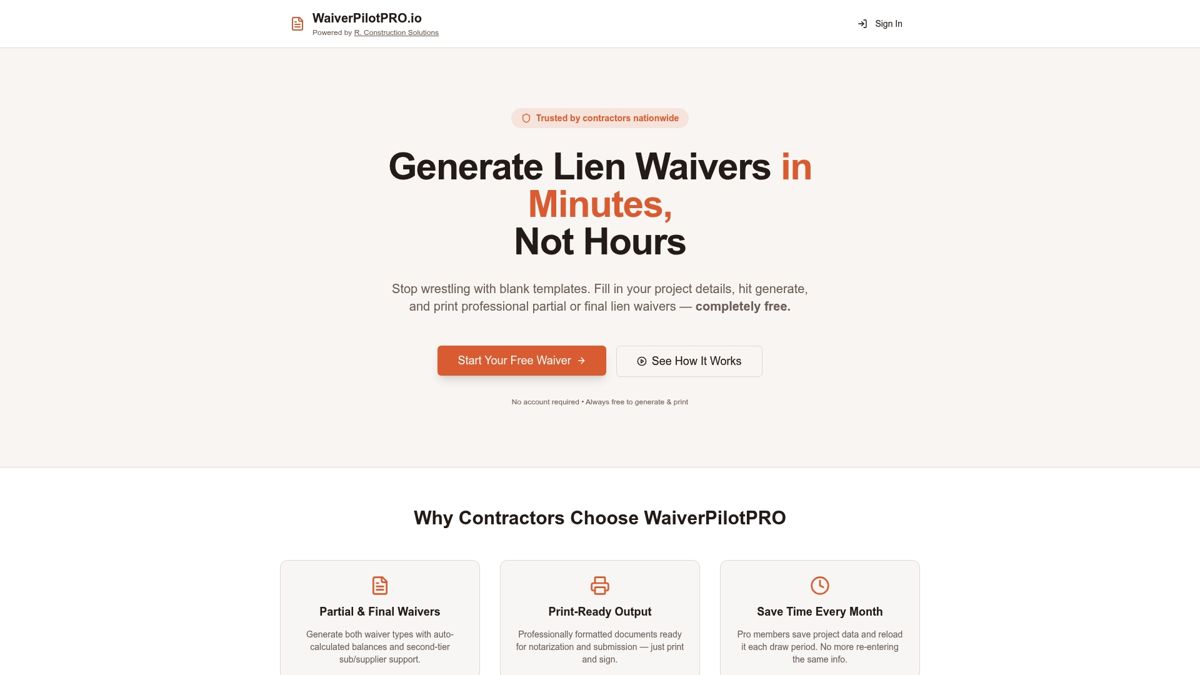
Waiverpilotpro generates both conditional and final lien waivers for free, with no account creation required. The platform supports state-specific statutory forms and integrates with construction management tools like Procore and QuickBooks, so your existing workflow stays intact. Auto-calculated balances and multi-subcontractor support reduce the manual work that slows down waiver collection. Use the free lien waiver generator to produce a notarizable, professionally formatted document in minutes. For contractors who want downloadable backups, free construction forms in PDF, Word, and Excel are also available at no cost.
FAQ
What is a construction waiver without monthly subscription?
A construction waiver without monthly subscription is a lien waiver generated using a free or pay-per-use tool rather than a recurring software plan. It carries the same legal weight as any other lien waiver when the correct form and language are used.
Which states require specific statutory lien waiver forms?
Fifteen states require statutory waiver forms with mandated language, including California, Texas, Florida, Arizona, and Massachusetts. Using a non-compliant form in these states can make the waiver unenforceable.
When should I sign an unconditional lien waiver?
Sign an unconditional lien waiver only after the payment has cleared your bank account. Signing before payment clears permanently waives your lien rights even if the funds never arrive.
Do subcontractor waivers cover material suppliers?
No. Waivers signed only by subcontractors do not cover their material suppliers. General contractors must collect separate waivers from every supplier in the chain.
How do I handle disputed amounts on a lien waiver?
List any disputed or withheld amounts as exceptions directly on the waiver before signing. Signing without noting exceptions waives your right to claim those amounts in any future dispute.