
Why Construction Payments Get Delayed: 2026 Guide
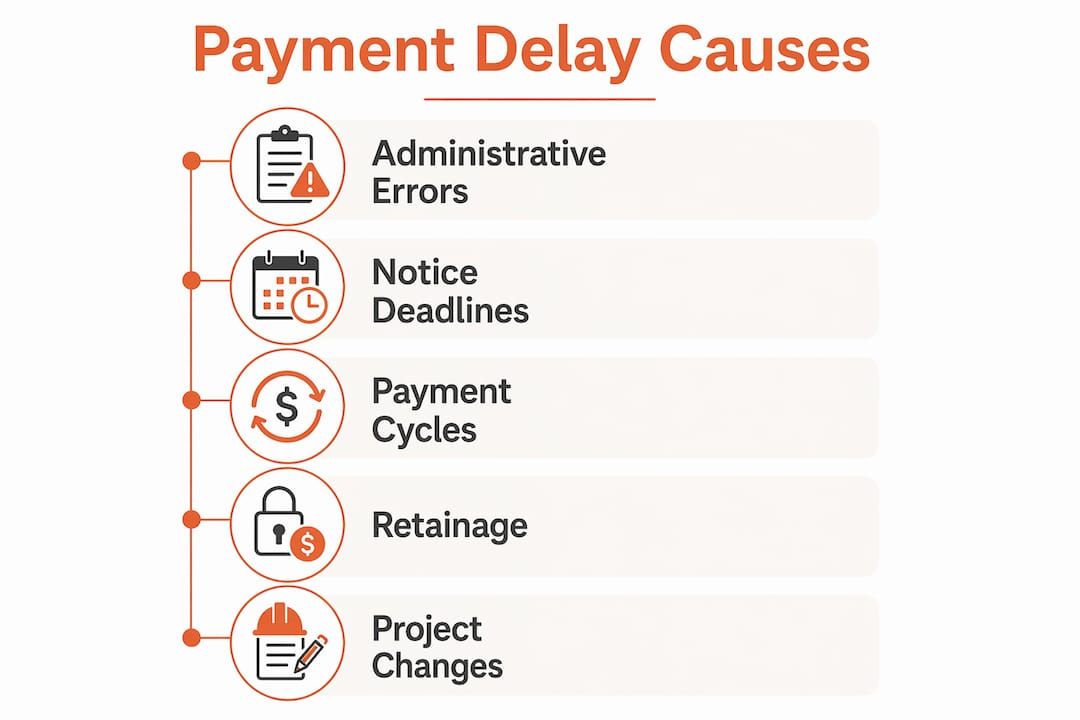
Construction payment delays are caused primarily by missed administrative steps and contractual notice failures, not by payer insolvency. Most contractors and project managers assume a late check means a cash-strapped client. The reality is more frustrating and more fixable. Missing documents, disorganized billing, and defective payment notices are the leading causes of delayed payments in construction. Understanding why payment delays happen in construction puts you in a position to prevent them before they hit your cash flow.
Why construction payments get delayed: the administrative roots
Administrative failures cause more payment delays than any other single factor. A billing package that arrives incomplete, or one that doesn’t match the contract schedule of values, will stall at the owner’s desk until corrections are made. That correction cycle can add weeks to your payment timeline.
The most common administrative problems that trigger delays include:
- Missing backup documentation: Invoices submitted without certified payroll, material receipts, or signed delivery tickets get rejected outright.
- Disorganized billing packages: When line items don’t align with the approved schedule of values, approvers flag the entire application.
- Incomplete payment applications: Forms like the AIA G702 and G703 require precise cost-to-date figures. A single miscalculation pauses the whole review.
- Missing lien waivers: Owners and general contractors routinely hold payment until conditional lien waivers are received from every tier of the project.
- Status lock failures: Billing packages submitted before project controls have finalized quantities or confirmed completion status create internal conflicts that delay approval.
Timing gaps between project controls and finance are a particularly underappreciated cause of construction billing problems. The field team closes out a work package, but the billing team submits before the documentation is locked. The owner’s reviewer finds discrepancies and puts the application on hold.
Pro Tip: Before submitting any payment application, run a completeness checklist that matches every line item to its backup document. Confirm that project controls have locked the status on all included work packages. One missing attachment can delay your entire application by a full billing cycle.

What role do contract payment notice deadlines play in delaying payments?
Contract notice requirements are binding, and missing them has direct financial consequences. Most standard construction contracts, including those based on AIA, ConsensusDocs, or NEC frameworks, set strict deadlines for issuing payment notices and pay-less notices. When those deadlines pass, your options narrow significantly.
Failure to issue timely payment or pay-less notices forces payers into a corner. If a general contractor misses the window to issue a valid pay-less notice, they may be legally obligated to pay the full notified sum, even if they dispute the amount. That same mechanism works against subcontractors who miss their own notice deadlines.
The consequences of notice failures include:
- Late notices: A payment notice issued after the contractual deadline is treated as if it was never issued at all.
- Defective notices: Notices that omit required information, such as the basis for any deduction or the correct payment period, are invalid and cannot be corrected after the fact.
- Unclear notices: Vague or ambiguous language in a pay-less notice can be challenged, triggering a dispute that delays payment for months.
The UK Housing Grants, Construction and Regeneration Act provides a clear example of how strict these regimes can be. Under that framework, late or invalid notices cannot be retroactively fixed, and the paying party must pay the notified sum by the final date for payment. American contracts are increasingly adopting similar hard-deadline structures, particularly on public projects.
Payment disputes often stem from process failures rather than genuine disagreements about money. A contractor who tracks notice deadlines with the same discipline they apply to the construction schedule will avoid most of these disputes entirely.
Why payment cycle length and retainage holdbacks cause structural delays
Even when your paperwork is perfect and your notices are timely, the structure of construction payment cycles creates built-in delays. You pay labor and materials upfront. You get reimbursed weeks later, after the owner reviews and approves your application. Costs are paid before revenue arrives, and that timing gap creates cash flow pressure even on profitable projects.
Retainage compounds this problem significantly. Retainage is the practice of withholding a percentage of each progress payment until the project reaches substantial completion or final completion. It acts as a performance bond held by the owner, but the cost falls entirely on the contractor and their subcontractors.
| Retainage stage | Typical holdback | When released |
|---|---|---|
| During construction | 5%–10% of each progress payment | At substantial completion |
| Punch list period | Reduced or full retainage | At final completion |
| Subcontractor retainage | Mirrors prime contract rate | After lien waiver submission |
Retainage typically holds back 5% to 10% of every progress payment until the project is complete. On a $2 million project, that means $100,000 to $200,000 is locked up for the entire duration of construction. Subcontractors feel this most acutely because they often finish their scope months before the overall project reaches substantial completion.
Retainage release is not automatic. Milestone approval and lien waiver verification are both required before owners release held funds. Owners and lenders treat retainage release as a separate financial process, requiring inspections, punch list sign-offs, and confirmed progress payment lien waivers from every subcontractor and supplier on the project.
State-level retainage reform is gaining momentum in 2026. Several states have passed or are considering legislation that caps retainage at 5% and requires prompt release once a subcontractor’s scope is complete, regardless of overall project status. These reforms directly address the cash flow timing problem that has long made retainage one of the most painful common payment delays in the industry.
Pro Tip: Track your retainage balance as a separate line item in your cash flow forecast. Build your financing plan around the assumption that retainage will not be released until 30 to 60 days after substantial completion, even if your contract says otherwise.
How project changes, disputes, and approvals contribute to payment hold-ups
Operational factors create a second layer of delays on top of administrative and structural ones. Change orders, valuation disputes, and slow approval chains all extend the time between completing work and receiving payment.
Disputes over payment validity, valuation of completed work, and deductions for defects are among the most common reasons contractor payments are held up beyond the normal billing cycle. These disputes rarely resolve quickly. Each round of correspondence adds days or weeks to the delay.
The most frequent operational causes of payment hold-ups include:
- Unapproved change orders: Work performed under a verbal direction, without a signed change order, is routinely excluded from payment applications until the change is formally approved.
- Valuation disagreements: When the owner’s quantity surveyor or project manager measures completed work differently than the contractor does, the disputed portion is withheld pending resolution.
- Defect deductions: Owners and general contractors sometimes apply back-charges for alleged defects without prior notice, reducing the approved payment amount and triggering a dispute.
- Slow approval chains: On large projects with multiple approval layers, a payment application can sit in queue for weeks before a decision is made.
The practical lesson here is that delays in contractor payments are rarely caused by one factor alone. An incomplete billing package that triggers a correction cycle, combined with a disputed change order and a retainage holdback, can push your payment out by 60 to 90 days on a project where the contract specifies 30-day terms.
Key Takeaways
Construction payment delays are caused by administrative failures, missed notice deadlines, retainage holdbacks, and operational disputes, not primarily by payer insolvency.
| Point | Details |
|---|---|
| Administrative errors top the list | Missing documents and disorganized billing are the leading causes of late payments, not client cash problems. |
| Notice deadlines are binding | Late or defective payment notices cannot be corrected after the fact and can trigger unintended payment obligations. |
| Retainage locks up capital | Holdbacks of 5%–10% per progress payment tie up significant cash until substantial or final completion. |
| Timing gaps create pressure | Costs are paid upfront while revenue arrives weeks later, creating cash flow strain even on profitable jobs. |
| Disputes compound delays | Unapproved change orders and valuation disagreements add weeks on top of existing billing cycle delays. |
What I’ve learned after years of watching payment delays unfold
The contractors I’ve seen manage cash flow well share one habit: they treat payment administration as a production activity, not a back-office task. They assign someone to own the billing package the same way they assign a foreman to own a work package. That person is accountable for completeness, timing, and follow-up.
The contractors who struggle most are the ones who treat invoicing as something that happens after the real work is done. By the time they submit, the billing window has closed, the owner’s reviewer has moved on, and the payment lands in the next cycle. That one-month slip, repeated across three or four billing periods, turns a 30-day payment term into a 90-day reality.
The other thing I’d push back on is the assumption that digital tools are optional for small contractors. A project manager running three jobs simultaneously cannot reliably track notice deadlines, lien waiver requirements, and retainage milestones in a spreadsheet. The administrative complexity of construction payment is genuinely high. Tools that auto-fill waiver details, flag missing documents, and integrate with platforms like Procore or QuickBooks are not a luxury. They are the difference between getting paid on time and chasing checks.
My honest advice: audit your last five payment applications. Count how many were submitted on time, complete, and with all required waivers attached. If the answer is fewer than four out of five, your payment delays are self-inflicted, and they are fixable.
— Rowena
Waiverpilotpro helps contractors get paid faster
Lien waivers are one of the most common reasons payment applications stall. Owners hold payment until every subcontractor and supplier submits a valid waiver, and chasing those documents manually costs time you don’t have.

Waiverpilotpro lets you generate conditional and final lien waiver forms for free, with no account required. Fill in your project details, and the platform produces a professional, notarizable document ready for submission. Waiverpilotpro integrates with Procore and QuickBooks, so your waiver data stays connected to your existing workflow. Auto-calculated balances and multi-subcontractor support reduce the back-and-forth that turns a simple document into a week-long delay. If you want to cut the administrative time out of your payment process, generate your first waiver at no cost today.
FAQ
What is the most common reason construction payments are delayed?
Missing documents and disorganized billing are the leading causes of late construction payments, ahead of payer insolvency. Incomplete payment applications stall owner approvals and push payments into the next billing cycle.
How does retainage cause payment delays in construction?
Retainage withholds 5%–10% of each progress payment until substantial or final completion, tying up significant capital for the entire project duration. Release requires milestone approvals, inspections, and lien waiver submissions from all project tiers.
Can a missed payment notice deadline be corrected after the fact?
No. Late or invalid payment notices cannot be retroactively fixed under most construction contract frameworks. Missing the deadline can obligate the paying party to pay the full notified sum regardless of any dispute.
Why do change orders cause delays in contractor payments?
Work performed without a signed change order is routinely excluded from payment applications until formal approval is received. Valuation disagreements over change order scope add further time before the disputed amount is paid.
How can contractors reduce payment delays on their projects?
Submit complete, well-documented payment applications before the billing deadline, track all notice deadlines, and provide lien waivers promptly. Using a tool like Waiverpilotpro to generate accurate conditional and final waivers removes one of the most common administrative bottlenecks in the payment process.