
Waiver Processing Speed Benefits for Construction Pros
Fast waiver processing is defined as the ability to collect, validate, and deliver lien waivers within a single billing cycle, and it directly determines how quickly your project gets paid. Waiver processing speed benefits construction teams by cutting payment cycle times, reducing administrative labor, and protecting projects from costly mechanic’s liens. Manual lien waiver processing delays projects by 5–12 days per billing cycle. That delay compounds across every draw, every subcontractor, and every month of a project’s life.
1. How waiver processing speed benefits your payment cycle
Faster waiver collection is the single most direct way to cut your Days Sales Outstanding (DSO). The industry median DSO in construction sits at 83 days, which means most contractors wait nearly three months to collect on work already completed. Automation can reduce that figure by 37%, which translates to real working capital returned to your business.
The math is straightforward. Automation cuts average waiver collection time from 6.2 days to 1.8 days, a 71% speed improvement. Payment runs blocked for more than one day drop by 87% when automated systems replace manual tracking. That means your billing cycle moves faster, your draws close sooner, and your cash arrives weeks earlier.

| Metric | Manual process | Automated process |
|---|---|---|
| Average waiver collection time | 6.2 days | 1.8 days |
| Payment runs blocked over 1 day | Frequent | Reduced by 87% |
| DSO reduction potential | Baseline (83 days) | Up to 37% lower |
| Staff hours per draw cycle | 11.4 hours | 2.1 hours |
2. Reducing administrative overhead with faster waiver workflows
Administrative labor is one of the most underestimated costs in construction billing. Staff hours per draw cycle drop from 11.4 to 2.1 when teams switch from manual to automated waiver collection. That is an 82% reduction in time spent chasing, filing, and reconciling documents.
The financial impact compounds quickly. On a project with monthly draw cycles, that labor savings adds up to dozens of hours per year that your team can redirect to higher-value work. Waiver amount errors also drop by 86% when automation handles matching and validation. Fewer errors mean fewer rejected waivers, fewer delayed payments, and less back-and-forth with subcontractors.
The primary bottleneck in manual systems is email-based document chasing. Automation replaces that chase with real-time dashboards that show every waiver’s status at a glance. Project managers stop playing phone tag and start making decisions with current information.
- Eliminate manual email follow-ups with automated reminders sent directly to subcontractors
- Track every waiver status in real time without spreadsheets or shared drives
- Reduce waiver amount errors by auto-matching payment figures before document generation
- Free up admin overhead hours for project coordination instead of paperwork
Pro Tip: Set your automated system to escalate overdue waivers to both the billing contact and the project manager queue after 48–72 hours. Without that escalation layer, digital waivers still create the same chasing cycles you were trying to avoid.
3. Risk management benefits of accelerated waiver processing
A lien waiver is a legal document that transfers payment rights only after payment is made. It functions as a receipt that also surrenders a powerful legal remedy: the mechanic’s lien. Lien waivers prevent double payments and mechanic’s liens when collected properly from every subcontractor tier. Delayed collection leaves that protection gap open longer than necessary.
When waivers arrive late, your exposure to payment disputes and lien filings grows with every passing day. A subcontractor who has not signed a waiver retains the legal right to file a lien against your project, even if payment is in process. Faster waiver collection closes that window quickly and keeps your project’s title clean.
Speed also builds trust. Subcontractors who receive payment faster and with less friction are more likely to prioritize your projects, submit accurate pay applications, and maintain a reliable working relationship. That loyalty has real operational value, especially in a tight labor market.
- Collect waivers from every subcontractor tier, not just the general contractor level
- Use conditional lien waivers before payment clears and unconditional waivers after funds are confirmed
- Close the lien exposure window faster by automating collection at the start of each draw cycle
- Reduce payment dispute risk by maintaining a complete, timestamped waiver record for every project
4. The real cost of slow waiver turnaround time
Slow waiver turnaround time is not just an inconvenience. It carries a direct financial cost that most contractors never calculate. Late waiver collection can exceed $44,000 per year per project in carrying costs on a $10 million budget, based on an estimated daily carrying cost of $1,100 per day of delayed payment.
Construction inefficiencies caused $280 billion in added costs in 2024. A significant portion of that figure traces back to payment cycle delays, many of which start with missing or late waivers. Treating waiver collection as a low-priority administrative task is one of the most expensive habits in construction management.
The carrying cost calculation is simple. Multiply your daily interest or financing cost by the number of days your draw is delayed. On larger projects, even a two-day improvement in waiver turnaround time pays for an entire year of automation software. The waiver processing advantages are not theoretical. They show up directly on your balance sheet.
5. Key features that enable faster waiver processing today
Digital waiver generation is the foundation of any accelerated workflow. Instead of emailing PDF templates and waiting for signed scans to return, digital platforms generate pre-filled waivers based on project data and deliver them for electronic signature. That single change eliminates multiple manual steps and cuts collection time dramatically.
Integration with your project management and accounting systems is the next critical layer. Disconnected waiver and payment systems cause up to 22% error rates in waiver amounts, which stalls billing and erodes subcontractor trust. When your waiver platform pulls payment data directly from tools like Procore or QuickBooks, those errors disappear because the numbers never need to be re-entered manually.
Real-time dashboards provide full visibility into waiver statuses across every subcontractor and every draw. Project managers can see at a glance which waivers are pending, which are overdue, and which are complete. That visibility shifts the burden off individual team members and onto the system itself.
Pro Tip: Look for a platform that supports login-free signing for subcontractors. Any friction in the signing process, including account creation requirements, slows adoption and reintroduces the delays you are trying to eliminate.
A closed-loop waiver-to-payment system connects every step: waiver request, delivery, signature, validation, and payment release. When all of those steps live in one connected workflow, bottlenecks have nowhere to hide.
6. How to improve waiver speed: what to prioritize now
Improving waiver speed starts with automating follow-up. Manual email reminders get ignored, forgotten, or buried. Automated systems send reminders on a schedule, escalate to project managers when deadlines pass, and maintain a full audit trail without anyone lifting a finger.
The second priority is waiver amount accuracy. Automating the match between waiver amounts and post-retainage payment figures before the print run corrects the most common oversight in manual processing. Subcontractors often bill gross amounts while checks are issued net of retainage. That mismatch creates invalid waivers and payment delays that can set a draw back by days.
Here is a practical sequence for improving your waiver workflow:
- Audit your current draw cycle to identify where waivers get stuck most often
- Switch to a digital platform that generates pre-filled waivers from your existing project data
- Integrate your waiver tool with your accounting or project management software to eliminate data re-entry
- Enable automated reminders and set escalation rules for waivers overdue by 48–72 hours
- Use conditional vs. unconditional waivers correctly at each payment stage to avoid legal complications
- Offer subcontractors a login-free signing option to maximize adoption and reduce friction
Pro Tip: Build a simple one-page waiver guide for your subcontractors explaining what they will receive, why it matters, and how to sign it in under two minutes. Adoption resistance is the most common reason digital waiver programs stall.
Key takeaways
Faster waiver processing is the most direct lever construction teams have to accelerate payment cycles, reduce administrative costs, and protect projects from lien exposure.
| Point | Details |
|---|---|
| Speed cuts DSO significantly | Automation reduces construction DSO by up to 37%, returning working capital weeks earlier. |
| Labor savings are measurable | Staff hours per draw cycle drop from 11.4 to 2.1 with automated waiver collection. |
| Carrying costs are real | A 4-day draw delay on a $10M project can cost over $44,000 per year in carrying costs. |
| Integration eliminates errors | Connecting waiver and payment systems cuts waiver amount error rates caused by manual re-entry. |
| Escalation rules are non-negotiable | Automated escalation to project managers within 48–72 hours prevents digital systems from recreating manual chasing cycles. |
The waiver bottleneck most teams never see coming
I have worked with enough construction teams to know that the waiver conversation almost always starts the same way. Someone realizes their draws are consistently late, they blame the subcontractors, and they start sending more emails. The real problem is almost never the subcontractors. It is the system.
The most overlooked benefit of faster waiver processing is not the time saved. It is the working capital that gets unlocked. When your draw closes four days earlier every month, that money is available for payroll, materials, and the next project. Most teams never calculate that number, so they never feel the urgency to fix the process.
The second trap I see constantly is teams that go digital but skip the escalation layer. They send electronic waivers, feel like the problem is solved, and then discover three weeks later that half the waivers are still unsigned because no one followed up. Digital delivery without automated escalation is just faster email. It is not a system.
The cultural shift that comes with true waiver automation is underrated. When subcontractors know they will get paid faster because the waiver process is frictionless, they show up differently. They submit accurate pay applications. They sign promptly. They flag issues early. That transparency and trust is worth more than any single efficiency metric. Balancing compliance with speed is not a tradeoff. Done right, it is the same thing.
— Rowena
Waiverpilotpro: built for faster waiver processing
Waiverpilotpro gives contractors a free, direct way to generate both conditional and unconditional lien waivers without account creation or complex templates. You fill in your project details, and the platform produces professional-grade, notarizable documents ready for submission.
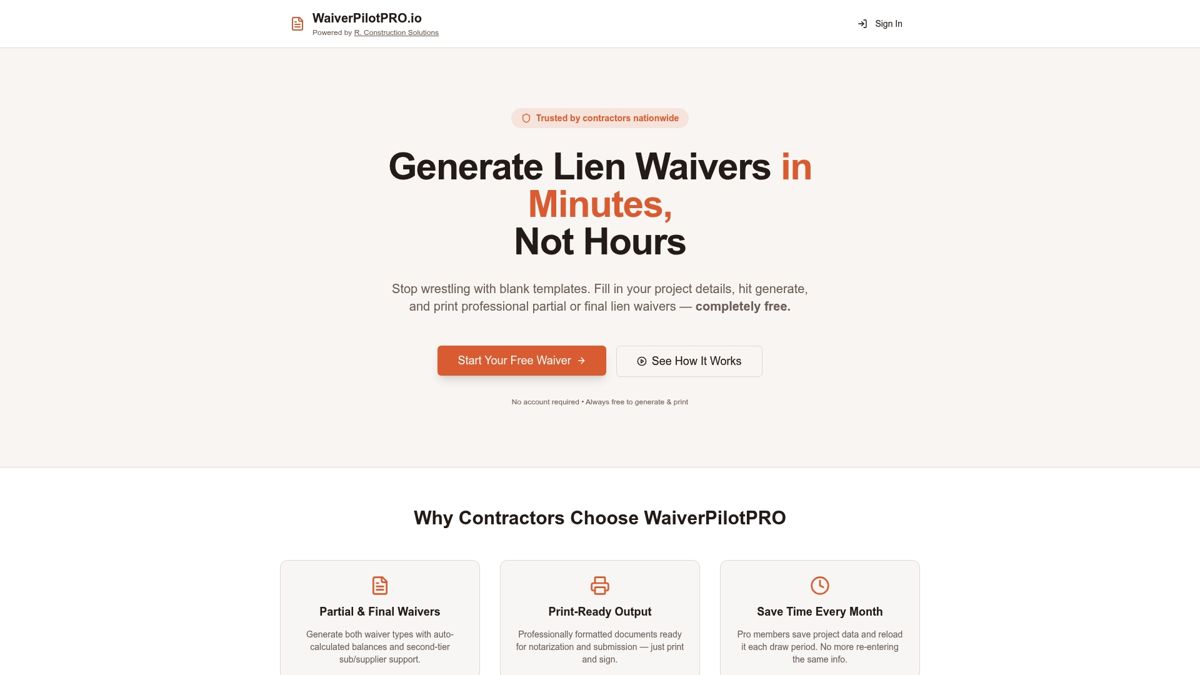
Waiverpilotpro integrates with Procore, QuickBooks, and other major construction management platforms, so your waiver amounts pull directly from your existing payment data. That connection eliminates the re-entry errors that cause invalid waivers and stalled draws. Subcontractors can sign without creating an account, which removes the friction that kills adoption. If you want to see how much time your team can recover each month, start with the free lien waiver generator and run your next draw cycle through it.
FAQ
What are the main waiver processing speed benefits for contractors?
Faster waiver processing cuts payment cycle times, reduces staff hours per draw cycle by up to 82%, and lowers DSO by as much as 37%. It also reduces lien exposure and carrying costs on active projects.
How does automation improve waiver turnaround time?
Automation replaces manual email follow-ups with scheduled reminders and escalation rules, reducing average waiver collection time from 6.2 days to 1.8 days. Systems that escalate overdue waivers to project managers within 48–72 hours prevent delays from compounding across draw cycles.
Why do waiver amount errors cause payment delays?
Subcontractors often bill gross amounts while checks are issued net of retainage, creating a mismatch that makes waivers invalid. Automating the amount match before document generation corrects this before it stalls your billing cycle.
Do I need to collect waivers from every subcontractor tier?
Yes. Collecting waivers from all tiers, not just the general contractor level, is the standard required for full lien risk protection. Missing a lower-tier subcontractor leaves your project exposed to mechanic’s liens even after the GC has signed.
What is the difference between conditional and unconditional lien waivers?
A conditional waiver takes effect only when payment clears, making it safe to sign before funds are confirmed. An unconditional waiver surrenders lien rights immediately upon signing, so it should only be used after payment is received and verified.