
Subcontractor Default Explained for General Contractors
A subcontractor default is the failure of a subcontractor to meet its contractual obligations on a construction project, and it ranks among the most costly disruptions a general contractor can face. The subcontractor default definition is not set by universal law. It is defined entirely by the language in your subcontract agreement. Common triggers include abandonment, insolvency, missed schedule milestones, and failure to pay sub-tier contractors or suppliers. The Associated General Contractors of America identifies subcontractor failure as one of the top causes of project failure, and replacement subcontractors brought in after a default often charge 15–30% above the original contract price. That cost premium alone makes understanding and managing subcontractor default risk a core skill for every general contractor and project manager.
What is a subcontractor default under your contract?
A subcontractor default occurs when a sub commits a material breach of the subcontract. The specific acts that constitute a breach depend entirely on how your contract is written. No two subcontracts define default the same way, which is why contract language is your first and most important line of defense.
Material breaches commonly defined in subcontracts include:
- Abandonment: The sub stops work without written notice or authorization.
- Insolvency: The sub files for bankruptcy or becomes unable to pay its debts.
- Schedule failure: The sub falls behind a milestone by a defined number of days.
- Unpaid sub-tiers: The sub fails to pay its own suppliers or lower-tier contractors.
- Safety violations: The sub repeatedly ignores site safety requirements.
- Defective work: The sub delivers work that fails to meet contract specifications.
Vague default clauses create serious legal exposure. A clause that says “failure to perform satisfactorily” is nearly impossible to enforce in court. A clause that says “failure to maintain a crew of at least eight workers for five consecutive working days” gives you a measurable, defensible standard.
Effective contract drafting includes “time is of the essence” provisions, which make every deadline legally binding, and step-in rights clauses, which allow you to take over a sub’s work directly without waiting for a formal termination process. Both provisions significantly strengthen your position when a default occurs.
Pro Tip: Review every subcontract for a specific, numbered cure period. If your contract says “reasonable time,” replace it with a defined window of 48–72 hours before your next project starts.
How should you respond when a subcontractor defaults?
Speed and precision define a legally sound default response. Delayed or vague action can invalidate your termination rights and leave you absorbing costs you could have recovered.
Follow these steps in order:
- Identify the breach. Confirm the specific contract clause the sub has violated. Do not act on general dissatisfaction.
- Issue a formal cure notice within 48–72 hours. The notice must cite the exact contract clause, describe the breach in measurable terms, and state the objective standard the sub must meet to cure it.
- Document everything immediately. Take time-stamped photos, maintain daily crew logs, and preserve delivery records. This evidence supports both termination and insurance claims.
- Monitor the cure period. Track whether the sub is making genuine progress. Log every observation.
- Decide on termination or continuation. If the sub fails to cure, you must choose between termination for cause and termination for convenience.
- Begin replacement procurement. Start sourcing a replacement sub as soon as the cure period expires without resolution.
Documentation such as time-stamped photos and daily crew logs is critical for proving default in any legal or insurance claims process. Without it, your position weakens significantly.
The distinction between termination types matters financially. Termination for cause allows you to recover excess re-procurement costs from the defaulting sub or its insurer. Termination for convenience requires you to pay the sub for all work performed to date, with no recovery of premium costs.

Pro Tip: Never issue a cure notice that says “fix poor performance.” Vague notices are legally inadequate and will not survive a legal challenge. Cite the specific clause number and the exact metric the sub must meet.
The table below summarizes the key differences between your two termination options:
| Factor | Termination for cause | Termination for convenience |
|---|---|---|
| Trigger requirement | Documented material breach | No breach required |
| Cost recovery | Excess re-procurement costs recoverable | Pay sub for all work performed |
| Documentation burden | High — must prove breach | Low |
| Legal risk if improperly used | High — can convert to convenience | Minimal |
What is Subcontractor Default Insurance and how does it compare to surety bonds?
Subcontractor Default Insurance, commonly called SDI, is a policy purchased by the general contractor that covers losses caused by a subcontractor’s failure to perform. It is not the same as a traditional surety bond, and the operational difference is significant.
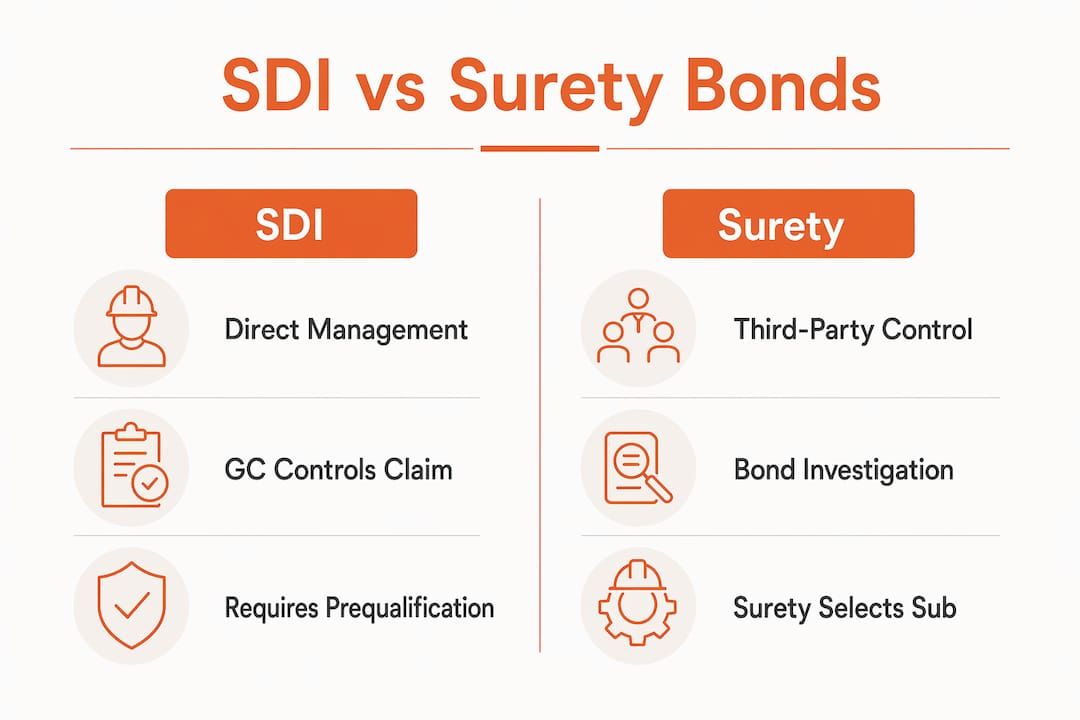
Under a traditional surety bond, a third-party surety company investigates the claim, selects the replacement sub, and manages the recovery process. That investigation can take weeks, stalling your project. SDI policies allow immediate project continuation after a default without the lengthy investigations typical of surety bond claims. You control the replacement process from day one.
SDI differs from surety bonds by requiring the GC’s active management. SDI policies typically carry a high deductible, meaning you absorb initial costs before the insurer reimburses you. That structure rewards GCs who prequalify subs carefully and respond to defaults quickly.
Key advantages of SDI:
- Speed: You select and mobilize a replacement sub without waiting for a third-party investigation.
- Control: You manage the claim submission and recovery process directly.
- Coverage scope: SDI can cover a broader range of subcontractors than individual surety bonds.
- Project continuity: Work resumes faster, reducing schedule impact.
SDI does have limitations. Underwriting requires GCs to demonstrate strong prequalification programs. Insurers review your sub selection process, financial thresholds, and historical default rates before issuing a policy. The high deductible model also means smaller GCs may find the upfront cost exposure difficult to absorb.
| Factor | SDI | Surety bond |
|---|---|---|
| Who manages the claim | General contractor | Third-party surety |
| Speed of response | Fast — GC acts immediately | Slower — investigation required |
| Deductible | High — GC absorbs initial costs | Typically none for GC |
| Sub prequalification required | Yes — insurer reviews GC’s program | Varies by bond type |
| Coverage flexibility | Broad — covers enrolled subs | Per-sub, per-project |
What strategies reduce subcontractor default risk?
Effective subcontractor default management starts at contract drafting, not after problems appear. The best time to protect your project is before the sub mobilizes.
Build these practices into your standard process:
- Prequalify every sub. Review financial statements, bonding capacity, and references before award. A sub that cannot bond a job is signaling financial stress.
- Write measurable performance metrics into the contract. Specify crew size minimums, milestone dates, and material delivery windows. Vague language protects no one.
- Include “time is of the essence” and step-in rights clauses. These give you legal authority to act fast when performance slips.
- Monitor sub-tier payment status. Prime contractors bear legal responsibility to oversee subcontractors and can be liable when they ignore early warning signs like unpaid suppliers or reduced crews.
- Enroll high-risk subs in your SDI program. Not every sub needs a bond, but specialty trades on critical-path work should be covered.
- Document baseline performance from day one. Start logging crew counts, deliveries, and progress photos before any problem appears. Early records make later claims far stronger.
Lien waiver management is also part of default risk control. When a sub stops paying its own suppliers, those suppliers can file mechanics liens against your project. Collecting conditional and final lien waivers at each payment milestone gives you documented proof that lower-tier claims have been resolved.
Pro Tip: Ask your sub for lien waivers from its major suppliers at every progress payment. If a supplier refuses to sign because it has not been paid, you have an early warning of a default in progress.
Key Takeaways
A subcontractor default is defined by your contract language, not by law, and your response speed and documentation quality determine whether you recover your costs.
| Point | Details |
|---|---|
| Default is contract-defined | No universal legal standard exists; your subcontract language sets every trigger. |
| Cure notices must be specific | Cite the exact clause and measurable cure standard within 48–72 hours of identifying the breach. |
| Documentation wins claims | Time-stamped photos, crew logs, and delivery records support both termination and insurance recovery. |
| SDI gives GCs more control | SDI lets you manage replacements directly, unlike surety bonds that rely on third-party investigation. |
| Prevention starts at drafting | Measurable performance metrics and step-in rights clauses reduce default risk before work begins. |
What I’ve learned about defaults that most GCs find out too late
The most common mistake I see general contractors make is treating a subcontractor’s site abandonment as automatic grounds for termination. They stop the sub, bring in a replacement, and then discover months later that they skipped a required cure notice step. That procedural gap can flip a termination for cause into a termination for convenience, wiping out any cost recovery.
The second mistake is issuing a cure notice that reads like a complaint letter. “Your performance has been unsatisfactory” is not a cure notice. It is an invitation for a legal dispute. A proper notice names the contract clause, states the specific deficiency in measurable terms, and sets a clear deadline. That level of specificity feels excessive until you are sitting across from an attorney who is arguing your notice was invalid.
Record-keeping is where most projects either win or lose a default claim. I have seen GCs with strong termination grounds lose recovery claims because their documentation was inconsistent or started too late. Daily logs, time-stamped photos, and written communications need to begin on day one of the project, not the day you suspect a problem.
The last thing worth saying: termination for cause is not always the right move. If a replacement sub will cost you 25% more and push your schedule by six weeks, a negotiated cure agreement with the original sub may cost less overall. Run the numbers before you pull the trigger on termination.
— Rowena
Lien waivers and subcontractor risk management with Waiverpilotpro
Managing subcontractor default risk does not stop at termination. Every payment you make to a sub creates potential lien exposure from that sub’s own suppliers and lower-tier workers. Collecting the right waiver at each payment stage is how you close that exposure.
Waiverpilotpro lets you generate both conditional and final lien waivers for free, with no account creation required. The platform integrates directly with Procore, Buildertrend, and JobTread, so your lien waiver workflow fits inside the project management tools you already use. Auto-calculated balances and multi-subcontractor support mean you spend less time on paperwork and more time managing your project. Use Waiverpilotpro to protect your payment chain at every milestone, from the first progress payment through final lien release.
FAQ
What is a subcontractor default in construction?
A subcontractor default is a material breach of the subcontract agreement, such as abandonment, insolvency, or schedule failure. The specific triggers are defined by your contract language, not by a universal legal standard.
How long do you have to issue a cure notice after a default?
General contractors should issue a formal cure notice within 48–72 hours of identifying the breach. Delays or vague notices can invalidate your termination rights and prevent cost recovery.
What is the difference between termination for cause and termination for convenience?
Termination for cause requires documented default procedures but allows you to recover excess re-procurement costs. Termination for convenience requires payment for all work performed and offers no cost recovery from the defaulting sub.
What causes subcontractor defaults most often?
The most common causes are cash flow problems leading to insolvency, failure to pay sub-tier suppliers, crew shortages, and schedule failures. Monitoring unpaid suppliers and reduced crew sizes gives you early warning before a formal default occurs.
Is Subcontractor Default Insurance better than a surety bond?
SDI gives the general contractor direct control over replacement and claims, allowing faster project continuation. Surety bonds involve third-party investigation that can delay recovery, but they typically require no high deductible from the GC.