
Auto-Calculated Waiver Balance Benefits for Contractors
Auto-calculated waiver balance benefits are defined as the efficiency, accuracy, and financial control gains that contractors and project managers achieve when lien waiver amounts are matched automatically to payment application values before any funds are released. In standard industry terms, this process is called automated lien waiver balance reconciliation. Manual draw packages carry a 3%–5% error rate that creates lien exposure and payment delays. Automation eliminates that risk by enforcing exact dollar matching, selecting the correct waiver type, and confirming a waiver is on file before a payment run proceeds. Waiverpilotpro builds these auto-calculated waiver balance benefits directly into its free lien waiver generation workflow, giving contractors a faster and more reliable path from pay application to payment release.
1. How auto-calculated waiver balances reduce errors and payment delays
Automated lien waiver balance reconciliation removes the single biggest source of draw errors: human data entry. When a project manager manually copies a dollar amount from a pay application into a waiver form, a transposition or rounding mistake can block payment for days and expose the project to lien risk.

Automated systems perform a three-way compliance check before any payment runs: the waiver must be on file, the waiver type must match the payment phase, and the dollar amount must match within a $0.01 tolerance. Any exception triggers a digital escalation rather than a manual chase email. That shift alone cuts the time your team spends tracking down missing documents.
The results are measurable. Contractors using automated waiver tracking report an 87% reduction in blocked payment runs lasting more than one day. That number reflects how much of the payment delay problem is caused by documentation errors rather than funding issues.
- Waiver on file confirmed before payment authorization
- Waiver type (conditional vs. unconditional) matched to payment status automatically
- Dollar amount verified within $0.01 of the pay application value
- Exceptions escalated digitally, not chased by email
Pro Tip: Set your automated system to flag any waiver where the amount differs from the pay application by even one cent. A $0.01 mismatch today can become a lien dispute tomorrow.
2. Time and cost savings from automated waiver balance management
The labor savings from automated waiver balance tracking are concrete and significant. Contractors report saving 8 hours per draw cycle per project when they replace manual tracking with automation. Across six active projects, that adds up to roughly 48 hours of administrative labor saved every month.
At a fully loaded administrative labor rate, those 48 hours translate to approximately $3,744 in monthly cost savings. Annualized, that figure approaches $45,000 per year for a mid-size general contractor running a consistent project load. That is money that was previously spent on data entry, follow-up calls, and correcting waiver errors.
Payment cycle acceleration adds another layer of financial benefit. Payment delays cost approximately $1,100 per day in carrying costs on a $10M project. Accelerating draws by four days saves over $44,000 per project year in carrying costs alone.
| Metric | Manual process | Automated process |
|---|---|---|
| Hours per draw cycle | 8+ hours | Near zero manual input |
| Monthly admin labor (6 projects) | 48+ hours | Minimal oversight only |
| Monthly cost savings | Baseline | ~$3,744 |
| Annual carrying cost savings | Baseline | $44,000+ |
| Payment cycle length | 8.3 days average | ~2.2 days average |
The payment cycle compression from 8.3 days to approximately 2.2 days is not a minor convenience. It changes your cash flow position on every single draw, every month, across every project.
3. What features enable effective auto-calculated waiver balance management
The core capability behind automatic waiver balance advantages is event-triggered request generation. When a pay application is submitted, the system generates the correct waiver request automatically, without a project manager manually initiating the process. That removes an entire step from the workflow.
State-specific template selection is equally important. Lien waiver requirements vary by state, and using the wrong form creates legal risk even when the dollar amount is correct. An automated system selects the right template based on project location, removing a decision that is easy to get wrong under deadline pressure.
- Automated waiver requests triggered by pay application submission
- State-specific templates selected without manual lookup
- Conditional and unconditional waiver types matched to payment phase automatically
- Digital signature workflows completed without subcontractor account creation
- Payment releases gated on verified waiver presence and amount match
Login-free mobile signing allows subcontractors to complete a waiver in under four minutes without creating an account. That removes the most common friction point in waiver collection: the subcontractor who delays signing because the process feels complicated.
Waiverpilotpro integrates with platforms like Procore to connect waiver generation directly to your existing pay application workflow. You can explore the Procore waiver integration to see how that connection works in practice.
Pro Tip: Use conditional waivers for progress payments and unconditional waivers only after funds clear. Automating this distinction prevents the most common waiver type error in construction finance.
4. How these benefits improve project financial control and risk management
Lien waivers are a financial control, not just paperwork. Waivers tied to pay applications create a direct link between work completed, payment authorized, and lien rights surrendered. When that link is automated and verified, your project’s financial position becomes predictable rather than reactive.
The risk reduction numbers are striking. Contractors who automate waiver tracking see lien filings drop from 4.1% to 1.2% of projects. That 71% reduction in lien exposure translates directly to lower legal costs, fewer bonding complications, and smoother project closeouts.
Treating lien waivers as integral to cash flow management rather than end-of-cycle paperwork improves financial predictability and reduces downstream payment risk. When waiver collection is automated and tied to payment events, the entire payment cycle becomes a closed loop rather than a series of manual handoffs that can break at any point.
Audit readiness is another underappreciated benefit of waiver balance tracking. When every waiver amount is matched to a pay application and stored digitally, your draw package is complete and verifiable at any point in the project. That matters when an owner, lender, or bonding company requests documentation on short notice.
Document automation in construction is a financial control that prevents hidden risks from manual email and spreadsheet workflows. The risk is not just that a waiver is missing. The risk is that you do not know it is missing until a lien is filed.
Key Takeaways
Auto-calculated waiver balance benefits deliver measurable financial control, time savings, and legal risk reduction for contractors who replace manual draw tracking with automated reconciliation.
| Point | Details |
|---|---|
| Error elimination | Automated three-way checks catch dollar mismatches within $0.01 before payment runs. |
| Labor savings | Contractors save 48 hours of administrative labor per month across six active projects. |
| Cost reduction | Monthly savings reach approximately $3,744, with annual carrying cost savings exceeding $44,000. |
| Lien risk reduction | Automated tracking cuts lien filings from 4.1% to 1.2% of projects, a 71% reduction. |
| Faster payments | Automated workflows compress payment cycles from 8.3 days to approximately 2.2 days. |
Why I think manual waiver tracking is a liability, not just an inefficiency
After years of watching construction finance teams operate, I have come to one firm conclusion: manual lien waiver tracking is not a process problem. It is a financial risk that most contractors are carrying without realizing it.
The standard argument against automation is that the current system works well enough. It does not. A 3%–5% error rate on draw packages means that on a 20-draw project, you will likely have at least one blocked payment run. That delay costs real money in carrying costs, and it strains subcontractor relationships that took years to build.
What I find most valuable about auto-calculated waiver balance management is not the time savings, though those are real. It is the shift in where your team’s attention goes. When the system handles matching and verification, your project managers focus on exceptions rather than routine tracking. That is a better use of skilled labor.
The integration angle also matters more than people expect. Connecting waiver generation to Procore or similar platforms means the waiver workflow runs parallel to the pay application process, not after it. That parallel structure is what compresses the payment cycle from days to hours. If you are managing waiver status on every project manually today, the adoption hurdle for automation is lower than you think. The tools exist, they work, and the ROI is documented.
— Rowena
Waiverpilotpro automates what manual tracking cannot
Waiverpilotpro generates conditional and unconditional lien waivers for free, with auto-calculated balances that match your pay application values exactly. No templates to build, no account required for subcontractors to sign, and no manual dollar entry that introduces errors.
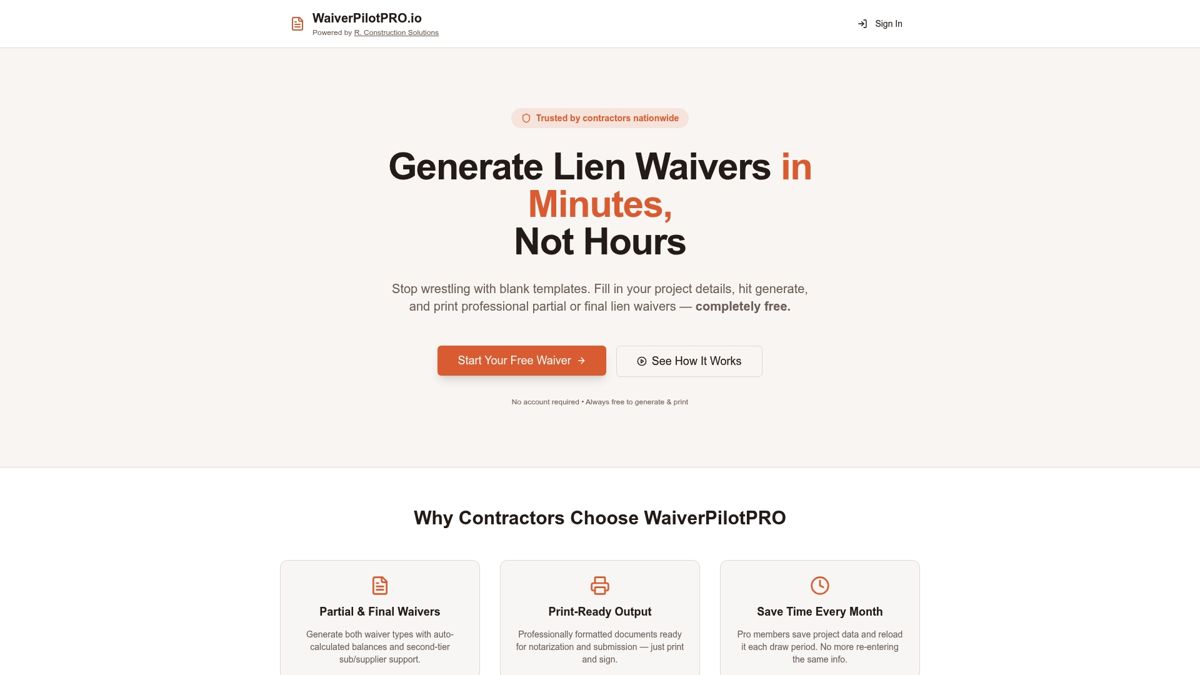
The platform supports state-specific waiver forms and integrates with Procore, QuickBooks, and other construction management tools your team already uses. Every waiver is notarizable and ready for submission. Use the free lien waiver generator to process your next draw with verified, auto-calculated balances and no administrative overhead.
FAQ
What is an auto-calculated waiver balance?
An auto-calculated waiver balance is the dollar amount on a lien waiver that is automatically matched to the corresponding pay application value, verified within a $0.01 tolerance, before a payment is authorized.
How much time does automated waiver balance tracking save?
Contractors save approximately 8 hours per draw cycle per project, adding up to 48 hours of administrative labor per month across six active projects.
Does automation reduce lien filing risk?
Automated waiver tracking reduces lien filings from 4.1% to 1.2% of projects, a 71% reduction, by ensuring every payment is tied to a verified waiver before funds are released.
What is the difference between conditional and unconditional waivers in automated systems?
A conditional waiver is used for progress payments before funds clear, while an unconditional waiver is used after payment is confirmed. Automated systems select the correct type based on payment status.
Do subcontractors need an account to sign waivers digitally?
Login-free mobile signing allows subcontractors to complete a lien waiver in under four minutes without creating an account, removing the most common delay in waiver collection.