
What Is a Subcontractor Agreement? A 2026 Guide
A subcontractor agreement is a legally binding contract that defines the scope, payment terms, schedule, and legal obligations between a general contractor and a subcontractor on a construction project. Every construction professional working with subcontractors needs one. Without it, you have no enforceable basis for payment disputes, scope changes, or liability claims. This guide breaks down what a subcontractor agreement must contain, how it intersects with labor law, and how tools like Waiverpilotpro help you manage the lien waiver side of the equation without the paperwork headache.
What are the key components of a subcontractor agreement?
A well-drafted subcontractor agreement legally establishes scope, payment, schedule, insurance, indemnification, lien waivers, warranty, and dispute resolution terms between the contractor and subcontractor. Each clause carries real legal weight. Miss one, and you expose your project to disputes, delays, or uninsured liability.
Here are the core components every subcontractor agreement must include:
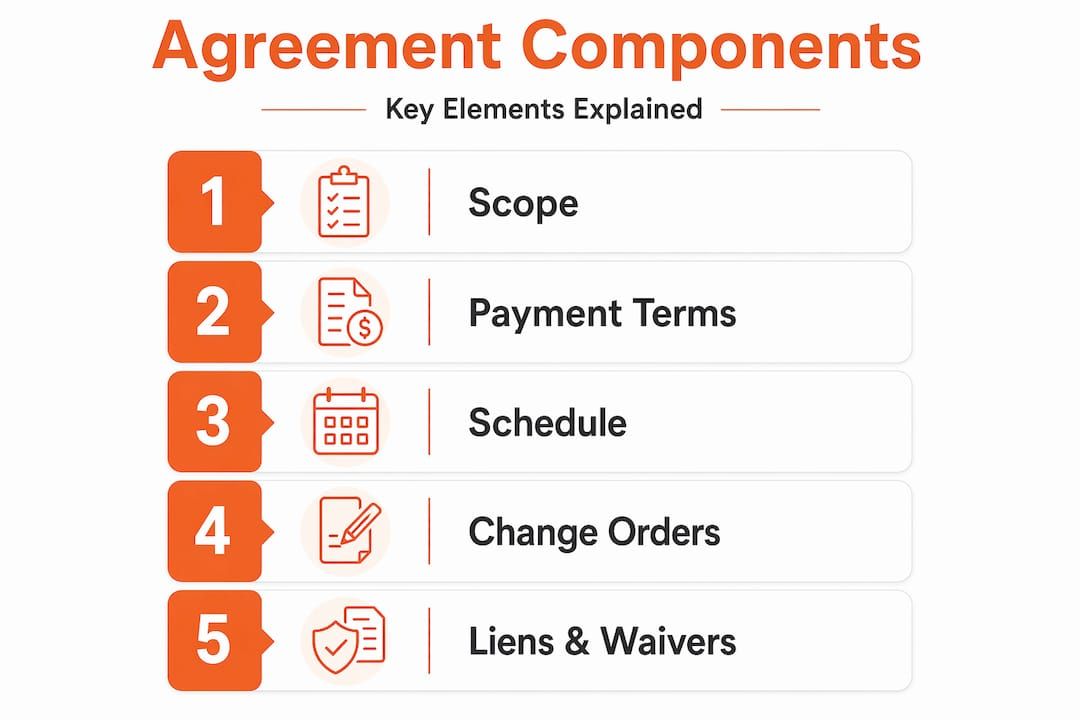
- Scope of work. Define exactly what the subcontractor will do, including any Exhibit attachments with drawings or specifications. Vague scope language is the single most common trigger for change order disputes.
- Payment terms and retainage. Specify the contract amount, payment schedule, and retainage percentage. Standard retainage runs at 10%, held until substantial completion.
- Schedule and milestones. Set start dates, completion deadlines, and key milestones. Tie payment releases to milestone completion where possible.
- Change order procedures. Require written, signed approval before any out-of-scope work begins. Verbal approvals are not enforceable under most standard agreements.
- Insurance and indemnification. Require the subcontractor to carry general liability and workers’ compensation insurance. Include “Additional Insured” status for the general contractor on the subcontractor’s policy.
- Lien waivers. Specify when conditional and unconditional lien waivers are required. Conditional waivers protect you before payment clears; unconditional waivers confirm full release after payment.
- Flow-down provisions. Bind the subcontractor to the same obligations the general contractor owes the project owner under the prime contract. This prevents gaps in accountability.
- Termination terms. Spell out grounds for termination for cause and for convenience, plus notice requirements and final payment procedures.
Pro Tip: Always attach the relevant sections of the prime contract as an exhibit to the subcontract. This makes flow-down obligations explicit and removes any argument that the subcontractor was unaware of owner requirements.
How do subcontractor agreements address worker classification?

Worker classification is one of the most legally consequential issues in construction contracting. The U.S. Department of Labor’s 2024 economic reality test uses six factors to determine whether a worker is an employee or a true independent contractor. Those factors focus on the degree of control the hiring party exercises, the worker’s opportunity for profit or loss, and whether the work is integral to the business’s core purpose.
Getting this wrong is expensive. Here is what you need to know to stay compliant:
- Execute the contract before work starts. Many states require a fully executed written subcontract within 30 days of the subcontractor beginning work. Failure to meet that deadline can trigger automatic misclassification penalties.
- Know your state’s test. Minnesota’s 14-factor misclassification test goes well beyond the federal standard. Penalties reach up to $10,000 per violation. Other states have similar frameworks.
- Match contract language to operational reality. A contract that calls someone an independent contractor means nothing if you control their hours, tools, and methods. Courts and regulators look at the actual working relationship, not just the document.
- Review classification annually. Labor law in this area is changing fast. The 2024 federal rule shifted the analysis, and state-level updates continue to follow.
Pro Tip: Have legal counsel review your subcontractor agreement template at least once a year. A $500 legal review is far cheaper than a $10,000 misclassification penalty per worker.
What are common pitfalls in drafting subcontractor agreements?
Most contract disputes in construction trace back to a small number of avoidable mistakes. Knowing what they are puts you ahead of the majority of contractors working from memory or outdated templates.
The verbal change order trap is the most common and most costly. Standard agreements invalidate verbal authorizations for change orders. If a subcontractor performs extra work based on a phone call and you later dispute the cost, you have no enforceable obligation to pay. Require a written, signed change order before any out-of-scope work begins. No exceptions.
Broad form indemnity clauses create a different kind of risk. These clauses can require a subcontractor to cover losses caused by the general contractor’s own negligence. Many states prohibit them outright, but they still appear in contracts. Subcontractors should negotiate limits on indemnification to avoid assuming liabilities that their insurance will not cover.
Poor alignment between the prime contract and the subcontract is a leading cause of disputes. Flow-down clauses are critical to enforce consistent obligations across the project. If your subcontract does not mirror the prime contract’s requirements for submittals, safety, or schedule, you carry the gap.
“Using industry-standard templates such as the AIA A401™ reduces drafting errors and accounts for common industry risks and legal precedents. A validated template gives you a legal foundation that a one-page handshake agreement never can.”
Dispute resolution clauses are often the last thing contractors think about and the first thing that matters when a payment conflict escalates. Binding arbitration resolves disputes faster and at lower cost than litigation in most cases. Specify the venue, the governing rules, and the timeline for initiating a claim.
How do lien waivers work within subcontractor agreements?
A lien waiver is a document in which a contractor or subcontractor waives their right to file a mechanics lien against the property in exchange for payment. Think of it as a receipt that also surrenders a powerful legal remedy. Getting the type and timing right protects both sides of the transaction.
The difference between conditional and unconditional waivers matters significantly. A conditional lien waiver takes effect only when the specified payment actually clears. An unconditional waiver releases lien rights immediately upon signing, regardless of whether the funds have been received. Signing an unconditional waiver before payment clears is one of the most common and damaging mistakes subcontractors make.
| Waiver type | When to use | Risk if misused |
|---|---|---|
| Conditional progress waiver | Before each progress payment | Low risk; rights preserved until payment clears |
| Unconditional progress waiver | After progress payment confirmed received | High risk if signed before funds clear |
| Conditional final waiver | Before final payment | Low risk; protects until full payment confirmed |
| Unconditional final waiver | After full payment received and cleared | Permanent release; no recovery if payment bounces |
Standard subcontractor agreements require conditional waivers before progress payments and unconditional waivers within 10 days of final payment. Retainage, typically held at 10%, releases alongside the final unconditional waiver. Tying waiver submission to your payment schedule in the subcontract removes ambiguity and keeps the payment process moving.
For a deeper breakdown of how these two waiver types differ in practice, the conditional vs. unconditional waiver guide from Waiverpilotpro covers the mechanics in plain English.
Key Takeaways
A subcontractor agreement is the legal foundation of every construction subcontracting relationship, and its strength depends entirely on the specificity of its clauses, the accuracy of its classification language, and the discipline with which both parties follow its payment and waiver procedures.
| Point | Details |
|---|---|
| Core components are non-negotiable | Every agreement needs scope, payment, schedule, insurance, lien waivers, and termination terms. |
| Classification compliance is time-sensitive | Execute written contracts within 30 days of work starting to avoid penalties up to $10,000 per violation. |
| Written change orders protect payment | Verbal approvals are unenforceable; always get signed written authorization before out-of-scope work begins. |
| Waiver timing determines payment security | Use conditional waivers before payment clears and unconditional waivers only after funds are confirmed received. |
| Templates reduce legal risk | Industry-standard forms like AIA A401™ provide a vetted legal foundation and reduce common drafting errors. |
Why I think most contractors underestimate their subcontract
After years of watching construction disputes unfold, the pattern is almost always the same. The contract existed. It just wasn’t specific enough to be useful when things went sideways.
Contractors tend to treat the subcontract as a formality, something to sign before the real work starts. That mindset is exactly what makes disputes expensive. The clauses you skip in drafting are the ones you desperately need in a payment fight. Flow-down provisions, dispute resolution timelines, and lien waiver schedules are not legal boilerplate. They are the operating manual for your project relationship.
The contractors I’ve seen manage projects cleanly share one habit: they treat the subcontract as a living document. They reference it during progress meetings, tie payment releases to its milestones, and require waivers on schedule without exception. That discipline alone prevents most disputes before they start.
My recommendation is simple. Start with a validated template like AIA A401™, have legal counsel review it once a year, and use a tool like Waiverpilotpro to handle the lien waiver side without adding administrative overhead. The agreement protects you. The waiver process proves you followed it.
— Rowena
Waiverpilotpro makes lien waiver compliance straightforward
Managing lien waivers is one of the most repetitive and error-prone parts of subcontractor payment administration. Waiverpilotpro removes that friction.
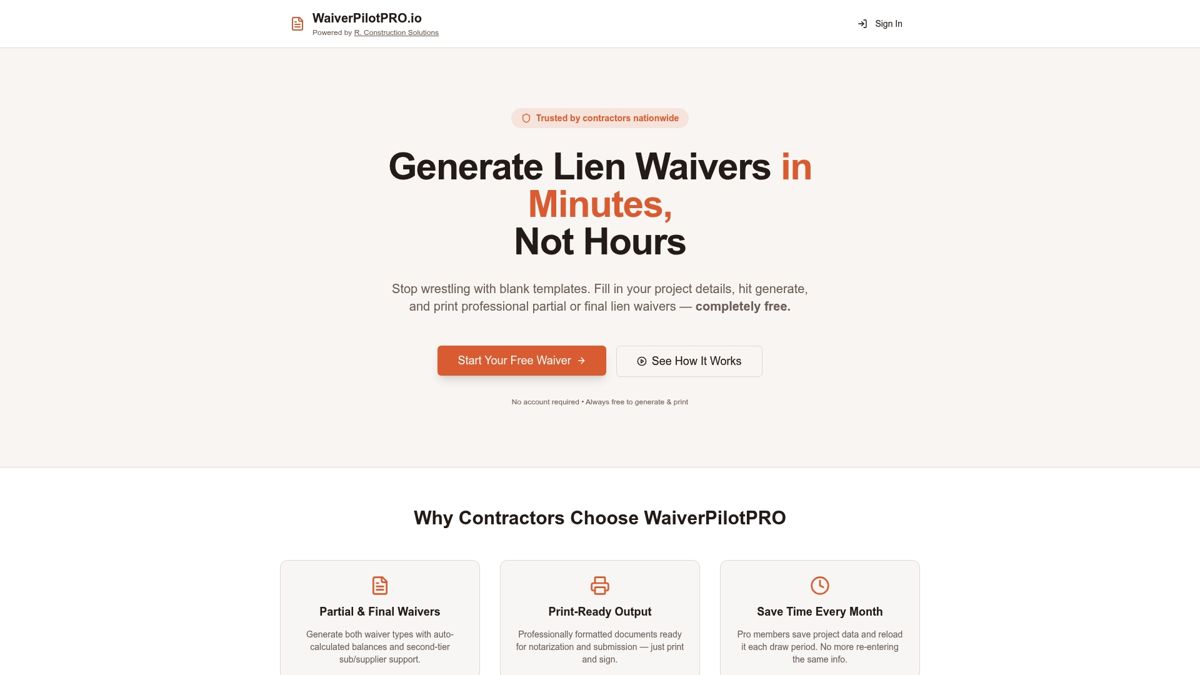
The platform lets you generate conditional and unconditional lien waivers for free, with auto-calculated balances and support for multiple subcontractors on a single project. It integrates with construction management tools including Procore and QuickBooks, so your waiver workflow fits inside the systems you already use. Documents come out notarization-ready and formatted to professional standards. Use the free lien waiver generator to produce the right waiver at the right time, every time, without building templates from scratch or creating an account first.
FAQ
What is a subcontractor agreement in construction?
A subcontractor agreement is a legally binding contract between a general contractor and a subcontractor that defines scope of work, payment terms, schedule, insurance requirements, and dispute resolution procedures. It protects both parties and establishes enforceable obligations for the entire project.
What should be in a subcontractor agreement?
Every subcontractor agreement should include scope of work, payment terms, retainage provisions, a change order process, insurance and indemnification clauses, lien waiver requirements, flow-down provisions, and termination terms. Missing any of these creates gaps that become costly in a dispute.
How does worker classification affect a subcontractor agreement?
The U.S. Department of Labor’s 2024 economic reality test determines whether a worker qualifies as an independent contractor or an employee, regardless of what the contract says. Contracts must be fully executed within 30 days of work starting in many states to avoid misclassification penalties.
Are verbal change orders valid in a subcontractor agreement?
Verbal change orders are not enforceable under most standard subcontractor agreements. Only written, signed change orders authorize out-of-scope work, and performing work without one risks nonpayment.
What is the difference between a conditional and unconditional lien waiver?
A conditional lien waiver takes effect only when the specified payment actually clears, while an unconditional waiver releases lien rights immediately upon signing. Always use conditional waivers before payment is confirmed to preserve your legal protections.