
What Is a 1099 Contractor in Construction?
A 1099 contractor in construction is an independent worker — typically a subcontractor — who is not your employee and receives payment reported on Form 1099-NEC rather than a W-2. You withhold nothing from their pay. They handle their own income taxes, self-employment taxes, and benefits. That single distinction drives every downstream decision about lien rights, payment documentation, and audit exposure.
Here’s what that means for your day-to-day workflows:
- No withholding. You pay the gross invoice amount; the contractor owns their tax obligations.
- 1099-NEC filing. You must report payments totaling the reportable threshold or more to any qualifying contractor during the tax year.
- W-9 before first payment. Collect a completed W-9 to get the contractor’s taxpayer identification number before any money changes hands.
- COI required. A certificate of insurance (COI) protects you if an uninsured sub gets hurt on your site.
- Lien waivers at every payment stage. Conditional waivers at progress payments, final waivers at project close.
Table of Contents
- What does the IRS actually look at to classify a construction worker?
- Why is construction high-risk for misclassification audits?
- How does classification affect lien rights and payment documentation?
- What documents should you collect for every 1099 engagement?
- What should you do if you think a worker might be misclassified?
- How do payment schedules and invoicing work for 1099 contractors?
- How do 1099 contractors handle their own tax filings?
- What insurance do 1099 contractors need in construction?
- Key Takeaways
- The paperwork is the protection
- Waiverpilotpro cuts the waiver admin down to minutes
- Useful sources
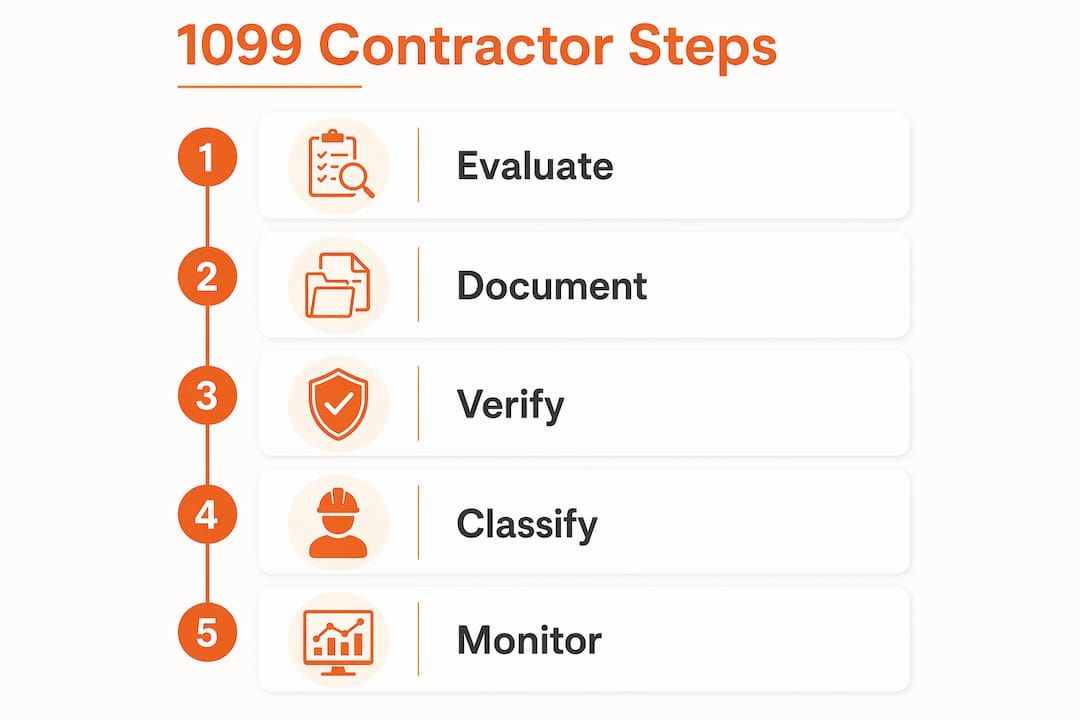
What does the IRS actually look at to classify a construction worker?
The IRS bases classification on the degree of control you have over how the work gets done, not just the result. Three categories of evidence determine status:
- Behavioral control. Do you set the worker’s schedule, dictate which tools to use, or direct how tasks are performed? A framing crew that shows up when you say, uses your nail guns, and follows your foreman’s daily instructions looks like an employee regardless of what the contract says.
- Financial control. Does the worker invest in their own equipment, carry risk of profit or loss, and work for multiple clients? A concrete sub who owns their own pump truck and bids multiple GCs simultaneously is a strong independent contractor indicator.
- Type of relationship. Is there a written agreement? Does the worker receive benefits like health insurance or paid time off? Has the relationship continued indefinitely on work that is central to your business?
A written contract that says “independent contractor” is not enough. The IRS gives greater weight to the actual economic reality of the relationship than to a label in a document. If the facts on the ground look like employment, the IRS will treat it that way.
State rules add another layer. Many states apply an ABC test, which is stricter than the federal common-law standard. Under a typical ABC test, a worker is presumed to be an employee unless the hiring firm proves all three conditions: the worker is free from control, performs work outside the company’s usual business, and is customarily engaged in an independent trade. Passing the IRS test does not guarantee you pass your state’s test.
Pro Tip: Evaluate every worker engagement individually. Document your reasoning in writing at the time of hire, not after an audit notice arrives.
Why is construction high-risk for misclassification audits?
Construction draws more misclassification enforcement attention than most industries. The combination of seasonal labor, multiple pay arrangements, and a heavy reliance on subcontractors creates conditions where the line between employee and independent contractor gets blurry fast.

EisnerAmper warns that blanket classification policies — treating everyone the same way because “that’s how we’ve always done it” — are a primary source of exposure. Each engagement must be assessed on its own facts.
Common audit triggers on construction jobsites:
- Missing or late W-9s, or paying workers in cash without documentation
- A workers’ comp claim filed by an uninsured subcontractor, which often triggers simultaneous DOL and IRS reviews
- Long-term subs who work exclusively for your company, use your equipment, and perform the same tasks as your W-2 employees
- Inconsistent treatment — paying two painters as employees and four as subcontractors doing identical work
Seasonal or temporary work alone does not make someone an independent contractor. A specialty sub whose work is integral to your project can be especially difficult to defend as outside your usual course of business.
How does classification affect lien rights and payment documentation?
Worker classification and mechanics lien rights are more connected than most contractors realize. A mechanics lien is a legal claim against a property that secures payment for labor or materials. If a worker you treated as a 1099 contractor is later reclassified as an employee, the lien and waiver documentation you collected may not reflect the actual legal relationship, creating exposure for both you and the property owner.
Practical rules for every pay application:
- Collect W-9 before first payment. No exceptions. The IRS requires you to keep W-9s on file for four years.
- Require a current COI. Verify the named insured, policy limits, and expiration date. An expired COI is the same as no COI.
- Use conditional vs. final waivers correctly. A conditional progress waiver releases lien rights only if the payment actually clears. A final unconditional waiver closes out all claims at project completion.
- Match invoices to waivers. Every invoice should correspond to a waiver for the same amount and payment period.
Pro Tip: Stage your payments so that a conditional waiver accompanies every progress payment request. This protects your cash flow and limits lien exposure without requiring you to release rights before funds are confirmed.
What documents should you collect for every 1099 engagement?
Good documentation is your first line of defense in an audit and your best protection against lien disputes. Collect and verify these before work begins, at each progress payment, and at final close.
| Document | Before First Payment | At Progress Payments | At Final Payment |
|---|---|---|---|
| Completed W-9 | Required | Verify on file | Confirm current |
| Subcontractor agreement | Required | N/A | N/A |
| Certificate of insurance (GL + WC) | Required | Verify not expired | Confirm active |
| Signed conditional lien waiver | N/A | Required | N/A |
| Invoice | N/A | Required | Required |
| Signed final (unconditional) waiver | N/A | N/A | Required |
| Business license / EIN verification | Required | N/A | N/A |
Keep W-9s for at least four years per IRS guidance. Retain contracts, COIs, and lien waivers for the duration of the applicable statute of limitations in your state, which is often three to six years for construction disputes. Annual re-verification of active COIs and business licenses is best practice, especially for subs you work with repeatedly.
What should you do if you think a worker might be misclassified?
Act before an audit notice arrives. If you suspect a borderline engagement, here is a practical triage sequence:
- Assemble all documentation: W-9, subcontractor agreement, COIs, invoices, and pay records for the worker in question.
- Flag workers who have been with you for more than a year, work exclusively for your company, or use your equipment and follow your supervisors’ daily direction.
- Do not stop payments unilaterally without legal advice; that can create its own liability.
- Consider filing Form SS-8 with the IRS to request an official determination of worker status. Note that a determination can take six months or more and does not retroactively protect you from penalties.
- Contact a labor attorney for state-level misclassification exposure and a licensed CPA for back-tax calculations, penalty estimates, and amended filings. These are different specialists for different problems.
Misclassification financial exposure can include back employment taxes, interest, penalties, unpaid workers’ compensation premiums, and unemployment insurance contributions. If tax liens result from unpaid employment taxes, resolving them requires a separate IRS process. Preserve all signed lien waivers and date-stamped invoices as evidence of the payment relationship.
How do payment schedules and invoicing work for 1099 contractors?
Most 1099 contractors in construction invoice on a schedule tied to project milestones: mobilization, rough-in, substantial completion, and final. Some work on a time-and-materials basis and invoice weekly or biweekly. Others bid fixed-price scopes and invoice at defined percentage completions.
Whatever the schedule, the invoice should itemize the work performed, reference the contract or purchase order number, state the payment period, and specify the amount due. A well-structured invoice makes it easier to match the corresponding lien waiver and reduces disputes at pay-app time. For a deeper look at how invoicing ties into cash flow, the subcontractor cash flow guide from Waiverpilotpro covers the mechanics in practical detail.
How do 1099 contractors handle their own tax filings?
As a 1099 contractor, you are self-employed. That means you owe both the employee and employer portions of Social Security and Medicare taxes, collectively called self-employment tax. You also owe federal income tax, and possibly state income tax, with no employer withholding to cover any of it.
The IRS expects you to pay estimated taxes quarterly, typically in April, June, September, and January. Missing those payments triggers underpayment penalties. Common deductible expenses for construction contractors include tools and equipment, vehicle mileage or actual vehicle costs, subcontractor payments you make to others, materials, home office space if used exclusively for business, and professional liability insurance premiums. Keep receipts and mileage logs throughout the year. A licensed CPA familiar with construction can identify deductions specific to your trade and help you avoid overpaying.
What insurance do 1099 contractors need in construction?
Insurance requirements for independent contractors in construction vary by state, project type, and contract terms, but two coverages come up on nearly every job.
General liability insurance covers property damage and bodily injury claims arising from your work. Most GCs require a minimum of $1 million per occurrence, and many commercial projects require $2 million. Your COI should name the GC or property owner as an additional insured.
Workers’ compensation is where things get complicated. If you have employees of your own, most states require you to carry workers’ comp for them. If you are a sole proprietor with no employees, some states exempt you, but others do not. A GC who hires an uninsured sub and that sub gets injured on site may be liable for the claim under the GC’s own workers’ comp policy, and that incident is one of the most common triggers for a misclassification audit. Verify your state’s requirements before signing any subcontract.
Key Takeaways
Treating every construction worker as an individual engagement, backed by complete documentation, is the single most reliable way to reduce both misclassification risk and lien exposure.
| Point | Details |
|---|---|
| Collect W-9 before payment | The IRS requires W-9s on file for four years; missing them is a primary audit trigger. |
| Use conditional waivers at progress payments | Conditional waivers protect lien rights until payment clears; switch to final waivers at project close. |
| Evaluate each worker individually | No blanket classifications; document your reasoning for each engagement at the time of hire. |
| Consult a CPA or labor attorney | A CPA handles back-tax exposure; a labor attorney handles state misclassification claims — different specialists. |
| Waiverpilotpro simplifies waiver admin | Waiverpilotpro generates conditional and final waivers for free, with integrations for Procore and QuickBooks. |
The paperwork is the protection
Most contractors I talk with understand the classification rules well enough. What trips them up is the gap between knowing the rules and actually running a consistent process across every sub on every project. A foreman onboards a new electrician on a Monday morning, the job is moving fast, and the W-9 gets pushed to “later.” Later becomes never. Then a workers’ comp claim comes in six months down the road, and suddenly you are reconstructing a paper trail that should have been built from day one.
The documentation checklist in this article is not bureaucratic overhead. It is the evidence that demonstrates an independent contractor relationship actually existed. Signed waivers, current COIs, project-scoped agreements, and matched invoices tell a coherent story. Missing any one of them leaves a gap that an auditor or opposing attorney will find.
The contractors who handle this best treat onboarding documentation the same way they treat safety protocols: non-optional, consistent, and completed before work starts. That discipline also makes lien waiver collection faster and less contentious at project close, because the paperwork habit is already built in.
Waiverpilotpro cuts the waiver admin down to minutes
Collecting, generating, and storing lien waivers for every 1099 sub on every project is one of the most time-consuming parts of payment administration. Waiverpilotpro removes that friction. You fill in the project details, and the platform generates professional-grade conditional and final waivers instantly, at no cost, with auto-calculated balances and support for multiple subcontractors on a single project.
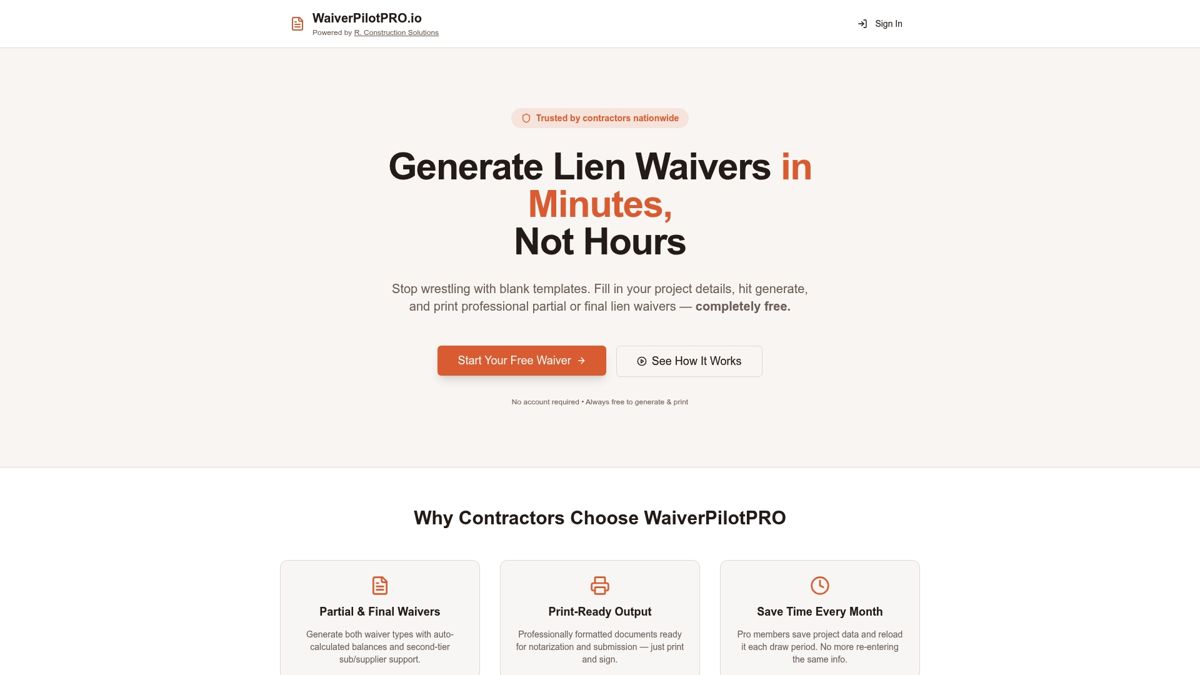
The documents are notarizable and ready for submission. Waiverpilotpro integrates with Procore and QuickBooks, so your waiver workflow connects directly to the project management and accounting tools you already use. You can also download free lien waiver templates in PDF, Word, and Excel formats to support the full documentation checklist covered in this article. Start generating waivers now at the free lien waiver generator and get your subcontractor documentation in order before the next pay app is due.
Useful sources
The following primary sources back the guidance in this article and are worth bookmarking for your own reference.
- IRS: Independent contractor defined — the foundational federal definition and the right-to-control standard.
- IRS: Independent contractor or employee? — the three-factor test (behavioral, financial, type of relationship) and Form SS-8 guidance.
- IRS: Reporting payments to independent contractors — Form 1099-NEC filing requirements and conditions.
- IRS: Forms and associated taxes for independent contractors — W-9 collection requirements and four-year retention rule.
- IRS training guide: Independent contractor vs. employee — detailed economic-reality analysis and written-contract weight.
- EisnerAmper: Independent contractor vs. employee in construction — construction-specific audit risk, ABC test issues, and recommended administrative controls.
- U.S. Department of Labor: Misclassification under the FLSA — federal wage-and-hour misclassification rules and the 2024 final rule.
- Waiverpilotpro: Free lien waiver generator — generate conditional and final waivers at no cost.
- Waiverpilotpro: What is a lien waiver? — plain-English guide to conditional vs. final waivers and how they interact with pay applications.
This article is general information, not legal or tax advice. Confirm current IRS rules, state classification standards, and insurance requirements with a licensed CPA or labor attorney for your specific situation.