
Lien Waiver Audit Trail Accounting: 2026 Best Practices
A lien waiver is defined as a legal document in which a contractor, subcontractor, or supplier surrenders their right to file a mechanics lien in exchange for payment. Think of it as a receipt that also gives up a powerful legal remedy. For construction accountants and project managers, lien waiver audit trail accounting refers to the systematic process of documenting every waiver request, collection, verification, and payment release in a traceable, time-stamped record. This discipline sits at the intersection of accounts payable, accounts receivable, and legal compliance. Failing to include a lien waiver with a pay application is treated as a red flag by general contractors, stalling payments regardless of work quality. Controllers and CPAs recognize lien waiver documentation as a core component for month-end financial reporting and accounts receivable aging reliability. The standard industry term for this discipline is lien waiver compliance tracking, and the best programs combine weekly reviews, monthly reconciliations, and 60-day closeout audits to stay audit-ready year-round.
What does an effective lien waiver audit trail system require?
An effective lien waiver audit trail system starts with three non-negotiable prerequisites: standardized project documentation, a complete subcontractor registration list, and an authorized signer registry. Without these foundations, even the best tracking software produces gaps that auditors and general contractors will flag. Your subcontractor registration list should capture legal entity names, license numbers, and contact details before the first pay application arrives.
The tools you select must support full audit trail capabilities, meaning every action leaves a time-stamped, immutable record. The table below summarizes the core components you need.

| Component | Purpose | Example |
|---|---|---|
| Tracking software | Centralize waiver requests and status | Waiverpilotpro, integrated platforms |
| Verification checklist | Confirm form type, signer, and amount | AIA G702/G703 review checklist |
| Escalation workflow | Automate reminders and payment holds | Day 3, 7, 14 escalation schedule |
| Document repository | Store executed waivers with metadata | Cloud-based, permission-controlled |
| AP/AR integration | Link waivers to payment release approvals | QuickBooks, Procore job cost sync |
Integration with your accounts payable and accounts receivable systems is not optional. Linking AP to AR through job cost structures and enforcing waiver collection at pay application submission directly reduces lien risk and improves cash flow predictability. Without that connection, waivers become a paper exercise disconnected from actual payment decisions.
Pro Tip: Validate signer authorization and form compliance before the project kicks off. Confirm that the person signing conditional waivers matches the authorized representative on file. Catching a mismatch at month one is far easier than correcting it at closeout.
Understanding the role of accounting in lien compliance helps your team see waiver tracking as a financial control, not just a paperwork task.
How does the lien waiver process work from pay app to payment release?
The lien waiver process begins the moment a subcontractor submits a pay application. That submission triggers an automatic conditional waiver request, which must be collected and verified before payment is approved. A conditional waiver is appropriate here because payment has not yet cleared. Once funds are confirmed, the conditional waiver converts to an unconditional waiver, which permanently releases the lien right for that payment period.
The most reliable systems follow a three-stage escalation schedule to handle missing waivers:
- Day 3: Send an automated reminder to the subcontractor that the conditional waiver is outstanding.
- Day 7: Escalate to the project manager, who contacts the subcontractor directly and documents the outreach.
- Day 14: Issue an AP payment hold notification, suspending payment until the waiver is received and verified.
This three-stage escalation is a recognized best practice that keeps your audit trail consistent and your team accountable at every step.
Verification at each stage covers four checks. First, confirm the form type matches the payment stage: conditional for pending payment, unconditional for cleared funds. Second, verify the signer against your authorized signer registry. Third, reconcile the waiver amount against the approved pay application amount. Fourth, confirm the project identification number and contract reference match your records. Any discrepancy stops the payment release.
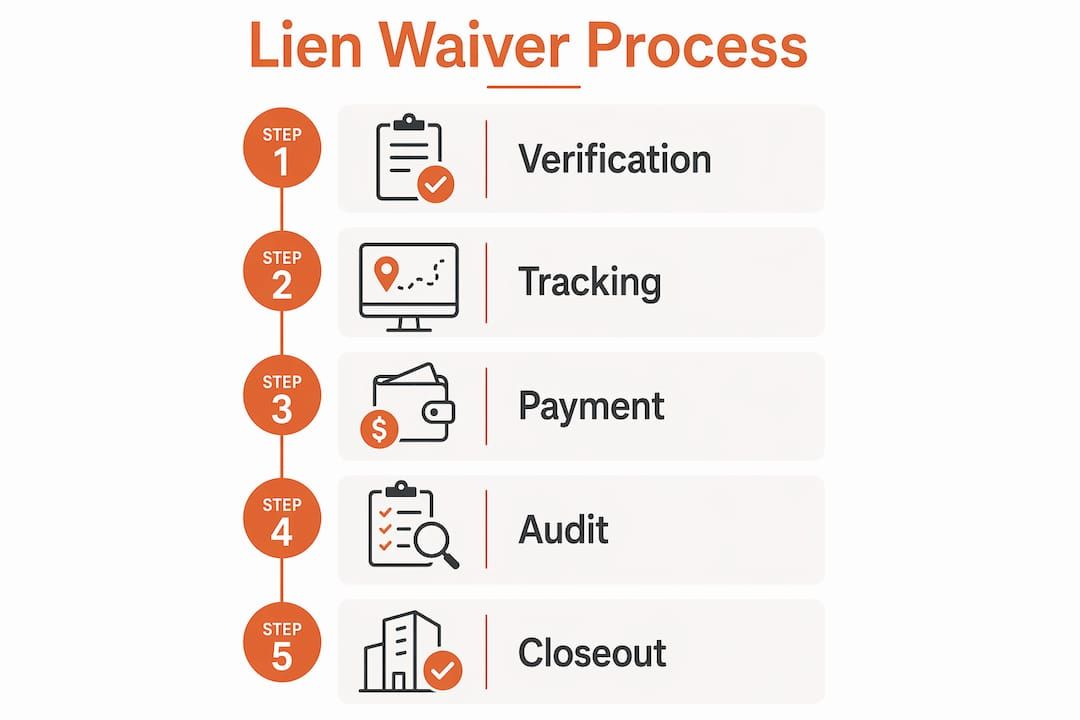
Linking waivers directly to payment processing is the control that prevents releases without clearance. Automated tracking software reduces manual accounts receivable tasks by 70% and cuts Days Sales Outstanding by an average of 37%. That efficiency gain comes directly from removing the manual handoff between waiver collection and payment approval.
Pro Tip: When a waiver is missing at day 14, do not simply hold payment and wait. Document the hold in your AP system with a timestamped note, notify the controller, and log the subcontractor’s response or non-response. That paper trail protects you if a dispute arises later.
Project managers tracking waiver status on every project are the first line of defense against gaps that become legal problems at closeout.
How do monthly reconciliations and closeout audits protect your books?
Monthly lien waiver reconciliation is the accounting equivalent of a bank statement review. Reconciliation takes 2–4 hours per month for firms managing 5–10 active projects. That time investment is modest compared to the cost of a disputed lien or a failed audit.
Your monthly reconciliation should check five things:
- Waiver completeness: Every pay application in the period has a corresponding executed waiver on file.
- Amount tolerance: Waiver amounts match approved pay application amounts within your firm’s accepted variance.
- Document expiration: Conditional waivers older than 30 days without a corresponding unconditional waiver are flagged for follow-up.
- Subcontractor registration: Any new subcontractor added during the month is registered with verified signer information.
- AP/AR alignment: Payment records in your accounting system match the waiver log with no orphaned entries on either side.
Closeout audits require a different level of scrutiny. Conducting a waiver audit 60 days before substantial completion gives your team time to resolve gaps before they require legal intervention. Post-closeout gap resolution often involves attorneys, stop-payment orders, and project delays that cost far more than the original waiver collection effort.
The table below compares monthly and closeout audit criteria side by side.
| Criteria | Monthly audit | Closeout audit |
|---|---|---|
| Waiver completeness | All pay periods current month | All pay periods full project life |
| Waiver type check | Conditional vs. unconditional | Final unconditional for all parties |
| Signer authorization | Spot-check new subs | Verify every signer on record |
| Amount reconciliation | Current period amounts | Cumulative contract amounts |
| Expired documents | Flag and follow up | Resolve or obtain replacements |
| Timing | Monthly, ongoing | 60 days before substantial completion |
Common findings during closeout audits include conditional waivers that were never converted to unconditional status, waivers signed by individuals no longer authorized, and amounts that do not match final change order totals. Each finding requires a documented remediation step logged in your audit trail.
What are the most common lien waiver audit trail challenges?
The single biggest failure in lien waiver management is a disconnect between waiver collection and payment processing. When AR collects waivers and AP releases payments without a shared system, waivers get filed but payments go out anyway. That gap creates ambiguity that is nearly impossible to resolve in a dispute without an immutable audit trail.
“Immutable, timestamped audit trails documenting waiver generation, transmission, and payment confirmation are the only reliable way to resolve disputes and enforce compliance. Without them, you are arguing from memory against a party with documentation.”
Other common challenges include:
- Missing waivers: Subcontractors submit pay applications without waivers, and no escalation protocol exists to catch the gap before payment.
- Improperly executed waivers: Wrong form type, missing notarization in states that require it, or unauthorized signers invalidate the document.
- Lost joint checks: Lost or misendorsed joint checks require a stop payment, full documentation of the reissue, and a suspension of further payments until all waivers and payment records align.
- Siloed teams: Project managers, AR, AP, and controllers each hold pieces of the waiver record but never consolidate them into a single audit trail.
The best practices that prevent these errors are straightforward:
- Enforce a policy that no payment is released without a verified waiver on file.
- Use software that creates a time-stamped log for every waiver action: request, receipt, verification, and payment release.
- Train project managers, AR staff, AP staff, and controllers together so every role understands its part in the workflow.
- Audit your waiver policy annually and update it when contract structures or subcontractor rosters change.
Construction payment disputes almost always trace back to a broken link in the waiver chain. Fixing the process before a dispute is always cheaper than fixing it after.
Key Takeaways
A reliable lien waiver audit trail accounting system requires integrated workflows, automated escalation, and monthly reconciliation to prevent payment disputes and pass financial audits.
| Point | Details |
|---|---|
| Start with prerequisites | Register all subcontractors and authorized signers before the first pay application arrives. |
| Automate escalation | Use a day 3, 7, and 14 escalation schedule to collect missing waivers before payment holds are needed. |
| Reconcile monthly | Spend 2–4 hours each month verifying waiver completeness, amounts, and AP/AR alignment. |
| Audit 60 days before closeout | Resolve conditional waiver gaps before substantial completion to avoid legal intervention. |
| Integrate AP and AR | Link waiver collection directly to payment release so no funds move without a verified waiver on file. |
Why I stopped treating lien waivers as a paperwork afterthought
After years of working with construction accounting teams, the pattern I see most often is this: the waiver process works fine until it doesn’t, and when it breaks, it breaks at the worst possible moment. Closeout. Audit. Dispute.
The teams that avoid those crises share one habit. They treat waiver collection as a payment control, not a documentation task. The moment you connect waiver status to payment approval in your accounting system, the entire team’s behavior changes. Project managers follow up faster. AR stops releasing invoices without clearance. AP stops approving payments without a verified waiver in the queue.
What I have also learned is that early automation adoption pays off faster than most controllers expect. The manual effort of chasing waivers, logging follow-ups, and reconciling amounts by hand is where errors accumulate. Automation does not just save time. It creates the consistent, time-stamped record that makes audits and disputes manageable.
The hardest part is not the technology. It is getting every role in the room at the same time to agree on the workflow. Run that training session before the project starts, not after the first missed waiver. Consistency in documentation is a team habit, and habits are built at the beginning of a project, not the end.
— Rowena
How Waiverpilotpro makes audit-ready waiver management practical
Waiverpilotpro is built for exactly the workflow described in this guide. It generates both conditional and unconditional lien waivers for free, with auto-calculated balances that eliminate manual math errors. The platform integrates with Procore, QuickBooks, and other construction management tools, so your waiver records stay connected to your payment data from day one.
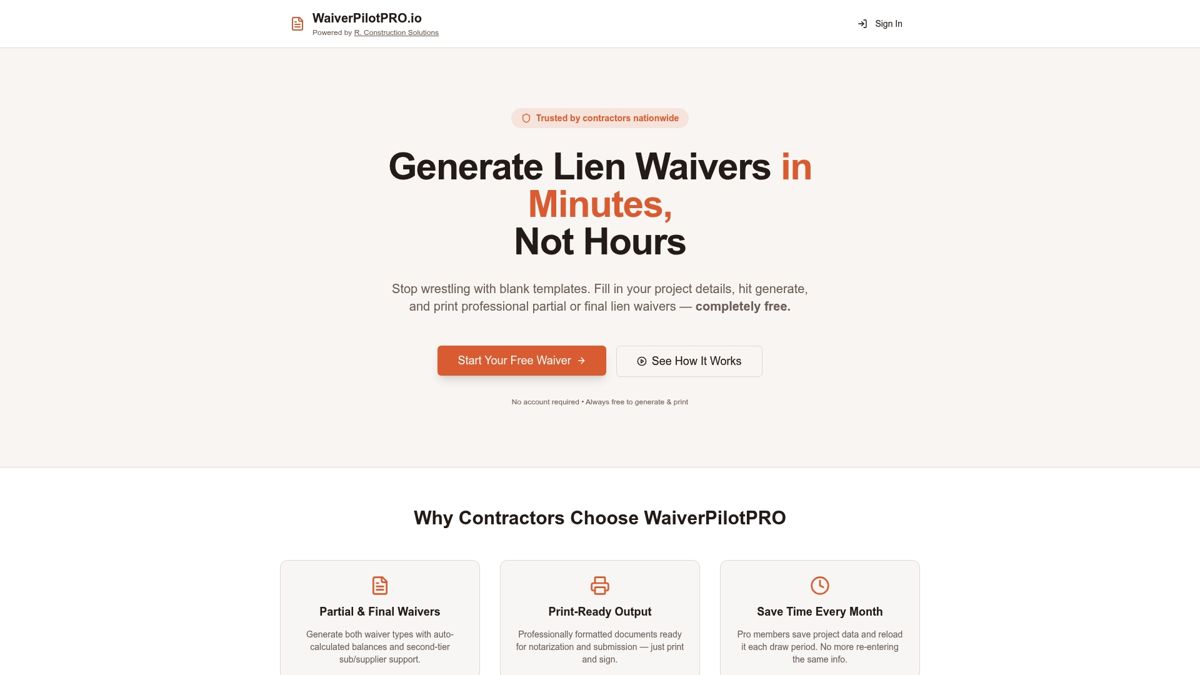
Every waiver generated through Waiverpilotpro produces a professional, notarizable document ready for submission. Multi-subcontractor support means you can manage an entire project roster without switching tools or rebuilding templates. If you want to see how fast compliant waiver generation can be, try the free lien waiver generator and have your first audit-ready document ready in minutes. You can also explore the full platform at Waiverpilotpro to see how it fits your existing accounting workflow.
FAQ
What is a lien waiver in construction accounting?
A lien waiver is a document in which a contractor or subcontractor gives up their right to file a mechanics lien in exchange for payment. In accounting, it serves as proof that payment obligations for a specific period have been satisfied.
What is the difference between a conditional and unconditional lien waiver?
A conditional waiver takes effect only when payment clears, making it appropriate at the time of pay application. An unconditional waiver takes effect immediately upon signing and is used only after payment is confirmed.
How often should you reconcile lien waivers for accounting accuracy?
Monthly reconciliation is the standard best practice, requiring 2–4 hours for firms with 5–10 active projects. A full closeout audit should also be completed 60 days before substantial completion.
What happens if a lien waiver is missing from a pay application?
A missing lien waiver is treated as a red flag by general contractors and typically stalls payment regardless of the quality of work completed. It also creates a gap in your audit trail that can complicate disputes and month-end financial reporting.
How does automation improve lien waiver audit trails?
Automated tracking reduces manual accounts receivable tasks by 70% and cuts Days Sales Outstanding by an average of 37%. It also creates the consistent, time-stamped records that make audits and payment disputes far easier to resolve.