
Single-Project Waiver Best Practices for Contractors
A lien waiver is a receipt that also surrenders a powerful legal remedy. On any single project, how you handle these documents determines whether you get paid cleanly or spend months fighting liens. Single-project waiver best practices center on one rule: use conditional waivers when requesting payment and unconditional waivers only after payment clears. Get that timing wrong, and you can permanently lose your right to file a mechanics lien. This guide covers the waiver types, common mistakes, automation tools, and record-keeping policies that keep your projects protected.
1. What are the essential types of lien waivers and when to use them?
The four main lien waiver types define your legal exposure at every payment milestone. Understanding each one is the foundation of effective waiver management on any project.
Conditional progress waiver. You sign this when submitting a payment application for work completed so far. It only takes effect once payment actually arrives in your account. Your lien rights stay intact until the money clears.

Unconditional progress waiver. This waiver releases your lien rights immediately upon signing, regardless of whether payment has arrived. Signing an unconditional waiver before payment clears is one of the most costly errors in construction. According to AIA Contract Documents guidance, doing so can cause a permanent, unrecoverable loss of lien rights.
Conditional final waiver. Use this when submitting your final payment application. It releases all remaining lien rights once the final payment is received. It protects you through the last dollar of the contract.
Unconditional final waiver. This closes out all lien rights permanently. Sign it only after your final check has cleared the bank, not before.
The difference between conditional and unconditional waivers is not a technicality. It is the line between having legal protection and giving it away for free.
- Use conditional waivers at every payment application submission.
- Switch to unconditional waivers only after confirmed payment receipt.
- Match the waiver type to the payment stage: progress or final.
- Check your state’s rules. Approximately a dozen states require specific statutory forms, and using the wrong form voids enforceability entirely.
Pro Tip: Never sign a waiver in advance and hold it for later delivery. Courts in many states treat the signing date, not the delivery date, as the effective date.
2. How automation improves single-project waiver management
Manual waiver tracking through spreadsheets and email chains is the single biggest source of delays and missed documentation on construction projects. Manual tracking creates a 3 to 5 day scramble at every payment run. That scramble costs you time and increases the risk of releasing payment before all waivers are collected.
Automation solves this by connecting waiver requests directly to your payment application workflow. When a pay app is submitted, the system automatically sends the correct waiver form to the right party. No manual follow-up required.
The measurable impact is significant. Automated waiver platforms reduce month-end collection times from a full week down to 1–2 days by sending bulk reminders and tracking signature status in real time. That compression frees up your project managers for actual project work.
Key automation capabilities worth building into your process:
- State-specific form selection. The system pulls the correct statutory form for your project’s state automatically.
- Electronic signature integration. Parties sign digitally, eliminating printing, scanning, and mailing delays.
- Digital notarization. Three states require notarization for lien waivers. Digital notarization removes that bottleneck entirely.
- Real-time status tracking. You see at a glance which waivers are signed, pending, or overdue across every tier of your subcontractor chain.
- Escalation alerts. Overdue waivers trigger automatic reminders to the responsible party without you lifting a finger.
Waiverpilotpro integrates with construction management platforms including Procore and QuickBooks, so your waiver workflow connects directly to your existing project data. The Procore lien waiver integration means you generate and track waivers without switching between systems.
3. What are the most common waiver mistakes and how to avoid them?
Most lien waiver problems come from a small set of repeatable errors. Knowing them in advance is the fastest way to protect your projects.
1. Signing unconditional waivers before payment clears. This is the most dangerous mistake in waiver management. The AIA golden rule is clear: collect conditional waivers at payment application and unconditional waivers only after payment is confirmed. Reversing that order surrenders your lien rights with no recourse.
2. Mismatched dollar amounts. Collecting a waiver for less than the actual payment amount leaves the difference unreleased and exposed to liens. Every waiver must match the exact payment amount to the dollar. Double-check figures before signing or requesting signatures.
3. Using outdated state forms. State statutory forms change, and a waiver that was valid two years ago may be unenforceable today. California, Texas, Florida, Georgia, and Michigan all have mandatory forms. Using a generic template in these states can invalidate the entire waiver.
4. Skipping lower-tier subcontractors and suppliers. General contractors often collect waivers from their direct subs but forget tier-2 subs and material suppliers. Lower-tier parties can file liens even when the GC has a waiver from the prime sub. Every party with lien rights needs to be tracked.
5. Delaying waiver collection until payment is already released. Releasing payment before collecting waivers removes your leverage entirely. Build waiver collection into your payment approval process as a required step, not an afterthought.
Pro Tip: Create a waiver checklist tied to your pay app approval workflow. No waiver, no payment approval. That single policy eliminates most collection delays.
4. What standardized policies improve waiver efficiency and legal protection?
A consistent company-wide waiver policy removes guesswork from every project. Without one, each project manager handles waivers differently, and that inconsistency creates gaps.
Start by defining your collection trigger. Waivers should be requested at the same point in every payment cycle, tied to pay app submission. That consistency makes it easy to audit compliance across all active projects.
Centralize your document storage. Waivers, payment records, and correspondence should live in one place, accessible to your whole team. Scattered files in personal email inboxes are a liability when a dispute arises. Construction management software with built-in document storage solves this directly.
- Set a company standard for which waiver type applies at each payment stage.
- Require waiver collection from all tiers, not just prime subcontractors.
- Review your state’s statutory form requirements at least once per year.
- Store executed waivers alongside the corresponding payment records for easy cross-reference.
- Assign one person per project as the waiver tracking owner to prevent gaps.
Regular process audits matter too. Review your waiver collection rate quarterly. If waivers are consistently late or missing from certain subcontractors, address it contractually before the next project starts.
5. How to select and use lien waiver templates effectively
The template you use is as important as the timing of the waiver. A well-drafted waiver on the wrong form is unenforceable in states with mandatory statutory requirements.
AIA forms G901, G902, G903, and G904 are the recognized standard templates covering all four waiver types. They are widely accepted, legally reviewed, and designed to minimize ambiguity. For projects in states without mandatory forms, AIA templates are the safest starting point.
For states with mandatory forms, use only the state-approved version. California’s statutory waiver forms, for example, are set by Civil Code and cannot be substituted. Using a modified or generic form in California voids the waiver. The same applies to Texas, Florida, Georgia, and Michigan, among others.
| Situation | Recommended template |
|---|---|
| State with no mandatory form | AIA G901–G904 series |
| State with mandatory statutory form | State-issued form only |
| Progress payment, payment not yet received | Conditional progress waiver |
| Final payment, payment not yet received | Conditional final waiver |
| Any payment after funds confirmed | Unconditional version of the applicable type |
Avoid waiver language that releases claims beyond the specific payment amount. Overly broad waivers can inadvertently release rights to future payments or disputed amounts. If you are unsure about the language in a waiver you have been asked to sign, a construction attorney can review it quickly and inexpensively.
Waiverpilotpro provides free lien waiver templates in PDF and Word formats, including state-specific versions, so you always start with the right form for your project’s jurisdiction.
Key Takeaways
The most effective approach to single-project waiver management is pairing correct waiver timing with automated collection and state-specific forms to protect lien rights at every payment stage.
| Point | Details |
|---|---|
| Conditional before unconditional | Always collect conditional waivers at pay app submission and unconditional waivers only after payment clears. |
| Dollar amounts must match exactly | Waiver amounts must equal the payment amount to the dollar or lien exposure remains. |
| State forms are mandatory in many states | About a dozen states require specific statutory forms; using the wrong form voids enforceability. |
| Track all tiers, not just prime subs | Lower-tier subcontractors and suppliers retain lien rights if their waivers are not collected. |
| Automation compresses collection time | Automated platforms cut month-end waiver collection from a week down to 1–2 days. |
Why I think most contractors underestimate the waiver timing problem
After working closely with construction payment workflows, the pattern I see most often is not ignorance of the rules. Contractors generally know they should use conditional waivers first. The problem is execution under deadline pressure. When a payment run is coming and a subcontractor is slow to respond, the temptation is to accept whatever waiver is available and sort it out later. That shortcut is where lien rights quietly disappear.
The other thing I have noticed is that lower-tier tracking gets treated as someone else’s problem. A GC collects waivers from their direct subs and considers the job done. But the material supplier three tiers down has the same lien rights as anyone else, and they are the ones most likely to be underpaid and motivated to file. Ignoring that tier is not a minor oversight. It is a real financial exposure.
Automation does not just save time. It removes the human judgment calls that create these gaps. When the system sends the right form to the right party at the right time, the pressure-driven shortcuts disappear. That is the actual value of building a proper waiver workflow, not efficiency for its own sake, but the removal of the conditions that cause mistakes.
The contractors who handle this best treat waiver collection as a payment condition, not a paperwork formality. That mindset shift is worth more than any single tool or template.
— Rowena
Waiverpilotpro makes waiver management straightforward
Managing lien waivers on a single project does not need to be a manual, error-prone process. Waiverpilotpro gives contractors a free, fast way to generate both conditional and unconditional waivers with auto-calculated balances and state-specific forms built in.
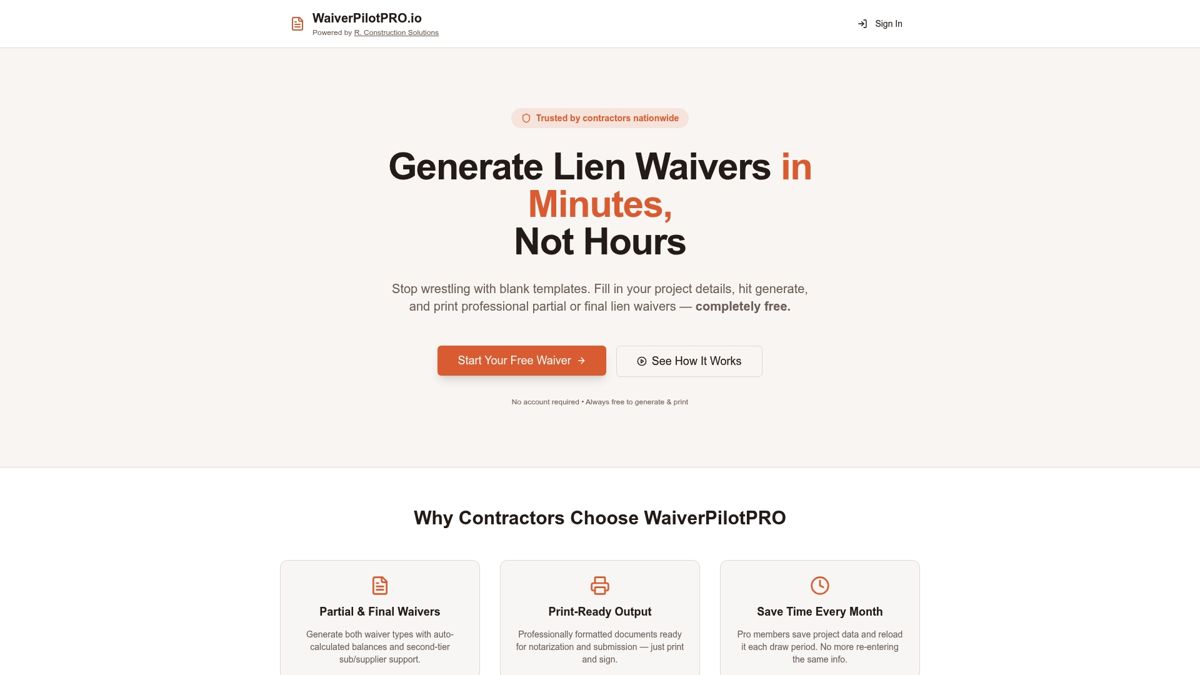
The platform supports multi-subcontractor projects and integrates with Procore, QuickBooks, and other construction management tools your team already uses. Documents come out professional-grade and notarizable, ready for immediate submission. You fill in the project details, and Waiverpilotpro handles the rest. Use the free lien waiver generator to create your first waiver in minutes, with no account required.
FAQ
What is the golden rule for lien waiver timing?
Collect conditional waivers when submitting a payment application and switch to unconditional waivers only after payment has cleared. AIA guidance identifies reversing this order as the most critical lien waiver error a contractor can make.
Which states require specific statutory lien waiver forms?
Approximately a dozen states, including California, Texas, Florida, Georgia, and Michigan, require state-mandated forms. Using a generic or outdated form in these states makes the waiver unenforceable.
What happens if the waiver amount does not match the payment?
The unreleased portion remains exposed to liens. Every waiver must match the exact payment amount; any shortfall leaves that dollar amount unprotected.
Do lien waivers need to be notarized?
Three states require notarization for lien waivers to be valid. For all other states, notarization is not required, though some owners request it. Check your state’s notarization rules before signing.
How do I track waivers from lower-tier subcontractors?
Build a waiver requirement into your subcontract that covers all tiers. Use a tracking system, whether software-based or a structured spreadsheet, that logs every party with lien rights and their waiver status at each payment cycle.