
Simplify Your Construction Payment Waiver Process
A lien waiver is a receipt that also surrenders a powerful legal remedy. When you sign one, you give up your right to file a mechanics lien against a property in exchange for payment. The construction payment waiver process becomes a serious liability when it runs on spreadsheets, email chains, and memory. Firms that make waiver submission mandatory for every pay application cycle report 91% fewer lien disputes than those without such policies. That number alone makes the case for building a structured, automated waiver workflow before your next project kicks off.
How to streamline the construction payment waiver process
Efficient waiver processing starts before the first pay application goes out. You need three things in place: the right documents, the right integrations, and clearly defined roles for every stakeholder.
Documentation and data you need first
Before generating a single waiver, gather the following:
- Signed subcontract and supplier agreements with authorized signatory names confirmed in writing
- Lower-tier subcontractor and supplier lists for every tier of the project, not just your direct subs
- Project payment schedule tied to AIA G702 and G703 pay application milestones
- State-specific statutory forms where required. 12 US states mandate specific statutory lien waiver forms, and using the wrong form makes the waiver unenforceable
Missing any of these at the start creates bottlenecks that compound through every pay period.
Manual vs. automated waiver tools

| Feature | Manual process | Automated workflow |
|---|---|---|
| Waiver generation time | 30–90 minutes per pay period | Under 5 minutes |
| PM follow-up time weekly | 8–12 hours | Under 30 minutes |
| Collection rate | 60–80% | 95–100% |
| Audit trail | Inconsistent | Automatic and timestamped |
| State form compliance | Manual selection | Auto-selected by state |
Automation systems reduce PM waiver follow-up time from 8–12 hours to under 30 minutes weekly. That time savings alone pay for most platforms within the first month.
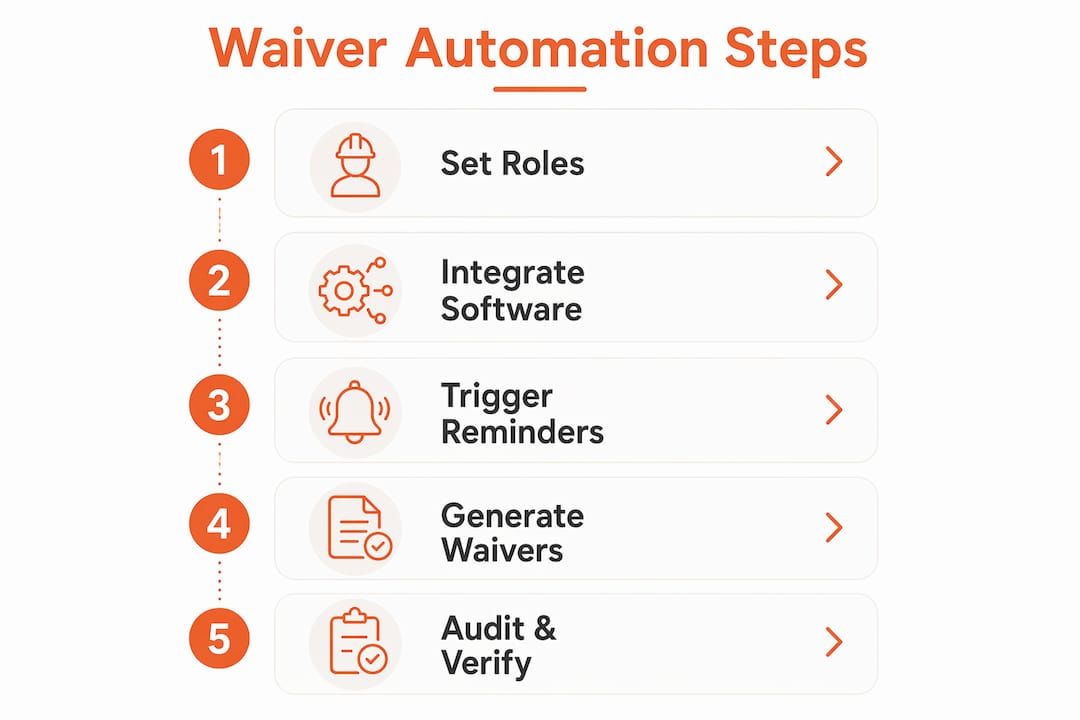
Roles that must be defined before you start
Your project manager owns the waiver request trigger. Your accounting team owns payment hold enforcement. Your subcontractors and suppliers own timely signature and return. Without written role assignments, waivers fall through the cracks at every handoff.
Pro Tip: Link your project management software (such as Procore) and your accounting system (such as QuickBooks) before the project starts. Waiverpilotpro supports both integrations, so waiver data flows directly into your payment records without manual re-entry.
How to implement an effective lien waiver workflow with automation
A well-built waiver workflow follows the pay application cycle, not the calendar. Here is the sequence that works.
- Pay application submitted. The subcontractor or supplier submits their pay app through your project management system.
- Conditional waiver requested automatically. Your system triggers a conditional progress waiver request tied to the payment amount on the pay app. A conditional waiver is effective only when payment actually clears, so it protects both parties during the review period.
- E-signature collected. The sub signs electronically. Platforms that support e-signature collection eliminate the fax-and-scan cycle that delays most manual processes.
- Waiver received and logged. The signed waiver is stored with a timestamp and linked to the specific pay application.
- Payment released. Accounting releases payment only after the signed conditional waiver is confirmed received. This is the payment hold trigger, and it is the most important control in the entire workflow.
- Unconditional waiver issued after payment clears. Once the check clears or the wire confirms, the sub signs an unconditional waiver covering that payment period. An unconditional waiver means the lien right for that amount is permanently released.
- Automated reminders escalate if no response. Reminders go out on days 1, 3, and 7 after the request. A payment hold activates after 14 days of no response.
- Final waivers collected at project closeout. Before final payment releases, you collect final unconditional waivers from every tier, including lower-tier subs and suppliers.
Automating this lifecycle compresses reconciliation time from 12 days to 1–2 days per pay period. That is not a marginal improvement. It is the difference between closing out a project on time and carrying weeks of unresolved payment exposure.
Pro Tip: Tie your automated reminder triggers to pay application submission dates, not calendar dates. Linking reminders to pay app events reduces administrative friction and gets you faster responses because the timing feels relevant to the sub, not arbitrary.
How to verify and audit lien waivers to prevent disputes
Collecting a waiver is not enough. A waiver with errors is often as useless as no waiver at all.
What every valid waiver must contain
Every waiver, conditional or unconditional, must include:
- Full legal names of the claimant (sub or supplier) and the property owner
- Property description sufficient to identify the project
- Payment amount matching the pay application exactly
- Through date specifying the period covered
- Authorized signature from a person with legal authority to waive lien rights
- Notarization where required by state law. You can check state-specific requirements using free waiver templates that flag notarization fields automatically
Amount mismatches are the most common error. A waiver for $48,000 on a $48,500 pay application leaves $500 of lien exposure open. That gap can anchor a dispute months later.
The lower-tier problem most GCs underestimate
Lower-tier subcontractors and suppliers account for over 50% of lien claims on commercial projects. Most general contractors collect waivers from their direct subs and stop there. That leaves the majority of lien exposure unaddressed. Your waiver package must include every tier, and your direct subs must be contractually required to flow down that obligation.
Audit schedule before project closeout
Run a waiver gap audit at three points: after every third pay period, at 80% project completion, and 30 days before scheduled final payment. Each audit should confirm:
- Every pay period has a matching conditional waiver on file
- Every cleared payment has a matching unconditional waiver
- No lower-tier subs or suppliers are missing from the waiver log
- All forms match the correct state-specific statutory version
Treating waiver collection as a closeout activity instead of integrating it with pay applications delays project closeout by 47 days on average. On a $25M project, that delay carries approximately $9,600 in direct carrying costs, before accounting for legal fees if a lien gets filed.
What are the common mistakes in waiver processing?
Most waiver errors fall into three categories: wrong timing, wrong form, and wrong tier. Each one is preventable.
Accepting unconditional waivers before payment clears
This is the single most dangerous error in the entire process. Accepting an unconditional waiver before payment clears means the sub has permanently released their lien rights without confirmed compensation. If the check bounces or the wire fails, they have no legal remedy left. The average dispute involving premature unconditional waivers involves $67,000 in contested payments and takes 8–14 months to resolve legally. The fix is simple: unconditional waivers go out only after your bank confirms the payment posted.
Never treat an unconditional waiver as a formality to collect in advance. It is a permanent legal release. Issue it only after payment is confirmed, and require the same discipline from every subcontractor managing their own lower-tier subs. One premature signature can unwind months of careful documentation.
Late and missing waivers
Late waivers are a process failure, not a subcontractor failure. If your subs consistently return waivers late, your reminder system is not tied to the right trigger. Automated multi-stage reminders on days 1, 3, and 7 after request, with a payment hold at day 14, reduce late waivers significantly and create a documented communication trail that holds up in disputes.
Construction professionals should target 100% waiver collection with escalations triggered automatically after 14 days of outstanding waivers. Anything below that rate is a gap in your lien protection.
Pro Tip: During subcontractor onboarding, walk every sub through your waiver process in writing. Explain the payment hold trigger, the reminder schedule, and the unconditional waiver timing. Subs who understand the system comply faster than those who receive waiver requests without context.
Key Takeaways
Making waiver submission a mandatory part of every pay application cycle is the single most effective way to reduce lien disputes and protect payment on construction projects.
| Point | Details |
|---|---|
| Integrate waivers with pay apps | Tie waiver requests to pay application submission, not calendar dates, for faster compliance. |
| Automate reminders and holds | Use escalating reminders on days 1, 3, and 7, with a payment hold at day 14 of no response. |
| Collect all tiers | Lower-tier subs and suppliers account for over 50% of lien claims; collect waivers from every tier. |
| Never rush unconditional waivers | Issue unconditional waivers only after payment is confirmed to avoid permanent loss of lien rights. |
| Audit before closeout | Run waiver gap audits at 80% completion and 30 days before final payment to catch missing documents early. |
What I’ve learned about waiver automation after years in construction compliance
The firms that resist automation almost always cite the same reason: “Our subs won’t use a new system.” In my experience, that concern disappears within two pay periods once subs realize that a faster waiver means a faster check. The friction is never really about technology. It is about not explaining the connection between waiver submission and payment release clearly enough upfront.
The bigger shift I have seen in 2026 is that general contractor waiver compliance is no longer treated as a back-office function. The best project managers I have worked with treat waiver collection the same way they treat safety documentation: non-negotiable, tracked in real time, and tied directly to project progress. That mindset change, more than any software, is what drives collection rates toward 100%.
For firms still hesitant about adopting automated waiver tools, start with one project. Pick your next mid-size job, set up a conditional waiver workflow tied to your first pay application, and measure how much PM time you recover by the third pay period. The numbers will make the decision for you. You can also use a step-by-step waiver guide to get your team aligned on correct form completion before the first request goes out.
— Rowena
Waiverpilotpro makes waiver compliance faster for contractors
Waiverpilotpro was built specifically for contractors who need professional-grade lien waivers without the complexity of enterprise software or the cost of legal templates.
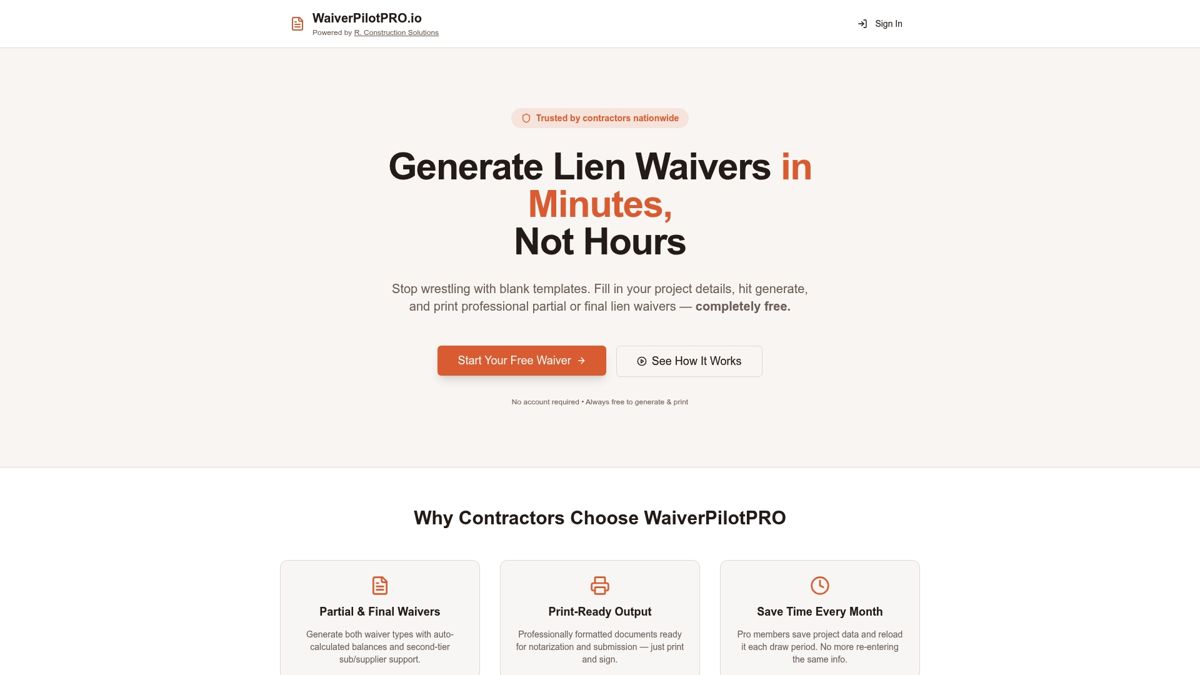
With Waiverpilotpro, you fill in your project details and generate both conditional and final waivers in minutes, at no cost. The platform auto-calculates balances, supports multiple subcontractors on a single project, and produces notarizable documents ready for immediate submission. It integrates directly with Procore and QuickBooks, so your waiver records stay connected to your payment data. Use the free lien waiver generator to get your first waiver out today, or browse state-specific waiver forms to confirm you are using the correct statutory version for your project location.
FAQ
What is a conditional vs. unconditional lien waiver?
A conditional waiver releases lien rights only when payment actually clears, protecting the sub if payment fails. An unconditional waiver permanently releases lien rights and should only be signed after payment is confirmed.
How do I get subcontractors to return waivers on time?
Tie payment release to waiver receipt and communicate that policy during onboarding. Automated reminders on days 1, 3, and 7 after the request, with a payment hold at day 14, drive collection rates to 95–100%.
Which states require specific statutory lien waiver forms?
12 US states require specific statutory lien waiver forms, and using the wrong form can make the waiver legally unenforceable. Check your state’s requirements and use state-compliant templates to avoid this risk.
How often should I audit my waiver files on an active project?
Audit after every third pay period, at 80% project completion, and 30 days before final payment. These checkpoints catch gaps before they become closeout delays or lien exposure.
Does automating waivers really save that much time?
Automation reduces PM follow-up time from 8–12 hours per week to under 30 minutes and compresses reconciliation from 12 days to 1–2 days per pay period. The time savings are measurable within the first pay cycle.