
What Does Payment Flow Mean in Construction?
Payment flow in construction is the structured movement of money from the project owner down through the general contractor (GC) to subcontractors and suppliers, triggered by completed work and governed by contract terms. Unlike a standard accounts payable process, construction payment flow is conditional. Money moves only when specific documentation is verified, approved, and compliant with legal requirements like lien waivers and certified payroll.
Here is what construction payment flow actually involves:
- Money moves in tiers. Owner pays the GC; the GC pays subs; the subs pay their suppliers and crews.
- Invoicing is progress-based. Pay applications reflect work completed against a pre-agreed Schedule of Values (SOV), not a flat invoice for services.
- Approval gates every payment. An architect or owner certifies the pay application before funds release, typically using AIA G702/G703 forms.
- Lien waivers travel with every payment. Conditional waivers accompany each pay application; unconditional waivers follow once funds clear.
- Payment instruments vary by tier. ACH handles most recurring sub and supplier volume; virtual cards work for material orders; wires cover high-value milestones; paper checks remain for joint-payee scenarios.
- Retainage slows the flow. Owners typically withhold 5–10% of each approved pay application until substantial completion.
What are the three phases of construction payment flow?
Construction payment management follows three sequential phases: verification, approval, and disbursement. Each phase has its own documentation requirements and failure points.
Verification matches the work completed in the field against the SOV line items. The GC reviews each subcontractor’s pay application for accuracy, checks progress against contract terms, and consolidates everything into a single pay application for the owner. Disputes over percent complete are the most common cause of delays at this stage.
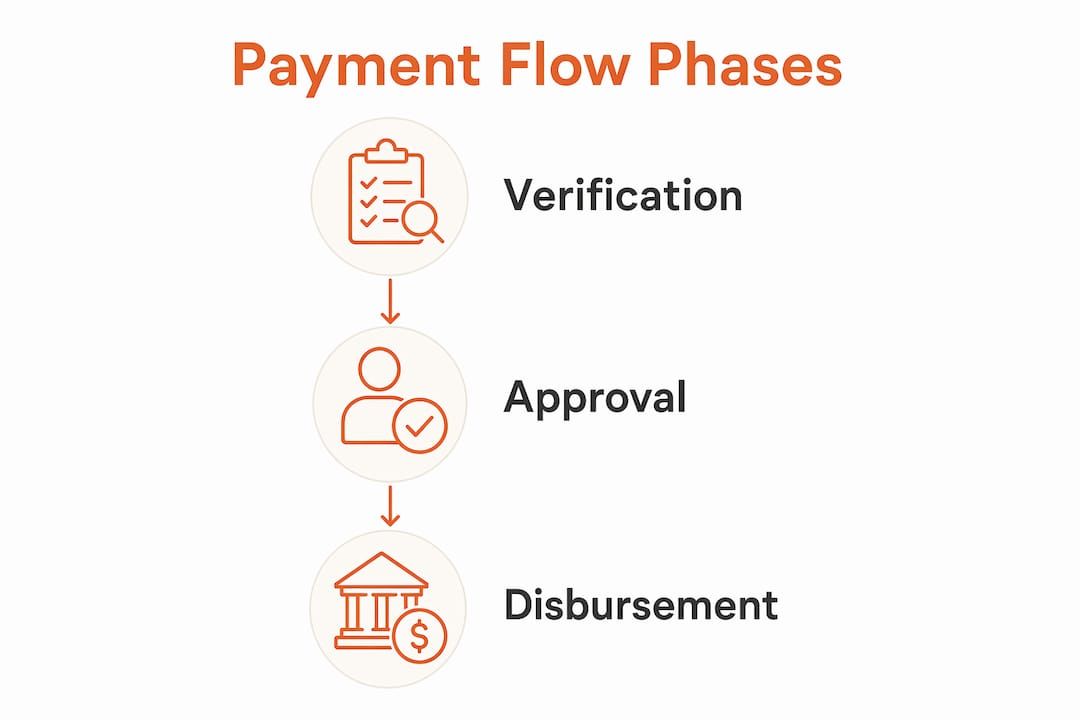
Approval happens when the architect or owner reviews the consolidated pay application and issues a Certificate for Payment. Per AIA A201-2017, the architect has seven days from receipt to issue the certificate. If the owner then fails to pay within the period stated in the contract, the contractor has the right to stop work after giving seven days’ notice.
Disbursement releases funds downstream once approval is confirmed and lien waiver compliance is met. Key documents at this stage include:
- Conditional progress lien waivers (submitted with the pay application)
- Unconditional lien waivers (exchanged after payment clears)
- Certified payroll records on prevailing wage projects
- Payment certificates authorizing fund release
How long does construction payment actually take?
The average U.S. construction payment cycle is 90 days, according to Rabbet’s 2024 Construction Payments Report. That is twice the 45-day threshold financial analysts consider healthy for any business.
The typical cycle: Work happens in weeks 1–4. The pay application submits around day 30. Architect certification takes another 7–14 days. Owner approval and processing adds another 30 days. Funds clear somewhere between day 45 and day 90, depending on the owner’s internal accounts payable cycle.
Meanwhile, your payroll runs weekly, material suppliers want payment in 30–45 days, and your subs are owed on their own contract terms. You are funding that gap out of the prior month’s draw and a working-capital line of credit. Common cash flow challenges that compound this timing problem include:
- Administrative float. Delays between invoice approval and actual payment release, often caused by slow internal processing.
- Retainage holdbacks. The 5–10% withheld per pay application traps working capital for the project’s duration.
- Pay-when-paid clauses. Subcontractors absorb the GC’s timing risk, pushing liquidity pressure further down the chain.
- Change order lag. Field work performed today may not be billed for 60 days and paid for another 60.
- Mobilization costs. Cash goes out before the first pay application is even submitted.
Pro Tip: Submit pay applications on the same date every month, without exception. A late or incomplete pay application costs you 30 or more days of cash flow. Pre-populate your G703 weekly so monthly billing is a review, not a scramble.
How the Schedule of Values controls your payment flow
The Schedule of Values is the financial backbone of every progress-billing contract. It is a line-item breakdown of the contract sum submitted at project start and approved by the architect, with each line representing a portion of the work and its agreed dollar value.

Every month, you report percent complete on each line item to calculate the payment due. Pre-agreed values prevent disputes over how much a phase of work is worth, which is the leading cause of payment holdbacks. A well-built SOV also gives you a cash flow forecast built into the contract: you know when money should arrive based on your construction schedule.
Benefits of a detailed SOV include:
- Reduces disputes over percentage of completion
- Sets clear payment expectations for both owner and contractor
- Supports weekly cash flow forecasting at the project level
- Creates an audit trail for every pay application
- Helps identify underbilling before it compounds across billing cycles
For residential projects, a custom home budget checklist can serve a similar function, mapping anticipated costs to project phases before construction begins.
How lien waivers and technology protect your payment flow
Lien waivers are the legal receipts that confirm payment and release the right to file a mechanics lien against the property. They are not optional paperwork. Owners and lenders require them at every tier before releasing the next draw, making them a direct control point in the payment flow.
There are four waiver types used across most U.S. states:
- Conditional progress waiver: Submitted with each pay application; takes effect only when payment clears.
- Unconditional progress waiver: Signed after payment clears; permanently waives lien rights for that period.
- Conditional final waiver: Submitted with the final pay application; effective upon final payment receipt.
- Unconditional final waiver: Signed after final payment; closes out all lien rights on the project.
Using the wrong waiver type, or the wrong state-specific form, can void the waiver entirely. California has four prescribed forms; Texas has five. Getting this wrong does not just slow payment. It can eliminate your legal remedy entirely.
Digital lien waiver platforms reduce paperwork errors and cut the time contractors spend generating and tracking waivers each month. Waiverpilotpro lets you fill in project details and generate both conditional and final waivers for free, with no account creation required. The platform integrates with Procore and QuickBooks, so waiver generation fits directly into your existing approval workflow. Auto-calculated balances and multi-subcontractor support mean you are not manually checking math on every document.
Pro Tip: Use a progress payment lien waiver for every partial billing period. Sending an unconditional waiver before payment clears is one of the most common and costly mistakes contractors make.
How payment flow affects subcontractors and suppliers
Subcontractors sit at the most financially exposed position in the payment chain. They perform work, wait for the GC to collect from the owner, and then wait again for the GC to distribute funds. On public work or large GC projects, that wait can stretch to 75–90 days from work performed to cash received.
Pay-when-paid clauses make the timing risk explicit: the GC pays the sub after receiving owner payment. Pay-if-paid clauses go further, shifting the owner’s credit risk entirely to the sub. Pay-if-paid clauses are banned or unenforceable in several states, including California, New York, and Wisconsin. Suppliers face the longest waits of all. Net-30 terms with a sub, combined with the sub’s own 60-day collection cycle, means a supplier may not receive payment for 90–120 days after delivery.
Unreleased retainage compounds the problem. Tracking retainage carefully and pushing for timely release at substantial completion can surface significant trapped working capital across a project portfolio.
What legal frameworks govern construction payment flow?
Two legal mechanisms shape how payment flows in U.S. construction: mechanics liens and prompt payment laws.
A mechanics lien gives contractors, subcontractors, and suppliers the right to place a claim against the property if they are not paid for work or materials. It is the most powerful collection tool available, but protecting lien rights requires strict compliance with preliminary notice deadlines, filing windows, and state-specific forms. Missing a deadline can eliminate the right entirely.
Prompt payment laws exist in all 50 states and set mandatory timelines for payment at each tier. Many require owners to pay GCs within 30 days of a certified pay application, and GCs to pay subs within 7–10 days of receiving owner payment. Federal projects under the Prompt Payment Act carry their own requirements, including interest on late payments.
AIA Contract Documents, particularly A201-2017, provide the contractual framework most commercial projects use to define payment timing, certification requirements, and remedies for non-payment, including the contractor’s right to stop work.
Best practices for monitoring and auditing payment flow
Consistent monitoring prevents small delays from becoming cash crises. Top contractors reduce their Days Sales Outstanding by 10–15 days versus the industry average by submitting accurate pay applications promptly and eliminating unnecessary approval delays.
- Forecast weekly, not monthly. A 13-week rolling cash forecast at the project level gives you enough lead time to act before a gap becomes a problem.
- Track retainage separately. Know exactly how much is held on each project and when it is contractually due for release.
- Reconcile pay applications to the SOV every billing cycle. Underbilling in one period compounds into the next.
- Audit lien waiver compliance before each draw. Missing or incorrect waivers stall disbursement at the owner level.
- Log approval lag by owner. Historical data on each owner’s actual payment behavior lets you forecast inflows more accurately than contract terms alone.
What happens when payments are delayed?
Delayed payments do not stay in the finance department. They move onto the job site. When a structural subcontractor stops receiving payment, they may stop paying their rebar supplier. The supplier puts a hold on the next delivery. The schedule slips. Every dollar in the payment chain is doing two jobs: paying for past work and signaling to the next vendor that it is safe to keep working.
Oliver F. Lehmann’s research on contractor project finance makes the point directly: a project can be profitable on paper and still place the contractor under existential pressure if the timing mismatch between outflows and inflows exceeds the contractor’s financial capacity. The critical measure is not the final profit margin. It is the maximum negative cash position the organization must carry while waiting for payment.
Schedule slippage adds a second layer of risk. When a job’s schedule slips by 30 days, cash collection slips by 30 days. Costs run at full speed regardless. Change orders performed in the field today may not be billed for 60 days and not paid for another 60, meaning the labor cost is out the door long before any reimbursement arrives.
Key Takeaways
Construction payment flow is the structured, contract-driven movement of funds from owner to GC to subcontractors, controlled by verification, approval, and lien waiver compliance at every tier.
| Point | Details |
|---|---|
| Average payment cycle | The U.S. construction payment cycle typically ranges from 56 to 90 days, which is longer than the 45-day threshold analysts consider healthy. |
| Three core phases | Verification, approval, and disbursement each require specific documentation before funds release. |
| Retainage impact | Owners withhold 5–10% of each pay application, trapping working capital until substantial completion. |
| SOV as financial roadmap | A detailed Schedule of Values pre-agrees line item values, reducing disputes and supporting cash flow forecasting. |
| Lien waivers control disbursement | Conditional waivers gate each draw; unconditional waivers close out lien rights after payment clears. |
Waiverpilotpro makes lien waiver compliance faster and less error-prone for contractors at every tier. Generate conditional and final waivers for free, with auto-calculated balances and direct integration into Procore and QuickBooks. No templates to wrestle with, no account required to get started.
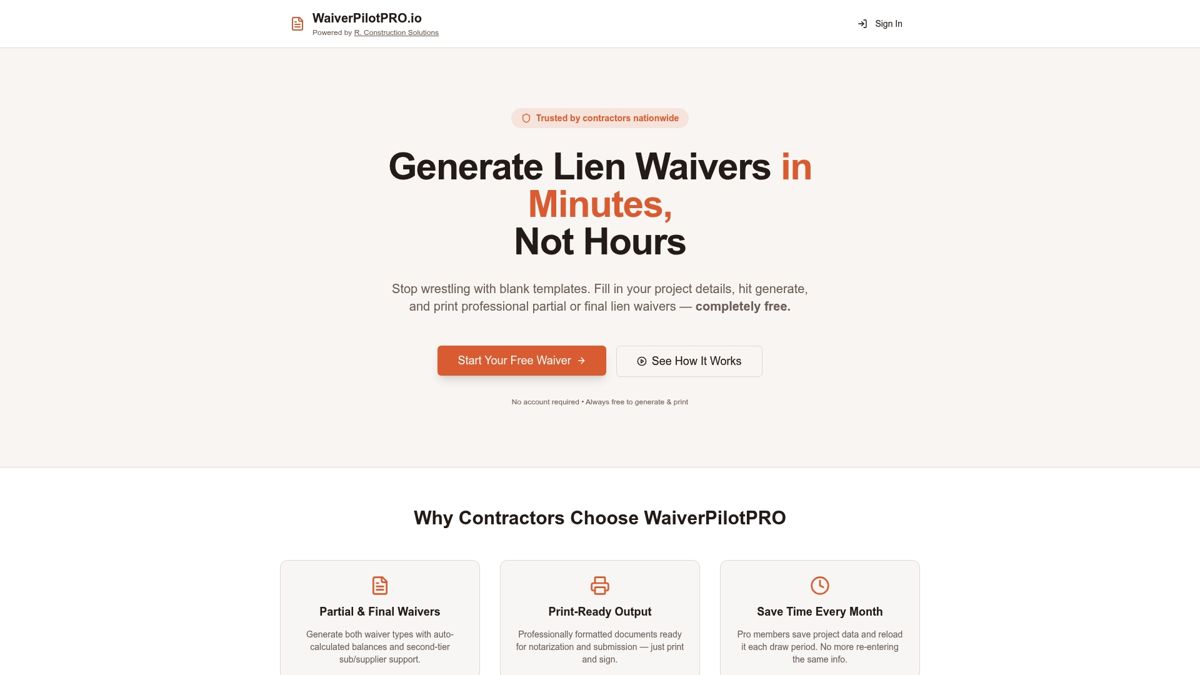
Generate your free lien waiver and keep your payment flow moving.