
Georgia Lien Waiver Rules: Forms, Deadlines, and Your Rights
Georgia law requires you to use the exact statutory waiver forms spelled out in O.C.G.A. § 44-14-366, and every waiver you sign automatically becomes final if you don’t act. A conditional waiver converts to unconditional on the earliest of three events: you receive payment, you sign a written acknowledgment of full payment, or 90 days pass. Miss that window and you lose your lien rights even if the check bounced.
If someone hands you a lien waiver today, do one thing first: confirm it uses the statutory language, not a generic form pulled from a template site. Sign only the conditional (interim) version, and if payment doesn’t clear, start your Affidavit of Nonpayment paperwork immediately.
- Refuse any waiver that skips the statutory notice language or witness/seal block.
- Track every signed waiver’s date. The 90-day clock starts at execution, not at the payment due date.
- Notarize the Affidavit of Nonpayment before filing. Georgia doesn’t require this for the waiver itself, but the affidavit needs it to be recordable.
A signed lien waiver isn’t just a receipt. It’s a legal document that surrenders your right to file a lien, and Georgia gives you exactly 90 days to undo that if you never got paid.
Key Takeaways
Georgia lien waivers must follow O.C.G.A. § 44-14-366’s exact statutory language, and any conditional waiver becomes final after 90 days unless you file an Affidavit of Nonpayment first.
| Point | Details |
|---|---|
| Use statutory forms only | Georgia requires the prescribed interim or final waiver language in 12-point font or larger. |
| Track the 90-day clock | A conditional waiver converts to unconditional automatically 90 days after execution unless you file an affidavit. |
| Know the three triggers | Waivers become final on payment receipt, written acknowledgment, or the 90-day deadline, whichever comes first. |
| Notarize the affidavit, not the waiver | Waivers need a witness and seal; the Affidavit of Nonpayment must be notarized to be recordable. |
| Generate compliant forms fast | Waiverpilotpro’s Georgia-specific templates build in the required statutory language and formatting automatically. |
Primary Sources Behind This Guide
This guide draws directly from O.C.G.A. § 44-14-366, the SB-143 amendment text, and Georgia’s consumer education pages.
- Statutory text: O.C.G.A. § 44-14-366 and SB-143 (2021 amendment)
- Explanatory: Georgia consumer education resources and practitioner summaries
- Filing: contact your county recorder’s office for affidavit submission procedures
Table of Contents
- What Does Georgia’s Lien Waiver Law Actually Require?
- Conditional vs. Unconditional Lien Waivers: What Changes at Each Payment
- Filing an Affidavit of Nonpayment in Georgia
- Where to Get Valid Georgia Lien Waiver Forms
- Common Mistakes That Cost Contractors Their Lien Rights
- A Practical Workflow for Managing Waivers on Every Project
- Frequently Asked Questions
- Sources
What Does Georgia’s Lien Waiver Law Actually Require?
Georgia doesn’t let contractors write their own waiver language. Under O.C.G.A. § 44-14-366, you must use the statute’s prescribed interim or final form, printed in at least 12-point font, with the required notice text intact. A waiver that deviates materially from that language, or omits the notice altogether, risks being unenforceable. Minor blanks or small formatting quirks generally survive as long as the subject matter remains reasonably determinable, but the core statutory text isn’t optional.
The statute also draws a hard line around what a waiver actually gives up. Subsection (a) limits its effect strictly to lien rights and labor/material bond claims. It does not touch breach-of-contract claims, warranty rights, or any other remedy you might have against a nonpaying party. That distinction matters when someone tries to use a signed waiver as proof you’ve abandoned every legal option, because you haven’t.
Georgia also voids any waiver signed in advance of furnishing labor, services, or materials. A property owner or general contractor cannot make you sign away lien rights before you’ve done the work. If that clause shows up in a contract, it has no legal effect under Georgia law.
Under the statute, a lien waiver becomes conclusively effective on the earliest of: actual receipt of payment, a signed written acknowledgment of payment in full, or 90 days after execution, unless you file an Affidavit of Nonpayment before that deadline runs out.
Pro Tip: Keep a simple spreadsheet with the execution date of every conditional waiver you sign. Add 90 days to each one and treat that date like a hard filing deadline, because legally, it is.
Conditional vs. Unconditional Lien Waivers: What Changes at Each Payment
An interim, or conditional, waiver releases lien rights through a specific “through date,” but only once payment is actually verified. It’s the form you sign at each progress payment on a multi-draw project, and Georgia’s own consumer guidance recommends it precisely because it keeps your rights alive until the money is in hand. Retainage held back under the contract typically isn’t waived by an interim form covering the current draw.
A final, or unconditional, waiver is different. Once signed and triggered, it releases lien and bond rights outright, with no built-in safety net tied to a bank clearing.
Here’s where contractors get burned: a conditional waiver isn’t conditional forever. It becomes conclusively effective, meaning it acts exactly like an unconditional waiver, the moment any of three things happens: you receive payment, you sign an acknowledgment of payment in full, or 90 days pass after you signed it. Filing an Affidavit of Nonpayment before that 90-day mark suspends the conversion until you’re actually paid.
- A check that hasn’t cleared your bank does not count as “receipt” of payment.
- Signing an acknowledgment form under pressure can trigger conversion even without cash in hand.
- A bank hold on funds doesn’t stop the 90-day clock from running.
Filing an Affidavit of Nonpayment in Georgia
If payment doesn’t come through, the Affidavit of Nonpayment is your statutory lifeline. You have 90 days from the date you signed the conditional waiver to file it in the county where the property sits. Miss that window and the waiver converts to unconditional automatically, regardless of whether you were ever paid.
The affidavit must contain specific information, following the statutory language introduced by SB-143: the project name, the contractor’s identity, the unpaid amount, the date the waiver was signed, a description of the property, and your sworn signature. Unlike the waiver itself, the affidavit must be notarized to be recordable at the county level.
Filing alone isn’t enough. Georgia law requires you to serve copies within seven days of filing:
- Send a copy to the property owner by registered mail, certified mail, or statutory overnight delivery.
- Notify the contractor if you’re not in direct privity with them and a Notice of Commencement exists on the project.
- Keep proof of mailing. Your certified mail receipt is your evidence the service requirement was met.
- File before day 90, not on it. Recorder offices don’t process instantly, and a late-arriving filing doesn’t save you.
- County recorder office: check filing hours and whether same-day recording is available.
- Notarization: schedule this before your deadline week, not during it.
- Witness requirement: applies to the underlying waiver, not the affidavit.
Where to Get Valid Georgia Lien Waiver Forms
Pulling a generic waiver template off a search engine is one of the fastest ways to sign something Georgia courts won’t honor. Start with the statutory text itself in O.C.G.A. § 44-14-366, or use a Georgia-specific generator built to match that exact language field for field.
Before you sign or submit any form, check these fields:
- Contractor and claimant names, spelled exactly as they appear on the contract.
- The precise dollar amount being waived, not a rounded estimate.
- A “through date” on interim waivers, marking exactly which payment period is covered.
- Retainage carve-outs, if your contract holds back a percentage until project completion.
- Property description, matching either the legal description or the address format your county recorder accepts.
- Witness and seal block, completed and signed, since Georgia requires this on the waiver itself.
- Font size of at least 12 points throughout the statutory notice language.
Once signed, keep the originals. If a dispute lands in court, you’ll need the executed waiver, proof of when payment cleared, and any written acknowledgment separately. For affidavits, hold onto your certified mail receipts indefinitely. You can pull ready-to-complete versions of these forms in PDF or Word so you’re not reconstructing the statutory language from scratch every time.
Common Mistakes That Cost Contractors Their Lien Rights
Most lien rights don’t disappear because of a legal technicality nobody could have predicted. They disappear because someone treated a waiver as paperwork instead of a deadline.
The most frequent mistake is confusing a waiver’s conditional status with permanent protection. Contractors sign the interim form, assume they’re covered until paid, and never realize the 90-day clock is already ticking. By the time payment falls through, the deadline to file an affidavit has often already passed.
Other recurring errors: signing a nonstatutory form because it looked close enough, skipping the witness and seal block because it seemed like a formality, and mailing the affidavit by regular mail instead of certified or registered mail, which fails the service requirement outright. Property descriptions that are vague or copied incorrectly from a different filing can also create problems when a recorder’s office reviews the document.
- Insist on the statutory form every time. Don’t accept a substitute because it “looks similar.”
- Verify funds have actually cleared before treating a waiver as satisfied.
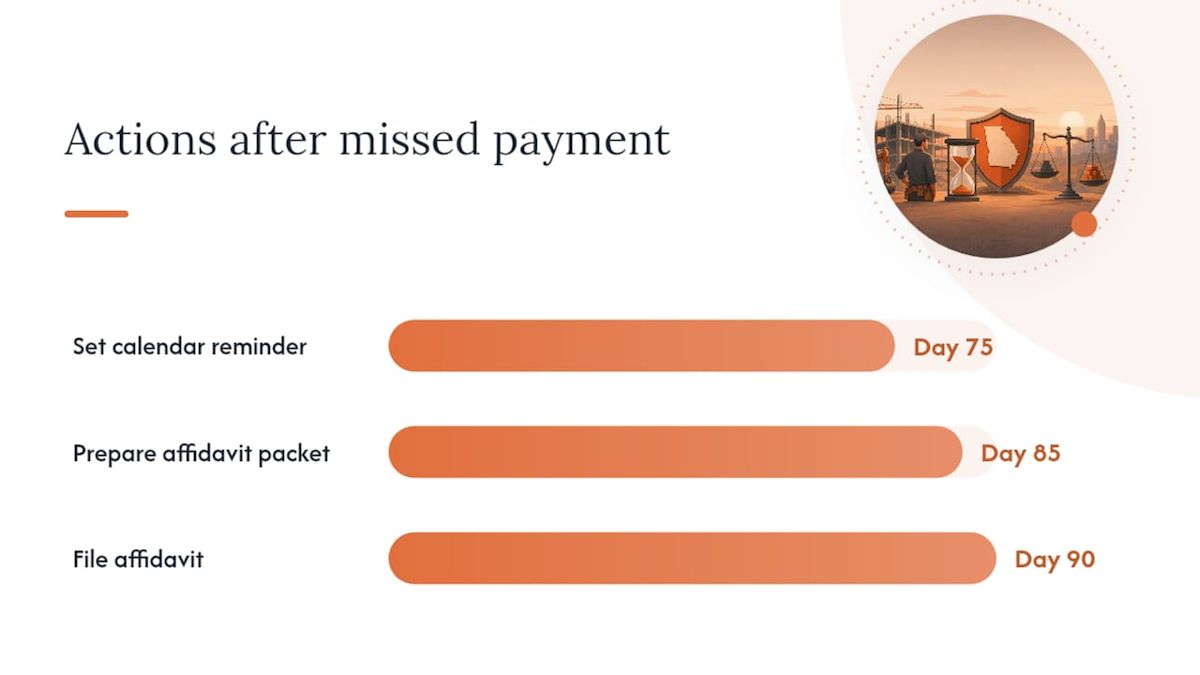
- Prepare your affidavit packet the moment payment is late, not after day 85.
- Send affidavit copies by certified mail and keep every receipt.
- Use a compliant progress payment waiver for each draw so through dates stay accurate.
Pro Tip: Store every signed waiver alongside its corresponding payment record in one folder, digital or physical, and set a calendar reminder for day 75, not day 90. That ten-day buffer gives you room to notarize and file if payment hasn’t shown up.
A Practical Workflow for Managing Waivers on Every Project
Treat each waiver request as a checklist, not a formality:
- Review the request. Confirm it’s the statutory Georgia form before anything else.
- Accept a conditional interim waiver only after you’ve verified the payment method and amount.
- Log the execution date the moment you sign.
- Set a 90-day countdown tied to that exact date.
- If payment stalls, prepare your affidavit packet early, notarization included.
- File in the correct county and serve all required parties within seven days.
Keep signed forms, bank clearing confirmations, certified mail receipts, and a note on whether a Notice of Commencement exists on the project. That last detail determines whether you need to notify the general contractor separately.
Pro Tip: A compliant waiver generator that auto-fills project details cuts down on the blank-field errors that cause enforceability disputes later.
Why These Rules Matter More Than They Seem
The 90-day conversion isn’t a technicality. It’s the mechanism that determines whether you still have leverage after a payment dispute starts. A lien waiver only releases lien and bond rights, but for most subcontractors, those rights are the only real pressure they have to get paid.
A Faster Way to Stay Compliant on Every Georgia Project
Chasing down the right statutory language, formatting the notice text correctly, and remembering witness and seal requirements takes time you probably don’t have between site visits and payment applications. Waiverpilotpro builds Georgia’s statutory interim and final waiver forms directly into a generator, so the notice language, font size, and witness block are already correct before you print anything.
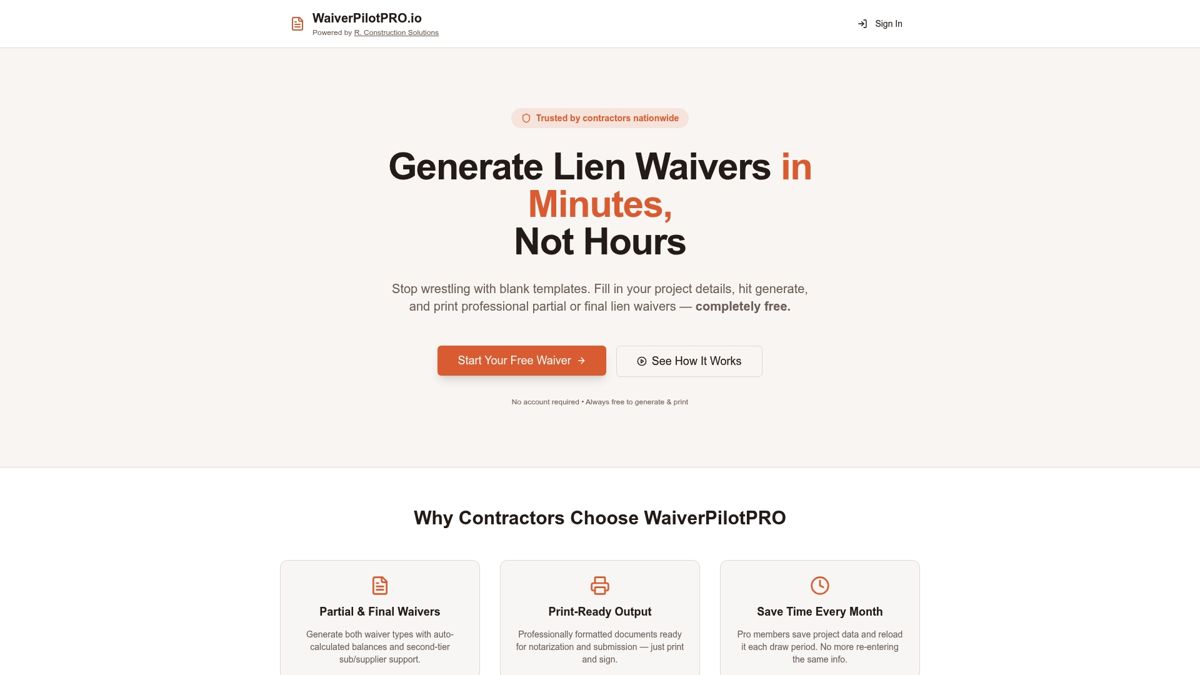
You fill in project details, generate the form, and it’s ready to sign, no account creation, no template hunting. The platform also supports multi-subcontractor projects and connects with tools like Procore and QuickBooks, so waiver tracking doesn’t live in a separate spreadsheet from the rest of your job records. For homeowners and general contractors juggling related paperwork, resources like this roofing contract guide cover the agreement side of the same projects.
This is document generation, not legal advice. If you’re already in a payment dispute, talk to a construction attorney about your specific situation. But for getting a compliant, free Georgia lien waiver into signable shape today, start there and see how much time it saves on your next draw request.
Frequently Asked Questions
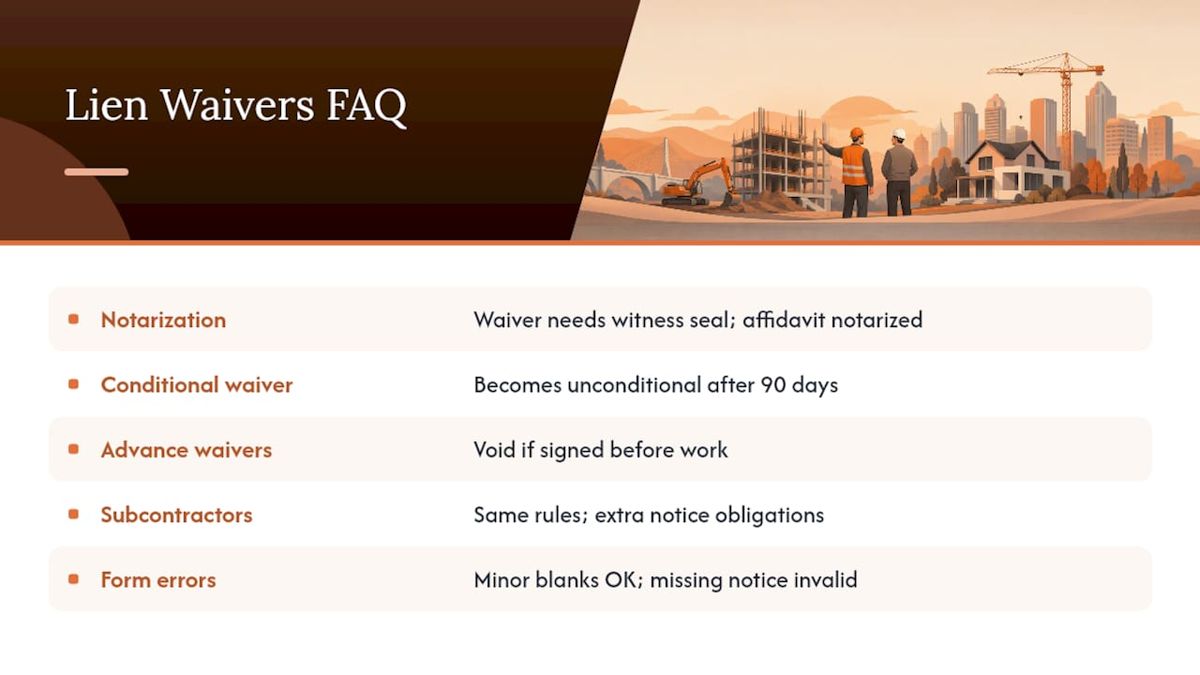
Does Georgia require lien waivers to be notarized? No. The waiver itself needs a witness signature and seal under O.C.G.A. § 44-14-366, but the Affidavit of Nonpayment must be notarized to be recorded at the county level.
What happens if I don’t file an Affidavit of Nonpayment in time? Your conditional waiver automatically converts to an unconditional waiver 90 days after you signed it, even if you were never paid.
Can a property owner make me sign a lien waiver before I start work? No. Georgia voids any waiver signed in advance of furnishing labor, services, or materials.
Do subcontractors follow different lien waiver rules than general contractors in Georgia? The statutory forms and conversion rules apply the same way to both, but subcontractors without direct privity to the owner have extra notice obligations when filing an affidavit if a Notice of Commencement exists on the project.
What if a lien waiver form has small errors or blank fields? Minor blanks generally don’t invalidate the form as long as the subject matter stays reasonably determinable, but omitting the required statutory notice language can make the whole waiver unenforceable.
This article is general information, not a substitute for advice from a qualified lawyer. Consult a qualified legal professional about your own circumstances before acting on anything here.
Sources
- Georgia Code § 44-14-366 (2025) - Waiver of lien or claim upon bond in advance of furnishing labor, services, or materials
- SB-143 signed legislation (2021) — Georgia General Assembly / governor’s office
- Liens Against Your Home - Consumer Ed - Georgia.gov
- Do Lien Waivers Need to Be Notarized? By State - LegalClarity
- Georgia mechanic’s lien waiver rules | Ezel