
Why GCs Need Automated Waiver Generation in 2026
Why general contractors need automated lien waiver generation
Automated lien waiver generation is not a convenience upgrade. For general contractors managing multiple projects and dozens of subcontractors, it is the difference between getting paid on time and spending weeks chasing paperwork at closeout. The Construction Financial Management Association (CFMA) found that GCs who automated lien waiver tracking reduced their average pay-app cycle time and decreased billing disputes compared to firms using manual collection.
A lien waiver is a legal document in which a subcontractor or supplier waives the right to file a mechanics lien against a property in exchange for payment. Think of it as a receipt that also surrenders a powerful legal remedy. On a project with 20 active subcontractors and monthly draws, you need 40 or more waivers collected, verified, and matched every billing cycle before a single payment can release. Most teams handle that by email, spreadsheet, and memory. The result is a multi-day scramble at the end of every draw period.
Automation fixes that scramble by tying waiver generation directly to pay application approval events. Here is why GCs are making the switch:
- Scalability: A GC managing 10 concurrent projects processes over 2,000 waiver events per year. Manual tracking cannot keep up.
- Accuracy: Automated systems pre-fill dollar amounts, billing periods, and subcontractor names directly from pay app data, eliminating transcription errors.
- Integration: Platforms that connect to Procore and QuickBooks tie waiver status to payment processing in a single workflow.
- Legal protection: Correctly timed conditional and unconditional waivers protect your lien rights at every stage of the payment cycle.
- Payment speed: Automated waiver collection reduces the billing cycle gap by 8–12 days for GCs managing 10 or more subcontractors.
What lien waiver automation actually does
Automation replaces the manual cycle of drafting forms, chasing signatures, and reconciling compliance status with a triggered workflow that runs every draw cycle without human prompting. The core idea is straightforward: waiver collection starts automatically when a pay application is submitted, and payment is blocked until the waiver is received and validated.
Here is how the workflow operates in practice:
- Trigger: When a pay application is approved in your project management platform, the system reads the subcontractor list, approved amounts, and billing period from the pay app data.
- Generation: The correct waiver type is generated automatically. Conditional waivers (waiving lien rights only if payment clears) go out before payment. Unconditional waivers (a full, permanent release) are triggered only after funds clear.
- Distribution: Each subcontractor receives a personalized request with the correct dollar amount, period dates, and an e-signature link. All requests fire simultaneously, not one by one.
- Tracking and escalation: If a waiver is not returned within 48 hours, the system sends a second request automatically. At 72 hours without a response, the project manager receives an escalation alert. At five days, the pay application is flagged as payment-blocked.
- Validation: When a signed waiver returns, the system checks the waiver type, billing period, dollar amount, and signatory against the pay app data. Mismatches create an exception item for human review rather than blocking the entire payment run.
The labor savings are real. GCs who automate this step reduce administrative overhead significantly per draw cycle per project.
Pro Tip: Configure your automation rules to distinguish waiver type by payment status, not by draw number. Conditional waivers belong at pay app submission; unconditional waivers belong after ACH confirmation or check clearance. Mixing those up is one of the most common and costly errors in manual workflows.
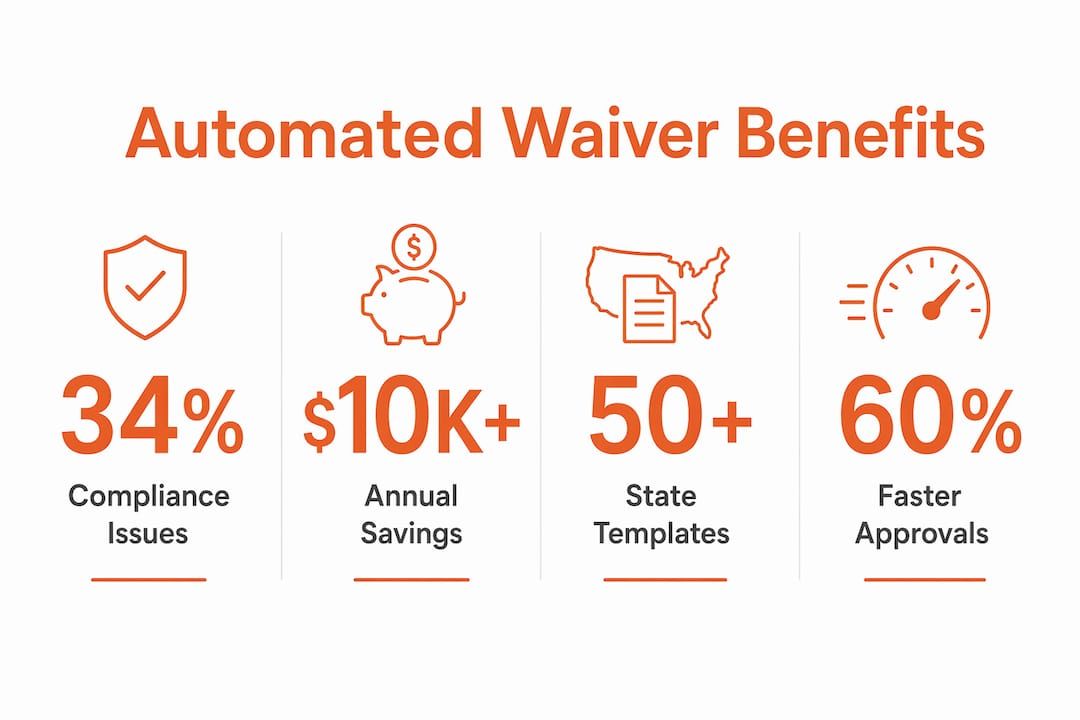
Understanding waiver compliance failures and the “waiver gap”
The waiver gap is what happens when waivers are not collected during project execution and the absence is discovered at closeout. It is the most damaging form of compliance failure because it surfaces at exactly the wrong moment: when the owner is withholding retainage and your leverage to collect missing documents has largely evaporated.
Consider a scenario that plays out regularly on commercial projects. A GC finishes a $4.2M tenant improvement job and requests release of $380,000 in retainage. The owner’s representative refuses because three conditional waivers from the first two pay periods are missing from the project file. The project manager spends the next two weeks tracking down subcontractors, one of whom has gone out of business. Sorting out the documentation takes 19 days and requires the GC’s attorney. The retainage is eventually released, but 37 days late, with carrying costs and a damaged owner relationship.
According to the CFMA, documentation gaps including missing lien waivers are cited as a primary factor in 34% of commercial construction payment disputes. Missing lien waivers are also the single most common reason progress payments are held beyond the pay-app due date on commercial projects.
Why does the gap form? Lien waiver collection competes with budget management, schedule oversight, and client communication for project manager attention. According to the Associated General Contractors of America (AGC), project managers spend an average of 3–5 hours per project per pay period on administrative compliance tasks, with lien waiver collection representing roughly 40% of that burden. Under project execution pressure, waiver follow-up consistently loses that competition. Response rates average 65–70% on the first request, and manual follow-up brings that to 80–85% at best. The remaining 15–20% either get forgotten or escalated too late.
Automation closes the gap by making the collection process independent of any individual’s calendar or memory. Every subcontractor gets the same request, the same follow-up, on the same schedule, every cycle.
Multi-state lien waiver compliance and how automation helps at scale
State lien laws are not uniform, and that creates a real compliance burden for GCs working across state lines. Twelve states mandate specific statutory waiver language, including Arizona, California, Florida, Georgia, Massachusetts, Michigan, Mississippi, Missouri, Nevada, Texas, Utah, and Wyoming. Using the wrong form in California or Michigan can void the waiver entirely, which means your lien protection disappears even if the document is signed.

Three states (Texas, Mississippi, and Wyoming) require notarization on lien waivers. In a manual process, that means printing the waiver, locating a notary, and mailing or scanning the notarized document back. Electronic notarization built into a digital signing workflow eliminates that bottleneck entirely.
The volume problem compounds the compliance challenge. A GC managing multiple concurrent projects with numerous subcontractors and pay periods must track a large volume of waiver events annually, which becomes unmanageable manually. Managing that volume manually across multiple state requirements is structurally unsustainable.
Automated platforms address multi-state compliance through a 50-state statutory template library. When a project is created, the system identifies the state and applies the correct form automatically. For states without statutory requirements, custom templates handle the gap. The result is that every waiver leaving the system is jurisdictionally correct before a sub ever sees it.
| State | Statutory form required | Notarization required | Key risk of wrong form |
|---|---|---|---|
| California | Yes (California Civil Code) | No | Waiver voided entirely |
| Texas | Yes | Yes | Waiver voided; Prompt Payment Act deadlines compressed |
| Michigan | Yes | No | Waiver voided entirely |
| Florida | Yes | No | Lien rights not released |
| Wyoming | Yes | Yes | Waiver unenforceable |
| All other states | No (custom templates apply) | No | Form errors create disputes |
Challenges that manual processes face at scale:
- Tracking which state form applies to each project and each subcontractor tier
- Ensuring notarization requirements are met without delaying the payment cycle
- Maintaining current statutory forms as state laws change
- Reconciling waiver status across projects with different billing schedules
- Catching amount mismatches when waivers are reviewed individually rather than against pay app data
Pro Tip: When you operate in California, treat lien waiver compliance as a separate risk category. California’s mechanic’s lien statutes create the most complex waiver environment in the country, with preliminary notice requirements and tight recording deadlines. Errors there carry disproportionate legal exposure compared to most other states.
How automated waiver generation accelerates your payment workflow
Payment delays in construction are rarely caused by slow owners. They are caused by missing paperwork, specifically lien waivers that arrive inconsistently, incompletely, or days after the billing window has closed. Automation addresses that directly by tying waiver collection to the payment workflow rather than treating it as a separate administrative task.

The most impactful feature in any automated system is payment hold integration. When payment is genuinely contingent on waiver receipt, subcontractors who had been slow to sign become responsive within the first pay cycle. The compliance problem largely solves itself.
Here is how the payment workflow improves step by step:
- Pay application is submitted and marked approved in your project management platform.
- The automation layer reads all subcontractor commitments and generates pre-filled waiver requests simultaneously, within minutes of the approval event.
- Subcontractors receive personalized e-signature requests with the correct amount, period, and waiver type.
- Signed waivers return and are validated automatically against pay app data.
- Exceptions (amount mismatches, wrong waiver type) are routed to the project accountant’s review queue with the specific discrepancy flagged.
- Once all waivers are validated, the system assembles the complete waiver package and attaches it to the pay-app record.
- Payment releases with a complete, documented compliance package already in place.
Benefits that show up directly in your cash flow:
- Shorter billing cycle: Automated collection cuts the billing cycle gap by 8–12 days for GCs managing 10 or more subcontractors.
- Faster retainage: When waiver compliance reaches 95% or higher, closeout packages are submitted faster and owners release retainage earlier.
- Reduced disputes: The CFMA found a 27% decrease in billing disputes for GCs using automated tracking versus manual collection.
- Lower carrying costs: For a GC with $8M in annual revenue, retainage averaging 10% creates $800,000 in receivables. Waiver-related delays on even a portion of that balance generate real carrying costs that automation eliminates.
- Cleaner closeout: The system compiles all conditional and unconditional waivers by pay period into a single organized PDF automatically, eliminating weeks of manual document assembly at project end.
Good construction project visibility across your portfolio makes it far easier to spot which projects are approaching closeout and which waiver packages need attention before the final draw.
Best practices for implementing automated lien waiver generation
Getting automation right from the start saves you from having to fix compliance gaps mid-project. The implementation decisions you make in the first few weeks determine how much of the ROI you actually capture.
Integrate with your existing platforms first. Automation only works when it reads live pay app data. Connect your system to Procore for project management data and QuickBooks or your accounting platform for payment status. When those connections are live, waiver generation and payment hold enforcement happen without manual data entry. Waiverpilotpro supports Procore integration and QuickBooks workflows directly, so the setup does not require custom development.
Configure payment holds before your first automated draw cycle. Payment hold integration is the highest-leverage component of any automated waiver system. Without it, compliance rates plateau around 70–80% and the labor savings are reduced. The CFMA reports that contractors who implement payment hold automation see near-elimination of missing waiver issues within two pay cycles.
Conduct a waiver inventory audit at implementation. Before automation goes live, identify any outstanding waivers from prior pay periods on active projects. Projects within six months of closeout are the highest priority. Launching a remediation campaign to collect historical waivers before the automated system takes over prevents the old waiver gap from contaminating your new compliance record.
Additional best practices:
- Customize waiver templates for each contract type (lump sum, cost-plus, GMP) and each state where you operate.
- Set escalation rules that route non-responses to the project manager, not just the billing contact, after 72 hours.
- Automate unconditional waiver collection as rigorously as conditional collection. Unconditional waivers are the legally protective document for GCs and the most commonly skipped step in manual processes.
- Run monthly reconciliation reports showing cumulative waiver compliance by project and subcontract. These reports catch gaps before they reach closeout.
- Brief your subcontractors on the new process before the first automated draw. One clear communication explaining the e-signature workflow and the payment hold policy eliminates most of the friction.
Pro Tip: The cost of manual waiver management runs tens of thousands of dollars annually for a GC managing multiple projects when accounting for direct labor, carrying costs, and lien exposure. Run that number against your automation platform cost before your next budget conversation. The ROI case is usually settled in under five minutes.
Tracking field activity alongside waiver compliance is easier when your team uses mobile attendance tracking tools that keep jobsite data current and connected to your project management workflow.
How Waiverpilotpro simplifies automated lien waiver generation for GCs
Waiverpilotpro is built for exactly the situation most GCs find themselves in: too many waivers to manage manually, not enough administrative staff to chase them, and real financial consequences when documents go missing. The platform lets you fill in project details and generate both conditional and unconditional waivers without creating a complex account or navigating a steep learning curve.
Here is what Waiverpilotpro delivers for GCs:
- Free lien waiver generation: Generate professional-grade conditional and final waivers at no cost, with auto-calculated balances that pull directly from your project data.
- Multi-subcontractor support: Handle an entire draw cycle across all your subs in one workflow, not one email at a time.
- Notarizable documents: Every waiver produced is formatted and ready for notarization where state law requires it, so you are not reformatting documents at the last minute.
- Platform integration: Waiverpilotpro connects with Procore, QuickBooks, and other construction management tools so waiver generation fits inside your existing payment workflow rather than running parallel to it.
- AI-powered auto-fill: The AI lien waiver generator pulls contract data automatically, reducing the manual entry that causes amount mismatches and wrong-period errors.
The platform also covers the compliance details that trip up manual processes. Conditional versus unconditional waivers are handled correctly by design. If you want to understand the legal distinction before you configure your workflow, Waiverpilotpro’s guide on conditional vs. unconditional waivers explains the difference in plain language, including when each type should be signed and what happens if the timing is wrong.
For GCs who want to understand the full legal foundation before automating, the lien waiver basics guide covers the mechanics lien system, waiver types, and state-specific requirements without legal jargon.
Pro Tip: Start with a single project when you first deploy Waiverpilotpro. Run one full draw cycle with automation active, review the exception queue, and adjust your escalation rules before rolling out across your entire portfolio. The first cycle reveals the configuration gaps that are much harder to fix at scale.
Waiverpilotpro gives GCs a faster path to waiver compliance
Generating lien waivers correctly, on time, and across every subcontractor on every draw cycle is the kind of task that sounds manageable until you are running six projects simultaneously. That is where manual processes break down and where Waiverpilotpro earns its place in your workflow.
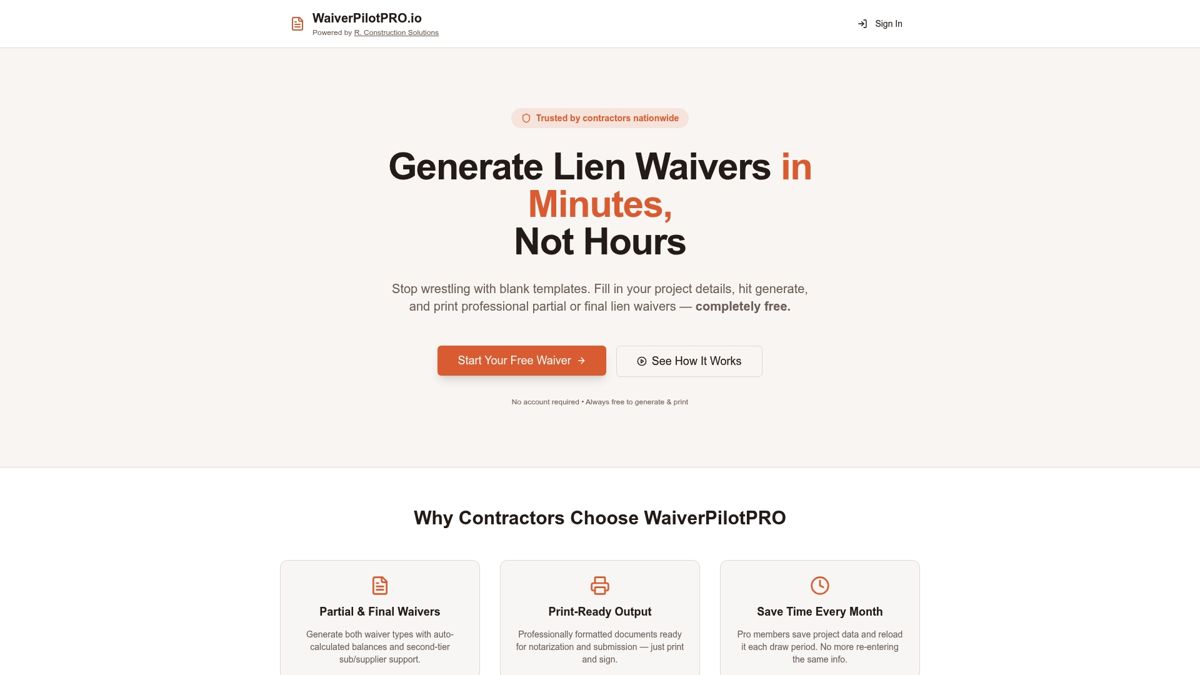
Waiverpilotpro’s free lien waiver generator produces professional, notarizable conditional and final waivers in minutes, with auto-calculated balances and multi-subcontractor support built in. There is no complex account setup and no per-waiver fee. The platform integrates with Procore and QuickBooks so your waiver workflow connects directly to your payment approvals, not to a separate folder that someone has to remember to check. For GCs who want to start immediately, the free construction forms library includes waiver templates in PDF, Word, and Excel formats ready for download.
If you are managing active projects right now with waivers outstanding, the right next step is to generate your first waiver through Waiverpilotpro and see how much faster the process runs when the form fills itself.
Key Takeaways
Automated lien waiver generation reduces billing cycle gaps, cuts annual manual management costs substantially, and eliminates the waiver gap that causes payment disputes at project closeout.
| Point | Details |
|---|---|
| Billing cycle impact | Automation cuts the billing cycle gap by 8–12 days for GCs managing 10 or more subcontractors. |
| Annual cost of manual tracking | The cost of manual waiver management includes $28,000–$61,000 annually for direct labor and opportunity costs for a 10-project GC; automation ROI can be 3–8x in year one. |
| Payment dispute reduction | CFMA data shows a 27% decrease in billing disputes for GCs using automated waiver tracking versus manual collection. |
| Multi-state compliance | Twelve states mandate specific statutory waiver language; automated platforms apply the correct form by jurisdiction automatically. |
| Waiverpilotpro | Generates free, notarizable conditional and final waivers with Procore and QuickBooks integration and multi-subcontractor support. |