
Why Contractors Face Payment Delays: Retainage & Pay-App Guide
Payment delays on U.S. construction jobs trace back to three root causes: the layered payment chain from owner to GC to subcontractor, cascading retainage holdbacks that typically run 5–10% of each pay application, and missing or incorrect documentation such as unsigned lien waivers, incomplete AIA G702/G703 payment application forms, and expired certificates of insurance. Construction attorney Mary Klett of the American Subcontractors Association (ASA) has noted that retainage creates a serious cash-flow drag for subs who fund labor and materials upfront while waiting months or years to recover holdbacks. The fix: submit complete pay apps, attach conditional lien waivers, track retainage in a dedicated subledger, and use the escalation roadmap below when payment stalls.
Table of Contents
- How construction payments actually flow — and where funds stall
- Top causes of payment delays on U.S. jobs — what to look for on your projects
- 1. Retainage stacking across the payment chain
- 2. Pay-if-paid and pay-when-paid contract clauses
- 3. Owner or GC cash-flow problems
- 4. Incomplete or incorrect pay applications
- 5. Missing or incorrectly signed lien waivers
- 6. Compliance document gaps
- 7. Disputed change orders
- 8. Schedule-of-values mismatches
- What legal remedies are available when payment is late?
- Contract provisions and bidding tactics that reduce payment risk
- Operational fixes: documentation, workflows, and software that speed approval
- How Waiverpilotpro reduces waiver-related payment delays
- Step-by-step checklist to submit a pay application that won’t get kicked back
- If payment is late: an escalation and collection roadmap
- Key Takeaways
- The admin gap is the real payment problem
- Waiverpilotpro: generate your lien waivers in minutes, not hours
- Useful sources and references
How construction payments actually flow — and where funds stall
Money on a construction project does not move in a straight line. It travels through an approval chain, and each handoff is a potential delay point.
The typical approval sequence:
- Sub submits a pay application (G702/G703 plus schedule of values) to the GC
- GC reviews, consolidates with other subs, and submits to the architect or engineer for certification
- Architect certifies the application and forwards it to the owner or lender
- Owner or lender releases funds to the GC
- GC disburses to each sub, minus retainage
Each stage adds days. Lender draw cycles alone can add two to three weeks on top of the GC’s internal review.
Retainage stacking makes the wait longer. The owner withholds 5–10% from the GC, who withholds the same percentage from each sub. A sub finishing early on a 24-month project may complete their scope in month 3 but wait until month 24 or beyond for retainage release. That is cash tied up for nearly two years on a single job.
| Trigger event | Typical time range | Documentation required |
|---|---|---|
| Sub submits pay app | — | G702/G703, schedule of values, COI |
| GC review and consolidation | Days 1–10 | Conditional lien waiver, certified payroll (if required) |
| Architect/lender certification | Days 5–10 | Certified pay app, change-order backup |
| Owner funds GC | — | Owner draw request, title/lien status |
| GC disburses to sub | Days 30–60 | Sub’s conditional waiver exchanged for payment |
| Retainage release | Project closeout (months to years) | Final waiver, notice of completion, punch-list sign-off |
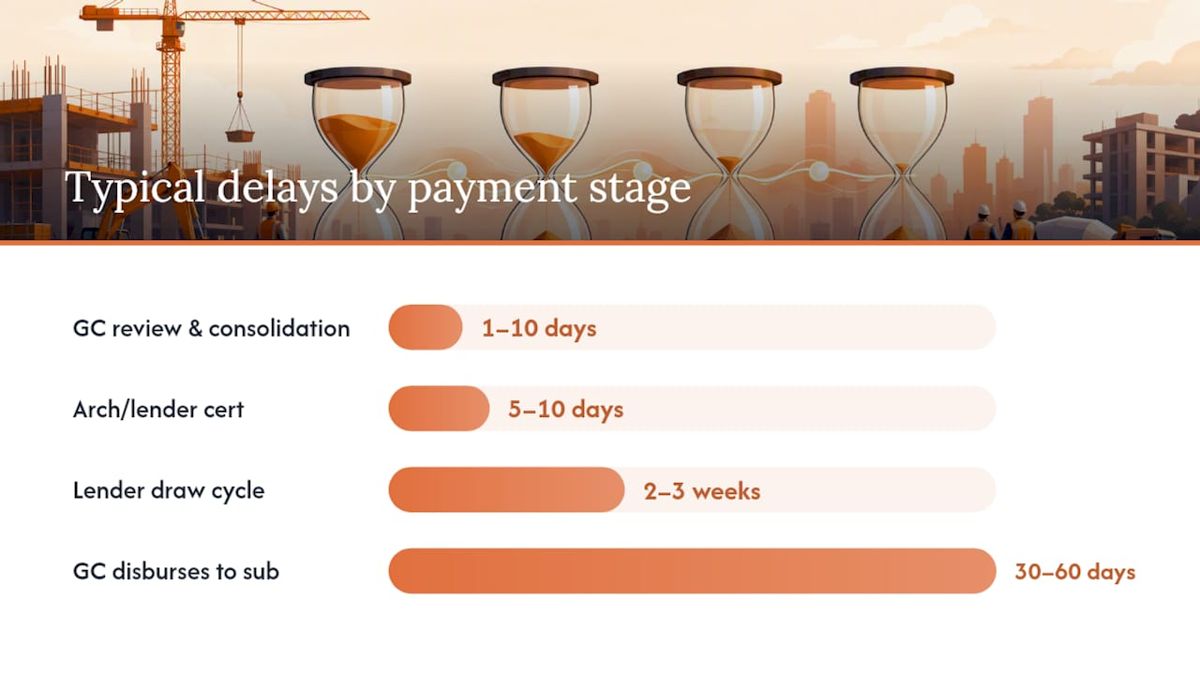
Administrative errors at any stage push the application into the next billing cycle, which typically means a 30-day reset.
Top causes of payment delays on U.S. jobs — what to look for on your projects
Understanding why payments are late on your specific job lets you fix the right problem. These are the most common causes, ranked by how often they appear.
1. Retainage stacking across the payment chain
Retainage is withheld at every tier, typically at a rate of 5–10%. The owner holds back from the GC, and the GC mirrors that holdback on each sub. On a multi-year project, retainage creates a major cash-flow drag that forces subs to act as interest-free lenders. Mary Klett (ASA) recommends building a retainage buffer into your bid price and negotiating scope-based releases whenever possible.
2. Pay-if-paid and pay-when-paid contract clauses
Pay-if-paid clauses can shift the entire risk of owner nonpayment to the sub. Pay-when-paid clauses set the GC’s receipt of funds as the payment trigger. Enforceability varies widely by state, and some states have banned pay-if-paid outright. Have any contingent payment clause reviewed by counsel before signing.
3. Owner or GC cash-flow problems
Even a well-run sub can wait if the owner’s financing is shaky or the GC is overextended. Signs of trouble include slow draw approvals, requests to defer billing, and GCs who consistently pay after the contractual deadline. Pay cycles of 60–90 days from approval to receipt are common even on healthy jobs; distressed projects stretch further.
4. Incomplete or incorrect pay applications
A G702/G703 with a math error, a schedule-of-values line that doesn’t match the contract, or a missing stored-materials backup will get kicked back. One rejection means a full billing cycle lost.
5. Missing or incorrectly signed lien waivers
GCs routinely hold payment until they receive a conditional lien waiver matching the payment amount. A waiver for the wrong dollar amount, the wrong project, or signed as unconditional before payment clears can either delay the check or surrender your lien rights prematurely.
Pro Tip: When retainage is being withheld, note the exact withheld amount in the exceptions section of your conditional waiver. This preserves your lien rights on the unpaid balance while still clearing the current payment.
6. Compliance document gaps
Expired certificates of insurance, missing certified payroll on prevailing-wage jobs, or an unsigned subcontract can all freeze a pay app. GCs and owners often run compliance checks at the time of payment, not at project start.
7. Disputed change orders
Work performed outside the original scope without an approved change order is frequently excluded from the pay app. The GC may pay the base contract amount and hold the disputed extra until resolution, sometimes for months.
8. Schedule-of-values mismatches
If your schedule of values was set up loosely at the start of the job, front-loaded line items may trigger scrutiny, and back-loaded items may understate your actual progress. Both create friction at review time.
What legal remedies are available when payment is late?
U.S. law gives contractors and subs several tools to compel payment. Knowing the timelines matters as much as knowing the tools.
Mechanic’s liens are the most powerful remedy. Filing a lien against the property can freeze title, block refinancing, and force the owner to address unpaid claims. The filing itself often prompts payment without litigation. That said, liens are typically a last resort because they damage relationships and can complicate future work with the same GC or owner.
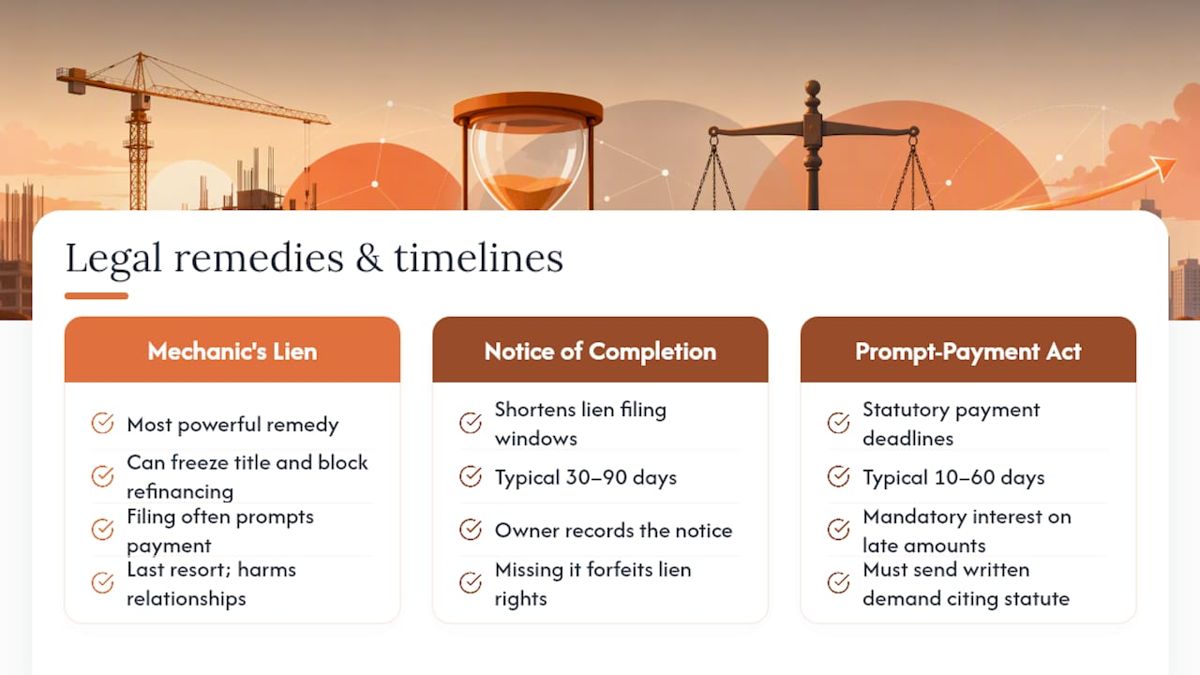
Notice of completion affects lien filing windows. Once an owner records a notice of completion, most states start a shortened clock for subs to file. Typical windows range from 30 to 90 days after the notice, but the exact deadline is state-specific. Missing it forfeits your lien rights entirely.
Prompt-payment acts exist in every state and set statutory timelines for payment after an application is approved. Many states require payment within 10–60 days and impose mandatory interest on late amounts, with some statutes also allowing attorney-fee awards for prevailing claimants.
Key point: Prompt-payment statutes are not self-executing. You must send a written demand that cites the applicable statute and states the interest accruing. A demand letter that references the statute and calculates the daily interest rate often produces payment faster than any other step short of a lien filing.
Pro Tip: Before sending a demand letter, confirm your state’s prompt-payment statute applies to your contract type (public vs. private, prime vs. sub). Public projects often carry stronger remedies and shorter payment windows than private ones.
Contract provisions and bidding tactics that reduce payment risk
The best time to protect your cash flow is before you sign the subcontract.
Contract items to negotiate or verify:
- Payment schedule tied to owner draw cycles, with a hard deadline after GC receipt of funds
- Retainage cap at 5–10% (ideally at the lower end of the range) and a milestone-based release for early-finishing trades
- Removal or limitation of pay-if-paid language, or a carve-out for owner insolvency
- Explicit dispute-resolution timeline for change orders (30 days is a reasonable ask)
- Escrow or joint-check arrangement on large retainage balances
Questions to ask during bidding:
- Who finances this project, and has the construction loan closed?
- What is the typical time from your pay-app submission to owner funding?
- What documents do you require with each pay application?
- How are change orders approved, and what is the average turnaround?
- Has retainage been released on time on your last three projects?
Pro Tip: Ask for a sample pay-app package from the GC before mobilizing. If they can’t produce one, that tells you something about how organized the payment process will be.
Operational fixes: documentation, workflows, and software that speed approval
Fixing payment delays often comes down to fixing your own submission process before blaming the GC.
Recommended pre-submission workflow:
- Reconcile your schedule of values against actual work in place
- Complete the G702/G703 with correct math and attach all backup
- Generate a conditional progress payment lien waiver tied to the exact payment amount
- Attach current COI, certified payroll (if required), and any approved change-order documentation
- Send with a brief cover email that lists every enclosed document
Three operational fixes that shorten approval cycles:
| Fix | What it does | Common rejection it prevents |
|---|---|---|
| Three-way matching | Aligns pay app, schedule of values, and waiver dollar amounts | Amount mismatches that trigger GC review holds |
| Automated waiver generation | Ties waiver to specific pay-app line items | Missing or wrong-amount waivers |
| Retainage subledger | Tracks withheld amounts per project and release conditions | Missed retainage at closeout |
Maintaining a retainage subledger and running monthly WIP reviews can cut retainage collection time by exposing missing paperwork early, before the closeout scramble.
Pro Tip: Pair your lien-waiver generation directly with your accounting or construction management software. When waivers are created at the point of payment rather than chased down afterward, missed documentation drops sharply.
How Waiverpilotpro reduces waiver-related payment delays
Lien waivers are the single most common document that holds up a payment check. Waiverpilotpro addresses that directly.
- All waiver types covered: conditional progress, unconditional progress, conditional final, and unconditional final waivers with state-specific templates built in
Pro Tip: Use the conditional waiver for every progress payment and switch to the final waiver of lien only after retainage has cleared your bank account. Never sign an unconditional waiver before funds are confirmed.
Step-by-step checklist to submit a pay application that won’t get kicked back
Use this before every submission.
- Reconcile your schedule of values — confirm percent complete on each line item matches site progress
- Complete AIA G702 (cover sheet) and G703 (continuation sheet) with correct math
- Attach all approved change orders with backup documentation
- Generate a conditional lien waiver for the current payment amount (note retainage in exceptions)
- Attach a current certificate of insurance
- Include certified payroll if the project is prevailing-wage or publicly funded
- Prepare a cover email listing every enclosed document by name
- Submit by the GC’s stated cutoff date — late submissions roll to the next cycle
Cover email essentials: project name and number, billing period, payment amount requested, list of attachments, and a request for written confirmation of receipt.
Pro Tip: Log every submission with a timestamp and request a reply confirming receipt. That timestamp becomes your evidence if a prompt-payment clock dispute arises later.
If payment is late: an escalation and collection roadmap
Late payment requires a measured response. Escalating too fast damages relationships; waiting too long forfeits legal rights.
- Days 1–7 past due: Send a polite written follow-up referencing the contract payment date and asking for a status update
- Days 8–14: Send a formal written demand citing the contract clause, the amount owed, and the applicable state prompt-payment statute; include accruing interest calculation
- Day 15–21: If no response, send a notice of intent to suspend work (where permitted by contract and state law)
- Before lien deadline: File a mechanic’s lien if payment is not received; confirm your state’s filing window from the last date of work or notice of completion
- Post-lien: Pursue mediation or arbitration per the contract’s dispute-resolution clause before committing to litigation
- Last resort: Litigation, with counsel, when the amount justifies the cost and other remedies have failed
Decision triggers for escalating faster: owner insolvency signals (project financing pulled, other subs unpaid), GC not funding draws despite owner payment, or statutory lien deadline within 14 days.
Pro Tip: Send preliminary notices early in the project, even when payment is current. Preliminary notices preserve your lien rights and signal to the GC that you track compliance. Many subs skip this step and lose lien rights before a dispute even starts.
- Keep all correspondence in writing, even if the initial conversation is verbal
- Document every site visit, delivery, and milestone with dated photos and logs
- Never release retainage rights in a waiver before the retainage check clears
Key Takeaways
Retainage stacking, incomplete pay applications, and missing lien waivers are the three most controllable causes of construction payment delays, and fixing all three starts before you submit your next pay app.
| Point | Details |
|---|---|
| Retainage runs 5–10% and stacks | Withheld at every tier; negotiate scope-based releases and build a buffer into bids. |
| Complete pay apps prevent cycle resets | A single missing document (G702/G703 error, wrong waiver amount) pushes payment 30 days. |
| Legal remedies require timing | Prompt-payment acts and lien windows are state-specific; missing a deadline forfeits your rights. |
| Retainage subledger cuts collection time | Monthly WIP reviews expose paperwork gaps early, before closeout pressure builds. |
| Waiverpilotpro removes waiver friction | Free conditional and final waivers with auto-calculated fields and software integrations reduce the most common cause of pay-app rejections. |
The admin gap is the real payment problem
The construction industry talks about payment delays as if they are purely a cash or relationship problem. They are not. Most of the delays I see diagnosed in practice come down to a documentation gap that nobody caught until the GC kicked back the pay app.
A profitable sub with a full crew and a signed contract still ends up waiting 90 days because a waiver had the wrong amount, or because retainage was never tracked in a subledger and the closeout paperwork was missing. The money was there. The process was not.
The firms that get paid faster are not necessarily the ones with the best GC relationships. They are the ones who submit clean packages every single cycle, who know their lien windows, and who treat the pay-app process as a discipline rather than an afterthought. That shift in mindset, paired with the right tools, closes the gap faster than any contract negotiation.
Waiverpilotpro: generate your lien waivers in minutes, not hours
Chasing down waiver paperwork after a pay app is already submitted costs you days and sometimes an entire billing cycle. Waiverpilotpro gives you a faster path.
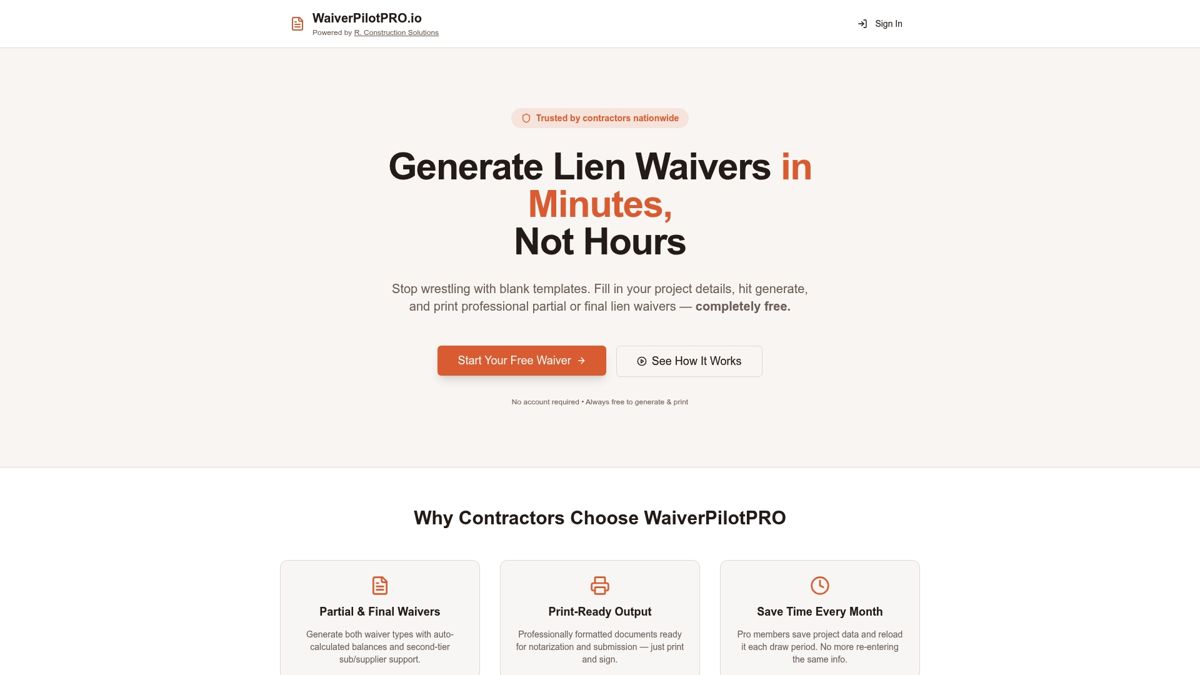
- Free lien waiver generator: — generate conditional and final waivers at no cost, with state-specific templates and auto-calculated payment fields
Generate your first waiver now at the free lien waiver generator and attach it to your next pay app before the GC’s cutoff.
Useful sources and references
- Why Retainage Remains a Persistent Challenge for Subs Nationwide … and What You Can Do to Manage the Risks — FASA
- What Is a Lien Waiver? How To Manage Construction Payment Risk
- What Is a Construction Holdback and How Does It Work? — LegalClarity
- How to Improve the Subcontractor Payment Process | AIA Contract Documents
- Construction cash flow: why subcontractor payments are often late (PowerHomeBiz)
- How to Collect Construction Retainage Faster | Northstar Financial Advisory
- Construction Payment Management: The Complete Guide | Corpay
This article is general information, not legal advice. Prompt-payment statutes, lien deadlines, and retainage rules vary by state and contract type. Confirm current rules with your state’s statutes or a qualified construction attorney.