
Joint Payment in Construction: What Contractors Must Know
A joint payment in construction is a single check or payment instrument made payable to two or more parties at the same time. The industry term you’ll hear most often is a joint check. Its core purpose is straightforward: make sure funds actually reach every party in the payment chain, from the general contractor (GC) down to subcontractors and material suppliers.
Here is why this matters to you. On most projects, an owner pays the GC, the GC pays subs, and subs pay their suppliers. When that chain breaks, unpaid parties can file mechanic’s liens against the property. A joint check short-circuits that risk by requiring every named payee to endorse the check before anyone can cash it.
Key elements of a joint payment:
- Single payor: typically the owner or GC
- Multiple payees: usually a subcontractor and a lower-tier supplier listed together on the check
- Endorsement requirement: all named parties must sign before the check clears
- Legal context: Section 9.5.4 of AIA A201-2017 explicitly allows owners to issue joint checks when a contractor fails to pass payment downstream
- Common goal: prevent lien claims and double-payment exposure for owners and GCs
Joint checks are not the same as direct payments, where an owner bypasses the GC entirely and pays a sub directly. They are also distinct from retainage, which is a withheld percentage released at project completion. A joint check keeps the normal payment structure intact while adding a layer of accountability.

How joint checks work in construction payment processes
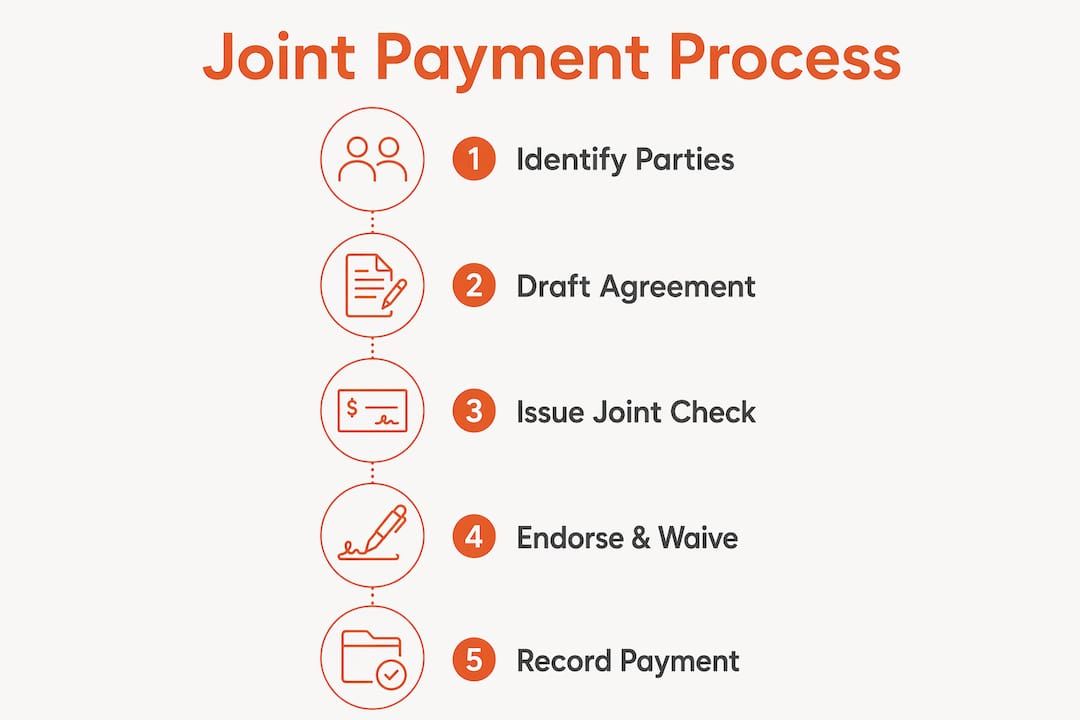
The typical payment cycle on a commercial project occurs regularly. A GC submits a pay application, the owner releases funds, and the GC distributes payments to each sub. A joint check enters that flow when someone in the chain needs extra assurance that money will reach its intended destination.
Here is how the process usually unfolds:
- The GC (or owner) prepares a check naming both the subcontractor and the supplier as co-payees.
- The check is delivered to one of the payees, often the subcontractor.
- Both parties must endorse the check before it can be deposited.
- The subcontractor typically endorses first, then hands the check to the supplier, who deposits it and remits any excess back to the sub.
- The GC records the payment against the schedule of values and the relevant pay application line items.
This process differs from standard progress billing, where the GC simply cuts a check to the sub and trusts them to pay their suppliers. With a joint check, the supplier gains direct visibility into every payment and can withhold endorsement if the amount is wrong. That leverage is the whole point.
Joint checks also intersect with lien waiver documentation. Best practice ties each joint check to a conditional lien waiver, so the supplier releases lien rights only for the amount actually paid. Keeping those documents aligned prevents disputes over what was covered by which payment.
Parties commonly involved in joint check arrangements include:
- Owners issuing checks to the GC and a first-tier sub
- GCs issuing checks to a sub and that sub’s material supplier
- First-tier subs issuing checks to their lower-tier subs or specialty suppliers
- Sureties, who may require joint checks on bonded projects to limit bond exposure
Legal and contractual considerations for joint checks
The legal framework around joint checks is more complex than the mechanics suggest. Getting it wrong can expose you to liability you never intended to take on.
AIA A201-2017, Section 9.5.4 is the most widely cited standard on this topic. It states that the owner may, at its sole option, issue joint checks to the contractor and any subcontractor or supplier when the contractor has failed to make payment for work properly performed. The contractor and architect must then account for that payment on subsequent pay applications. That “sole option” language is deliberate: the owner is not obligated to issue joint checks, and the provision does not create a duty to do so.
Key legal principle: Issuing a joint check without express authorization in the subcontract may constitute a breach of that subcontract. The GC must obtain the subcontractor’s consent before making joint payments, ideally through contract language giving the GC the right, but not the obligation, to issue joint checks.
The Joint Check Rule adds another layer of risk. Under this rule, adopted in various forms across multiple states, a supplier’s endorsement of a joint check creates a legal presumption that the supplier received all sums owed at that time, even if the actual payment was partial. That presumption can extinguish lien rights and bond claims, which is a serious consequence for an unwary sub or supplier.
Additional legal considerations:
- Written authorization matters: a subcontract should include express language permitting the GC to issue joint checks at its option, not as a requirement
- Lien rights: endorsement can be treated as a release of mechanic’s lien rights in jurisdictions that follow the Joint Check Rule
- Miller Act projects: on federal public works, endorsement of a joint check alone generally does not release Miller Act payment bond rights unless a specific joint check agreement expressly states otherwise
- Privity concerns: a series of joint payments to a lower-tier party can create an implied contractual relationship between the owner and that party, potentially expanding the owner’s direct payment obligations
- Accounting obligation: under AIA A201-2017, any joint check issued by the owner must be reflected in subsequent payment applications to avoid double-counting
Formal written joint check agreements, drafted with legal counsel, are the clearest way to define each party’s rights and prevent these issues from surfacing mid-project.
Risks and benefits of using joint checks on your project
Joint checks offer real protection, but they carry genuine risks too. Understanding both sides helps you decide when to use them and how to structure them properly.
Benefits:
- Payment transparency: every named payee sees exactly what is being paid and for what work
- Lien protection: joint checks reduce the likelihood of mechanic’s liens by ensuring suppliers receive funds directly
- Double-payment defense: GCs and owners gain protection against paying twice for the same work or materials
- Supplier confidence: material suppliers are more willing to extend credit and keep shipping when a joint check arrangement is in place
- Project continuity: steady material supply reduces the risk of work stoppages caused by unpaid vendors
Risks:
- Endorsement dilemma: a subcontractor who refuses to endorse can delay the entire payment, creating friction and potential project slowdowns
- The Joint Check Rule trap: without a written agreement, a supplier who endorses a joint check may inadvertently waive claims to unpaid balances, as established in cases like Brown Wholesale Electric, Inc. v. Beztak of Scottsdale, Inc.
- Accounting complexity: joint checks that are not tied to specific invoices or schedule of values line items create payment disputes and credit confusion
- Unintended obligations: ad hoc joint checks issued by an owner without a formal policy can shift direct payment responsibility to the owner
- Breach of subcontract: issuing a joint check without subcontract authorization may expose the GC to a breach claim
Pro Tip: Never issue a joint check without a written agreement in place first. The agreement should specify which invoices the check covers, confirm that endorsement acknowledges only the amount actually paid, and preserve each party’s lien rights for any unpaid balance.
Joint checks are a tool, not a guarantee. Used without discipline, they can create more problems than they solve.
Best practices for managing joint payments effectively
The difference between a joint check that protects everyone and one that creates a legal mess usually comes down to documentation and process.

Start with the subcontract. Include express language giving the GC the right, but not the duty, to issue joint checks. Language like “Contractor may, but is not obligated to, issue joint checks to Subcontractor and any of its suppliers” is a standard starting point. This prevents a unilateral joint check from being characterized as a breach.
Use a written joint check agreement for every arrangement. A solid agreement covers:
- The specific project and contract it applies to
- Which parties are bound and their respective roles
- The scope of payments covered (specific invoices or date ranges)
- A clear statement that endorsement acknowledges only the amount actually paid, not full satisfaction of all sums owed
- Lien waiver requirements tied to each payment
- Delivery procedures, including whether the sub must come to the GC to endorse or whether the GC delivers the check directly to the supplier
Tie every joint check to a conditional lien waiver. Requiring a conditional waiver limited to the exact amount of the check protects the GC and owner from broad releases that reach beyond what was actually paid. Never accept a final waiver in exchange for a progress payment.
Reflect joint payments on the schedule of values. If a joint check is not clearly accounted for in the pay application, you risk double-counting or disputes about what was covered. Under AIA A201-2017, the contractor and architect must adjust subsequent applications to reflect any joint check the owner has issued.
Pro Tip: If you manage multiple subcontractors and suppliers across a project, use construction management software that integrates payment tracking with your lien waiver workflow. Platforms like Procore and QuickBooks, which connect directly with Waiverpilotpro, make it much easier to keep joint check records and waiver documentation aligned.
Involve legal counsel before signing any joint check agreement. A poorly drafted agreement can expand your liability rather than limit it. For example, language that guarantees payment to a supplier or creates a direct contractual relationship between the GC and a lower-tier party can negate the protections you were trying to create. Good document-sharing practices across your project team also help ensure that everyone working with these agreements is using the current, approved version.
Joint checks work best when they are part of a defined payment policy, not a one-off workaround. Treat each one like a mini-amendment to your payment flow and document it accordingly.
Protect your lien rights every time you get paid
Joint checks and lien waivers go hand in hand. Every time you endorse a joint check, you need a waiver that accurately reflects what you were actually paid, not a blanket release that surrenders your rights to unpaid amounts.
Waiverpilotpro makes that process fast and free. Generate conditional and final lien waivers in minutes, with auto-calculated balances and direct integration with Procore, QuickBooks, and other platforms you already use. No account required to get started.
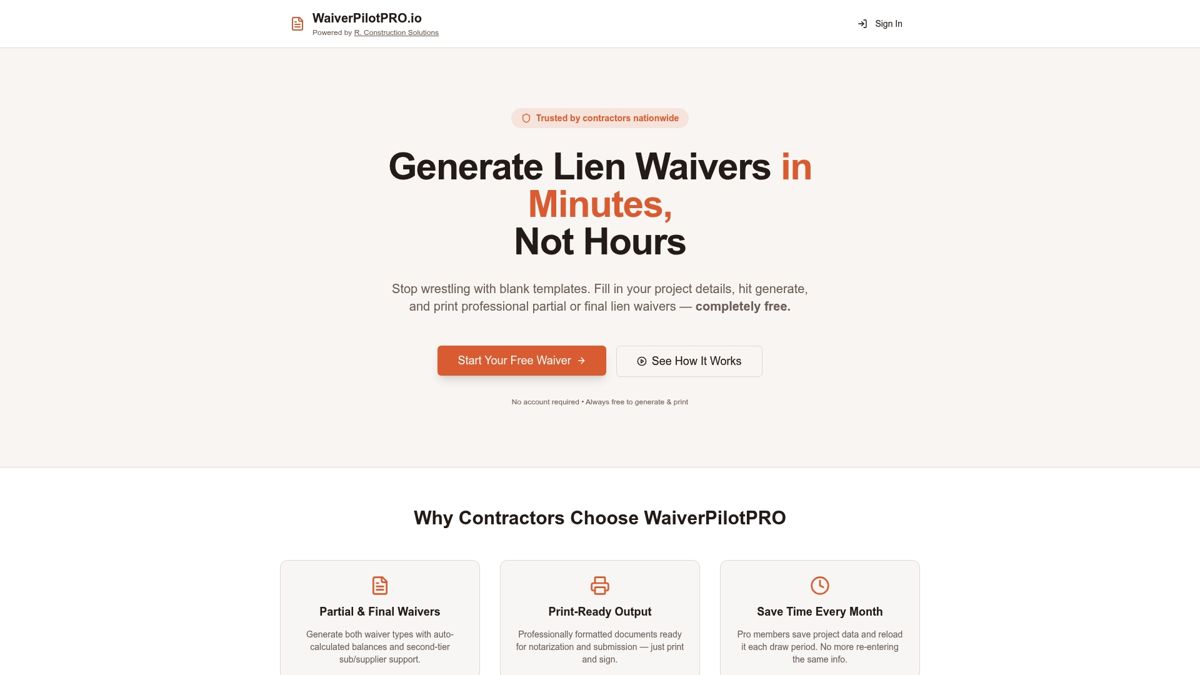
Generate your free lien waiver and make sure your documentation matches every joint check you receive.
Key Takeaways
Joint payments in construction require written agreements, proper lien waiver documentation, and express subcontract authorization to protect every party in the payment chain.
| Point | Details |
|---|---|
| Joint check definition | A check made payable to two or more parties, requiring all named payees to endorse before it can be cashed. |
| AIA A201-2017 authority | Section 9.5.4 gives owners the option, not the obligation, to issue joint checks when a contractor fails to pass payment downstream. |
| Joint Check Rule risk | Endorsing a joint check without a written agreement can create a legal presumption of full payment, potentially waiving lien rights for unpaid balances. |
| Written agreement required | A formal joint check agreement must specify covered invoices, parties, endorsement limits, and lien waiver requirements to prevent unintended liability. |
| Lien waiver coordination | Every joint check should be paired with a conditional lien waiver limited to the exact amount paid, not a broad final release. |