
Notice of Completion Explained: What Contractors Must Know
A Notice of Completion (NOC) is a document recorded by a property owner with the county recorder that officially establishes the date a construction project was completed. In states that recognize it, recording an NOC typically shortens the window mechanics-lien claimants have to file, which is why understanding this document matters whether you own the project or worked on it.
The NOC is recognized with lien-shortening effect in roughly eight U.S. states, including California, Utah, and Nevada. If you’re a subcontractor or supplier in one of those states and an NOC gets recorded on your project, your deadline to file a mechanics lien may be cut significantly shorter than the default period. Missing that shortened window can mean losing your lien rights entirely.
Table of Contents
- What is a Notice of Completion and why do owners record it?
- How does an NOC change your mechanics-lien deadline?
- Who can record an NOC, where does it go, and when?
- What information must a valid NOC include?
- How do NOC rules differ by state?
- What should you do when an NOC is recorded on your project?
- How does a Notice of Completion differ from related documents?
- What mistakes do owners make when recording an NOC?
- What the research and statutes actually say
- Key Takeaways
- The part most owners and contractors get wrong
- Pair your NOC process with the right lien waiver tools
- Where to check the exact rules for your state
What is a Notice of Completion and why do owners record it?
An NOC is a recorded legal instrument, signed by the owner or the owner’s authorized agent, that fixes the official completion date of a construction project in the public record. Think of it as the owner’s formal declaration that the work is done, filed with the county recorder so the world can see it.

Owners record an NOC for three practical reasons: to shorten their exposure to mechanics-lien claims, to speed up title clearance (lenders and title companies want to see the lien period close), and to trigger the clock on final payment resolution with contractors and suppliers.
What an NOC does for owners:
- Shortens the lien filing window for claimants in states that recognize it, reducing the period during which liens can cloud the title
- Establishes a clear, documented completion date that can be referenced in disputes
- Signals to lenders and title insurers that the project is closed out
- Prompts contractors and suppliers to submit final invoices and lien waivers
What an NOC does NOT do:
- It does not confirm that anyone has been paid
- It does not replace conditional or unconditional lien waivers, which are the actual instruments that release lien rights in exchange for payment
- It does not automatically cancel a subcontractor’s lien rights if the statutory filing window is still open
- It does not serve as a final payment document or a release of claims
Whether recording an NOC is voluntary or carries statutory effect depends entirely on state law. In California, Utah, and Nevada, the statute gives the recorded NOC direct legal consequences for lien deadlines. In states that don’t recognize it, recording one may have no effect on lien timelines at all.
How does an NOC change your mechanics-lien deadline?
The core legal effect of an NOC in states that recognize it is simple: it replaces the longer default lien window with a shorter one. Without an NOC, claimants typically have a generous period after project completion to file a mechanics lien. Once an owner records a valid NOC, that window shrinks.
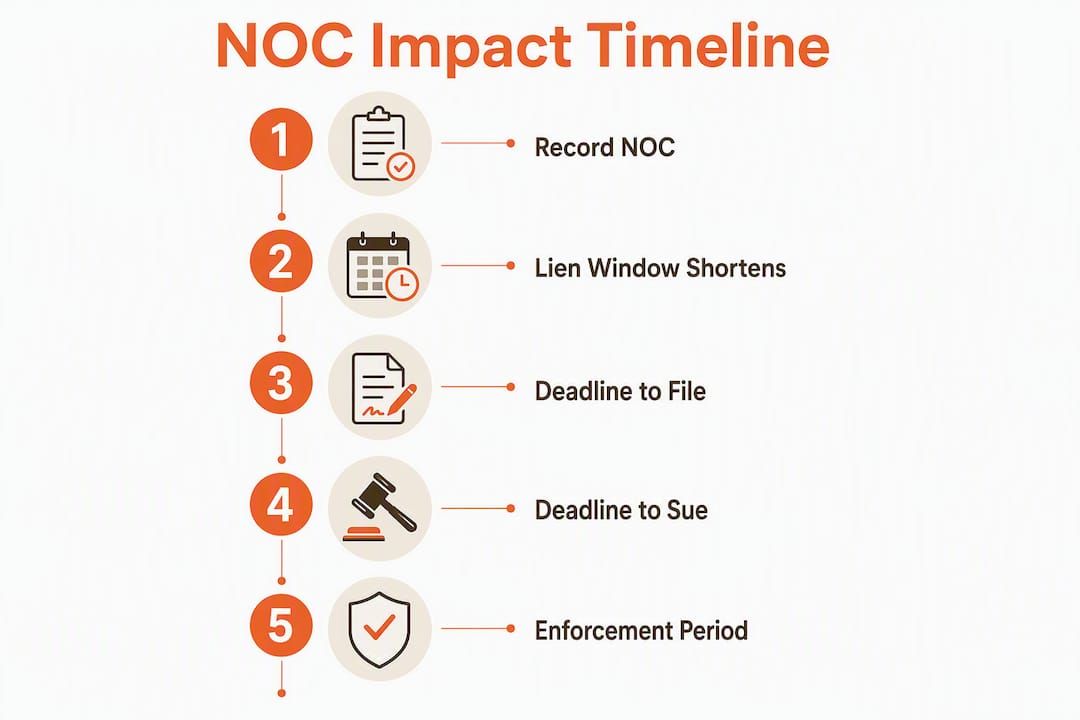
The concrete state examples make this real. In Utah, recording an NOC can shorten the lien filing period from 180 days down to 90 days. In Nevada, the default 90-day window drops to 40 days after a valid NOC is recorded. California’s rules are more layered, with deadlines varying by claimant type and whether the claimant had a direct contract with the owner or worked further down the chain.
Beyond lien filing deadlines, an NOC can also affect the deadline to bring a lawsuit to enforce a lien, since enforcement deadlines often run from the lien filing date. Service requirements matter too: in California, owners who record an NOC must notify parties who filed a preliminary notice, because that service is what triggers the shortened window for those claimants.
What counts as “completion” varies by statute. Some states define it as the date of final inspection or issuance of a certificate of occupancy. Others use a continuous 60-day cessation of labor as the trigger. Knowing your state’s definition matters because recording an NOC before the statutory completion date can create its own problems.
Who can record an NOC, where does it go, and when?
The owner of the property is the typical filer. In most states, an owner’s authorized agent (such as a construction manager or attorney) may record on the owner’s behalf. Some states allow the direct contractor to record in limited circumstances, but that is the exception rather than the rule. State statutes define who qualifies, so confirm the rule for your jurisdiction before proceeding.
The NOC is recorded with the county recorder’s office (sometimes called the registrar of deeds) in the county where the property sits. Many counties now accept electronic recording through vendors like Simplifile or eRecording Partners Network, which speeds up the process and creates a timestamped digital record. Recording fees and e-recording availability vary by county, so check the county recorder’s website or call ahead.
Timing is where owners most often stumble. Most states that recognize NOCs set a tight window for recording, commonly 10–15 days after the completion date. Miss that window and the NOC loses its lien-shortening power. The owner still has a recorded document, but claimants get the full default period.
After recording, service is often required. In California, for example, owners must serve the recorded NOC on parties who filed a preliminary notice. Best practice is to send service by certified mail with return receipt and keep the proof of service in your project file. That documentation can be critical if a claimant later disputes whether the shortened window applies to them.
What information must a valid NOC include?
A legally effective NOC must contain specific fields, and errors or omissions can render it ineffective for shortening lien deadlines. The exact requirements vary by state, but these fields appear consistently across statutes:
- Legal description of the property: The full legal description from the deed, not just the street address. This is the field most prone to error.
- Street address: Include the physical address as a secondary identifier.
- Owner’s name and interest: The name of the owner of record and the nature of their interest (fee owner, lessee, etc.).
- Direct contractor’s name: Required in many states when a prime contract exists.
- Date of completion: The actual date the work was completed under the applicable statutory definition.
- Signature: The owner or authorized agent must sign the document.
- Notarization: Required in many jurisdictions. Check your state’s statute.
An incorrect legal description is the most common fatal error. If the description doesn’t match the deed, the NOC may be deemed ineffective, leaving the owner exposed to the full default lien period. A wrong completion date creates similar risk.
Pro Tip: Pull the legal description directly from the recorded deed or title report, not from the construction contract or permit. The deed description is the authoritative version, and even minor discrepancies can give claimants grounds to challenge the NOC’s validity.
For projects where only a portion of the work is complete, some states allow a partial NOC covering a defined portion of the property. This is a specialized filing and typically requires careful legal review to confirm the partial description is accurate and the statute permits it.
You can handle the sign-off process electronically using tools like ksign.co, which captures practical completion data digitally and creates a timestamped record useful for supporting your NOC filing.
How do NOC rules differ by state?
The table below shows how an NOC affects lien filing windows in several commonly referenced states. These figures come from statutory sources and the Seyfarth 50-state lien law guide; always verify the current rule with the applicable state statute and county recorder.
| State | Default lien window | Window after valid NOC | Key statutory reference |
|---|---|---|---|
| California | Varies by claimant type | Shortened; varies by claimant type | Cal. Civ. Code §8182 |
| Utah | 180 days | 90 days | Utah Code §38-1a-507 |
| Nevada | 90 days | 40 days | — |
| Tennessee | Varies | Varies; NOC affects claimant rights | Tenn. Code Ann. Title 66 |
| Arizona | — | Varies by circumstance | A.R.S. §33-993 |
California’s rules deserve a specific note. Under Cal. Civ. Code §8182, an owner may record an NOC on or within 15 days after the completion date. The shortened deadlines apply differently depending on whether the claimant had a direct contract with the owner or worked as a subcontractor or supplier further down the chain. Owners must also serve the NOC on parties who filed a preliminary notice to trigger those shortened windows.
Tennessee’s rules restrict who may file an NOC and treat it as a meaningful owner tool for reducing lien risk, but the specifics differ from California’s framework. Arizona’s statute at A.R.S. §33-993 sets its own timeline and content requirements.
Utah’s State Construction Registry provides an online portal for filing an NOC, which is worth bookmarking if you work on Utah projects.
For exact, current rules in your state, go directly to the state statute and your county recorder’s website. The Seyfarth 50-state guide is a reliable starting point for cross-state comparisons, but statutes change and county procedures vary.
What should you do when an NOC is recorded on your project?
If you’re a contractor, subcontractor, or supplier and an NOC hits the public record on a project where you’re owed money, your response window may be much shorter than you think. Here’s the sequence to follow:
-
Confirm the recorded NOC. Search the county recorder’s database for the property address. Verify the recording date, the named parties, and the stated completion date. Check whether the legal description matches the property where you worked.
-
Check whether you were served. If you filed a preliminary notice on the project, the owner may have been required to serve you with the recorded NOC. If you weren’t served when service was required, the shortened window may not apply to you. Document this either way.
-
Verify your last date of furnishing. Your lien deadline typically runs from your last date of work or material delivery, not from the NOC recording date. Confirm that date from your own records, delivery receipts, and timesheets.
-
Assess whether your preliminary notice is still valid. In states like California, a preliminary notice is a prerequisite for filing a mechanics lien. If you haven’t served one yet, check whether the deadline to do so has passed.
-
Calculate your remaining lien window. Apply the shortened period to the NOC recording date (or the completion date, depending on your state’s rule) and mark the deadline on your calendar. Build in buffer time for document preparation.
-
Gather your documentation. Collect contracts, change orders, invoices, delivery receipts, and any payment records. You’ll need these to support a lien claim or a payment demand.
-
Pursue payment or file your lien. Send a formal payment demand first. If payment isn’t forthcoming and the deadline is approaching, file your mechanics lien. Learning how to fill out a lien waiver correctly is also worth doing now, since a payment resolution will require one.
-
Consult a construction attorney if the NOC looks invalid. If the NOC was recorded late, contains an incorrect legal description, or was filed by someone without authority, you may have grounds to challenge it. An attorney can assess whether the full default lien period still applies to your claim.
How does a Notice of Completion differ from related documents?
Confusion between an NOC and other construction documents is common, and the distinctions carry real legal weight.
Notice of Completion vs. Notice of Cessation: Both are owner-recorded documents, but they serve different purposes. An NOC declares that the project is finished. A Notice of Cessation declares that work has stopped, typically after a continuous period of inactivity (often 30 or a continuous 60-day cessation of labor as the trigger depending on the state), even though the project isn’t complete. Both can shorten lien windows in states that recognize them, but they apply to different factual situations.
NOC vs. preliminary notices: A preliminary notice (sometimes called a pre-lien notice) is filed by a claimant, not the owner, to preserve the right to file a mechanics lien. It’s a protective step for contractors and suppliers. An NOC is an owner action. The two documents interact: in California, an owner’s NOC must be served on parties who filed preliminary notices to trigger shortened deadlines for those claimants.
NOC vs. lien waivers: This is the most important distinction. An NOC does not confirm payment and does not release anyone’s lien rights. A lien waiver is a contractual document signed by the claimant in exchange for payment, relinquishing their right to file or enforce a lien. The two documents serve completely different functions. An owner who records an NOC but fails to collect lien waivers still faces potential lien exposure from unpaid claimants within the filing window.
Common misconceptions, corrected:
- “An NOC means everyone has been paid.” False. It means the owner has declared the project complete. Payment status is a separate matter.
- “An NOC automatically cancels a subcontractor’s lien rights.” False. It shortens the window in states that recognize it, but lien rights remain intact until the deadline passes or a waiver is signed.
- “An NOC works the same way in every state.” False. Roughly eight states give it lien-shortening effect. In others, it may have no statutory impact on lien deadlines at all.
What mistakes do owners make when recording an NOC?
Recording an NOC looks straightforward on paper, but procedural errors are common and the consequences can be significant. A late recording or an erroneous legal description can leave owners exposed to the full default lien period, defeating the entire purpose of filing.
Owner checklist for a valid NOC:
- Confirm the exact statutory completion date definition for your state before selecting the date
- Pull the legal description from the recorded deed, not from the permit or contract
- Record within the state’s required window (commonly 10–15 days after completion)
- Name all required parties correctly, including the direct contractor where required
- Have the document notarized if your state requires it
- Serve the recorded NOC on all parties who filed a preliminary notice, and keep proof of service
- Use e-recording vendors like Simplifile to get a timestamped confirmation of recording
What happens when owners get it wrong:
- Late recording: The NOC is ineffective for shortening lien windows. Claimants get the full default period.
- Wrong legal description: Claimants can challenge the NOC’s validity, potentially restoring the longer default window.
- Failure to serve preliminary notice filers: In states like California, the shortened window may not apply to those claimants, even if the NOC itself is valid.
- Wrong named parties: Can create ambiguity about which project or contract the NOC covers.
Avoiding these errors is largely an administrative discipline. Pairing your NOC process with a project closeout checklist, and having a construction attorney review the document before recording, reduces risk considerably. Documentation mistakes in construction closeout are a leading source of project delays and disputes, and an invalid NOC is one of the more avoidable ones.
What the research and statutes actually say
The most important clarification from the statutory record is this: an NOC is not a universal rule. It carries lien-shortening effect in roughly eight U.S. states, according to the Seyfarth 50-state lien law guide. If you’re working in a state outside that group, an owner recording an NOC may have no effect on your lien deadline at all.
The statutes that do recognize NOCs are specific about what triggers the shortened period. California Civil Code §8182 sets the 15-day recording window and ties the shortened deadlines to claimant type and whether service was completed. Utah’s statute at §38-1a-507 sets the 180-to-90-day reduction. Nevada’s rules drop the window from 90 to 40 days. These are not interchangeable.
Common misconceptions the statutes correct:
- “An NOC equals final payment.” The statutes say nothing of the kind. Payment is confirmed through invoices, receipts, and lien waivers, not through an owner’s recorded completion notice.
- “An NOC releases liens.” It does not. Lien rights survive until the filing window closes or a waiver is signed.
- “Recording an NOC is enough to protect the owner.” Not without proper service, accurate content, and timely recording. All three conditions must be met for the NOC to have its intended effect.
- “The shortened window starts on the recording date.” In some states it does; in others it runs from the completion date stated in the NOC. Read the statute for your state.
Key Takeaways
A Notice of Completion shortens mechanics-lien filing windows in roughly eight U.S. states, but only when recorded within the statutory window, with accurate content, and with proper service on preliminary-notice filers.
| Point | Details |
|---|---|
| NOC effect is state-specific | Lien-shortening effect applies in roughly eight states; confirm your state’s rules before relying on an NOC. |
| Timing is critical | Most states require recording shortly after completion; missing this window removes the shortening effect. |
| Accuracy protects validity | An incorrect legal description or wrong completion date can make an NOC ineffective and expose owners to the full default lien period. |
| NOC is not a payment release | An NOC does not confirm payment or replace lien waivers; claimants retain lien rights until the window closes or a waiver is signed. |
| Waiverpilotpro pairs with NOC workflow | Use Waiverpilotpro’s free lien waiver generator alongside your NOC process to collect conditional and final waivers and close out payment properly. |
The part most owners and contractors get wrong
The NOC is one of those documents that looks simple until it isn’t. Owners treat it as a formality, record it without checking the legal description against the deed, miss the service requirement, and then discover months later that a subcontractor’s lien is valid because the shortened window never actually triggered.
What’s underappreciated is how much the NOC’s value depends on the steps that surround it. Recording the document is the easy part. Confirming the statutory completion date, pulling the correct legal description, serving every preliminary-notice filer by certified mail, and keeping proof of service in the project file, those are the steps that determine whether the NOC does what the owner intended.
For contractors and subcontractors, the practical lesson is equally clear: don’t assume the NOC is valid just because it’s recorded. Check the recording date against the completion date. Verify the legal description. Confirm whether you were served. If anything looks off, the full default lien period may still apply to your claim, and that’s worth knowing before you let a deadline slip.
The NOC is a useful tool. It’s just not a substitute for a complete closeout process, and it’s definitely not a substitute for getting paid and documenting that payment properly.
Pair your NOC process with the right lien waiver tools
Once an NOC is recorded, the next step is collecting lien waivers from every contractor and supplier who worked on the project. That’s where payment gets documented and lien rights get formally released.

Waiverpilotpro makes that part straightforward. The free lien waiver generator lets you create conditional and unconditional waivers in minutes, with state-specific templates and auto-calculated payment fields. No account required to get started. For teams managing multiple subcontractors or recurring projects, the Pro tier adds contract upload, AI-powered auto-fill, and multi-subcontractor support that connects with Procore, QuickBooks, Jobtread, Sage, and Buildertrend. The documents are professional-grade and notarizable, ready to submit alongside your project closeout package. Generate your first waiver free at Waiverpilotpro.
Where to check the exact rules for your state
Rules change, and county procedures vary. Use these authoritative sources to verify the current requirements before you record or respond to an NOC:
- California: Cal. Civ. Code §8182 via Leginfo for the full statutory text on NOC content, timing, and service requirements.
- Utah: Utah State Construction Registry for online NOC filing and Utah Code §38-1a-507 for the statute.
- Arizona: A.R.S. §33-993 via azleg.gov for Arizona’s NOC and lien requirements.
- Tennessee: State-specific FAQs explain filing mechanics and claimant rights; check the Tennessee Code Annotated Title 66 for the current statute.
- Cross-state comparisons: The Seyfarth 50-state lien law guide provides a matrix of notice and deadline differences across all 50 states and is a reliable starting point for multi-state work.
- County recorder lookup: Search your county recorder’s website directly to confirm recording fees, e-recording availability, and any local form requirements. Many counties accept electronic submissions through Simplifile or eRecording Partners Network.
For any situation involving disputed deadlines, an invalid NOC, or a lien claim that’s already been filed, consult a licensed construction attorney in your state. This article is general information, not legal advice, and lien law rules change frequently enough that verifying with a primary source or qualified professional is always the right call.