
Waiver Document Notarization Process: A Clear Guide
The waiver document notarization process is the official act of a commissioned notary public verifying a signer’s identity and voluntary consent, transforming a simple signature into a legally recognized verification. This process is governed by standards from bodies like the National Notary Association and the Revised Uniform Law on Notarial Acts (RULONA), which most states have adopted to standardize how notarizations are conducted. Notarization confirms the authenticity of a signature, not the document’s content, which is a distinction that matters enormously in legal disputes. Standard fees are modest, with state fee caps typically under $30 even for in-person sessions. Remote Online Notarization (RON) has expanded access significantly, making notarizing waiver documents faster and more flexible than ever before.
What are the legal requirements before notarizing a waiver document?
Getting your waiver ready before you walk into a notary’s office saves time and prevents rejection. The requirements are specific, and missing even one can force you to reschedule.
The core prerequisites for notarizing waiver documents are:
- Document must be unsigned (for jurat notarization). If the waiver requires a jurat, you must sign it in front of the notary. Signing beforehand invalidates the entire notarization.
- Valid government-issued photo ID. Most states require a photo ID such as a driver’s license or passport. The ID must be current, not expired, and must include both a photo and a signature.
- All fields must be completed. Leaving blank fields in a document before notarization gives notaries grounds to refuse. Fill in every field except the signature line and date.
- Know your notarization type. Waivers typically require either an acknowledgment or a jurat. An acknowledgment allows pre-signing; a jurat requires you to sign in the notary’s presence and swear an oath.
- Bring required witnesses. Some waiver documents require additional witnesses beyond the notary. Powers of attorney and certain liability waivers often fall into this category. Confirm witness requirements with the receiving party before your appointment.
- Check state-specific rules. Waiver notary requirements vary by state. California, for example, has specific acknowledgment certificate language that differs from states following RULONA verbatim.
Pro Tip: Call the entity receiving your waiver before you visit a notary. Ask them directly whether they need an acknowledgment or a jurat. This one question prevents the most common reason for re-notarization.
Understanding the difference between an acknowledgment and a jurat is the single most important prerequisite check. Many contractors and individuals assume any notarization type will do. That assumption causes delays and added cost.

How to complete the waiver document notarization process step by step
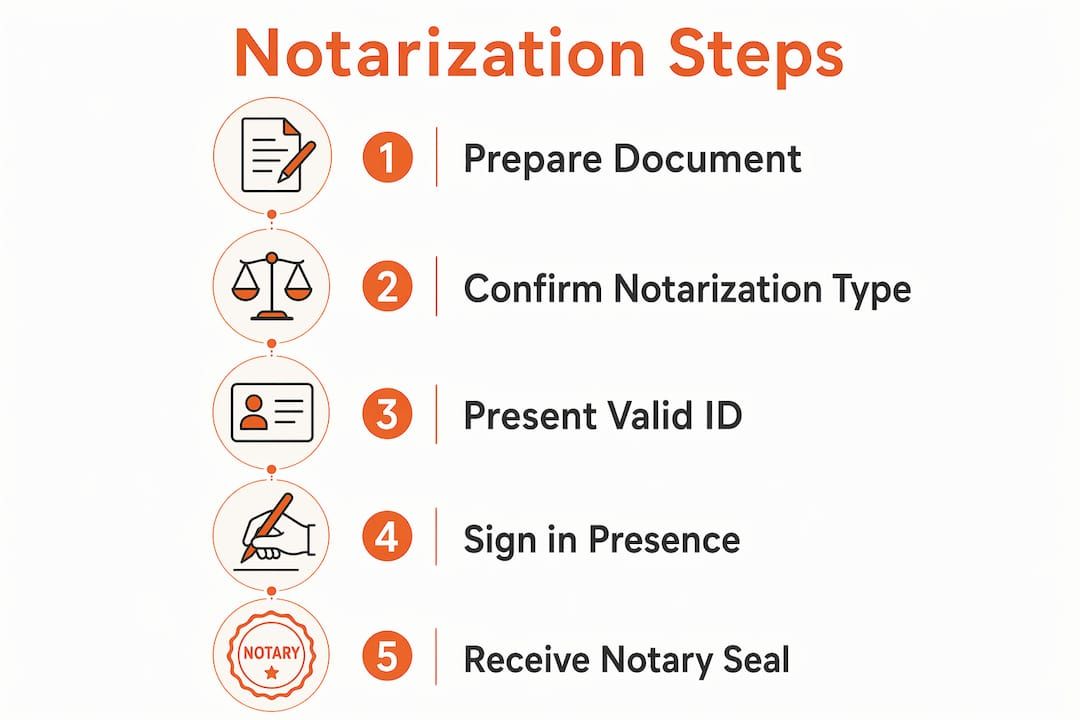
The step-by-step notarization process for a waiver document follows a clear sequence. Skipping any step, even briefly, can void the legal effect of the notarization.
-
Confirm whether your waiver requires notarization and which type. Not every waiver legally requires notarization. Lien waivers in states like California and Nevada mandate it; others do not. Check your state’s requirements or review the waiver form itself. If you are unsure whether your lien waiver needs a notary, Waiverpilotpro’s guide covers state-by-state rules in plain language.
-
Locate a commissioned and verified notary public. Banks, UPS stores, law offices, and public libraries commonly offer notary services for waivers. For construction-related waivers, confirm the notary is active and commissioned in your state. Notaries are prohibited from notarizing documents for relatives in some states due to conflict-of-interest rules, so choose an impartial notary.
-
Bring your completed, unsigned document and valid photo ID. Complete every field on the waiver before your appointment. Bring a government-issued photo ID that is current and includes your signature. If witnesses are required, coordinate their attendance in advance.
-
Sign the document in the notary’s presence (for jurat) or verbally acknowledge your signature (for acknowledgment). Bringing a pre-signed document for a jurat invalidates the process entirely. For an acknowledgment, you may have signed earlier, but you must appear in person and confirm the signature is yours.
-
The notary applies their official seal and signature. The notary stamps the document with their official seal, signs it, and completes the notarial certificate. This certificate language is prescribed by state law. Do not alter or remove it.
-
Receive your notarized document and confirm next steps. Some waivers must be filed with a county recorder’s office or submitted to a general contractor within a specific deadline. Understand the filing requirement before you leave the notary’s office. For lien waivers, filling out the form correctly before notarization is just as critical as the notarization itself.
Pro Tip: Ask the notary to review your document for completeness before you sign. Notaries see common errors daily and will often flag a blank field or missing date before it becomes a problem.
What are common mistakes during the waiver notarization process?
Most failed notarizations trace back to a short list of avoidable errors. Knowing them in advance keeps your waiver on track.
- Signing before the appointment for a jurat. Personal appearance is legally mandatory for traditional notarizations, and the notary must witness the actual act of signing for a jurat. Violations risk document invalidity and potential notary misconduct charges.
- Arriving without proper ID. A notary cannot legally proceed without verifying your identity. An expired license or a document without a photo will result in a failed appointment.
- Leaving fields blank. Notaries refuse to notarize incomplete forms to prevent fraud. Every field except the signature line must be filled before you arrive.
- Choosing the wrong notarization type. Incorrect notarization type or missing personal appearance results in document rejection or the need for re-notarization. Confirm the required type with the receiving party.
- Forgetting required witnesses. Failing to bring required witnesses results in a failed notarization transaction even when the notary is present and ready.
- Assuming notarization guarantees enforceability. This is the most widespread misconception in waiver document signing.
Notarization confirms that a signature is authentic and voluntary. It does not guarantee the waiver’s content is enforceable. Courts examine waiver language and intent independently, and poorly written waivers or those attempting to waive liability for reckless conduct can be struck down regardless of notarization.
If your notarization is rejected or flagged as incomplete, the fix is straightforward. Return with the correct ID, the right witnesses, and an unsigned document if a jurat is required. Most rejections are correctable within the same day.
What are the options for remote online notarization of waiver documents?
Remote Online Notarization (RON) is a fully legal alternative to in-person notarization in most of the country. RON is authorized in over 44 states and Washington, D.C. as of mid-2026, enabling complete notarization over a secure video call.
The identity verification process for RON is rigorous. Signers complete Knowledge-Based Authentication (KBA), which involves answering questions drawn from public records, and present a government-issued ID via webcam. States mandate that notaries keep audio-video recordings and digital journal logs of every remote session for a set number of years. That requirement actually makes RON more auditable than many in-person sessions.
| Feature | In-person notarization | Remote online notarization |
|---|---|---|
| Location requirement | Must appear physically | Any location with internet access |
| Identity verification | Government ID, in person | KBA plus government ID via webcam |
| Session record | Paper journal entry | Mandatory audio-video recording |
| Availability | Business hours, local notaries | 24/7 platforms in authorized states |
| Typical fee | $0–$25 per notarization | Platform fees vary; often $25 or more |
RON does have limits. Some states have not yet authorized it for specific document types, and certain receiving entities, such as county recorder offices, may still require a wet signature on a physical document. Always confirm with the receiving party before scheduling a remote session.
Pro Tip: Remote notarization combines modern technology with rigorous identity checks, making it a reliable option for contractors managing multiple waiver submissions across different job sites. Confirm your state’s RON authorization status before booking a platform session.
Key Takeaways
The waiver document notarization process requires the correct notarization type, complete documentation, valid ID, and physical or verified presence to produce a legally recognized result.
| Point | Details |
|---|---|
| Know your notarization type | Confirm whether your waiver needs a jurat or acknowledgment before your appointment. |
| Complete the document first | Fill every field except the signature line before visiting the notary. |
| Bring valid ID and witnesses | An expired or photo-less ID will stop the process; missing witnesses cause the same result. |
| Notarization is not enforceability | Courts assess waiver language independently; notarization only confirms the signature is authentic. |
| RON is a legal alternative | Remote Online Notarization is authorized in 44+ states and offers a fully auditable digital record. |
What I’ve learned about waiver notarization that most guides skip
Most articles on notarizing waiver documents treat the process as a simple checklist. The reality is that the most expensive mistakes happen before anyone walks into a notary’s office.
The single step I see skipped most often is confirming the notarization type with the receiving party. A contractor who assumes an acknowledgment is fine, when the general contractor’s compliance team requires a jurat, has to start over. That costs time and, in construction, time directly affects payment schedules.
The other thing worth saying plainly: notarization is not a substitute for well-drafted waiver language. I have seen notarized waivers thrown out in disputes because the release language was too broad or ambiguous. The notary’s seal confirms who signed and that they signed willingly. It says nothing about whether the waiver will hold up under scrutiny. Get the language right first, then notarize.
My practical advice for anyone managing multiple waivers, especially in construction, is to build a pre-notarization checklist and use it every time. Confirm the type, complete the form, gather witnesses, and verify your ID is current. That routine eliminates the vast majority of failed appointments. Scheduling a notary appointment for the same day you finalize a waiver is also a mistake. Give yourself a day to review the completed document before you sign anything in front of a notary.
— Rowena
Waiverpilotpro makes waiver preparation straightforward
Getting your waiver right before notarization is where most errors start. Waiverpilotpro is built specifically to eliminate that problem for contractors and construction professionals.

Waiverpilotpro’s free lien waiver generator produces professional-grade, notarizable documents with auto-calculated balances and support for multiple subcontractors, all without requiring account creation. The platform integrates with Procore, QuickBooks, and other construction management tools, so your project details flow directly into the waiver form. You can also download free construction waiver templates in PDF, Word, and Excel formats to use as a starting point. When your document is complete and accurate before you visit the notary, the notarization itself becomes the easy part.
FAQ
Does every waiver document need to be notarized?
No. Notarization requirements depend on state law and the document type. Lien waivers in states like California require notarization, while others do not.
What is the difference between a jurat and an acknowledgment for a waiver?
A jurat requires you to sign the waiver in the notary’s presence and swear an oath. An acknowledgment allows pre-signing but requires you to appear in person and confirm the signature is yours.
Can I notarize a waiver document online?
Yes, in most states. RON is authorized in 44+ states as of mid-2026, using video calls and Knowledge-Based Authentication to verify identity. Confirm your state’s authorization before booking a remote session.
Does notarization make a waiver legally enforceable?
Not automatically. Notarization confirms the signature is authentic and voluntary, but courts evaluate the waiver’s language and intent separately. A poorly written waiver can still be struck down.
How much does waiver notarization typically cost?
Standard notarization fees range from $0 to $25 depending on the state and session type. Remote online notarization platforms may charge more due to technology and identity verification costs.