
Statute-Backed Utah Lien Waivers: 7-Step Checklist for Contractors
A valid Utah lien waiver either matches the statutory language in Utah Code § 38-1a-802 or comes close enough to count as substantially similar, and it only takes legal effect once the payment it describes actually clears. Utah recognizes two official safe-harbor forms—progress and final—plus a restrictive check endorsement as an alternative to a signed form. You can pull the official templates from the Utah Department of Commerce and the State Construction Registry.
TL;DR:
- Using the correct statutory forms and matching the payment amount exactly are crucial, as non-conforming waivers are routinely rejected by title companies.
- Waivers only take legal effect once the specified payment actually clears, with bounced checks automatically voiding the waiver and reinstating lien rights.
- Check endorsements can replace formal waivers if they specifically state the payment type and are correctly worded; otherwise, the default is a progress waiver.
- Properly filed preliminary notices and current SCR project records are essential to preserve lien priority and avoid disputes over enforceability.
- Contractors should verify all waiver fields, signatures, and payment status before signing and use integrated tools for accurate, compliant waiver generation.
Table of Contents
- What Does Utah Law Actually Require for a Lien Waiver?
- Progress vs. Final Lien Waivers: Which Fields Matter?
- Can You Use a Check Endorsement Instead of a Separate Waiver?
- What Happens if the Check Bounces After You Sign a Waiver?
- How Do SCR Filings and Preliminary Notices Affect Your Waivers?
- A Step-by-Step Checklist Before You Sign or Accept a Utah Waiver
- How Waiverpilotpro Helps Utah Contractors Get Waivers Right
- Get a Compliant Utah Waiver Generated in Minutes, Not Hours
- Where This Perspective Comes From
- Sources
What Does Utah Law Actually Require for a Lien Waiver?
Utah Code § 38-1a-802 sets the baseline every waiver has to clear. The waiver must be signed by the claimant or someone with real authority to sign on their behalf, and it only becomes enforceable once the claimant actually receives the payment named in the document. Sign a waiver for a specified amount and get paid less, and the waiver only protects the amount actually received. That distinction trips up a lot of contractors who assume signing equals surrendering the whole claim.
The statute also builds in carve-outs that protect legitimate remaining claims. A properly drafted waiver does not wipe out:
- Retention held back under the contract
- Amounts tied to disputed change orders or unresolved billing items
- Work performed after the payment period the waiver covers
That last carve-out matters more than most people realize. If you sign a progress waiver covering work through March 15 and keep working after that date, the waiver has no bearing on the additional labor and materials. The statutory text at Findlaw spells this out precisely, which is why courts and title companies treat exact wording as more than a formality.
Progress vs. Final Lien Waivers: Which Fields Matter?
Utah’s two statutory forms look similar on the surface, but they serve different moments in a project and get scrutinized for different details. A conditional (progress) waiver applies to a partial payment mid-project. A final waiver closes out the entire contract once the last payment clears.
Both forms live or die on a handful of fields:
- The exact payment amount, not the total contract value
- The specific payment period the waiver covers
- An invoice or payment application number tying the waiver to a real transaction
- A property description matching the title and the project records
- A signature from someone actually authorized to bind the claimant
The most common invalidation risk isn’t fraud. It’s sloppiness: a payment period left blank, a property address that doesn’t match county records, or a payment amount that doesn’t reconcile with the invoice. LegalClarity’s breakdown of common filing errors notes that title companies reject non-conforming waivers routinely, not occasionally.
Can You Use a Check Endorsement Instead of a Separate Waiver?
Yes. Utah allows a restrictive endorsement on the back of a payment check to function as the waiver itself, skipping a separate signed document entirely for routine progress payments. This shortcut works well for repetitive draws but only if the wording is exact.
- The endorsement must state that the payment constitutes progress or final payment for the specific property.
- The payor must circle or otherwise indicate whether the check is a progress payment or a final payment.
- If neither is circled or specified, the endorsement defaults to a progress payment waiver, not final.
- The claimant’s act of depositing or cashing the check functions as the acknowledgment that triggers the waiver once funds clear.
That default rule catches people off guard. A payor who forgets to circle “final” on a last check has, legally, only secured a progress waiver, and the recipient’s mechanics lien rights on any uncovered balance stay intact. Justia’s compiled version of the statute reproduces the required wording verbatim, worth bookmarking if you process a lot of check payments.
What Happens if the Check Bounces After You Sign a Waiver?
Utah’s statute builds in an automatic safety net here. If a check given in exchange for a lien waiver fails to clear, the waiver is void, full stop. Your lien rights, bond claims, and contract remedies all revive as if the waiver had never been signed.
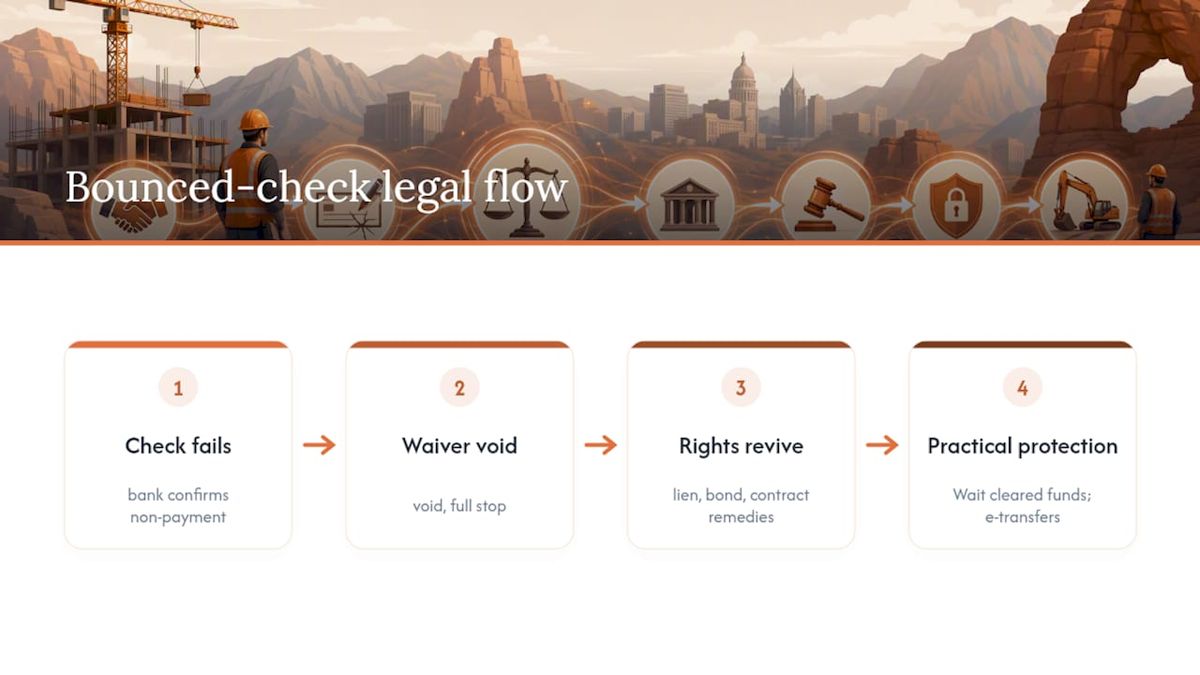
One clause, real leverage: the void-on-bounce rule means you never have to negotiate your way back into lien rights after a bad check. The law restores them automatically, without a lawsuit or a new filing, the moment the bank confirms non-payment.
That said, automatic restoration doesn’t undo the disruption of a bounced check mid-project. Practical protection still means waiting for confirmed cleared funds before releasing more materials or labor, favoring electronic transfers over paper checks on large draws, and using joint-payee checks or escrow arrangements on higher-risk payments.
How Do SCR Filings and Preliminary Notices Affect Your Waivers?
Waivers don’t exist in a vacuum. They sit inside a timeline governed by Utah’s State Construction Registry, and getting that timeline wrong can undercut lien rights a waiver was never meant to touch.
- Filing a preliminary notice within the required window preserves your place in line for lien priority.
- The SCR’s contractor guidance sets a 20-day preliminary notice standard that determines whether your later lien claim holds up.
- A recorded Notice of Completion starts the clock on your remaining lien filing deadline, so a waiver signed after that notice needs extra scrutiny on dates.
- Keeping your SCR project records current avoids disputes over who still holds enforceable lien rights when a project closes.
Align every waiver exchange with what’s actually on file in the SCR. A waiver that looks clean on paper can still create confusion if it contradicts the project’s registered timeline.
A Step-by-Step Checklist Before You Sign or Accept a Utah Waiver
Run through this sequence every time a waiver crosses your desk, whether you’re the one signing it or the one requesting it.
- Confirm the payment method. Wire and ACH transfers settle with more certainty than paper checks.
- Match the payment amount on the waiver to the actual invoice or payment application, line by line.
- Set the payment period precisely. Vague date ranges are one of the most common rejection triggers.
- Confirm the carve-outs are intact. Retention and disputed amounts should never disappear into a blanket waiver.
- Verify the signature comes from someone with actual authority to sign for the claimant.
- Keep a dated copy of every waiver you sign or receive, tied to the specific payment it covers.
- Refuse or delay signing if the payment hasn’t cleared yet, or if the form uses non-statutory language you can’t verify.
Pro Tip: Use the restrictive check endorsement only when your chain of payment is simple and traceable, like a single sub paid directly by the GC. On multi-tier draws with several subcontractors and suppliers in the payment chain, a signed statutory form gives you a cleaner paper trail than an endorsement buried on the back of a check.
How Waiverpilotpro Helps Utah Contractors Get Waivers Right
Building a custom lien waiver from scratch is exactly how contractors end up with missing carve-outs or a payment period that doesn’t match the invoice. Waiverpilotpro’s Utah-specific templates mirror the statutory language directly, with auto-filled payment fields that pull from your project data instead of a blank text box. The output is a notarizable PDF ready for a title company, and the platform connects with Procore and QuickBooks so the numbers on the waiver match what’s already in your accounting system. For firms juggling multiple subcontractors on one draw, the bulk and multi-subcontractor support cuts out the copy-paste errors that trigger disputes down the line.
Get a Compliant Utah Waiver Generated in Minutes, Not Hours
Retyping the statutory language from scratch every time a draw comes through is how payment periods go missing and invoice numbers stop matching. Waiverpilotpro gives you a free Utah lien waiver generator built around the exact safe-harbor forms this article walks through, with auto-calculated balances so the payment amount always reconciles against the invoice.
The free tier covers unlimited conditional and final waivers with instant PDF or Word output, ready to hand to a title company or lender without edits. If you’re running draws through Procore, QuickBooks, JobTread, Sage, or Buildertrend, the Pro tier adds project saving, AI-powered contract auto-fill, and multi-subcontractor batching so one project manager can clear an entire draw’s worth of waivers in one sitting instead of one form at a time. Head to the Utah lien waiver page and generate your next form before the next payment goes out.
Where This Perspective Comes From
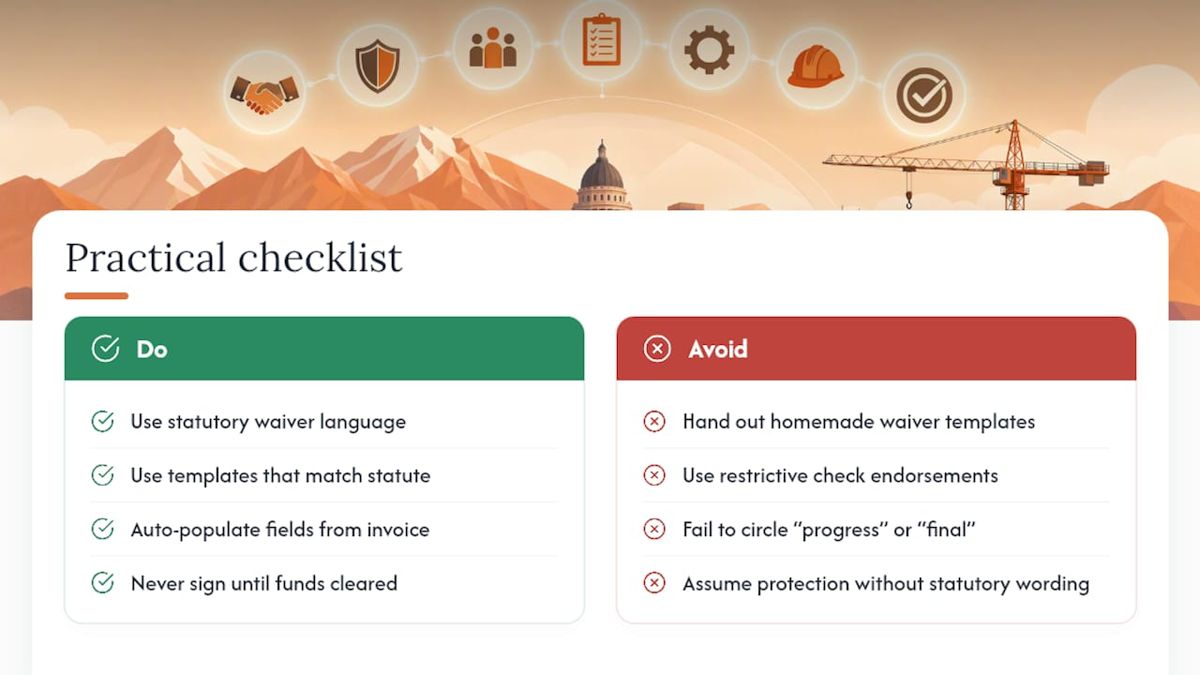
The gap between what the statute promises and what actually happens on Utah job sites is wider than most contractors assume. Utah Code § 38-1a-802 gives you real protection, the void-on-bounce rule alone should end most anxiety about signing a waiver before a check clears. But that protection only works if you actually use the statutory language, and a lot of firms still hand out homemade waiver templates copied from a job years ago, in a different state, with none of the carve-out language Utah requires.
The riskiest habit isn’t fraud. It’s convenience. A restrictive check endorsement that doesn’t circle “progress” or “final” quietly locks in the weaker default, and nobody notices until a dispute forces someone to reread the check six months later. The fix isn’t more legal caution, it’s better defaults: templates that already match the statute, fields that auto-populate from the actual invoice, and a habit of never signing anything until funds are confirmed cleared. Get the mechanics right once, and the legal protection Utah already built into the code does the rest of the work.
— Rowena
Sources
- Utah Code Title 38. Liens § 38-1a-802 | FindLaw
- 38-1-39. Waiver or impairment of a lien right – Forms – Scope. :: Justia
- How to Fill Out a Utah Construction Lien Waiver Form - LegalClarity