
US Contractors: 5 Checks Before Signing an Unconditional Progress Waiver
An unconditional progress waiver permanently gives up your lien rights for the billing period it covers, the moment you sign it, whether or not the payment ever clears. The rule practitioners live by is simple: sign conditional waivers when you invoice, and never sign the unconditional version until the funds are actually in your account. Get that order backward and you have no legal safety net if the check bounces.
TL;DR:
- Signing an unconditional progress waiver before funds are confirmed can permanently waive your lien rights for that period if the payment check bounces or is reversed afterward.
- Verify that the payment has fully cleared your bank, not just posted, before issuing the unconditional waiver to avoid losing leverage from payment delays or reversals.
- Use state-specific, statutory-compliant waiver templates and check key fields like the through date, dollar amount, and site identification to prevent waivers from covering more or less than intended.
- In states like Texas, signing an unconditional waiver before actual payment receipt may violate statutory rules that require funds to be received in good and sufficient form, risking unenforceability.
- Automate and standardize your waiver workflow with software that pulls data directly from payment records to eliminate errors and ensure the correct, legally compliant form is signed at the appropriate time.
Table of Contents
- What an Unconditional Progress Waiver Actually Does
- Why Signing Too Early Can Cost You Your Leverage
- When Is It Actually Safe to Sign?
- State Rules Can Trap You If You Use the Wrong Form
- A Repeatable Workflow That Keeps Every Draw Clean
- How WaiverPilotPRO Fits Into This Workflow
- Can You Revoke an Unconditional Progress Waiver Once Signed?
- What a Real Unconditional Progress Waiver Looks Like
- Author’s Practical Takeaway
- Get Started With Free Conditional and Unconditional Waiver Forms
- Where to Verify State Rules and Statutory Language
- Sources
- FAQ
What an Unconditional Progress Waiver Actually Does
An unconditional progress lien waiver strips you of the right to file a mechanics lien or bond claim for work completed through a specific date, and that release takes effect the instant you sign, regardless of whether the payment has cleared the bank. A conditional waiver, by contrast, only becomes effective once payment actually clears. That timing difference is the entire point of the two forms.
The “progress” part matters just as much as “unconditional.” A progress waiver covers a single pay-application period and normally does not touch retainage, which stays intact until the final waiver at contract closeout. You will sign a new progress waiver for every draw, not once for the whole job.
Before you sign anything, check three fields against your pay application:
- The through date, which defines exactly what work period the waiver releases.
- The dollar amount, which must match the payment you actually received, not the invoice total.
- The job or site identification, especially on multi-project accounts where forms get mixed up.
A mismatch on any of these three fields can waive more, or less, than you intended.
Why Signing Too Early Can Cost You Your Leverage
Payment cycles in construction routinely stretch weeks, sometimes months, and that lag is exactly why understanding how to finance building a new home is crucial, as the timing of an unconditional waiver matters so much. Sign it too soon and you have nothing left to fall back on if that money does not actually land.
Three failure modes show up again and again in the field:
- A check that bounces after you have already handed over an unconditional release.
- An ACH reversal initiated days after the transfer appeared to settle.
- A lender pulling funding mid-draw over a dispute unrelated to your work.
In any of these situations, an unconditional waiver already signed leaves you with no lien claim for that period. Your lien rights on that slice of work are gone the moment you sign, so you cannot resurrect them just because the payment fell through afterward. What you are left with is a straight contract claim, which means suing for breach of contract instead of enforcing a lien, a process that typically takes longer and costs more in legal fees than a lien claim would have.
When Is It Actually Safe to Sign?
“Cleared funds” is not the same thing as “funds appear in the account.” A check needs to clear the issuing bank, which can take several business days depending on the amount and the bank’s hold policy. An ACH transfer needs to fully settle, not just post. A wire is the fastest to confirm, often same day, which is one reason larger draws increasingly move by wire.
Here is the sequence that keeps you protected:
- Confirm the payment method and its typical clearing window with your bank before you count on the funds.
- Call your bank or check your account directly rather than trusting a payment notification email or a general contractor’s word that “it’s been sent.”
- Reconcile the cleared amount against your ledger, matching it to the specific invoice and pay application it covers.
- Confirm retainage treatment so the unconditional waiver you sign doesn’t accidentally release money still being withheld.
- Issue the unconditional waiver promptly once verification is complete, since delaying it past what your contract requires can create friction with the paying party without adding any real protection for you.
Pro Tip: Set a standing rule with your bookkeeper that no unconditional waiver goes out until a bank-confirmed cleared balance is logged against that specific invoice number, not just a deposit that “looks right.”
State Rules Can Trap You If You Use the Wrong Form
Statutory-form compliance is not optional in every state, and treating it as a formality is how contractors lose enforceability rights they thought they had. Some states mandate exact language for lien waivers, and a customized version that seems clearer to you can actually be unenforceable in court, or worse, waive more than you intended because courts read waiver language strictly.
Texas is the clearest cautionary example. Under Texas Property Code § 53.283, a party cannot require you to sign an unconditional waiver unless you have actually received payment in good and sufficient funds. If a general contractor or owner pressures you to sign an unconditional waiver before the money clears in Texas, that request runs against the statute itself.
Before you sign anything in a state you have not worked in before:
- Search that state’s statute for mandatory lien waiver language, not just a general description of the process.
- Check your state contractor licensing board’s published forms for the current required version.
- Cross-reference against AIA’s G901 through G904 waiver form family, which many states model their own requirements on.
A Repeatable Workflow That Keeps Every Draw Clean
The administrative burden of tracking paired waivers across dozens of vendors and draws is exactly why so many firms end up with mismatched dollar amounts and missing signatures. Fix the workflow once and every draw after that runs the same way.
- Issue the conditional waiver with the invoice, at the moment you bill, since it protects you without giving up anything.
- Queue the unconditional waiver separately, and only release it after your bank confirmation step is complete.
- Match the dollar figure and through date on both waivers to the exact numbers on your pay application, never a rounded or estimated figure.
- Preserve retainage explicitly on progress waivers so it does not get swept into a release by accident.
- Log who signed each waiver, on what date, with delivery confirmation, and store the copy linked to that specific draw number.
Pro Tip: Generate your conditional and unconditional waivers from the same underlying billing data instead of retyping figures twice. That single change eliminates most of the mismatched-amount errors that show up during closeout audits.
How WaiverPilotPRO Fits Into This Workflow
Every step above becomes a manual risk if you are retyping numbers into a blank template every draw. Waiverpilotpro was built around that exact problem: contractors need conditional and unconditional waivers that match, use the correct state language, and don’t take twenty minutes to fill out per subcontractor.
- State-specific templates generate both conditional and unconditional waivers quickly, so you are not guessing whether your custom form meets a state’s statutory requirements.
- Integration with Procore and QuickBooks, plus auto-calculated balances, pulls your payment figures directly from your existing records instead of relying on manual re-entry, which is where most through-date and dollar-amount mismatches originate.
- Notarizable, professional-grade output with multi-subcontractor support means closeout on a job with a dozen subs does not turn into a spreadsheet nightmare of chasing signatures one at a time.
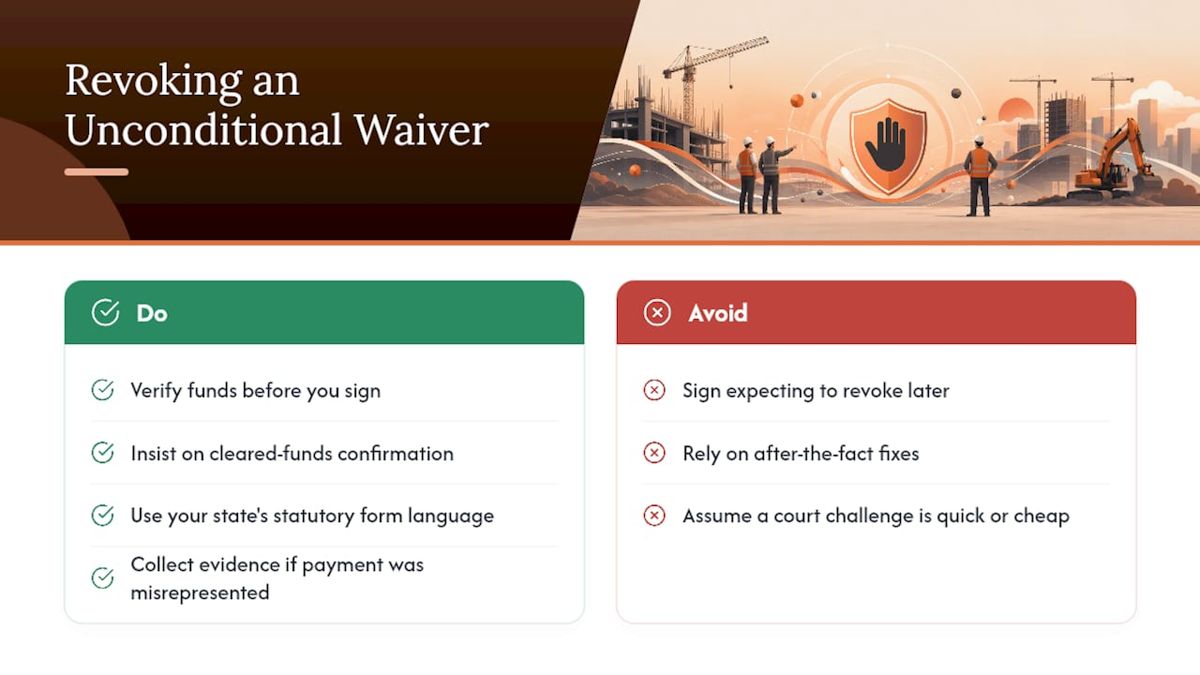
Can You Revoke an Unconditional Progress Waiver Once Signed?
Once signed, an unconditional waiver is difficult to undo, and that difficulty is exactly why the “wait for cleared funds” rule matters more than any after-the-fact fix. You generally cannot simply revoke it because you changed your mind or the payment turned out to be slower than expected. Courts treat the waiver as effective on signature, which is the entire mechanism that makes unconditional waivers valuable to paying parties in the first place.
There are narrow paths to contest one after the fact, though none of them are guaranteed:
Fraud or misrepresentation. If the paying party misled you about the payment status, told you funds had cleared when they had not, or pressured you into signing under false pretenses, you may have grounds to challenge the waiver’s validity in court. This requires evidence, not just a dispute over outcome.
Mutual mistake. If both parties genuinely believed the payment had cleared and it later turned out to be false due to a bank error rather than a payment failure, some jurisdictions allow relief on that narrow basis.
Statutory noncompliance. If the waiver you signed does not match your state’s mandatory form language, an attorney may be able to argue the waiver itself is unenforceable regardless of intent, which is one more reason the statutory-form issue in the previous section is not a minor detail.
None of these paths are quick or cheap. They typically require litigation, and courts start from the presumption that a signed unconditional waiver means exactly what it says. The realistic strategy is prevention: verify funds before you sign, not damage control after.
What a Real Unconditional Progress Waiver Looks Like
An unconditional progress waiver is a short document, usually one page, and its brevity is deceptive given how much legal weight it carries. The core fields you will find on nearly every version, whether it’s an AIA G902/G904 style form or a state-mandated template, include:
- Project name and address, identifying exactly which job the waiver applies to.
- Owner and general contractor names, establishing the parties involved.
- Claimant name, meaning you, the contractor or subcontractor signing away lien rights.
- Payment amount, the specific dollar figure the waiver covers.
- Through date, the cutoff for the work period being released.
- Signature, date, and often notarization, depending on the state and the payer’s requirements.
A few states, Texas among them, publish exact statutory wording that a waiver must include word for word to be enforceable. Other states allow more flexible language as long as the substance is clear. The safest approach is to start from a template built around your state’s actual requirements rather than a generic form pulled off a general search, since a form that looks complete can still be missing the specific phrasing your state’s statute demands.
Templates for both conditional and unconditional versions, organized by state, give you a starting point that already accounts for those statutory quirks rather than leaving you to catch a compliance gap after the fact.
Author’s Practical Takeaway
The rule that matters most here fits in five words: conditional out, unconditional back. Bill with a conditional waiver, receive payment, confirm it cleared, then send the unconditional. If a general contractor keeps pushing you to sign unconditional before funds clear, that is not impatience, it is a pattern worth escalating to an attorney, especially on large disputed balances or anything that smells like fraud. Keep every signed copy, every bank confirmation, and every email tied to the draw. That paper trail is worth more than any argument you could make after the fact.
— Rowena
Get Started With Free Conditional and Unconditional Waiver Forms
You do not need to build these forms from scratch or hope your custom template happens to match your state’s statutory language. Waiverpilotpro’s free lien waiver generator produces both conditional and unconditional waivers using state-specific templates, so the compliance question gets handled before you ever hit “generate.”
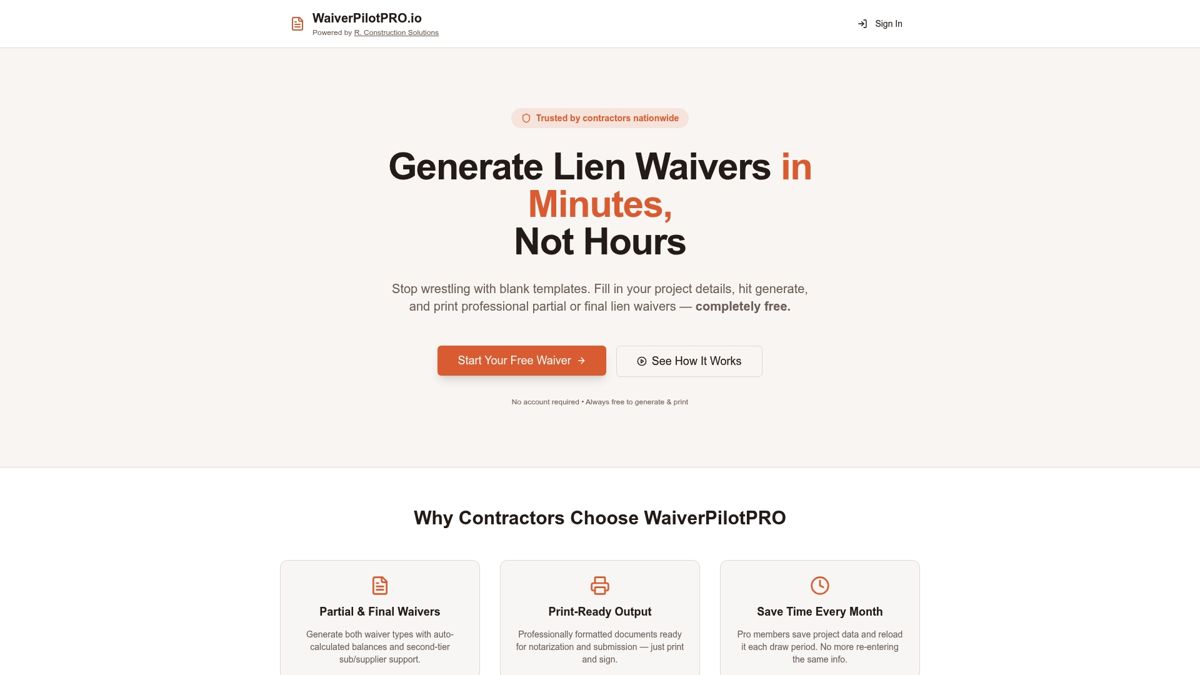
The workflow described above, conditional with the invoice, unconditional after cleared funds, becomes a lot less error-prone when both documents pull from the same billing data instead of two separate manual entries. Using software that integrates with construction management and accounting systems can carry your payment figures straight into the waiver, cutting out the retyping that causes through-date and dollar-amount mismatches in the first place. Once you have confirmed funds cleared using the checklist above, generating the unconditional waiver takes minutes rather than another round of copy-paste. Start with the free generator on your next draw and see how much friction that removes from closeout.
Where to Verify State Rules and Statutory Language
Cross-check your waiver against AIA’s waiver type guidance, the Corpay explainer on payment timing, and, if you work in Texas, Property Code § 53.283 directly rather than a summary of it.
This article is general information, not a substitute for advice from a qualified lawyer. Consult a qualified legal professional about your own circumstances before acting on anything here.
Sources
- Types of Lien Waivers in Construction: Conditional, Unconditional, Progress, and Final | AIA Contract Documents
- Construction lien waivers: conditional vs unconditional explained · Corpay
- Texas Property Code § 53.283 (Justia)
- Lien Waiver Essentials: Types, Timing & Best Practices for Subcontractors — CFMA
FAQ
What Does an Unconditional Waiver Mean?
It means you have given up your right to file a lien or bond claim for the work period covered, effective the moment you sign, regardless of whether payment has actually cleared your bank.
What Is an Unconditional Waiver and Release on Progress Payment in California?
It functions the same way in California as elsewhere: it releases lien rights for a specific progress payment period on signature, though California requires specific statutory wording, so a generic form may not meet state requirements.
Does an Unconditional Waiver Need to Be Notarized?
Notarization requirements vary by state and by the paying party’s own policy; some states require it for certain waiver types while others do not, so check your specific state’s form requirements or use a state-specific template that already builds in that requirement.
What Do Unconditional Release Waivers Mean for My Retainage?
An unconditional progress waiver typically covers only the specific payment period and dollar amount stated on the form, and it should not release retainage still being withheld unless the form explicitly says so, which is why checking the dollar amount field before signing matters so much.
How Do I Get an Unconditional Waiver That Matches My State’s Requirements?
Waiverpilotpro’s free lien waiver generator produces state-specific unconditional and conditional waiver templates so you are not stuck guessing at the right statutory language on your own.