
Unconditional Final Waiver for U.S. Contractors: Confirm Funds Posted
An unconditional final waiver permanently gives up your remaining mechanics’ lien rights the moment you sign it, whether or not payment has actually reached your bank. The rule that matters most: sign only after the final payment, including retainage, has fully cleared. Some states, including California, require specific statutory language, so check your state’s form before you sign anything unconditional.
TL;DR:
- Signing an unconditional final waiver permanently forfeits all remaining lien rights for the amounts and dates covered without any grace period.
- Contractors should verify the final payment has fully cleared their bank, including retainage and change order payments, before signing the waiver.
- State law and specific statutory language significantly impact waiver enforceability, requiring contractors to use jurisdiction-specific forms and include precise details like “through dates” and exceptions.
- Accepting a check before it clears or signing broad, generic waiver language can lead to losing lien rights and having to pursue slower breach or fraud claims.
- Utilizing tools like state-specific waiver generators helps ensure compliance, correct language, and proper documentation, reducing costly errors at project closeout.
Table of Contents
- What Is an Unconditional Final Waiver? The Four Waiver Types Explained
- What Legal Rights Do You Give Up by Signing?
- When Should You Sign an Unconditional Final Waiver?
- Common Mistakes That Cost Contractors Their Lien Rights
- Do State Laws Change What You Can Sign?
- Building a Safe Closeout Workflow
- WaiverPilotPRO’s Approach to Getting This Right
- Generate a Compliant Unconditional Final Waiver in Minutes
- Sources
What Is an Unconditional Final Waiver? The Four Waiver Types Explained
Every lien waiver you’ll ever sign falls into one of four boxes. Picture a simple grid: one axis is conditional versus unconditional, the other is progress versus final. Once you know which box you’re in, you know exactly how much risk you’re carrying.
The conditional/unconditional split determines when the waiver takes legal effect. A conditional waiver only kicks in once the specified payment actually clears. An unconditional waiver takes effect the instant you sign it, regardless of whether the check ever posts. That single distinction is why so many contractors get burned. The progress/final split determines how much of your work the waiver covers. Progress waivers apply to one billing cycle. Final waivers close out the entire contract, including any retainage held back for the life of the project.
Here’s how the four types break down in practice:
- Conditional waiver on progress payment. You sign this with a normal monthly pay application. It only becomes effective once that specific progress payment clears your bank. Your lien rights stay intact until then.
- Unconditional waiver on progress payment. Some owners or general contractors require this instead, usually because they want certainty that a payment dispute won’t cloud the title. It takes effect on signature, so you’re trusting that the funds are already good.
- Conditional waiver on final payment. You use this when the final payment, including retainage, hasn’t posted yet. It protects you: if the check bounces or a wire fails, your lien rights on that final amount survive.
- Unconditional waiver on final payment. This is the one that closes the book. You sign it only after confirming the money is sitting in your account, because it forfeits every remaining lien claim tied to that project and those dates.
Retainage deserves its own mention here. Many contractors sign a conditional final waiver at substantial completion, then don’t sign the unconditional final until retainage actually releases, sometimes months later. Treating those as two separate events, tied to two separate bank confirmations, is the safest approach.
What Legal Rights Do You Give Up by Signing?
Signing an unconditional final waiver extinguishes your remaining mechanics’ lien rights for the covered work and payment period, immediately and permanently. There’s no built-in grace period. There’s no “I’ll fix it once the check clears” clause. The waiver does exactly what its name says the second your signature hits the page.
That permanence changes your legal options if something goes wrong afterward. Before signing, an unpaid contractor can file a mechanics’ lien directly against the property, which puts real pressure on owners and lenders because it clouds title and can block a sale or refinance. After signing an unconditional final waiver, that lien remedy is generally gone for the amounts and dates covered. Your recovery path shifts to breach-of-contract or, in cases involving misrepresentation, fraud claims against the responsible party. Those routes work, but they’re slower, more expensive, and don’t carry the same leverage a lien against real property gives you.
State law governs the exact enforceability and required wording of these waivers, and that’s not a minor technicality. A waiver drafted in language your state doesn’t recognize as statutory can end up interpreted more broadly, or more narrowly, than you intended. Some states also limit how much a waiver can cover regardless of what it says on paper. Before you sign anything unconditional, it’s worth a quick check of your conditional versus unconditional waiver obligations under your specific state’s statute.
When Should You Sign an Unconditional Final Waiver?
Sign it only after the final payment, including retainage, has fully cleared your bank account. That’s the entire rule, and it’s echoed across every major piece of industry guidance on lien waiver timing. Here’s how to verify you’re actually there before you pick up the pen.
- Confirm the final invoice total. Match it against your pay application, including any retainage release, and make sure the numbers agree line by line.
- Verify the funds have cleared, not just arrived. A posted ACH transaction or a settled wire confirmation counts. A handed check, a pending ACH, or an email saying “payment is on its way” does not.
- Confirm change orders and extras are resolved. Every approved change order should be paid in full, or explicitly carved out as an exception in the waiver language.
- Check your bank ledger directly, not just a notification from your accounting software, since integration delays can show a payment as received before it’s actually settled.
- Sign, date, and file the waiver alongside your bank confirmation and the full waiver chain from any subcontractors you used.
Pro Tip: Set a standing rule with your bookkeeper: no unconditional final waiver leaves your office until someone can point to a specific line in a bank statement showing the funds posted. A verbal “it’s fine, the payment’s coming” is not a verification step.
Common Mistakes That Cost Contractors Their Lien Rights
The mistakes here follow a pattern: contractors trade a small convenience now for a large risk later. A contractor accepting a check without confirming it’s cleared before signing unconditional is the single most common way lien rights get lost, and it’s almost always driven by a general contractor pushing for a quick signature at closeout.
- Signing an unconditional waiver against an un-cleared check or a pending ACH transfer.
- Failing to explicitly exclude retainage, pending change orders, or any disputed line item from the waiver’s scope.
- Accepting broad, generic waiver language with no “through date” or exceptions list, which can end up covering more work than you intended to release.
- Releasing your own unconditional final waiver before collecting a complete waiver chain from every subcontractor tied to the retainage you’re releasing on their behalf.
Each of these is fixable with about thirty seconds of extra scrutiny before signing. That’s the frustrating part: the fix is cheap, but the mistake is expensive and, once signed, generally unrecoverable.
Do State Laws Change What You Can Sign?
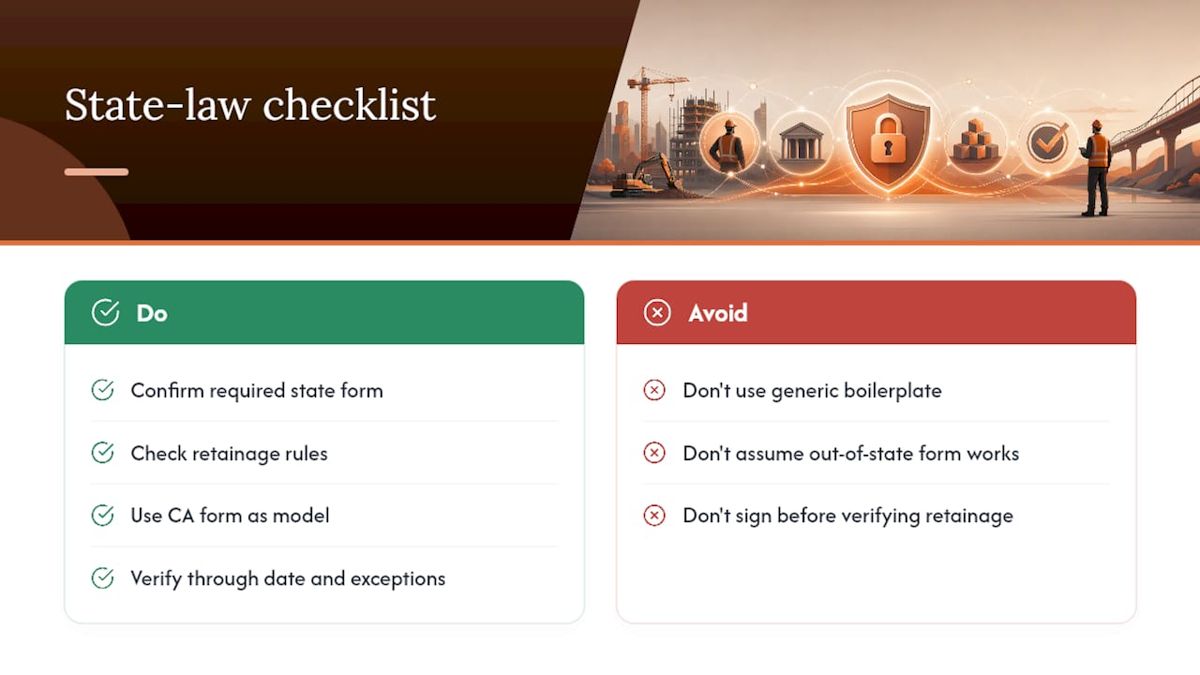
State law governs waiver enforceability, and the differences between states are bigger than most contractors expect. Using the wrong form, or generic boilerplate where your state expects statutory language, can void the waiver entirely or, worse, broaden it beyond what you meant to release.
California provides four distinct statutory forms covering conditional and unconditional waivers for both progress and final payments, published through the state’s civil code and referenced by the Contractors State License Board. It’s a useful model even outside California, because the forms explicitly require a “through date” and a dedicated line for exceptions, two elements that generic templates often skip entirely. If you work across state lines, don’t assume the form that worked in one jurisdiction will hold up in another.
Retainage handling is another area where states diverge. Some tie retainage release deadlines to final acceptance; others allow longer holds. Before you sign an unconditional final waiver on any out-of-state project, confirm which statutory form, if any, your state requires, and whether retainage needs separate treatment.
Building a Safe Closeout Workflow
A reliable closeout process removes the guesswork that causes most waiver mistakes. Build it around a fixed sequence rather than a case-by-case judgment call.
- Gather all change orders, subcontractor lien waivers, and confirm the scope of work is fully complete before requesting final payment.
- Sign a conditional final waiver first if payment is still pending, and hold the unconditional version until funds are confirmed posted.
- Keep bank statements, the full waiver chain, an exceptions appendix, and the retainage release documentation together in one project file.
Pro Tip: Build the bank-clearance check directly into your invoicing workflow, as a required step before any final waiver template gets generated, so it never depends on someone remembering to ask.
WaiverPilotPRO’s Approach to Getting This Right
The biggest risk with unconditional final waivers isn’t the concept. It’s the wording: missing exception lines, wrong state form, no through date. WaiverPilotPRO’s free generator uses state-specific templates, so the language matches what your jurisdiction actually expects, with auto-calculated balances that catch mismatches between your invoice and the waiver before you sign. Notarizable PDF output and integrations with platforms like Procore and QuickBooks mean the numbers on your waiver match the numbers in your accounting system, which is exactly where most costly errors start.
— Rowena
Generate a Compliant Unconditional Final Waiver in Minutes
Once your final payment clears, you shouldn’t have to hunt down the right state form or rebuild a template from scratch. A compliant unconditional final waiver generator can help you pick your state and produce language aligned with your jurisdiction’s requirements, with retainage and exceptions handled correctly the first time.
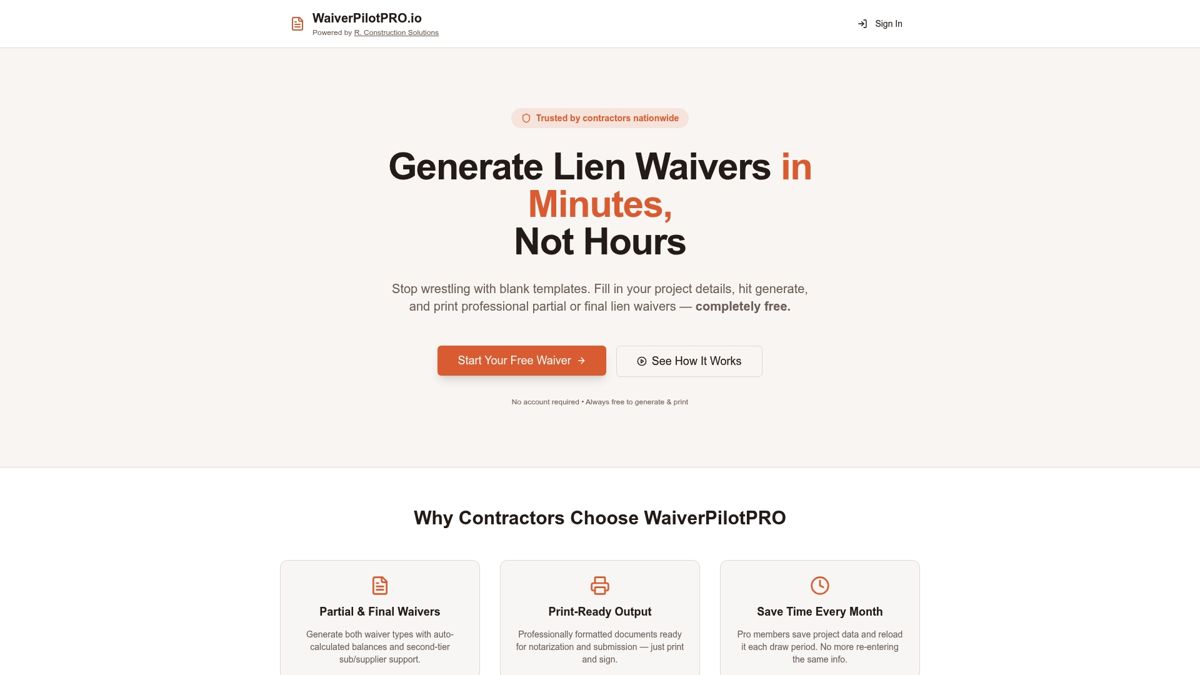
The free lien waiver generator produces notarizable, professional-grade PDFs at no cost, with auto-calculated balances that flag discrepancies before you sign anything final. Some platforms support bulk generation for managing multiple subcontractors on one project, so you don’t have to rebuild the same form multiple times at closeout. For contractors who want a deeper look at how conditional and unconditional waivers differ before deciding which one to send, that guide walks through the practical differences step by step. If your projects also involve heavy documentation and safety coordination at closeout, a tool like My Safety Solution can help keep those records organized alongside your waiver chain. Start your next final waiver now, confirm the funds have posted, and generate the correct state-specific form in a few minutes.
This article is general information, not a substitute for advice from a qualified lawyer. Consult a qualified legal professional about your own circumstances before acting on anything here.
Sources
- Lien Waiver Essentials: Types, Timing & Best Practices for Subcontractors
- What is an Unconditional Lien Waiver?
- Conditional and Unconditional Waiver and Release Forms (CSLB)
- Construction Lien Waiver Forms: Conditional vs. Unconditional | LienFlash