
Protect Payments in Tennessee: 4 Lien Waivers Contractors Need
Under Tennessee law, any contract clause that forces a contractor or subcontractor to waive mechanics lien rights before work begins is void. Lien waivers themselves must be written, signed, and specific. The safest approach is to use a conditional waiver until payment actually clears, then switch to unconditional once funds are verified.
TL;DR:
- Contract clauses requiring lien waivers before work begins are void under Tennessee law, making upfront unconditional waivers legally invalid.
- Contractors should always sign conditional waivers linked to actual receipt of payment, not promises or deposits in transit.
- A comprehensive lien waiver must include specific project details, exact waiver amount, and clear designation of waiver type to prevent future disputes.
- Notarization is not legally required for waivers between parties, but lenders or title companies may demand notarized copies for closings.
- Using a Tennessee-specific waiver generator reduces errors by ensuring all mandatory fields and correct waiver language are included before signing.
Table of Contents
- Why a Tennessee Lien Waiver Can’t Be Signed Away in Advance
- Conditional vs. Unconditional: Which Tennessee Lien Waiver Do You Sign?
- What to Include in a Tennessee Lien Waiver
- Do You Need a Notary for a Tennessee Lien Waiver?
- How Retainage and Payment Bonds Affect Your Lien Rights
- What to Do If Someone Pressures You to Waive Lien Rights
- Why a Tennessee-Specific Waiver Generator Reduces Risk
- Your Quick-Reference Tennessee Lien Waiver Checklist
- Conservative Waiver Practice Protects Your Cashflow and License
- Generate a Compliant Tennessee Lien Waiver in Minutes
- Sources
- FAQ
Why a Tennessee Lien Waiver Can’t Be Signed Away in Advance
Tennessee Code § 66-11-124 makes one thing clear: a contract provision that requires you to waive lien rights before you’ve earned the payment is void and unenforceable. This is the backbone of every Tennessee lien waiver form you’ll encounter, and it exists because owners and prime contractors used to bury waiver language deep in boilerplate contracts, stripping subs of leverage before a single invoice was sent.
The statute doesn’t just void the clause. It gives the Tennessee Board for Licensing Contractors authority to investigate contractors who try this, following a notice-and-hearing process that can end in license revocation for repeat violations.
There’s a real difference between accepting a payment and signing an express waiver:
- Simply cashing a check does not automatically waive your lien rights.
- An express written waiver, signed and delivered, does waive those rights, to the extent it states.
- A contract clause demanding a blanket waiver upfront is void regardless of what it says.
For contract review, this means striking any upfront waiver language you spot, and treating every waiver you sign later, tied to an actual payment, as a separate legal document worth reading closely.
Conditional vs. Unconditional: Which Tennessee Lien Waiver Do You Sign?
Tennessee recognizes four standard waiver categories, and knowing which one lands on your desk changes your risk exposure entirely.
- Conditional partial waiver — waives lien rights for a specific payment, but only once that payment actually clears. You sign it, but it has no legal teeth until the check funds.
- Unconditional partial waiver — waives lien rights for a payment amount immediately upon signature, whether or not the money has arrived yet.
- Conditional final waiver — closes out the entire project’s lien rights, contingent on final payment clearing.
- Unconditional final waiver — closes out all lien rights the moment you sign, full stop.
Conditional waivers typically get exchanged alongside a pay application, before funds move. Unconditional waivers show up after the money has landed, or at project closeout. Practitioners consistently advise subcontractors to prefer conditional waivers throughout progress billing and reserve unconditional signatures for confirmed funds.
Pro Tip: Never sign an unconditional waiver based on a promise to pay. Wait until the deposit shows in your account, not just in your inbox.
What to Include in a Tennessee Lien Waiver
Tennessee has no statutory waiver form, which means the drafting burden falls entirely on you. A vague or incomplete waiver invites disputes down the line, especially over ambiguous “through dates” or amounts that don’t match the pay application.
At minimum, a defensible Tennessee lien waiver form needs:
- Full property description, including address and, where available, county parcel or tax map number
- Exact legal names of both parties, plus confirmation the signer has authority to bind the company
- The precise amount waived and the “through date” covering that payment
- The waiver type stated explicitly (conditional, unconditional, partial, or final)
- Any exceptions, especially retainage or disputed line items, carved out by name
| Field | Why it matters |
|---|---|
| Property/parcel ID | Prevents disputes over which project the waiver covers |
| Signer authority | Confirms the waiver legally binds the company, not just an employee |
| Amount and through date | Must match the pay app exactly to avoid later challenges |
| Exceptions listed | Protects retainage or unresolved change orders from accidental waiver |
Do You Need a Notary for a Tennessee Lien Waiver?
Tennessee law doesn’t require notarization for a waiver to be valid between the contracting parties. It also recognizes electronic signatures under the Uniform Electronic Transactions Act, so an e-signed waiver carries the same legal weight as one signed with a pen.
That said, title companies and lenders frequently demand notarized waivers for recorded releases or closing packages, regardless of what the statute technically requires. A few practical notes:
- Ask early in the project whether a lender or title company will require notarization at closeout.
- Getting waivers notarized upfront avoids scrambling for a notary when a closing deadline is days away.
- E-signatures work fine for routine pay-app exchanges between contractor and sub.
How Retainage and Payment Bonds Affect Your Lien Rights
A clean, repeatable workflow protects both your cashflow and your legal position on every pay cycle.
- Submit a conditional waiver alongside your pay application, before the check is cut.
- Once funds clear, and only then, issue the unconditional waiver covering that same billing period.
- Track retainage separately. Tennessee allows retainage to be withheld on many projects, and downstream subs should confirm release timelines in their contract rather than assume automatic payout at substantial completion.
- Watch for payment bonds on the job. A payment bond covering 100% of the prime contractor’s contract price, recorded before work starts, can eliminate lien rights for remote contractors entirely, shifting your remedy to a bond claim instead.
Knowing which mechanism applies to your project before you start work saves you from discovering the hard way that your lien rights were never on the table.
What to Do If Someone Pressures You to Waive Lien Rights
If a prime contractor or owner tries to enforce a waiver clause buried in your contract, or pressures you to sign an unconditional waiver before payment clears, you have real options.
- Preserve the contract and every related email, text, or note. Documentation is your strongest asset if this escalates.
- Refuse to sign an unconditional waiver until the funds are verified in your account, no exceptions.
- File a complaint with the Tennessee Board for Licensing Contractors, which can move faster than civil court for licensing violations.
- Consult a construction attorney if the amount at stake justifies enforcing your lien rights directly, since some actions allow recovery of attorney fees.
Licensing complaints often resolve faster than litigation, and they put pressure on repeat offenders in a way a single lawsuit doesn’t.
Why a Tennessee-Specific Waiver Generator Reduces Risk
Because Tennessee provides no official form, every waiver you draft from scratch carries some risk of a missing field, an ambiguous amount, or a signer-authority gap that gives the other side an opening to dispute it later.
A generator built specifically for Tennessee lien waiver requirements closes that gap by forcing the required fields, correct waiver type, and exception language into the document before it ever gets signed.
- Required fields like property description, amount, and through date can’t be skipped or left blank.
- Conditional language stays intact until you explicitly mark the payment as received.
- Integrations with tools like Procore and QuickBooks pull project and payment data automatically, cutting down on manual entry errors.
Pro Tip: Generate the conditional waiver the same day you submit your pay application. Only convert it to unconditional after the deposit clears, never before.
Your Quick-Reference Tennessee Lien Waiver Checklist
Before signing anything, run through this:
- Confirm the property address and parcel identifier match the project.
- Verify the signer has legal authority to bind their company.
- Check that the amount waived matches your pay application exactly.
- Confirm the through date, and make sure it’s not open-ended.
- Identify the waiver type in plain language on the document itself.
- List retainage or disputed items as explicit exceptions.
- Decide if notarization is needed for this particular transaction.
- Keep a signed copy for your own project records, not just theirs.
Sample conditional phrasing: “This waiver is effective only upon receipt of payment in the amount stated above.” Sample unconditional phrasing: “Upon execution, the undersigned waives and releases all lien rights for the amount stated above.”
Conservative Waiver Practice Protects Your Cashflow and License
The contractors who get burned in Tennessee are almost always the ones who signed an unconditional waiver on a promise, not a cleared payment. has shown that a conditional-first habit costs you nothing and protects everything… Clients will push for faster paperwork. Your job is to balance that pressure against the simple fact that a signed unconditional waiver is nearly impossible to undo once it’s in the wrong hands.
— Rowena
Generate a Compliant Tennessee Lien Waiver in Minutes
Drafting a Tennessee lien waiver from a blank template means you’re the one responsible for catching every missing field, every mismatched amount, every ambiguous through date. Waiverpilotpro removes that guesswork by building the required fields, waiver type, and exception language directly into a Tennessee-specific form, so you’re not reinventing the wording every pay cycle.
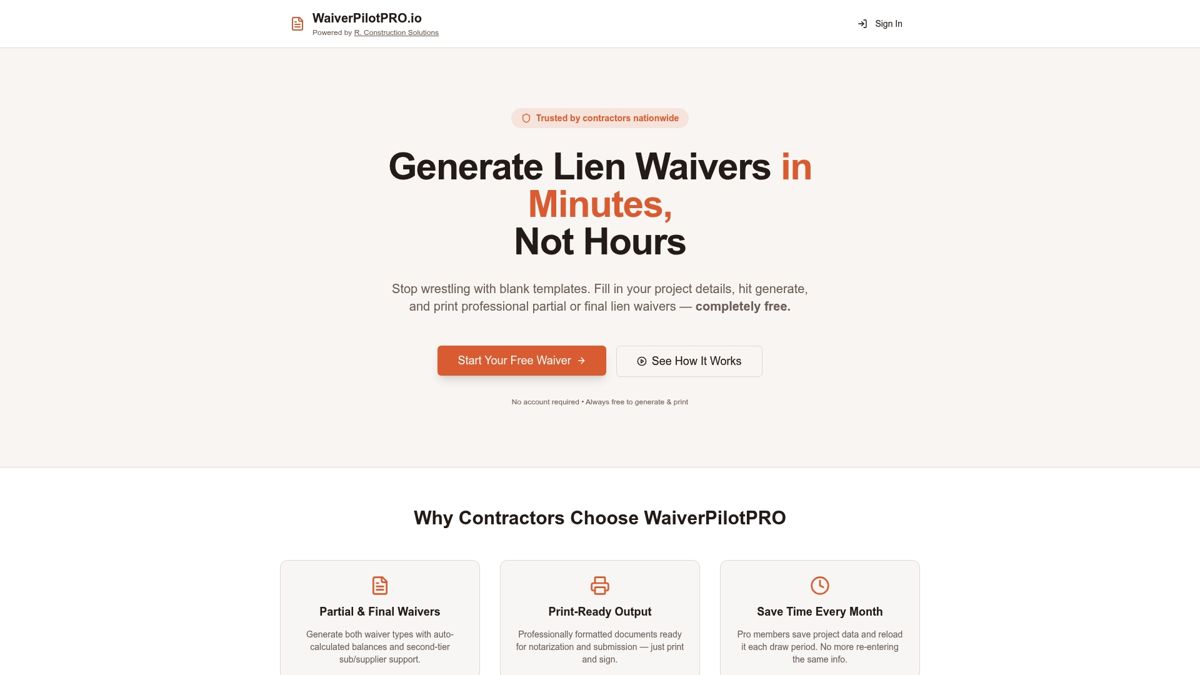
The platform auto-calculates balances, supports multiple subcontractors on one project, and connects with various construction and accounting tools, so payment data flows into the waiver instead of getting retyped by hand. Whether you’re issuing a conditional waiver alongside this month’s pay app or finalizing a project at closeout, the templates keep you inside Tennessee’s drafting requirements without a lawyer on retainer for every document.
Start with the free Tennessee lien waiver generator on your next pay application, submit the conditional version now, and convert it to unconditional only once the funds actually clear.
Sources
- Tennessee Code § 66-11-124 (2025) - Waiver of lien
- Tn
- How to Complete a Tennessee Lien Waiver Form: All Four Types - LegalClarity
- Lien waivers in Tennessee - Cotney
This article is general information, not a substitute for advice from a qualified lawyer. Consult a qualified legal professional about your own circumstances before acting on anything here.
FAQ
Which States Have Statutory Lien Waiver Forms?
Only a handful of states, including Texas and California, mandate a specific statutory lien waiver form. Tennessee has no required form, so contractors must draft their own compliant waiver using the correct fields and waiver type.
What Is the Lien Law in Tennessee?
Tennessee’s lien law, codified in part at TCA § 66-11-124, voids any contract clause that waives lien rights before payment is earned and allows the state licensing board to discipline contractors who include such clauses.
What States Require Lien Waivers to Be Notarized?
Tennessee does not require notarization between the contracting parties, though some states, like Texas for certain forms, do impose notarization rules. Title companies and lenders in Tennessee often request notarized waivers for closing documents regardless of the statutory requirement.
Who Can Require a Waiver of Lien?
Property owners, prime contractors, and lenders commonly require a waiver of lien before releasing payment, but they cannot legally force a Tennessee contractor to waive lien rights through a blanket contract clause signed before the work is performed.
Is a Conditional or Unconditional Waiver Safer to Sign?
A conditional waiver is safer because it only takes effect once payment clears, while an unconditional waiver waives your lien rights the moment you sign it, regardless of whether the funds have arrived. Tools like Waiverpilotpro’s generator default to conditional language to help you avoid signing away protection too early.