
Protect Your Payment: U.S. Supplier Lien Waiver Rule and Free Generator
A supplier lien waiver is a legal document you sign in exchange for payment, giving up your right to file a mechanics lien for the amount stated. The single rule that keeps you safe: sign conditional waivers whenever payment hasn’t cleared yet, and save unconditional waivers for after the funds, including retainage, are confirmed in your account. Some states require you to use exact statutory forms, and for a practical explainer on conditional versus unconditional waivers aimed at trade subcontractors, see Conditional lien waivers explained for trade subs. The sections below walk through the statutory details in more depth.
TL;DR:
- Sign conditional waivers during payment pending and only sign unconditional waivers after confirming funds, including retainage, have fully cleared your account.
- Avoid signing unconditional final waivers before funds, especially retainage, are deposited, as this permanently waives lien rights on unpaid amounts.
- In states with mandated statutory forms, always use official templates obtained from the relevant agency to maintain enforceability and compliance.
- Maintain a detailed ledger to track each waiver across all tiers, confirming payments and signatures before releasing further payments or final project closure.
- Verify each waiver by confirming requester identity, invoice amount, payment method, state form compliance, and timely signing to prevent costly legal disputes.
Table of Contents
- The Four Types of Lien Waivers Every Supplier Should Know
- When Should You Sign a Lien Waiver, and What Can Go Wrong?
- Which States Require Statutory Lien Waiver Forms?
- How Do You Track Supplier Waivers Across Every Tier?
- How Do You Verify a Supplier Lien Waiver Before Signing?
- Why Paperwork, Not Payment Disputes, Sinks Most Suppliers
- Generate a Compliant Waiver Without Building One From Scratch
- Where to Verify State Rules and Waiver Standards
- Sources
The Four Types of Lien Waivers Every Supplier Should Know
Every waiver you’re asked to sign falls into one of four categories, and mixing them up is how suppliers lose leverage without realizing it. A lien waiver waives your right to file a lien for a specific amount, but the timing of that waiver changes everything about your risk.
- Conditional progress (partial) waiver: You sign this at the time you submit a pay application. It only takes effect once payment actually clears, so it’s safe to sign even before the check lands.
- Unconditional progress (partial) waiver: This one takes effect the moment you sign it, no conditions attached. Sign it only after you’ve confirmed the funds are in your account, not when a check is merely handed to you.
- Conditional final waiver: Used at project closeout, contingent on final payment (including retainage) actually clearing.
- Unconditional final waiver: The most dangerous document in construction paperwork. It permanently surrenders your lien rights, so it should never touch your signature until every dollar, including retainage, has cleared.
Here’s the correct sequence: submit your invoice, sign a conditional progress waiver, wait for the deposit to clear, then sign the unconditional version. The incorrect sequence, and the one that gets suppliers burned, is signing unconditional at invoice submission because a project manager promises “the check is already cut.” Promises don’t clear banks. Learn the difference between conditional and unconditional lien waivers before you sign anything.
When Should You Sign a Lien Waiver, and What Can Go Wrong?
Timing is where most supplier mistakes happen, and the mistakes are expensive. Signing an unconditional waiver before funds clear can permanently eliminate your lien rights even if the payment never actually arrives. That’s not a technicality. It’s the difference between having a legal remedy and having nothing but a broken promise.
Closeout is the riskiest phase of any project. Contractors under pressure to finish their own paperwork often push suppliers to sign unconditional final waivers before retainage has cleared, sometimes weeks before. If you sign, you’ve waived your rights on money you haven’t received yet.
Joint checks add another wrinkle. In some states, endorsing a joint check is treated as conclusive proof you’ve been paid in full, even if the general contractor pockets part of it. Clarify endorsement terms in writing before you sign anything tied to a joint check.
Red flags to watch for:
- A request to sign “unconditional” when your bank shows no deposit
- Pressure to sign at final closeout before retainage clears
- A joint check with no written agreement on how it’s split
Pro Tip: If a GC asks you to sign unconditional before you see cleared funds, respond in writing: “Happy to sign the unconditional waiver once the ACH transfer posts. I can send the conditional version today.” That single sentence protects you without stalling the paperwork.
Which States Require Statutory Lien Waiver Forms?
Roughly a dozen U.S. states mandate specific statutory waiver forms, and courts in those states often read “substantial conformance” as something close to verbatim compliance. A waiver that looks close enough to the official language can still be thrown out if it deviates from the statute’s wording.
California is a good example. The CSLB publishes conditional and unconditional waiver and release templates and warns that a waiver isn’t binding until it’s signed and delivered according to state requirements. Treat that warning as the norm in every statutory-form state, not the exception.
What to do:
- Confirm whether your project’s state is one of the roughly dozen with mandated forms before you sign anything
- Pull the official template from the state agency’s site rather than trusting a GC-supplied version
- If a general contractor sends you a nonstandard form in a statutory state, push back and ask for the correct one
- Keep a copy of the exact statute or agency page you used, in case the form’s validity is ever challenged
Notarization is the one thing suppliers over-worry about. Most states accept e-signatures and don’t require a notary on lien waivers at all. Only sign in front of a notary when your contract or a specific state rule explicitly demands it, not as a default habit.
How Do You Track Supplier Waivers Across Every Tier?
Missing a lower-tier waiver is one of the most common ways a project ends up with a lien nobody saw coming. As a primary supplier, you’re responsible for your own waivers. If you’re also managing sub-suppliers or sub-subcontractors, you’re responsible for collecting theirs too, before you release payment upstream.
- Build a tracking ledger with columns for company name, invoice amount, waiver type, payment status, state form flag, and signature date.
- At every draw, collect a conditional waiver with the pay application, then swap it for unconditional once funds clear.
- At final closeout, cross-check every lower-tier waiver against your ledger before releasing final payment.
- If payment is disputed, withhold the unconditional waiver and put your reason in writing immediately.
Pro Tip: Set a recurring calendar reminder for every draw date. Waivers collected in the moment are far cleaner than waivers chased down after closeout, when contractors are moving on to the next job.
How Do You Verify a Supplier Lien Waiver Before Signing?
Before you sign anything, run through this checklist. It takes minutes and protects thousands of dollars.
- Confirm who’s asking and why. Match the requester to the actual paying party on your contract.
- Match the amount to your invoice. Check for retainage held back and any pending change orders that haven’t been billed yet.
- Confirm the payment method. For checks, wait for the deposit to clear your bank. For ACH, wait for the transfer to post, not just for a “sent” notification.
- Check state form conformity. In one of the roughly 12 statutory-form states, verify you’re using the official template.
- File your copy and update the ledger the same day you sign.
Following this sequence every time turns a legal risk into a five-minute routine. Suppliers who skip step three, waiting for cleared funds, account for a large share of the disputes that end up in the common mistakes industry sources describe.
Why Paperwork, Not Payment Disputes, Sinks Most Suppliers
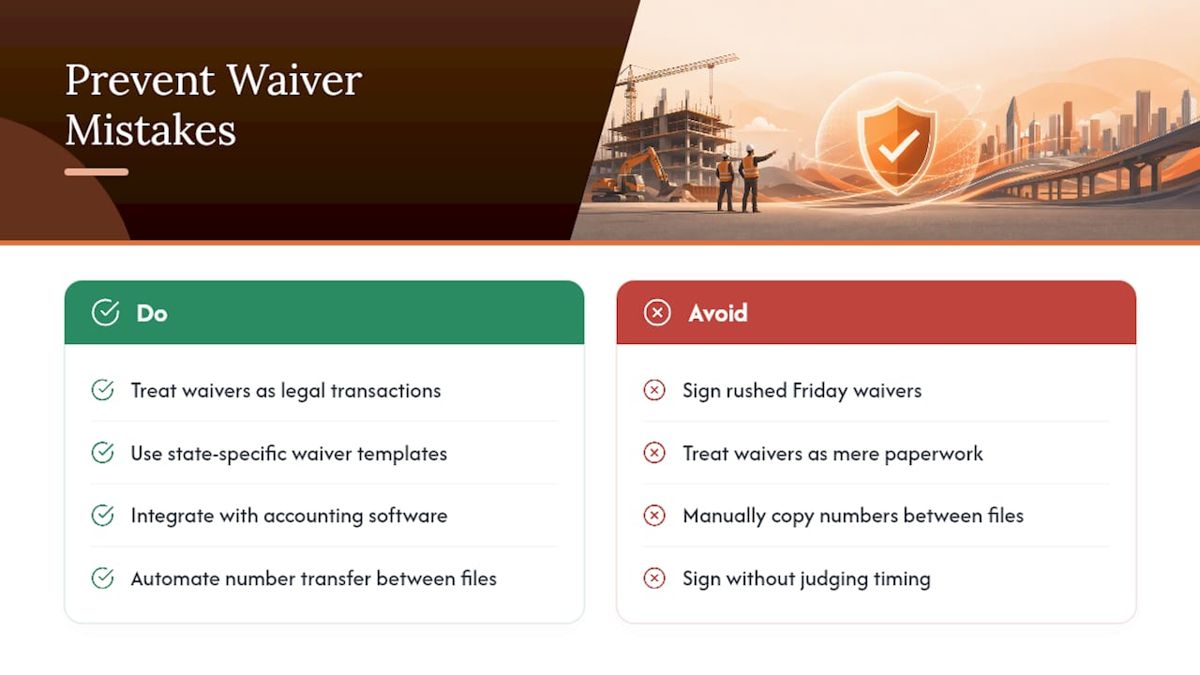
Most lien rights don’t get lost in a courtroom fight. They get lost in a rushed signature on a Friday afternoon, when a project manager needs “just one more form” before the weekend. That’s the uncomfortable truth conditional and unconditional waivers exist to manage, and it’s why the timing rule matters more than any clause in the document itself.
Suppliers who treat waivers as paperwork to get through, rather than a legal transaction with real consequences, are the ones who end up waiving rights on money that never showed up. The fix isn’t more legal knowledge. It’s a system: tools like WaiverPilotPRO that generate state-specific templates and connect with the accounting software you’re already using, like Procore and QuickBooks, cut down the manual errors that come from copying numbers between spreadsheets and PDFs by hand. Automation doesn’t replace judgment about when to sign. It just removes the paperwork friction that makes suppliers sign the wrong thing at the wrong time.
— Rowena
Generate a Compliant Waiver Without Building One From Scratch
You don’t need a subscription or a template library to get a professional waiver out the door today. Waiverpilotpro is the faster alternative to building lien waivers by hand in Word or hunting down a state’s exact statutory language on your own, and it costs nothing to start.
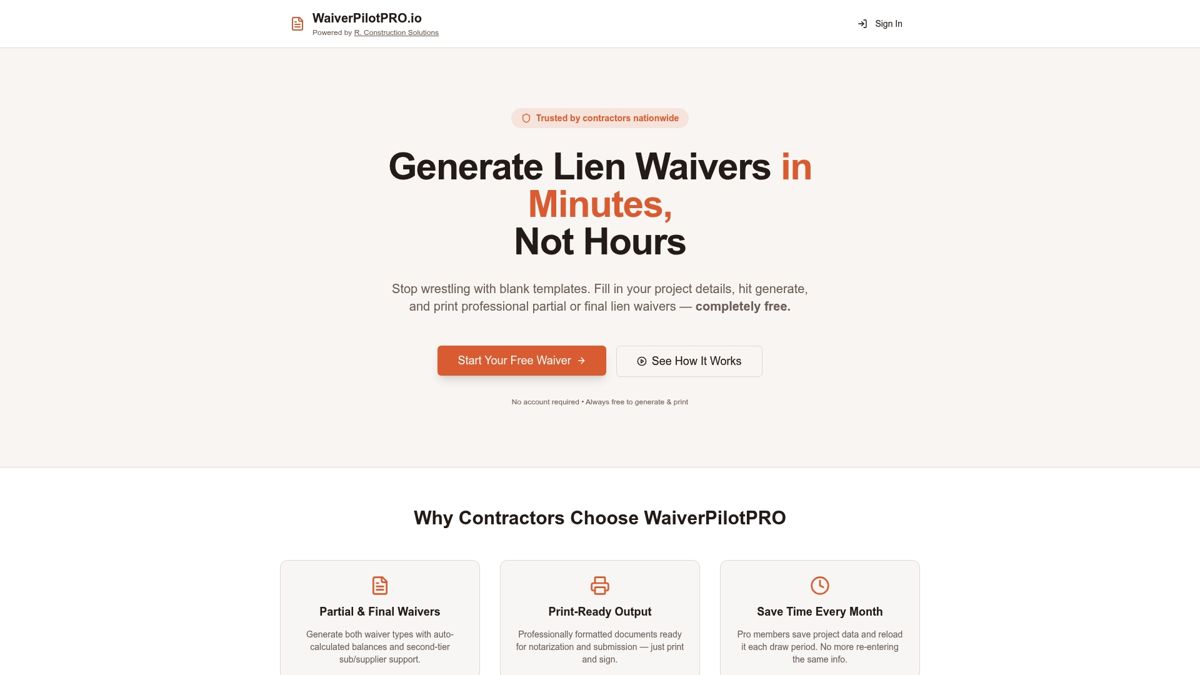
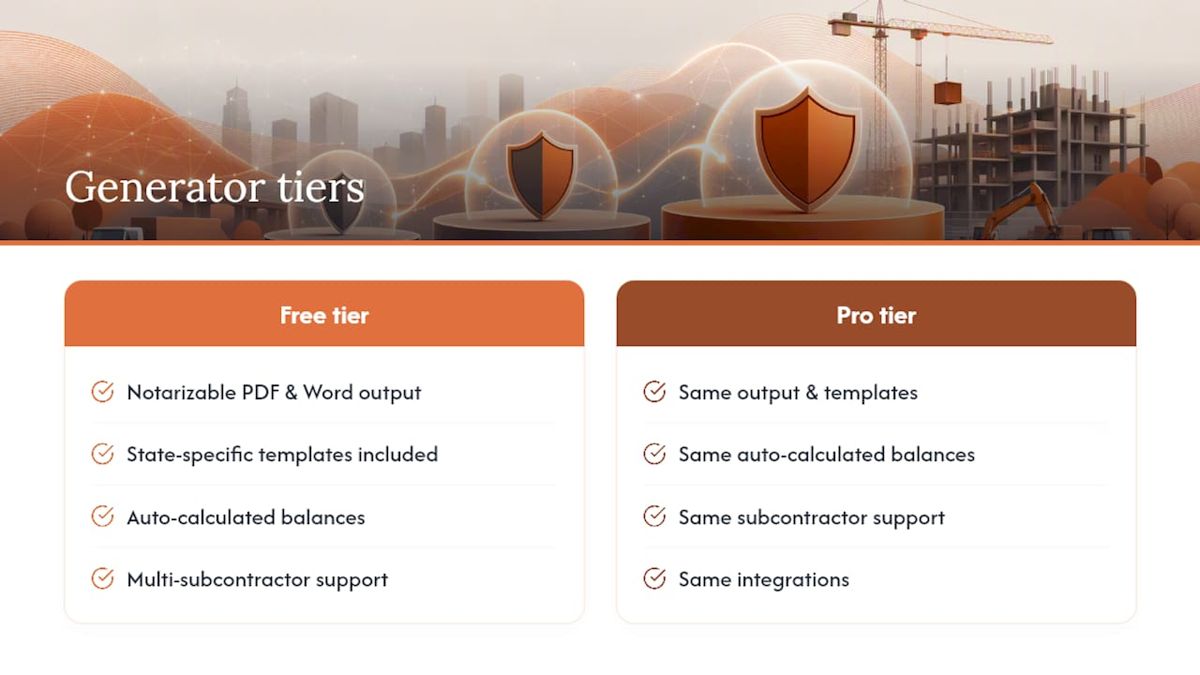
The free lien waiver generator produces notarizable PDF and Word output for all four waiver types, with state-specific templates built in so you don’t have to guess at “substantial conformance” in the roughly dozen states that require it. Auto-calculated balances catch amount mismatches before they become disputes, and multi-subcontractor support helps if you’re tracking lower-tier waivers across a crew. It connects directly with Procore, QuickBooks, JobTread, and Buildertrend, so project details flow in instead of getting retyped. The free tier covers unlimited basic generation; the Pro tier adds project saving, contract uploads, and AI-powered form auto-fill for suppliers juggling several projects at once.
Run through the verification checklist above the first time you generate a waiver, then let the platform handle the repeat work on every draw after that.
Where to Verify State Rules and Waiver Standards
Confirm your state’s exact requirements before relying on any form: CSLB’s California templates, Levelset’s 12-state breakdown, and Siteline’s subcontractor guide.
Sources
- What is a lien waiver? — Procore Support
- Materialman’s lien: filing, deadlines, and bond claims — LegalClarity
- Conditional and unconditional waiver and release forms — CSLB