
The GC’s Role in Subcontractor Payments Explained
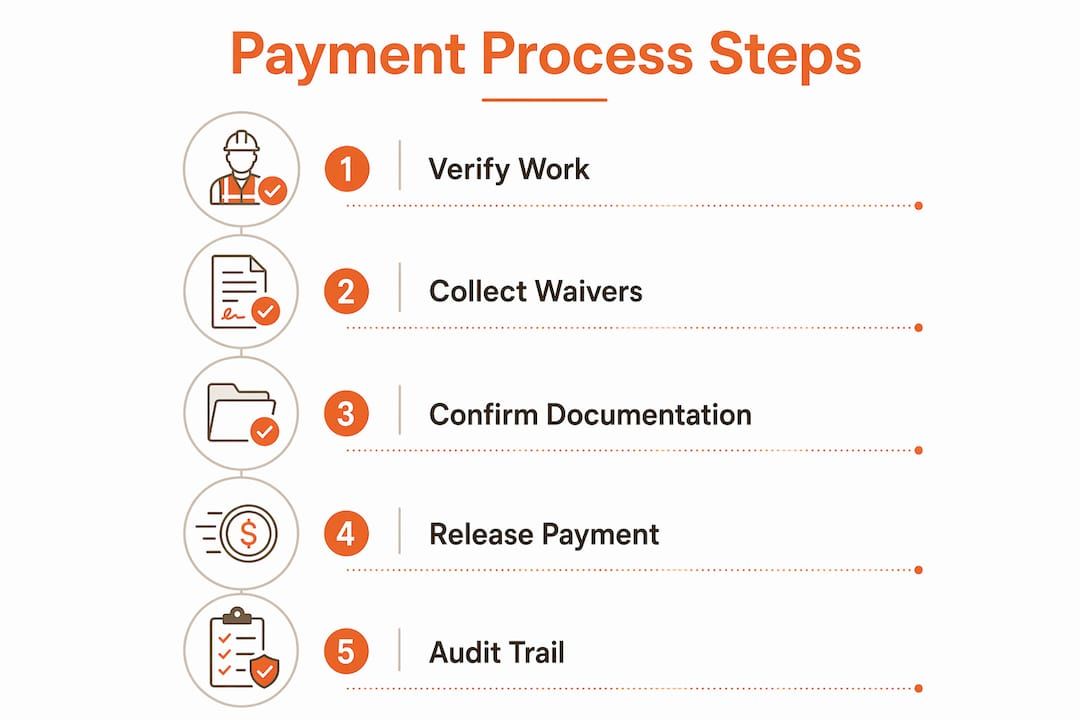
The general contractor is the central payment coordinator on every construction project. Money flows from the owner to the GC, then down to subcontractors — and the GC is responsible for managing that entire chain with precision. That means more than just cutting checks. The GC’s role in subcontractor payments covers payment timing, lien waiver collection, work verification, and risk control at every tier.
Here is what that looks like in practice:
- Payment coordination: The GC receives funds from the owner and distributes them to subs based on approved pay applications, typically documented with AIA G702 and G703 forms.
- Lien waiver collection: Before releasing payment, the GC collects signed lien waivers from each sub to protect the owner’s title and prevent duplicate claims.
- Work verification: The GC confirms that the work billed actually matches what was completed on site before approving any payment.
- Retainage management: The GC withholds a percentage of each payment until project milestones or final completion are met.
- Risk mitigation: The GC acts as a legal and financial buffer, using payment withholds and waiver documentation to protect all parties from lien exposure.
Most contractors think of the GC as a pass-through. In reality, the GC is actively managing legal and financial risk on behalf of the owner and the project.
Table of Contents
- How lien waivers work in the subcontractor payment process
- Common challenges GCs face with subcontractor payments
- How Waiverpilotpro simplifies lien waiver generation
- Best practices for GCs handling subcontractor payments
- Key Takeaways
How lien waivers work in the subcontractor payment process
A lien waiver is a written document in which a subcontractor, supplier, or laborer gives up their right to file a mechanic’s lien against the property — in exchange for payment. Think of it as a receipt that also surrenders a powerful legal remedy. Without it, a sub who claims they were not paid could file a lien that clouds the property title, stalls financing, and delays the project for everyone.
There are four standard types GCs work with:
- Conditional progress waiver: Releases lien rights for work completed to date, but only becomes effective once payment actually clears.
- Unconditional progress waiver: Releases lien rights immediately upon signing, regardless of whether payment has been received.
- Conditional final waiver: Covers all work on the project, effective upon receipt of final payment.
- Unconditional final waiver: Releases all lien rights permanently the moment it is signed.
Conditional waivers become effective only after payment clears, while unconditional waivers release lien rights immediately upon signing. That distinction matters most when a check is delayed or bounces. For a deeper look at how these types compare, the Waiverpilotpro guide on conditional vs. unconditional waivers breaks it down clearly.
A missing lien waiver can stall the entire draw process, increasing project risk for the owner, the GC, and every subcontractor waiting on the next payment cycle.
Lien waivers also flow downstream. The GC should collect waivers not just from direct subs, but from subs’ suppliers and lower-tier vendors when possible. A supplier who goes unpaid by a sub can still file a lien against the property, even if the GC paid the sub in full.
Common challenges GCs face with subcontractor payments
Managing subcontractor payments is rarely straightforward. The payment chain typically runs four tiers deep — owner, GC, sub, supplier — and a hold at any level can stop deliveries and work downstream.
The most common pressure points include:
- Payment delays: When the owner is slow to fund the GC, subs wait. That wait hits their cash flow, strains supplier relationships, and can pull crews off the job.
- Incomplete or incorrect lien waivers: A waiver with the wrong dollar amount, wrong date, or missing notarization may be unenforceable — leaving the GC exposed even after payment is made.
- Pay-if-paid vs. pay-when-paid disputes: Pay-if-paid clauses make the sub’s payment contingent on the GC receiving funds from the owner. Pay-when-paid clauses only delay timing. Many states enforce pay-if-paid only when the contract language is unambiguous — so the exact wording in your subcontract matters.
- Work verification complexity: Confirming that billed work matches actual progress takes time and documentation, especially on large projects with multiple active subs.
- Lower-tier lien exposure: Even after paying a sub, the GC can face a lien from that sub’s unpaid supplier. Collecting waivers from every tier is the only reliable protection.
Proper permit and billing documentation reduces the risk of disputes that can trigger payment holds and lien claims.
How Waiverpilotpro simplifies lien waiver generation

Waiverpilotpro was built specifically to take the friction out of lien waiver management for contractors. Instead of hunting down templates, manually calculating balances, or chasing subs for signatures, you generate compliant waivers in minutes.
Key features that directly support GC payment workflows:
- Free conditional and unconditional waiver generation: Create both progress and final waivers without account creation or subscription fees.
- Auto-calculated balances: The platform calculates remaining balances automatically, reducing math errors that can invalidate a waiver.
- Multi-subcontractor support: Manage waivers across multiple subs on the same project from a single workflow.
- Procore and QuickBooks integration: Waiverpilotpro connects with construction management software you already use, so waiver data pulls directly from your project records.
- Notarizable documents: Every waiver generated meets professional standards and is ready for notarization and submission.
- Built-in educational resources: Guidance on lien waiver best practices is embedded in the platform, so you are not left guessing about compliance.
The result is less administrative overhead, a cleaner audit trail, and reduced legal exposure on every payment cycle. You can start generating waivers immediately at the free lien waiver generator.
Best practices for GCs handling subcontractor payments
Getting payments right requires consistent process, not just good intentions. These practices reduce risk and keep projects moving:
- Standardize your pay application review. Use AIA G702 and G703 forms consistently so every sub submits documentation in the same format. This makes approval faster and disputes easier to resolve.
- Verify work before releasing payment. Walk the job or review progress photos before approving any pay application. Payment for work not yet completed is one of the hardest problems to unwind.
- Collect lien waivers at every tier. Get waivers from direct subs and, where possible, from their material suppliers. Use free construction forms to standardize the documents across your projects.
- Communicate retainage timelines clearly. Subs plan their cash flow around retainage release. Give them a written schedule at the start of the project and stick to it.
- Use joint check agreements when needed. When a sub’s supplier relationship is uncertain, joint check agreements issued to both the sub and their vendor prevent unpaid supplier liens. They add paperwork, but they close a real gap.
- Build a digital audit trail. Software-generated waivers with timestamps and version history protect you in a dispute far better than a folder of scanned PDFs.
Pro Tip: Never sign an unconditional lien waiver before the payment has cleared your account. Once signed, you have permanently released your lien rights — even if the check bounces. Always use a conditional waiver until funds are confirmed.
Key Takeaways
The GC’s core job in subcontractor payments is active risk management: verifying work, collecting lien waivers at every tier, and using the right waiver type at the right time to protect the project’s title and cash flow.
| Point | Details |
|---|---|
| GC as payment coordinator | The GC manages payment flow from owner to subs, including approvals, documentation, and retainage. |
| Lien waiver types matter | Conditional waivers protect you until payment clears; unconditional waivers release rights immediately upon signing. |
| Four-tier payment chain | Any hold at one level stops payments and deliveries downstream, affecting the entire project schedule. |
| Pay-if-paid vs. pay-when-paid | Contract wording determines whether the GC can withhold payment if the owner doesn’t pay — know your state’s rules. |
| Software reduces exposure | Tools like Waiverpilotpro automate waiver generation, calculate balances, and integrate with Procore and QuickBooks. |