
Ohio Contractors: 4 Lien Waivers, ORC 1311 Checklist to Protect Pay
Ohio does not prescribe a statutory lien waiver form or require notarization; waivers are contract-driven, so treat every one as a bespoke contract term. Use conditional waivers until payment clears, never sign an unconditional final waiver prematurely, and if payment stalls, look to ORC Chapter 1311 for your filing deadlines.
TL;DR:
- Ohio law does not mandate specific lien waiver language or notarization, leaving the drafting and negotiation of terms entirely up to the parties.
- Selecting the correct waiver type is critical, as unconditional waivers signed prematurely can waive rights, whereas conditional waivers protect lien rights until payment clears.
- Properly filling out a waiver requires precise, complete information on claimants, property, payment amounts, dates, and retainage to avoid inadvertent rights waivers.
- Ohio law protects lien rights unless explicitly waived in writing, and acceptance of promissory notes alone does not constitute a waiver.
- Using software like WaiverPilotPRO can streamline compliance, generate professional waivers quickly, and help manage multiple subcontractors and pay applications efficiently.
Table of Contents
- What Is an Ohio Lien Waiver and Where Does It Fit in Payment?
- What Does Ohio Law Actually Say About Lien Waivers?
- Conditional vs. Unconditional, Progress vs. Final: Choosing the Right Waiver
- How Do You Fill Out an Ohio Lien Waiver Correctly?
- Do You Need a Notary for a Lien Waiver in Ohio?
- How Do You File a Mechanics’ Lien in Ohio If Payment Fails?
- Practical Risk Management: What Contractors, Subs, and Owners Should Actually Do
- How WaiverPilotPRO Turns This Checklist Into a Repeatable Workflow
- Generate a Compliant Ohio Lien Waiver in Minutes
- Where to Verify Ohio’s Lien Waiver Rules Yourself
- Why Ohio’s “Blank Slate” Approach Cuts Both Ways
- Sources
What Is an Ohio Lien Waiver and Where Does It Fit in Payment?
An Ohio lien waiver is a document where a contractor, subcontractor, or supplier gives up some or all of their right to file a mechanics’ lien against a property, usually in exchange for payment. A lien release is closely related but technically distinct: a waiver gives up the right before or as payment happens, while a release typically clears a lien that has already been filed. Most people in the trade use the terms interchangeably, and for practical purposes on an Ohio job site, they function the same way.
Waivers show up at three points in a typical payment cycle:
- Progress payments — issued monthly or per draw, tied to a specific pay application
- Retainage — the withheld percentage released at substantial completion or closeout
- Final closeout — the last payment, closing out lien rights on the project entirely
Who signs depends on where you sit in the payment chain. A general contractor collects waivers from every subcontractor and supplier before releasing their payment, then signs their own waiver up to the owner or lender. A subcontractor signs a waiver to the general contractor covering the work and materials that payment covers. Suppliers do the same up the chain to whoever pays their invoice.
The mechanics matter here more than the terminology. A waiver signed for the wrong amount, the wrong date range, or without a retainage carve-out can quietly sign away rights to money you have not been paid yet. That is the entire reason Ohio’s approach to waivers, discussed next, puts so much weight on contract language instead of a government form.
What Does Ohio Law Actually Say About Lien Waivers?
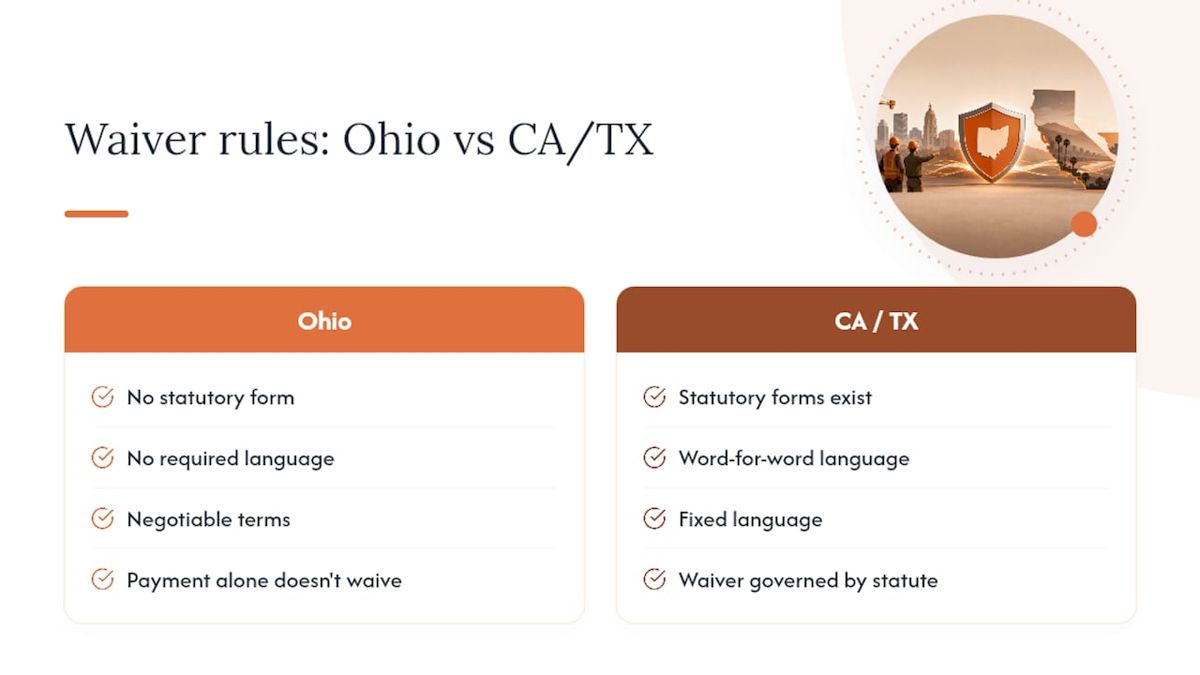
Chapter 1311 of the Ohio Revised Code governs mechanics’ liens in Ohio, and it is largely silent on lien waivers themselves. There is no statutory waiver form, no required language, and no notarization mandate written into the chapter. That silence is not an oversight.
This matters because states like California and Texas mandate specific statutory waiver language, word for word. Ohio gives contractors no such safety net, and no such straitjacket. You can negotiate the terms. You can also get burned by terms you didn’t read carefully.
One provision worth knowing by heart is Section 1311.21(A), which protects contractors from accidentally waiving lien rights through the payment method itself:
A person entitled to a lien does not waive that lien by taking a promissory note or other security for the labor, work, or materials furnished, unless a written agreement to that effect is signed by the party so entitled to such lien.
In plain terms: accepting a check, a promissory note, or other payment instrument does not, by itself, waive your lien rights. Only a written agreement that says so does. That is a meaningful protection, since it means the waiver document itself, not the payment mechanism, is what controls whether you have given anything up.
For the filing and affidavit mechanics that matter once a payment dispute actually escalates, Section 1311.06 sets the framework, covered in detail later in this guide. Industry trackers including Levelset describe Ohio’s approach as effectively a blank slate for waiver drafting, which is exactly why a checklist matters more here than in states with mandated forms.
Conditional vs. Unconditional, Progress vs. Final: Choosing the Right Waiver
Ohio gives you four practical waiver types, and choosing the wrong one at the wrong stage is the single most common mistake contractors make on Ohio jobs.
- Conditional progress waiver. This is the default for subcontractors and suppliers on any ongoing project. It only takes effect once the payment actually clears your bank. If the check bounces or payment is stopped, your lien rights for that amount stay intact. This is the waiver you should be signing on every progress payment unless you have a specific reason not to.
- Unconditional progress waiver. This takes effect the moment you sign it, whether or not the funds have cleared. General contractors and owners sometimes push for this version because it is cleaner for their records. The risk sits entirely with you: if the payment fails after you sign, you have already surrendered your lien rights for that draw.
- Conditional final waiver. Used at project closeout, this releases your remaining lien rights only after the final payment clears. Banks and title companies handling the closing often want this version notarized, even though Ohio law does not require it.
- Unconditional final waiver. This is the most consequential document in the entire payment cycle. It gives up every remaining lien right immediately upon signature. Sign it only after the final payment has actually cleared and any disputes over the work are resolved.
Pro Tip: If someone hands you an unconditional waiver before you’ve been paid, you don’t have to refuse outright. Cross out “unconditional,” write in “conditional upon receipt and clearance of payment,” and initial the change. Most general contractors will accept it without argument, because they know exactly why you’re asking.
The distinction between conditional and unconditional waivers is one of the most misunderstood parts of lien waiver practice nationwide, not just in Ohio, and it is worth understanding cold before you sign anything on your next project.
How Do You Fill Out an Ohio Lien Waiver Correctly?
Because Ohio gives contractors a blank canvas rather than a fixed form, every field on the document has to be filled in with precision. Vague or missing entries are exactly what turn a routine waiver into a costly mistake.
A properly completed Ohio waiver needs these fields filled in without ambiguity:
- Claimant name — the exact legal business name signing the waiver, not a trade name or abbreviation
- Property description — the address and, ideally, the parcel number tied to the county recorder’s records
- Owner and original contractor names — so the waiver ties clearly to the correct project chain
- Payment amount — stated in both numerals and words, matching the pay application exactly
- Through date — the cutoff date the waiver covers, which must match your pay application’s billing period
- Waiver type — clearly marked as conditional or unconditional, progress or final
Retainage deserves its own line. Skip that carve-out and a poorly worded waiver can accidentally release rights to money that is still sitting unpaid in someone else’s account. LegalClarity’s guide to Ohio waiver forms recommends stating the conditional effect, the retainage exclusion, and the amount limitation directly in the body of the document rather than relying on a form’s fine print.
Signer authority is the other quiet risk. A waiver signed by someone without the authority to bind the business can be challenged later, which defeats the entire purpose of getting it signed. Keep a written delegation of authority on file naming who can sign lien documents for your company, and confirm the same on the other side of any waiver you receive.
| Field | Why It Matters |
|---|---|
| Claimant legal name | Ties the waiver to the correct signing entity |
| Property address/parcel | Prevents disputes over which project the waiver covers |
| Payment amount (numerals + words) | Removes ambiguity if the two don’t match |
| Through date | Defines exactly what work the waiver releases |
| Retainage carve-out | Protects withheld funds from accidental release |
| Waiver type | Determines when the release actually takes legal effect |
For delivery, certified mail with a return receipt, a timestamped PDF, or an upload to a shared platform all create a paper trail. That record matters if a dispute ever surface over whether a waiver was received, or when.
Do You Need a Notary for a Lien Waiver in Ohio?
Chapter 1311 does not require notarization for any lien waiver in Ohio. That said, plenty of lenders and title companies require it anyway on final releases, purely as an internal underwriting standard rather than a legal mandate. Confirming this before closing day saves a real headache, since a missing notary stamp can hold up a fund disbursement even when the waiver itself is otherwise perfectly valid.
Electronic signatures carry full legal weight in Ohio under Chapter 1306, the Uniform Electronic Transactions Act, as long as both parties have agreed to conduct the transaction electronically. That consent piece is the part people skip. If your contract or your platform’s terms don’t establish that both sides accept electronic signing, a paper trail dispute later becomes harder to win.
A few practical habits keep this from becoming a problem:
- Confirm with the lender or title company early whether they’ll require a notarized wet-ink final release before you rely on an e-signed version.
- If a notarized final is coming later, use conditional-final language in the interim so you’re not stuck holding an unconditional release before the notarized version exists.
- Check that your payment platform or software explicitly documents both parties’ consent to electronic signing, not just a click-to-sign button.
Ohio’s own guidance on this split, covered in more detail in this notarization breakdown, is worth reading before your first Ohio closing if you haven’t run into a notarization demand yet.
How Do You File a Mechanics’ Lien in Ohio If Payment Fails?
If a waiver negotiation breaks down or payment simply stops, your leverage runs through Ohio’s mechanics’ lien affidavit process, and the clock on that process starts the moment your last work or materials went into the project.
- A time-limited period to file for residential projects involving one or two-family homes or condominium units, per ORC §1311.06.
- A time-limited period to file for most commercial and other project types.
- A longer time-limited period to file for oil and gas well or facility improvements.
The affidavit itself needs to identify the property, the amount owed, the dates labor or materials were furnished, and the parties involved, filed with the county recorder in the county where the property sits. The recorder timestamps the filing, and that timestamp is what establishes your priority against other claims.
Serving the affidavit correctly matters as much as filing it on time. Ohio requires that a copy reach the property owner, or the owner’s authorized designee if one has been named for the project, within a set window after recording. Miss that service step and you risk losing the lien even if the filing itself was timely.
Owners have their own tools in this process, too. Under provisions like §1311.021, an owner can require a general contractor to produce an affidavit listing every unpaid subcontractor and supplier before releasing payment. Owners can also condition payment on a joint check made out to both the general contractor and a subcontractor, which forces the release of lien rights as part of the same transaction that generates the payment.
Practical Risk Management: What Contractors, Subs, and Owners Should Actually Do
Every rule so far points toward the same handful of habits. Here’s how they play out in practice.
- Never sign an unconditional final waiver until the money has actually cleared and every dispute over the scope of work is closed out. Once signed, there’s no walking it back.
- Build retainage carve-outs into every progress waiver, and make the through date match your pay application exactly. A mismatched date range is one of the easiest ways to accidentally waive work you haven’t billed for yet.
- If you’re the owner, request an affidavit of unpaid subcontractors before releasing a large payment, or structure the check as a joint check between the general contractor and the sub. Either move ties the payment directly to the lien release.
- Keep every signed waiver, delivery receipt, and payment record in one place, organized by project and by payment date. When a dispute surfaces months later, this is the file that settles it.
Pro Tip: Document the exact date a payment clears your bank, not just the date the check arrived. That clearance date is what a conditional waiver actually hinges on, and disputes over “when” a conditional event occurred are far easier to settle with a bank record than with someone’s memory of a mailing date.
Escalate to legal counsel the moment a waiver dispute involves a signer authority question, a large final payment, or a lien filed against a residential property with an occupied home. Those situations carry consequences that go beyond what a checklist can protect against on its own.
How WaiverPilotPRO Turns This Checklist Into a Repeatable Workflow
Everything in this guide, the through dates, the retainage carve-outs, the signer verification, is a manual discipline until it becomes a software habit. There are software solutions available that aim to assist contractors working Ohio projects with waiver generation and auto-calculation features to help reduce mismatched amounts before signature.
Managing multiple subcontractors matters on projects with multiple pay applications, since manually matching through dates across many subcontractors can lead to errors. Some software tools integrate with construction management and accounting platforms to pull payment data directly from pay applications, helping ensure the waiver amount matches the approved payment rather than relying on manual entry.
,
Generate a Compliant Ohio Lien Waiver in Minutes
There are other paths to a compliant Ohio waiver. You can draft one from scratch in a word processor, pull a generic template off a legal forms site, or pay an attorney to review every one your business signs. Each of those works, but each one also costs you either time or money on a document you’ll need dozens of times a year.
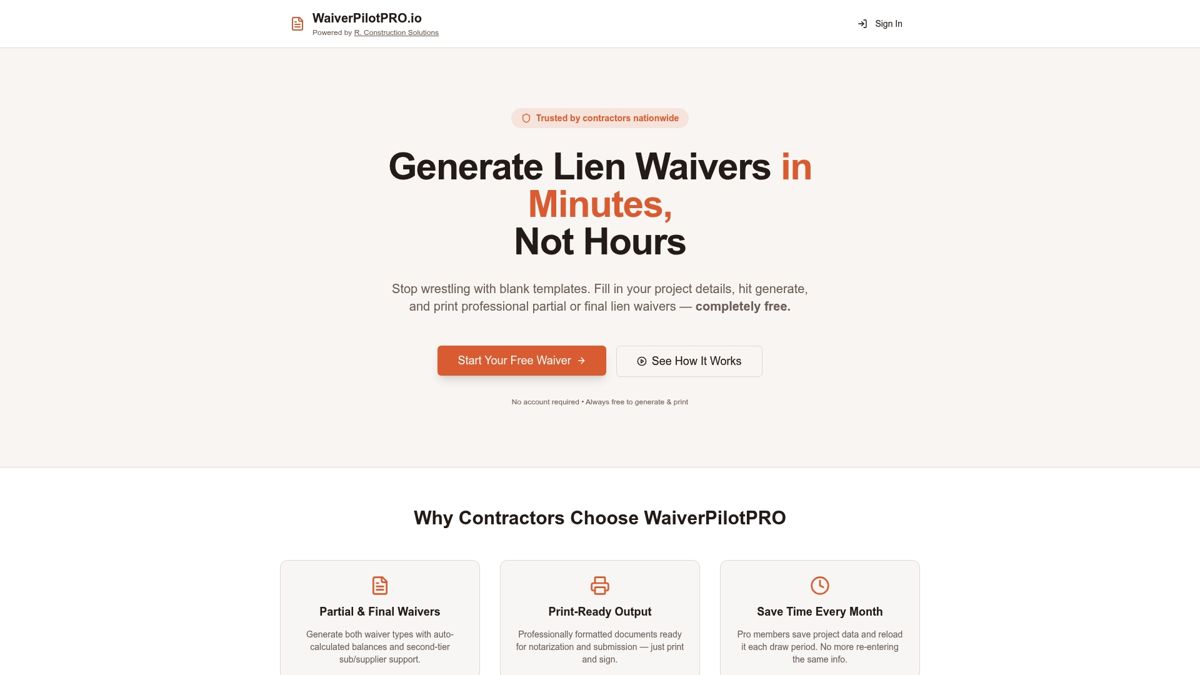
WaiverPilotPRO gives Ohio contractors, subcontractors, and suppliers a faster route: fill in project details once, and generate a conditional or unconditional waiver, progress or final, with auto-calculated balances that flag amount mismatches before you sign. There’s no account creation required to generate a free waiver, and the output is a professional, notarizable PDF ready for a lender or title company the same day you need it. Multi-subcontractor support handles the busy job with a dozen pay applications in flight at once, and integrations with tools like Procore and QuickBooks pull your payment data directly instead of forcing a manual retype.
If your business runs on JobTread, Buildertrend, or Sage, WaiverPilotPRO connects there too. Start with the free lien waiver generator and have your next Ohio waiver ready before your next pay application is even due.
Where to Verify Ohio’s Lien Waiver Rules Yourself
The statutory backbone of everything in this guide sits in ORC Chapter 1311, with the promissory note protection in Section 1311.21 and the affidavit filing deadlines in Section 1311.06. Electronic signature validity runs through Chapter 1306.
For sample language and downloadable templates, WaiverPilotPRO’s free construction forms library covers PDF, Word, and Excel formats. Subcontractors wanting a deeper walkthrough of conditional waiver mechanics should read Subascent’s guide for trade subs, and LegalClarity’s Ohio-specific breakdown walks through field-by-field completion in more depth than space allows here.
Why Ohio’s “Blank Slate” Approach Cuts Both Ways
Most guides to Ohio lien waivers frame the absence of a statutory form as a burden, one more way the state leaves contractors exposed. I’d argue the opposite is closer to true, with a caveat.
The lack of a mandated form means Ohio contractors have more room to negotiate protective language than their counterparts in states with rigid statutory templates. A subcontractor in a state with a fixed unconditional waiver form has no way to insert conditional language even if they wanted to. In Ohio, you can. That flexibility is a real advantage for anyone who understands what to ask for.
The caveat is that flexibility only helps the party who knows how to use it. Every industry source that calls Ohio’s system a blank slate is also, implicitly, warning that the burden of protection has shifted from the state to the contractor. If you don’t know to add a retainage carve-out or a conditional clearance clause, nobody is going to add it for you. The general contractor drafting the waiver template you’re handed has no incentive to make it more protective of your rights than the bare minimum requires.
That asymmetry is exactly why treating waiver management as a checklist discipline, not a one-off signature, matters more in Ohio than in states where the government has already written the safe version for you. The contractors who get burned aren’t the ones facing unusual circumstances. They’re the ones who signed the same template they’ve always signed, on a project where the amount, the through date, or the retainage carve-out quietly didn’t match.
— Rowena
Sources
- Chapter 1311 | Liens — Ohio Revised Code
- How to fill out and sign an Ohio lien waiver form — LegalClarity