
Notice of Intent to Lien: Contractor Guide and Template
A notice of intent to lien (NOI) is a formal written warning that you will record a mechanics lien against a property if an overdue construction payment isn’t cured within a stated deadline. If you have an unpaid invoice and your lien filing window is approaching, send the NOI now.
Your immediate next steps:
- Collect your documents: Gather all unpaid invoices, pay applications, signed delivery tickets, and your contract.
- Calculate your last-furnishing date: Identify the last day you provided labor, materials, or equipment on the project — this date drives your lien deadline.
- Choose a delivery method: Certified mail with return receipt or personal service by a process server are the two most defensible options.
Key Takeaways
A notice of intent to lien is only as effective as the accuracy of its contents and the verifiability of its delivery — get both right and it is one of the most powerful payment tools available to contractors.
| Point | Details |
|---|---|
| Send early, not last-minute | The NOI cure period (typically 10–30 days) must expire before your lien filing deadline. |
| Accuracy protects your rights | Wrong owner name, inflated amounts, or missing statutory language can void the notice entirely. |
| Certified mail is the minimum | Keep the green card, tracking confirmation, and a copy of the notice with all attachments. |
| State rules vary significantly | A handful of states require an NOI before filing; verify your statute before you send. |
| Waiverpilotpro speeds post-payment paperwork | Free state-specific lien waiver templates with Procore and QuickBooks integration close the file fast. |
Table of Contents
- What is a notice of intent to lien and why does it work?
- When should you send an NOI — and how do deadlines interact?
- Which states require an NOI before you can file a lien?
- What to put in your NOI — required elements and sample wording
- How to serve an NOI and prove delivery
- A short sample NOI and how to turn it into a fillable template
- What happens after you send the NOI?
- How do a preliminary notice, an NOI, and a mechanics lien differ?
- Checklist and best practices for an effective NOI
- What are the legal risks of sending an NOI improperly?
- How to handle disputes after sending an NOI
- Using an NOI as a negotiation and collection tool
- Speed up your construction paperwork with Waiverpilotpro
- Sources
What is a notice of intent to lien and why does it work?
An NOI is the final demand before a mechanics lien. It tells the property owner and the general contractor (GC) in writing: pay the outstanding balance within a set number of days or a lien will be recorded against the property title. That threat carries real weight because a recorded lien clouds the title, can trigger lender action, and can halt refinancing or sale of the property.
Construction lenders react quickly to liens, which is exactly why owners often settle rather than let a lien hit the record. The NOI is the moment the owner realizes you are serious.
Practically, an NOI fits into your payment timeline after invoices and payment applications have gone unanswered. It is not a lawsuit and it is not a lien. Think of it as a formal, documented last chance to resolve the dispute without escalating to a recorded encumbrance.
Common situations where an NOI makes sense:
- A subcontractor with no direct contract with the owner needs to put the owner on notice.
- A material supplier has shipped product and received no payment after the due date.
- A GC wants to pressure an owner who is withholding a final payment without a valid reason.
- Any party whose lien deadline is approaching and who wants one more documented attempt at collection before filing.
Some states legally require an NOI before you can file a mechanics lien. In others, it is entirely optional but widely used as a payment-collection tactic because it works.
When should you send an NOI — and how do deadlines interact?
Timing an NOI correctly requires tracking two separate clocks at the same time.
- Your lien filing deadline. Most states measure this from your last date of furnishing (the last day you provided labor, materials, or equipment). Windows vary widely by state — some are as short as 60 days, others extend to 120 days or more. Check the mechanics lien timing tables by state to confirm the exact window for your state.
- The statutory cure period. Where a state requires an NOI, it also sets a mandatory waiting period before you can file the lien. Cure periods typically run from about one to four weeks. You must send the NOI early enough that the cure period expires before your lien deadline does.
The math matters. If your lien deadline is 90 days from last furnishing and your state requires a 30-day cure period after the NOI, you need to send the NOI no later than day 60. Waiting until day 80 leaves you with an expired cure period and a missed lien window.
For optional-notice states, a 10-day cure period is common industry practice. It is short enough to create urgency and long enough to be considered reasonable.
Pro Tip: Sending an NOI does not extend your lien filing deadline. Both timelines run independently. Map them both on a calendar before you send the notice, and set a hard reminder for the lien filing date regardless of whether you receive payment.
Which states require an NOI before you can file a lien?
State lien laws vary significantly. A handful of states mandate an NOI as a condition of filing a valid mechanics lien. Many others treat it as optional. The practical steps to confirm your state’s rules are straightforward.
How to verify your state’s requirements:
- Look up your state’s mechanics lien statute directly (search “[State] mechanics lien statute” or visit your state legislature’s website).
- Check with your county recorder’s office for any local filing or recording requirements.
- Review the state-by-state lien timing tables for notice, filing, and foreclosure windows.
- When the amount at stake is significant, consult a construction attorney in your state for a current statutory reading.
The table below shows representative state categories. Always verify current statutes before relying on any summary.
Checklist to confirm your state’s exact requirements:
- Locate the statute citation (e.g., “O.C.G.A. § 44-14-361.1” for Georgia).
- Confirm whether the NOI must be recorded with the county recorder or only served on parties.
- Identify the exact parties who must receive the NOI (owner, GC, lender, or all three).
- Confirm the required delivery method under your state’s statute.
- Note whether specific statutory language must appear in the notice itself.
What to put in your NOI — required elements and sample wording
A complete, accurate NOI is the difference between a notice that gets taken seriously and one that gets challenged. Omitting required statutory language or inflating the amount owed can expose you to penalties or invalidate the lien entirely. Every field matters.
Required elements, line by line:
- Claimant’s full legal name and address: Use the exact name on your contract or license.
- Property owner’s legal name: Pull this from the county assessor’s records, not just the contract. Wrong names are one of the most common reasons notices fail.
- General contractor’s name and address (if applicable).
- Project address and legal description: Include the street address and, where required by statute, the legal parcel description.
- Last-furnishing date: The specific date you last provided labor, materials, or equipment. Do not estimate — confirm it from your job logs.
- Exact amount owed: State the precise dollar figure. Do not round up or add speculative amounts. Inflating the claim can subject you to penalties and undermine your lien rights.
- Invoice identifiers: List specific invoice numbers and dates so the recipient can match the claim to their records.
- Description of labor or materials furnished: A brief, accurate description of what you provided.
- Statement of intent: A clear sentence stating you will file a mechanics lien if payment is not received.
- Cure deadline: A specific date by which payment must be received (e.g., “on or before [date]”).
- Claimant’s signature and contact information.
Sample phrasing for the most sensitive lines:
Statement of intent: “Unless the balance of $[AMOUNT] is paid in full on or before [DATE], [CLAIMANT NAME] intends to file a mechanics lien against the above-referenced property.”
Cure deadline: “Payment must be received no later than [DATE], which is [10/30] days from the date of this notice.”
Pro Tip: Attach copies of the unpaid invoices and reference each invoice number in the body of the notice. This removes any ambiguity about what is owed and makes it harder for the recipient to claim they did not know the specific amounts.
How to serve an NOI and prove delivery
Serving the NOI correctly is just as important as drafting it correctly. A notice that cannot be proven delivered is a notice that may not hold up. Certified mail with return receipt and a process server affidavit are the most widely accepted proof-of-service methods; email alone is usually insufficient unless your contract explicitly authorizes electronic service or your state statute permits it.
Acceptable delivery methods:
- Certified mail, return receipt requested (USPS): The green card (PS Form 3811) is your proof of delivery. Keep the original.
- Personal service by a process server: The server’s affidavit of service is your evidence. This method is harder to dispute.
- Statutory alternatives: Some states permit overnight courier with delivery confirmation or registered mail. Check your statute.
Evidence checklist — keep all of this:
- The mailing receipt from the post office (showing date and recipient address).
- The signed green card or USPS tracking confirmation showing delivery.
- A process server’s affidavit, if used.
- A complete copy of the notice exactly as sent, including all attachments.
- A copy of the envelope (photographed before mailing) showing the recipient’s address.
A short note on recording: some states require the NOI to be recorded with the county recorder in addition to being served on the parties. Check your state statute for this requirement before you send.
A short sample NOI and how to turn it into a fillable template
The sample below is a starting point. Replace every bracketed field with your actual project data before sending.
NOTICE OF INTENT TO FILE A MECHANICS LIEN
Date: [DATE]
To: [PROPERTY OWNER LEGAL NAME], [OWNER ADDRESS] And: [GENERAL CONTRACTOR NAME], [GC ADDRESS]
Re: [PROJECT NAME AND ADDRESS]
This notice is provided pursuant to [STATE STATUTE CITATION].
[CLAIMANT LEGAL NAME] (“Claimant”) has furnished [DESCRIPTION OF LABOR/MATERIALS] to the above-referenced project. The last date of furnishing was [LAST FURNISHING DATE]. The total amount currently due and unpaid is $[EXACT AMOUNT], as reflected in Invoice No(s). [INVOICE NUMBERS].
Unless the full amount of $[EXACT AMOUNT] is paid to Claimant on or before [CURE DEADLINE DATE], Claimant intends to file a mechanics lien against the above-referenced property in accordance with applicable state law.
[CLAIMANT NAME] [CLAIMANT ADDRESS] [CLAIMANT PHONE AND EMAIL] [AUTHORIZED SIGNATURE]
Step-by-step instructions for converting this into a finished document:
- Replace every bracketed field with your verified project data.
- Attach copies of all unpaid invoices referenced in the notice.
- Save the final version as a PDF. Keep the original editable file as well.
- Some states require notarization — check your statute before signing.
- Make two copies: one to send, one for your records.
- Send via certified mail and photograph the sealed envelope before dropping it at the post office.
For free downloadable construction forms including state-specific templates, Waiverpilotpro offers ready-to-use PDF and Word formats that you can fill in and print immediately.
What happens after you send the NOI?
Most NOIs produce one of four responses. Knowing what to do in each scenario keeps you in control of the timeline.
- Immediate payment: The owner or GC pays in full. Confirm receipt of cleared funds, then issue the appropriate lien waiver to close out the claim. Do not release lien rights until payment has actually cleared.
- Negotiation or partial payment: The owner acknowledges the debt but offers less than the full amount. Decide whether to accept and issue a partial waiver or hold firm and proceed toward filing. Document every communication in writing.
- Request for documentation: The owner or GC asks for backup. Provide copies of invoices, delivery tickets, and the schedule of values promptly. This is often a delay tactic, so keep your lien deadline in view.
- No response: If the cure deadline passes without payment or communication, file the mechanics lien before your statutory deadline. The NOI documentation you kept becomes part of your lien file.
Lenders are sensitive to recorded liens because a lien can trigger a loan default or freeze draws. That pressure often motivates owners to resolve disputes quickly once a lien is actually filed.
A note on costs: filing a mechanics lien involves county recording fees, and in some states, you must file a lawsuit (lien foreclosure) within a set period to enforce it. If the amount owed is small relative to those costs and risks, weigh whether filing is worth it before you proceed.
In Florida specifically, Chapter 713 does not require an NOI before filing a mechanics lien, but sending one is still a practical collection tool. Florida’s Notice to Owner rules and the 90-day recording deadline still govern your timeline, so coordinate those separately.
How do a preliminary notice, an NOI, and a mechanics lien differ?
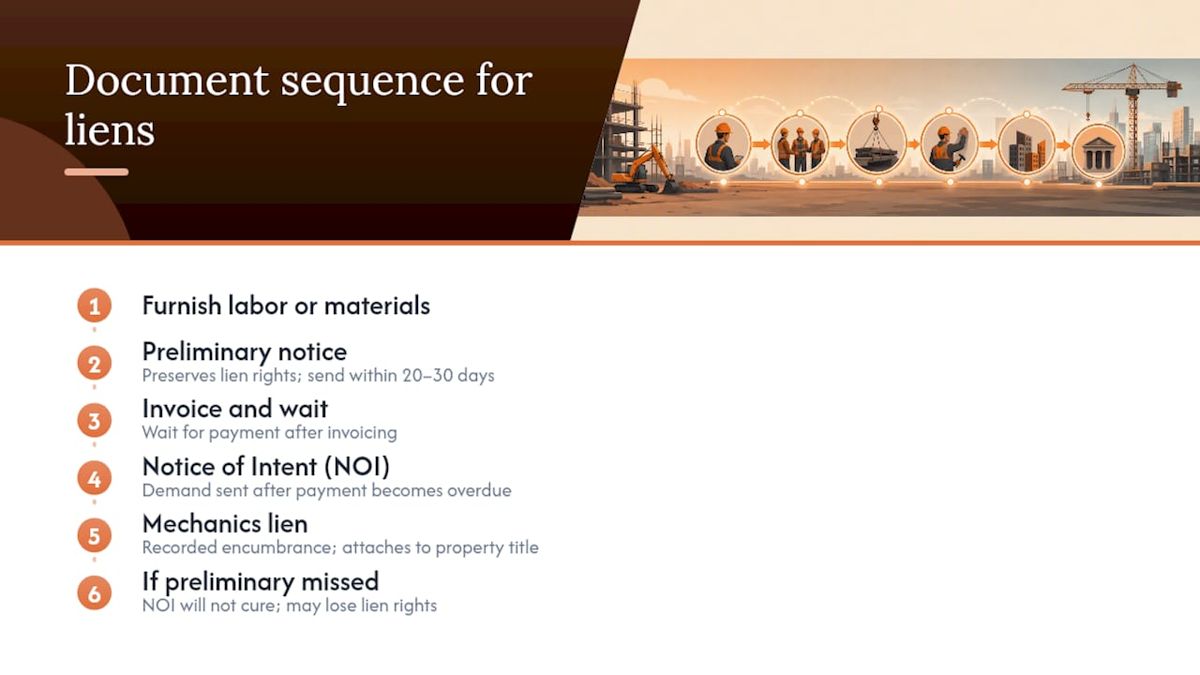
These three documents are often confused, but each serves a distinct purpose at a different point in the project.
Preliminary notice (also called a pre-lien notice or notice to owner) is sent early in the project, often within the first 20 to 30 days of furnishing. Its purpose is to preserve your right to file a lien later. Missing this window in states that require it means you may lose lien rights entirely, regardless of what you send afterward.
Notice of Intent to Lien is sent after payment becomes overdue. It is a demand document, not a rights-preservation document. Its purpose is to pressure the owner into paying before a lien is recorded. In states that require it, it is also a statutory prerequisite to filing.
Mechanics lien (also called a mechanic’s lien) is the recorded encumbrance. Once filed with the county recorder, it attaches to the property title and gives you a legal claim against the property itself. It is the enforcement step, not the warning step.
The sequencing on a typical project looks like this: furnish labor or materials → send preliminary notice (if required) → invoice and wait → send NOI when payment is overdue → file mechanics lien if NOI is ignored.
One critical point: if you missed a required preliminary notice window, sending an NOI will not cure that defect. The NOI and the preliminary notice are independent requirements. A false sense of security here is one of the most expensive mistakes in construction payment law.
Checklist and best practices for an effective NOI
Getting the NOI right the first time reduces legal risk and increases your chances of collecting. Here is a practical checklist drawn from common statutory requirements and practitioner guidance.
Before you draft:
- Verify the property owner’s legal name from county assessor records, not just the contract.
- Confirm your last-furnishing date from job logs, delivery receipts, or timesheets.
- Reconcile all invoices and confirm the exact amount owed — no estimates, no rounding.
- Confirm the correct delivery addresses for the owner, GC, and any required lender.
- Look up your state’s statute to confirm required language, cure period, and delivery method.
When you draft:
- Use the exact statutory language your state requires, if any.
- Reference specific invoice numbers and dates.
- Attach copies of all unpaid invoices and pay applications.
- Set a cure deadline that gives you enough time to file a lien if ignored.
When you send:
- Use certified mail with return receipt or a process server.
- Photograph the sealed envelope before mailing.
- Log the send date and the cure deadline in your project file.
When to consult an attorney: If the amount exceeds your state’s small claims threshold, if the owner has raised a formal dispute or counterclaim, or if you are unsure whether a preliminary notice was properly served, get a construction attorney involved before you file.
Pro Tip: Keep the tone of the notice professional and factual. Avoid accusatory language. A notice that reads as a legal document rather than an angry letter is taken more seriously and is less likely to provoke a counterclaim.
What are the legal risks of sending an NOI improperly?
Sending an NOI carelessly can backfire. The most common legal risks fall into three categories.
Overstating the amount owed is the most serious. Some states treat a willfully exaggerated lien claim as a basis for voiding the lien entirely and, in some jurisdictions, for awarding attorney’s fees to the opposing party. Use only the exact amount supported by your invoices.
Wrong owner name or wrong property description can render the notice legally ineffective. If the notice goes to the wrong party or describes the wrong parcel, it may not satisfy the statutory requirement even if the right person eventually sees it.
Sending an NOI without a legitimate basis — for example, when payment is not actually overdue or when the work was not completed as contracted — can expose you to claims of abuse of process or slander of title. Slander of title is a tort claim that arises when a false lien or lien-related document clouds a property’s title without legal justification.
The practical takeaway: verify your facts before you send. Confirm the amount, the owner’s name, the last-furnishing date, and your own compliance with any preliminary notice requirements. A notice built on accurate records is difficult to challenge.
How to handle disputes after sending an NOI
Disputes after an NOI usually fall into one of two patterns: the owner disputes the amount, or the owner disputes the quality or completeness of the work.

When the owner disputes the amount: Respond in writing with your invoice backup, delivery receipts, and any signed change orders. Do not reduce your claim without reviewing your contract and confirming what was actually agreed. If the owner’s position has merit, a negotiated partial payment with a conditional lien waiver may be the cleanest resolution.
When the owner disputes the work: This is more complex. Gather your project documentation — photos, inspection reports, signed completion forms, and any written approvals. If the dispute is genuine, a formal mediation or arbitration clause in your contract may govern next steps. Do not abandon your lien rights while the dispute is pending; file the lien to preserve your position and negotiate simultaneously.
In both cases, keep every communication in writing. Verbal agreements about payment timelines or dispute resolution are difficult to enforce. A short email confirming what was discussed in a phone call creates a paper trail that protects you.
If the dispute escalates to litigation, the NOI and its proof of delivery become key exhibits. A properly served, accurately drafted notice shows the court that you followed the process correctly and gave the owner a fair opportunity to pay.
Using an NOI as a negotiation and collection tool
The NOI is more than a legal formality. Used strategically, it is one of the most effective collection tools available to contractors and suppliers.

Send it at the right moment. An NOI sent the day after an invoice is due reads as aggressive and may damage the relationship. An NOI sent after 30 to 45 days of non-payment, after at least one follow-up attempt, reads as measured and professional. The timing signals that you have been patient and are now serious.
Make the cure deadline firm but reasonable. A 10-day cure period creates urgency. A 30-day period gives the owner room to arrange payment without feeling cornered. Match the cure period to the amount at stake and the relationship. For a large balance with a repeat client, 20 to 30 days may preserve the relationship while still moving things forward.
Use the NOI to open a conversation, not close one. Many contractors send the NOI and then go silent. A better approach: send the notice, then follow up by phone or email the next business day to confirm receipt and ask if there are any documentation needs. This keeps the door open for a quick resolution while the legal clock is running.
Document every response. If the owner calls after receiving the NOI and promises payment by a specific date, confirm that in writing immediately. If they pay, issue the correct lien waiver and close the file. If they miss the promised date, you have a written record of the broken commitment, which strengthens your position if you proceed to file.
What contractors get wrong — and how to fix it fast
The most common mistakes I see contractors make with an NOI are not complicated. They are almost always the result of moving too fast or not verifying the basics.
Wrong owner name. Contractors frequently address the NOI to the person they have been dealing with on-site rather than the legal owner of record. The legal owner is the party whose title you are encumbering. Pull the name from the county assessor’s database before you draft a single line.
Wrong last-furnishing date. Using the invoice date instead of the actual last day of work is a frequent error. The last-furnishing date is when you last provided labor, materials, or equipment, not when you billed for it. Keep a running log of site activity for exactly this reason.
Sending the notice too late. By the time some contractors think to send an NOI, the lien window is already too narrow to allow for a cure period. The NOI should be on your radar the moment an invoice goes 30 days past due, not when the lien deadline is two weeks away.
Weak proof of delivery. A notice sent by regular mail or email without contractual authorization is a notice that can be disputed. Certified mail with return receipt is the minimum. For large claims, a process server is worth the cost.
When should you step back from sending an NOI? If the disputed amount is small relative to the filing costs, the relationship risk, and the time required to pursue it, a direct conversation or a demand letter without lien language may be the better first move. The NOI is a serious legal step. Use it when the amount justifies it and the facts support it.
Speed up your construction paperwork with Waiverpilotpro
Once your NOI produces payment, the next document you need is a lien waiver, and that is where paperwork can slow you down all over again.

Waiverpilotpro gives you free, professional-grade lien waivers in minutes, without account creation or complex templates. Fill in your project details, choose conditional or unconditional, and download a notarizable PDF or Word file instantly. The platform supports all waiver types, auto-calculates payment balances, and integrates with Procore, QuickBooks, Jobtread, Sage, and Buildertrend, so your waivers fit directly into your existing workflow. State-specific templates mean you are not guessing about format requirements.
Whether you are closing out a single invoice or managing waivers across multiple subcontractors, Waiverpilotpro handles the paperwork so you can focus on the next job. Generate your first lien waiver free and see how much time you save.
Waiverpilotpro generates lien waivers and construction forms. For legal advice specific to your state or situation, consult a licensed construction attorney.
Sources
The sources below are the most reliable starting points for verifying state-specific NOI requirements, statutory language, and lien timing.
- What is a Notice of Intent to Lien? (The Final Warning)
- How to Fill Out and Serve a Notice of Intent (NOI) Form - LegalClarity
- Mechanics Lien Timing by State (2026): Notice, Filing & Foreclosure Windows
- What Is a Notice of Intent to Lien? | Werx Academy
To confirm required language and deadlines for your state, start with the state legislature site and cross-reference the lien timing tables. For templates you can fill in and send today, the Waiverpilotpro forms library covers the most common document types across all states.
This article is general information, not a substitute for advice from a qualified lawyer. Consult a qualified legal professional about your own circumstances before acting on anything here.