
Stop Losing Progress Payments: North Carolina Lien Waiver Rules
Since early 2022, G.S. 22B-5 voids any lien waiver required as a condition of a progress payment unless the waiver is limited to the payment actually received. Final-payment waivers still work the old way. If someone hands you an unconditional waiver tied to a progress payment, don’t sign it. Ask for conditional language that only takes effect once the check clears.
TL;DR:
- Progress-payment waivers that are not limited to the actual payment received are now legally void under North Carolina law.
- Always insist on a conditional waiver that only takes effect once the check has cleared, not simply when signed.
- Verify that the waiver matches the payment amount, date, and explicitly limits itself to the received payment before signing.
- Broad waivers covering future work or unbilled work are likely unenforceable and should be avoided.
- Use compliant tools and templates designed for North Carolina’s post-2022 rules to ensure legal protection and streamline documentation.
Table of Contents
- What Is a North Carolina Lien Waiver, and What Changed in 2026?
- How Does G.S. 22B-5 Actually Work?
- Conditional, Unconditional, Partial, and Final Waivers: What’s the Difference?
- What’s Your Pre-Signing Checklist for a North Carolina Lien Waiver?
- What Red Flags Should You Watch for in a Waiver?
- What Should Change in Your Office After the 2022 Law?
- Skip the Template Guesswork With a North Carolina-Ready Generator
- Where to Verify These Rules Yourself
- Sources
What Is a North Carolina Lien Waiver, and What Changed in 2026?
A lien waiver is a document you sign giving up your right to file a mechanics lien against a property, usually in exchange for payment. Before 2022, a general contractor or owner in North Carolina could legally demand that you sign away your lien rights on the whole project just to get a routine progress payment, whether or not the money actually showed up; that practice is now largely dead.
Quick facts:
- Effective date: Early 2022, under Session Law 2022-1.
- What’s void: Any progress-payment lien waiver that isn’t limited to the specific payment received.
- What’s still allowed: Final-payment waivers and written settlements of claims already identified in a dispute.
- Form requirements: North Carolina has no official lien waiver form and no notarization requirement.
- Field checklist: Confirm the amount matches what you were paid, the date matches the payment date, the waiver includes conditional language, and any disputed items are carved out in writing.
Statistic Callout: North Carolina’s lien-waiver reform has been in force since March 1, 2022 — any progress-payment waiver signed after that date without limiting language is void as a matter of law under G.S. 22B-5.
How Does G.S. 22B-5 Actually Work?
The statute targets a specific practice: contract clauses that force you to waive lien rights on the entire job as a precondition for getting paid on one draw. G.S. 22B-5 makes those broad waivers void and unenforceable when they’re tied to interim or progress payments, unless the waiver language is limited to the payment you actually received.
A waiver of liens or claims required as a condition of receiving an interim or progress payment is void and unenforceable unless it is limited to the specific interim or progress payment actually received.
That’s the core rule, and it flips the old leverage dynamic. Under the prior system, an owner or general contractor could hold your next payment hostage to a signature giving up rights far beyond that one payment. Now, if the waiver language sweeps too broadly, a court can throw it out entirely, even if you already signed it.
Two carve outs matter here. First, the limitation does not apply to final payments. Once the job wraps and you’re collecting the last dollar owed, a broader waiver is fair game. Second, it doesn’t touch written settlements of disputed claims you’ve already identified. If you and the owner negotiate a specific dispute and put it in writing, that agreement stands on its own footing.
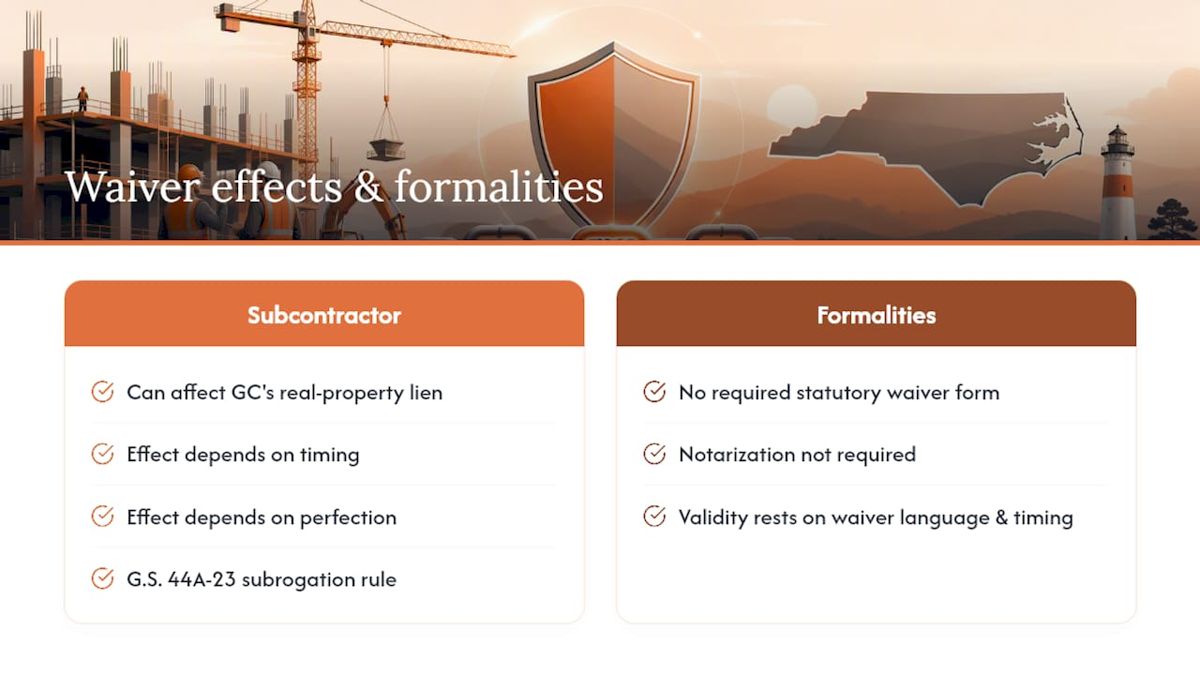
Chapter 44A adds another layer for subcontractors: subrogation. Under G.S. 44A-23, a subcontractor’s right to enforce a general contractor’s claim of lien on real property can be affected by a waiver the contractor signs, depending on timing and perfection. North Carolina requires no specific statutory waiver form, and notarization isn’t required for a waiver to hold up.
Conditional, Unconditional, Partial, and Final Waivers: What’s the Difference?
Every waiver you’ll see in North Carolina falls into one of these categories, and mixing them up is where contractors get burned.
- Conditional waiver: Takes effect only once payment is actually received and clears. This is the standard you should insist on for every progress payment.
- Unconditional waiver: Takes effect the moment you sign, regardless of whether the check has cleared. Appropriate only when you’ve already confirmed the funds landed.
- Partial waiver: Covers only the payment tied to a specific draw or invoice, leaving the rest of your lien rights on the project intact.
- Final waiver: Covers the entire project once the last payment is made and accepted.
For progress payments, always push for a conditional waiver with language such as “this waiver is effective only upon actual receipt of payment in the amount stated.” An unconditional or final waiver only belongs on your desk once you’ve confirmed the money is actually in your account, ideally with a bank record or cleared check as backup.
What’s Your Pre-Signing Checklist for a North Carolina Lien Waiver?
Run through this sequence before you sign anything, no exceptions:
- Match the number. Confirm the dollar amount on the waiver equals the payment you’re actually receiving, not a projected or rounded figure.
- Tie it to the payment. Make sure the waiver text expressly limits itself to “the payment received on [date],” not the project as a whole.
- Check the time window. Confirm the waiver only covers work performed through the payment date, not future work you haven’t billed yet.
- Carve out disputes. If there’s an unresolved change order or backcharge, get it excluded in writing before you sign anything that could be read to release it.
- Verify contractor lien status if you’re a sub. Under G.S. 44A-23, your ability to enforce a claim through subrogation depends partly on whether the general contractor has perfected its own lien.
- Keep records. File the signed waiver, the proof of payment, and any notices together for every draw.
Pro Tip: Don’t just check that a check was cut. Confirm it actually cleared your bank before treating a conditional waiver as final. A stopped payment after you’ve handed over even a conditional waiver can complicate your position.
What Red Flags Should You Watch for in a Waiver?
A few drafting tricks show up again and again on North Carolina jobs, and they’re worth knowing before you’re staring at one under deadline pressure.
- Pre-award waivers. Being asked to sign away lien rights just to win the contract, before any work starts. This runs against public policy under Chapter 44A and shouldn’t be enforceable.
- Missing conditional language. Any progress-payment waiver silent on “upon receipt of payment” is exactly the kind of broad waiver G.S. 22B-5 was written to void.
- Future-work releases. Language that reads like it waives rights to work not yet billed or performed.
- Sub-affecting contractor waivers. If you’re a general contractor, a waiver you sign can limit your subcontractors’ subrogation rights under G.S. 44A-23. Coordinate before signing anything broad.
If a waiver won’t budge on any of these points, that’s your signal to involve counsel rather than sign under pressure. Firms like Smith Anderson have noted that courts are still working out the edges of how broadly G.S. 22B-5 applies, which is exactly why conservative language on your end matters more, not less.
What Should Change in Your Office After the 2022 Law?
Build a standard conditional waiver template into your payment workflow instead of relying on whatever the owner sends over. Add one verification step to every pay-app approval: has the prior payment actually deposited, not just been mailed? Standardize how you log disputed items so nothing gets waived by accident in the shuffle of monthly paperwork. A landlord-style document checklist approach, applied to waivers and payment proof, catches most problems before they become legal ones.
— Rowena
Skip the Template Guesswork With a North Carolina-Ready Generator
There are tools available that help you get compliant paperwork out the door faster than digging through a contract file for the right clause every time a draw comes in. The free lien waiver generator produces conditional and final waivers built around North Carolina’s post-2022 rules, with auto-calculated payment fields so the amount on the waiver always matches what’s actually owed.
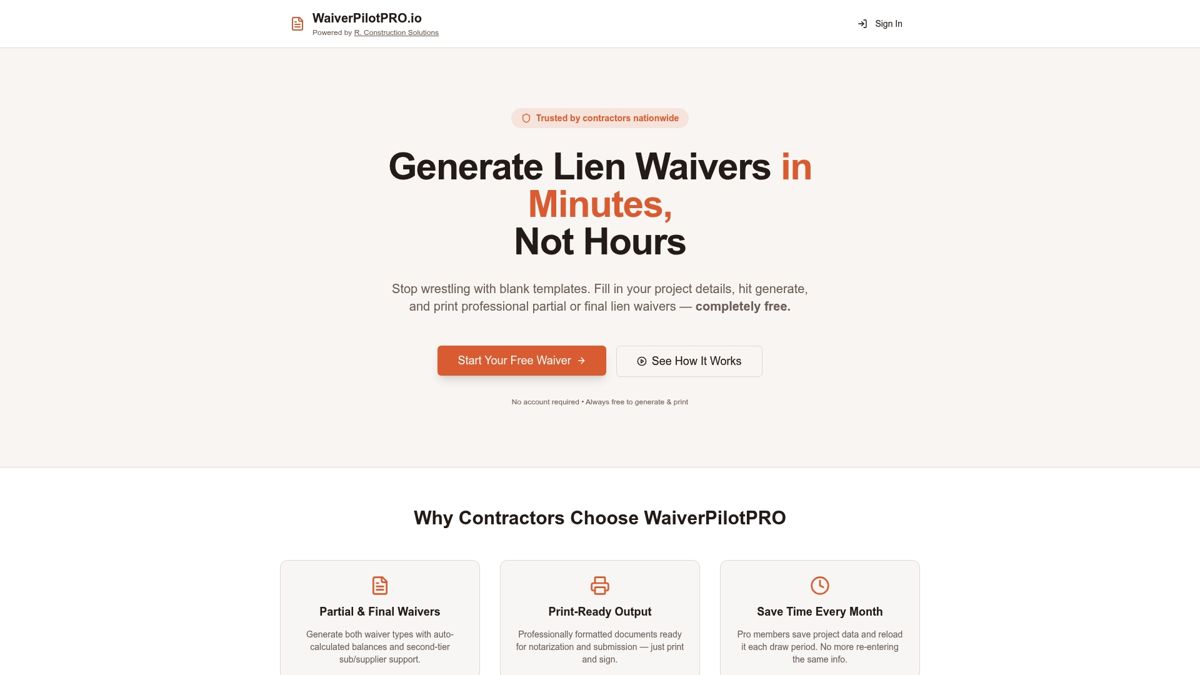
If you’re juggling multiple subcontractors on one draw, some tools offer multi-subcontractor support to help keep paperwork organized. The tool also connects with Procore and QuickBooks, so waiver data doesn’t have to be re-typed from your existing project management setup. Start with the North Carolina waiver page to generate your first conditional waiver in the format the statute actually requires.
Where to Verify These Rules Yourself
- G.S. 22B-5 — the statute voiding broad progress-payment waivers.
- G.S. 44A-23 — subcontractor subrogation and contractor lien perfection.
- Maynard Nexsen’s statutory update on drafting conditional language correctly.
- Free construction forms and templates for downloadable sample language.
Sources
- G.S. 22B-5 — Waiver of liens or claims as a condition of progress payment invalid (North Carolina General Statutes)
- G.S. 44A-23 — Contractor’s claim of lien on real property; perfection of subrogation rights of subcontractor (North Carolina General Statutes)
- Legislature makes significant changes to NC construction law – Smith Anderson
- Statutory update – New protections against broad waivers of lien rights (Maynard Nexsen)