Don’t Sign Missouri Lien Waivers Until Funds Clear: Avoid $500 Risk
Missouri does not require notarization or recording for most lien waivers exchanged between contractors and payers, but it does require a specific statutory form for unconditional final waivers on residential property, and it bars any waiver signed in anticipation of getting the job. The practical rule that keeps contractors out of trouble: never sign an unconditional waiver until the funds have actually cleared your bank. Use conditional waivers to protect payments still in transit.
TL;DR:
- Do not sign unconditional final waivers on residential projects until the final payment has actually cleared your bank account.
- Missouri law prohibits waivers signed in anticipation of work being completed or paid for, making prepayment waivers unenforceable.
- When completing the statutory unconditional final waiver form, accurately include claimant details, property description, payment date, and exclude disputed amounts or retainage.
- Recording a notice of rights triggers a five-calendar-day deadline for signing the final waiver after full payment, or risking liability and damages.
- Notarization is not legally required for waivers to be valid between parties, but lenders and title companies may insist on notarized or recorded releases before disbursing funds.
Table of Contents
- What Is a Missouri Lien Waiver, Exactly?
- What Do RSMo 429.005 and 429.016 Actually Require?
- How Do You Fill Out Missouri’s Unconditional Final Waiver Form?
- How Do Missouri Lien Deadlines Interact With Waivers?
- Do You Need a Notary for a Missouri Lien Waiver?
- How Do You Exchange Waivers Without Losing Leverage Too Early?
- What’s the One Rule That Protects You on Every Missouri Job?
- Generate Missouri-Compliant Waivers Without the Paperwork Headache
- Primary Statutes and Official Resources
- Sources
What Is a Missouri Lien Waiver, Exactly?
A lien waiver is a receipt that also surrenders a powerful legal remedy. When you sign one, you are confirming payment and giving up your right to file a mechanic’s lien against the property for the amount covered. That trade only makes sense if the money is actually in hand, which is why Missouri recognizes four distinct waiver types, each tied to a different point in the payment cycle.
Conditional partial waiver. You sign this after submitting a progress invoice but before the check clears. It says, “I’ll waive lien rights for this amount once I’m paid,” and it only takes effect on payment. This is the safest waiver to sign at any point where funds haven’t settled yet.
Unconditional partial waiver. You sign this after a progress payment has cleared. It immediately releases lien rights for that specific payment amount, with no conditions attached. Once signed, there’s no reversing it if the check bounces.
Conditional final waiver. Used at project closeout when final payment is pending. It waives all remaining lien rights, but only once the final payment is actually received.
Unconditional final waiver. The last document in the chain, signed after final payment clears. For residential property, Missouri requires this to follow the statutory form under RSMo 429.016.
A quick jobsite rule of thumb: if the check is in your hand and has cleared, unconditional is fine. If you’re still waiting on funds, sign conditional and nothing else.
- Progress billing, funds not yet received → conditional partial
- Progress payment cleared → unconditional partial
- Final payment pending → conditional final
- Final payment cleared (residential) → statutory unconditional final
What Do RSMo 429.005 and 429.016 Actually Require?
Two statutes govern almost everything about Missouri lien waivers, and they pull in opposite directions on purpose. One protects contractors from being pressured into giving up rights too early. The other locks down the paperwork once a residential job is actually finished.
RSMo 429.005 makes any waiver signed in anticipation of, or as consideration for, being awarded a contract legally unenforceable. An owner or general contractor cannot make you sign away lien rights as a precondition to winning the bid. That protection has limits, though: waivers required as a normal condition of receiving payment during the project remain perfectly enforceable under Missouri law. The distinction matters because plenty of owners and general contractors treat “signing a waiver before we cut the check” as standard practice, and that practice is lawful even though pre-contract waivers are not.
Missouri’s public policy draws a hard line here: a lien waiver used as leverage to win work is void, but a lien waiver used as a normal condition of getting paid for work already performed stands. The timing of the request, not the document itself, decides which side of that line you’re on.
RSMo 429.016 governs residential real property specifically. It prescribes an exact statutory unconditional final waiver form, with required content and signature elements that must be followed for the waiver to have legal effect. Deviating from that language on a residential job creates real risk that a court won’t treat your custom-drafted waiver as equivalent to the statutory one.
The same statute carries teeth. If a claimant has recorded a notice of rights and been paid in full, Missouri law requires that claimant to sign an unconditional final waiver within five calendar days of a written request. Refuse without good cause and you can face liability, including a $500 statutory presumption of damages against you. That penalty exists specifically to stop contractors from sitting on a signed waiver as leverage after they’ve already been paid in full.
How Do You Fill Out Missouri’s Unconditional Final Waiver Form?
Getting the statutory language right matters more than most contractors assume. Courts and title companies both look for substantial compliance with the RSMo 429.016 template, and a missing field can invite a dispute nobody wants to litigate.
- Claimant identification. Enter the full legal name and business address of the person or company giving up lien rights, exactly as it appears on your contract.
- Property description. Use the full legal description of the property, not just a street address. Pull it from the deed or title commitment if you don’t have it handy.
- Through date. Specify the exact date through which payment has been received. This date defines the scope of what you’re waiving, so it should never be vague or open ended.
- Dollar amount. State the precise amount paid. Rounding or estimating here weakens the document’s enforceability.
- Carve-outs. If any portion of the invoice is disputed or retainage is being held back, name it explicitly and exclude it from the waiver’s scope rather than signing a blanket release.
- Signature block. Include the signer’s printed name, title, and signature. An unsigned or improperly titled signature block is one of the most common reasons a waiver gets challenged later.
Pro Tip: Never sign the unconditional version and hand it over “in good faith” while a check is still in the mail. Hold the signed form until the funds have actually settled in your account, then release it.
Retainage deserves its own line item on the form rather than getting folded into the total paid.
How Do Missouri Lien Deadlines Interact With Waivers?
The through date on a waiver and Missouri’s lien filing clock move on separate tracks, and mixing them up causes real problems. Missouri gives claimants six months from the last date of labor or materials furnished to file a mechanic’s lien under RSMo 429.080. A waiver’s through date doesn’t reset that clock. It only defines what payment amount you’ve given up rights to.
Here’s how the sequence typically plays out on a residential remodel: a subcontractor submits a progress invoice in March, signs a conditional partial waiver, and receives payment two weeks later, converting it to unconditional. The same pattern repeats for April and May draws. At project completion in June, the owner pays the final balance and requests the statutory unconditional final waiver. If the sub had already recorded a notice of rights, Missouri law gives them five calendar days from that written request to deliver the signed statutory form.
- Six-month deadline runs from last furnished labor or materials, not from any waiver date
- The five-day rule only applies after full payment and only when notice of rights was recorded
- Missing the five-day window without justification exposes the claimant to the $500 statutory presumption
Do You Need a Notary for a Missouri Lien Waiver?
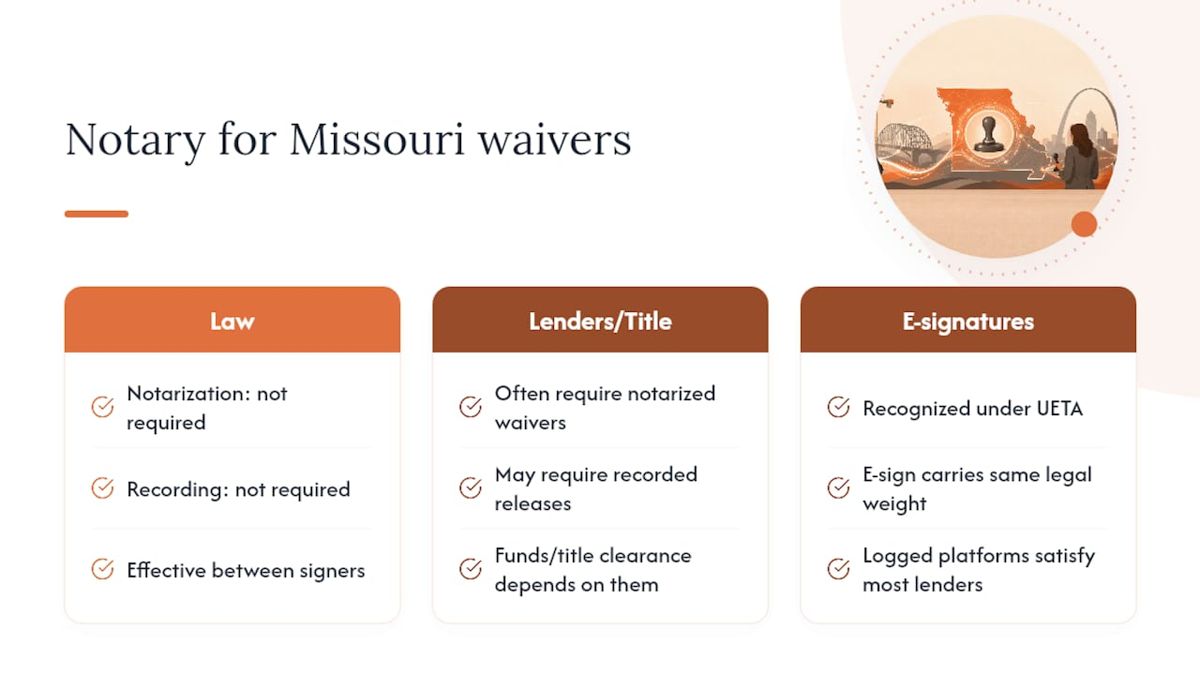
Missouri does not require notarization or recording for a lien waiver to be legally effective between the parties signing it. That surprises a lot of contractors who assume every legal release needs a notary stamp.
In practice, lenders and title companies frequently require notarized waivers, or recorded releases, before they’ll disburse funds or clear title at closing, as explained in this Epoxy Flooring FAQ — Common Questions Answered | Show Me Epoxy Jefferson City, MO. That’s a business requirement layered on top of the law, not a statutory one, so it pays to confirm what your specific title company wants before assuming a plain signature will do. Missouri also recognizes electronic signatures under the Uniform Electronic Transactions Act, meaning a compliant e-signature carries the same legal weight as ink on paper. Choosing an e-sign platform that logs signer identity and timestamps gives you an audit trail that satisfies most lenders even without a wet-ink notary block.
How Do You Exchange Waivers Without Losing Leverage Too Early?
The safest workflow treats every waiver as a mirror of your bank balance, not your invoice.
- Submit the invoice, then sign only a conditional waiver for that amount.
- Wait for the payment to actually clear, not just for a check to arrive.
- Once funds settle, exchange the conditional for an unconditional waiver, or negotiate specific carve-outs if part of the balance is disputed.
- On residential jobs where you’ve recorded a notice of rights, track the five-day statutory clock once full payment lands.
Keep retainage language explicit and the through date airtight on every form. If a dispute over amount or scope surfaces, escalate to counsel before signing anything unconditional, especially on larger commercial jobs where the dollar amounts at risk are significant.
What’s the One Rule That Protects You on Every Missouri Job?
Contractors get into trouble on lien waivers for one reason more than any other: they treat the waiver as paperwork instead of as the legal instrument it is. My checklist stays simple. Never sign unconditional before funds clear the bank, not just before a check arrives. Use the statutory form, close to verbatim, for every residential final waiver. Always carve out disputed amounts and retainage rather than hoping they get sorted out later. Contractors who follow that sequence rarely end up fighting over a waiver they signed too soon.
— Rowena
Generate Missouri-Compliant Waivers Without the Paperwork Headache
There are online tools that provide the statutory unconditional final form built for Missouri residential jobs, ready to fill in minutes instead of reconstructing the RSMo 429.016 language from scratch every time a project closes. These tools allow you to enter claimant details, property description, through date, and payment amount, and may auto-calculate balances and retainage carve-outs to help complete the form accurately.
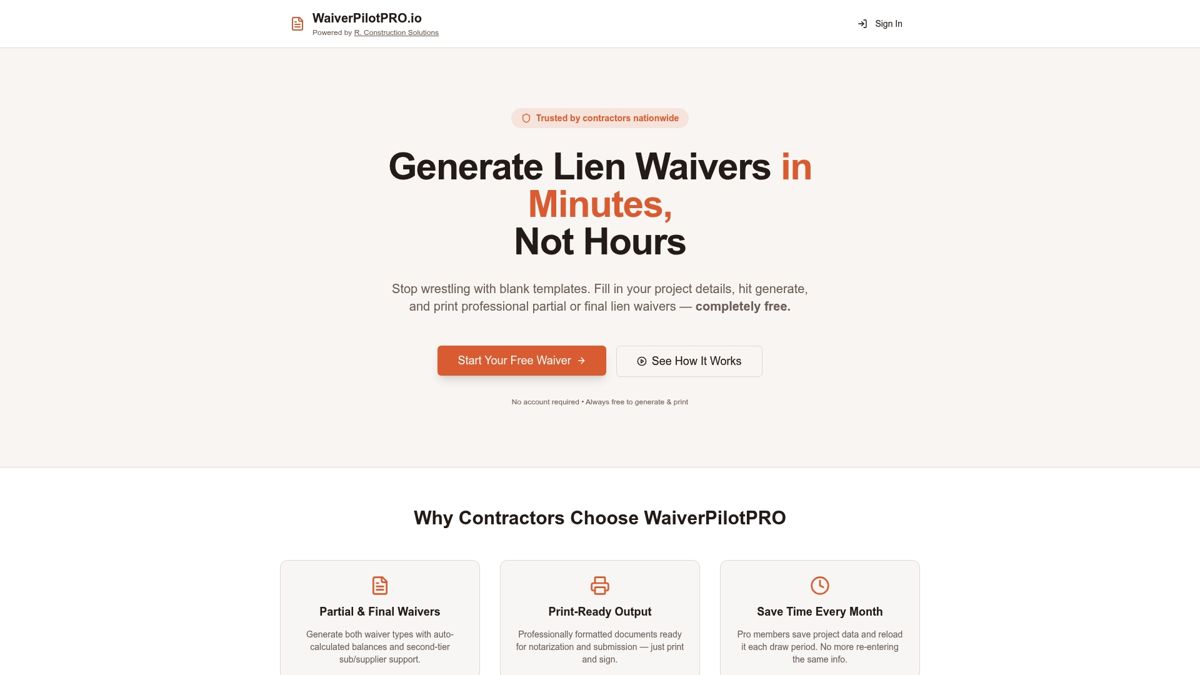
The same Missouri lien waiver generator produces conditional versions while you’re waiting on funds to clear and switches to notarizable unconditional output once payment settles, with e-signature capture that leaves an audit trail for lenders and title companies. Multi-subcontractor support and integrations with Procore and QuickBooks mean a general contractor juggling a dozen trade partners can generate every waiver from the same project data instead of retyping it each time. Start a free Missouri waiver on your next payment application and see how much faster closeout paperwork moves when the statutory form is already built for you.
Primary Statutes and Official Resources
For the underlying legal text, consult RSMo 429.016 on residential waiver requirements, RSMo 429.005 on anticipatory waivers, and House Bill 595 for the legislative history behind both. Waiverpilotpro’s free construction forms library has downloadable templates for contractors who need a starting point before generating a state-specific form.
Sources
- RSMo Section 429.016 — Residential real property — waiver and recording requirements
- House Bill No. 595 — Missouri House of Representatives (HB0595I)
- Missouri Revised Statutes §429.005 — Justia