4 Statutory Michigan Lien Waivers Every Contractor Must Sign Correctly
Michigan law does not let anyone force you to waive your lien rights before you finish the work or get paid. MCL 570.1115 bars advance contractual waivers outright, and a waiver only takes legal effect once the statute’s conditions are met or the money actually lands in your account. The practical rule for right now: never sign an unconditional lien waiver until the check has cleared. Use a conditional waiver in the meantime, and only issue the full unconditional version once you have confirmed payment.
TL;DR:
- Never sign an unconditional lien waiver until payment has cleared, as it immediately releases all lien rights regardless of whether funds settle; use a conditional waiver during payment processing.
- Michigan law strictly prescribes four waiver types, with only conditional ones remaining void until actual payment clears, protecting subcontractors from losing lien rights early.
- Accurately filling in the waiver form, especially the payment amount, is crucial because errors or ambiguities can lead to unintended full releases or legal disputes.
- When payment bounces or an unconditional waiver is signed prematurely, the proper remedy is to send written notice disputing the waiver’s validity due to unpaid funds.
- Using automated tools like WaiverPilotPRO ensures compliance, reduces errors, and streamlines the workflow for Michigan lien waivers across multiple subcontractors.
Table of Contents
- What Is a Michigan Lien Waiver and Why the Type Matters
- When Does a Michigan Lien Waiver Actually Take Effect?
- How to Sign Lien Waivers Safely on Michigan Projects
- What Every Michigan Lien Waiver Form Must Include
- If Payment Bounces or You Signed the Wrong Waiver
- Agent Authorization and the Residential Verification Rule
- How WaiverPilotPRO Fits Into Michigan Waiver Workflows
- The One Habit That Protects Your Lien Rights
- Generate a Michigan-Compliant Waiver in Minutes
- Sources
What Is a Michigan Lien Waiver and Why the Type Matters
A lien waiver is a receipt that also surrenders a powerful legal remedy. Sign the wrong one at the wrong time and you can permanently give up your right to file a construction lien, even if the payment behind it never actually clears.
Michigan doesn’t leave the format up to guesswork. The statute prescribes four specific waiver forms, and each one does something different to your lien rights:
- Partial conditional waiver. Covers a progress payment for work completed through a specific date, but only takes effect once that payment actually clears.
- Partial unconditional waiver. Also covers a progress payment, but takes effect the moment you sign it, whether or not the funds ever show up.
- Full conditional waiver. Releases all lien rights on the project, contingent on receiving the full amount stated.
- Full unconditional waiver. Releases all lien rights immediately upon signature, with no payment contingency at all.
The distinction between conditional and unconditional is the whole game. Under subsection 4 of the statute, a conditional waiver stays void until the stated payment actually clears. If a general contractor hands you a check for $40,000 and asks you to sign a conditional waiver on the spot, that waiver has no legal force yet. If the check bounces, you’re still fully entitled to lien the property.
An unconditional waiver works the opposite way. Sign it, and it takes effect that instant, regardless of what happens to the payment afterward. Attorneys at Szura & Delonis have flagged this as one of the most common ways Michigan subcontractors accidentally sign away lien rights: they treat “unconditional” as a formality rather than a binding release. A bounced check after an unconditional signature leaves you chasing a breach-of-contract claim instead of the faster, stronger remedy a construction lien provides.
When Does a Michigan Lien Waiver Actually Take Effect?
Timing is where most disputes start. MCL 570.1115 sets specific triggers for when each waiver type becomes binding, and the language matters more than most contractors realize.
A conditional waiver’s effectiveness hinges on the exact payment amount stated on the form. If you write “$25,000” on a conditional waiver and the payer only sends $22,000, the waiver stays void. This protects you against short payments disguised as full ones, but only if you fill in the number correctly and don’t leave it blank for someone else to complete later.
There’s a reliance exception worth knowing. If a third party, like a lender or title company, reasonably relies on a waiver you signed, that reliance can bind you even if the underlying payment situation gets messy later. This is one reason accuracy on the form matters as much as the waiver type itself.
“Cleared funds” means the check has actually settled, not that it landed in your inbox or your bank’s mobile deposit screen. Electronic payments can still reverse. ACH transfers can be recalled. A same-day wire is about as close to certainty as you’ll get; a personal check from a general contractor with a shaky payment history is not.
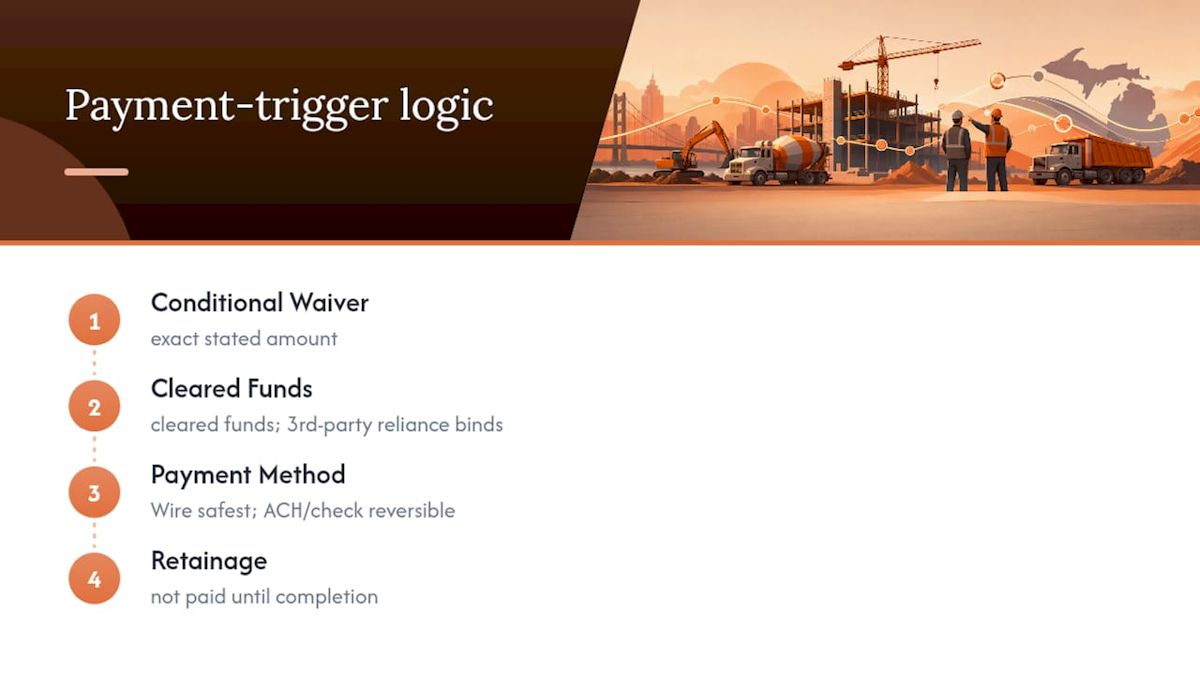
Retainage deserves its own note. If a contract holds back 10% until project completion, that retainage isn’t due yet, so it shouldn’t appear as “paid” on a progress waiver. Signing a waiver that implies retainage was released, when it wasn’t, creates exactly the kind of ambiguity that gets construed against whoever is trying to enforce the waiver later.
How to Sign Lien Waivers Safely on Michigan Projects
Every dispute over a Michigan lien waiver traces back to the same mistake: signing the wrong form at the wrong moment. Here’s the sequence that keeps your rights intact.
- Confirm the amount and the claimant’s identity first. Match the dollar figure on the waiver against your invoice or pay application before you touch a pen. A mismatch, even a small one, is a red flag.
- Accept the payment, but hold off on an unconditional signature. Deposit the check or receive the wire, then wait for confirmation that it cleared before signing anything unconditional.
- Use conditional waiver language tied to cleared funds. A conditional waiver protects you during the gap between “payment sent” and “payment settled,” which is exactly where bounced checks and clawbacks happen.
- Exclude retainage and disputed change orders by name. If $8,000 in retainage is being held back, or a $3,000 change order is still under dispute, write that exclusion directly onto the waiver instead of trusting a verbal side agreement. Rocky Mountain Underground’s guidance on change order management is a useful reference for tracking approved versus disputed amounts before they get lumped into a waiver.
If a general contractor insists you sign an unconditional waiver before releasing payment, you have a script for that: “Michigan’s lien statute doesn’t allow advance waivers, so I’ll sign the conditional version now and send the unconditional once the payment clears.” Most GCs who work regularly in Michigan will recognize this immediately and won’t push back.
Pro Tip: Keep a simple log of every waiver you sign, including the date, amount, and whether it was conditional or unconditional. When a payment dispute drags on for months, that log is often the only clean record of what you actually agreed to release.
Stop and get legal counsel if a form asks you to waive rights on work not yet performed, if the amount field is blank, or if the release language extends beyond the project at hand. Butzel Long’s construction alert specifically warns that payment portals sometimes auto-generate release language broader than the statutory forms, which is exactly the kind of thing a rushed signature can miss.
What Every Michigan Lien Waiver Form Must Include
A waiver missing statutory elements isn’t just sloppy paperwork. It can create ambiguity that courts resolve against the party trying to enforce it. Before you sign anything, check the form against this list:
- The claimant’s name and address, matching exactly what’s on the contract.
- The names of both contracting parties (who’s paying, who’s being paid).
- The specific dollar amount being released.
- The date through which the work or materials are covered.
- Conditional language, where applicable, tying the release to actual payment.
- A signature from the claimant or an authorized agent.
One field trips up more contractors than any other: the statement of whether the waiver “does” or “does not” cover all amounts due through that date. Leaving this ambiguous, or checking the wrong box, is how a partial payment ends up looking like a full release. FindLaw’s summary of the statute makes clear that precision here isn’t optional. Also worth knowing: Michigan waivers do not require notarization. A valid signature from the claimant or their authorized agent is enough, though some parties request notarization anyway for their own internal comfort.
If Payment Bounces or You Signed the Wrong Waiver
A bounced check after a conditional waiver is the easier scenario. Because the waiver never took effect, your lien rights are still intact, and you can move forward as if you’d never signed it.
An unconditional waiver signed before payment cleared is the harder problem, but it’s not unfixable. Construction law attorneys point to a specific remedy: send written notice stating that “the consideration for the waiver has failed.” This puts the payer on formal notice that you’re treating the waiver as void due to nonpayment, and it starts building the paper trail you’ll need if the dispute escalates.
Speed matters here more than almost anywhere else in construction law. Michigan’s lien filing deadlines run on fixed clocks regardless of your waiver dispute, so don’t let a rescission letter distract you from tracking those dates. Preserve your bank records, the original waiver, all related communications, and proof of when the payment failed. If you’re within your lien deadline, filing while the rescission is pending is often the safer move than waiting to see how the payer responds.
Agent Authorization and the Residential Verification Rule
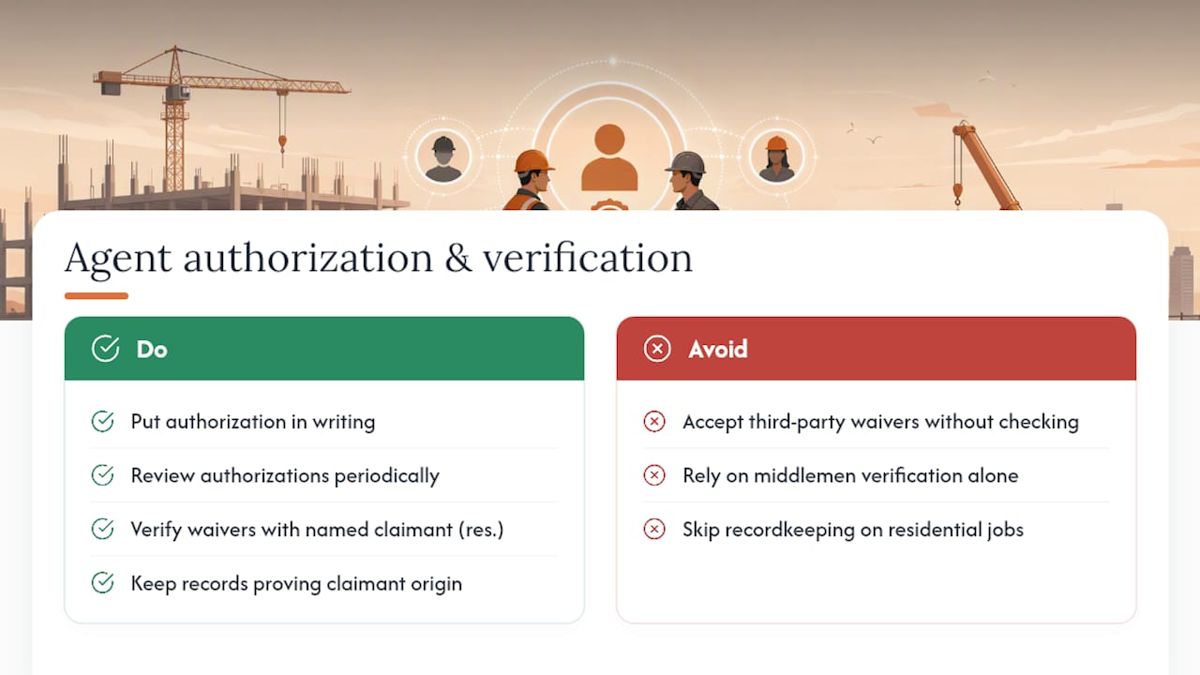
An agent authorized to serve a notice of furnishing or file a claim of lien on your behalf is automatically authorized to sign waivers for you too, unless you’ve revoked that authority in writing. This matters most on larger projects where a project manager or office administrator regularly signs paperwork on behalf of a crew or a company.
Residential projects carry an extra layer of protection. If a claimant has filed a notice of furnishing on a residential structure, the property owner or lessee can’t simply accept a waiver from a third party at face value. They’re required to verify it directly with the named claimant, according to MCL 570.1115. This rule exists specifically to prevent a general contractor or middleman from forging or misrepresenting a subcontractor’s waiver on a homeowner’s project.
If you’re a sub who routinely lets someone else sign waivers on your behalf, put your authorization in writing and review it periodically. If you’re a GC handling waivers from multiple subs, keep documentation showing each waiver actually came from the named claimant, especially on residential jobs where that verification step is a legal requirement, not just good practice.
How WaiverPilotPRO Fits Into Michigan Waiver Workflows
The safe sequence described above, conditional waiver first, unconditional only after cleared funds, only works if the paperwork matches it every time. That’s where a lot of manual processes break down: someone reuses last month’s unconditional template because it’s already in a folder, and the payment-verification step gets skipped.
A Michigan-specific template with a clear conditional-versus-unconditional toggle forces that check every time instead of leaving it to memory. Auto-calculated balances catch the kind of amount mismatch that turns a partial payment into an accidental full release, and integrations with tools like Procore and QuickBooks pull the payment data directly instead of relying on someone retyping numbers between systems. None of that replaces judgment on retainage exclusions or disputed change orders. It just removes the errors that come from doing the same paperwork by hand, month after month.
The One Habit That Protects Your Lien Rights
If you take one thing from Michigan’s lien waiver rules, make it this: never let payment and signature happen in the same motion. The safest sequence is always conditional waiver, confirmation that funds cleared, then unconditional waiver, in that order, every time, no exceptions for a contractor you trust.
Document everything, especially when someone else is signing on your behalf. Verification isn’t distrust. It’s the difference between a clean paper trail and a dispute you can’t prove.
— Rowena
Generate a Michigan-Compliant Waiver in Minutes
Filling out the right Michigan waiver form by hand, matching statutory language, tracking conditional-versus-unconditional status, catching retainage exclusions, takes real time on every single payment cycle. Waiverpilotpro is built to remove that friction. Instead of starting from a blank template or an outdated PDF you found online, you fill in project details once and get a properly formatted Michigan waiver ready to send, with the conditional or unconditional format already matched to the statute’s requirements.
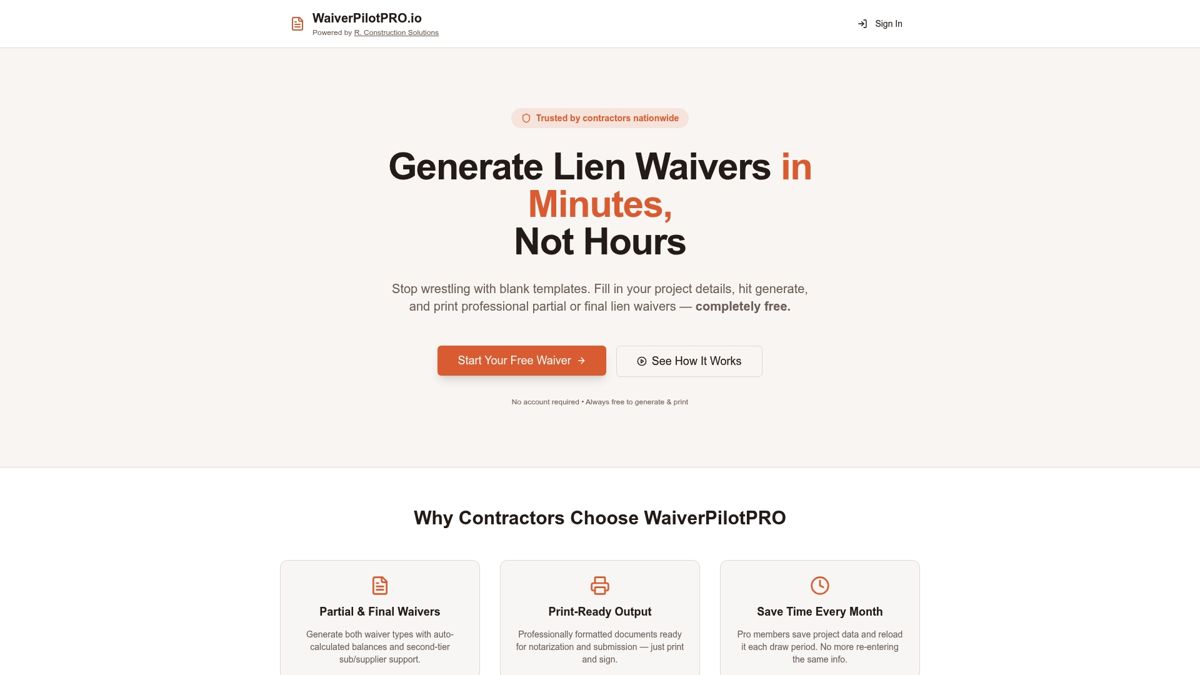
The platform’s free lien waiver generator auto-calculates balances so a short payment doesn’t accidentally look like a full release, and it connects directly with construction management tools like Procore and QuickBooks so payment data flows in instead of getting retyped by hand. If you’re managing waivers across multiple subcontractors on the same job, that consistency matters more than it sounds like it should. Generate your first Michigan waiver now and see how much faster payment cycles move when the paperwork stops being the bottleneck.
Sources
- MCL - Section 570.1115 - Michigan Legislature
- Michigan Compiled Laws, Chapter 570. Liens § 570.1115 | FindLaw
- Lien waivers in Michigan: How to sign them without destroying your rights | Szura & Delonis, PLC
- Lien waivers – critical to processing payment but a word of caution | Butzel Long
This article is general information, not a substitute for advice from a qualified lawyer. Consult a qualified legal professional about your own circumstances before acting on anything here.