
Material Supplier Lien: What It Is and How It Works
A material supplier lien is a statutory security interest that gives suppliers the legal right to place a claim against real property when they go unpaid for construction materials. Known more broadly as a mechanic’s lien, this remedy goes beyond a standard contract dispute. It attaches directly to the property title, blocking any sale or refinancing until the debt is resolved. For suppliers, contractors, and property owners alike, understanding how this lien works is the first step toward protecting your financial position on any construction project.
What is a material supplier lien?
A material supplier lien is a legal claim filed against real property to secure payment for materials furnished for a permanent improvement. The industry standard term is a mechanic’s lien, and material suppliers are one of the most common lien claimants in construction. The lien covers only materials incorporated into the property, excluding unused stock, off-site deliveries, and overhead costs.
The core purpose is simple: suppliers often extend credit to contractors and subcontractors without any collateral. A lien changes that equation. Once recorded, it clouds the property title and gives the supplier real leverage to collect payment. Without this remedy, a supplier’s only option is a breach of contract lawsuit, which is slower, more expensive, and offers no direct claim against the property itself.

Lien rights exist in every U.S. state, but the rules vary significantly. Each state sets its own deadlines, notice requirements, and eligibility criteria. Knowing the general framework helps, but you must verify the specific rules in the state where the project sits.
How does the material supplier lien process work?
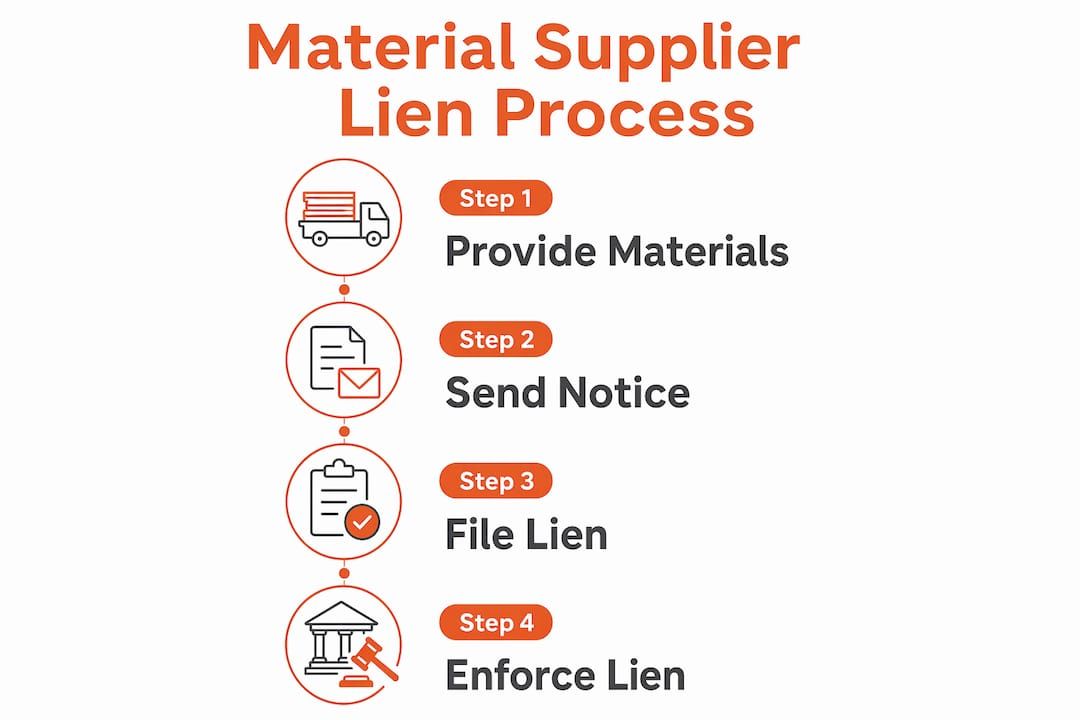
The material lien process follows a defined sequence of steps. Missing any one of them can void your rights entirely.
-
Serve a preliminary notice. Most states require a Notice of Furnishing before you can file a lien. Preliminary notice deadlines vary by state: California requires service within 20 days of first furnishing materials, Arizona within 45 days, and Texas before project completion. This notice informs the property owner and general contractor that you are supplying materials and intend to preserve your lien rights.
-
Track and document every delivery. Maintain signed delivery tickets, invoices, and receipts for every shipment. These records form the foundation of your lien claim. Courts require proof that specific materials were delivered to the project site and incorporated into the improvement.
-
File the lien claim. The lien must be filed at the county recorder’s office in the county where the property is located. Filing fees vary by jurisdiction. About 35 states require the lien document to be notarized before recording.
-
Serve the lien on the property owner. Many states require you to serve a copy of the recorded lien on the property owner within a set number of days after filing. Skipping this step can invalidate an otherwise valid claim.
-
Enforce the lien through foreclosure if necessary. If the owner does not pay or release the lien, you must file a foreclosure lawsuit within the state’s deadline. Failure to file suit within the deadline causes the lien to expire automatically.
Pro Tip: Set calendar reminders for every deadline the moment you start supplying materials on a new project. Lien deadlines are absolute. Courts do not grant extensions for administrative oversights.
What are the rights and limitations of material suppliers under lien laws?
Supplier lien rights are powerful, but they come with clear boundaries. Understanding those limits prevents wasted effort and potential legal liability.
Who qualifies for lien rights
Direct suppliers who sell materials to a general contractor or subcontractor typically qualify. Suppliers’ position in the contracting chain matters enormously. A supplier who sells through a distributor, rather than directly to a contractor, may have limited or no lien rights depending on the state. The further you are from the prime contract, the harder it becomes to establish a valid claim.
What materials are lienable
- Materials physically incorporated into the permanent improvement qualify.
- Consumables used during construction, such as fuel or welding rods, may qualify in some states.
- Off-site deliveries or warehouse stock do not qualify, even if the materials were purchased for the project.
- Repair and maintenance work generally does not qualify unless it constitutes a permanent improvement that increases the property’s value.
- Overhead, profit markups, and financing charges are typically excluded from lienable amounts.
Public project exceptions
Traditional mechanic’s liens do not apply on public projects due to the sovereign immunity doctrine. You cannot place a lien on a government-owned building or public road. The alternative remedy is a claim against the project’s payment bond, which is required on most public contracts under the federal Miller Act and equivalent state statutes. Payment bond claims have their own notice and deadline requirements, which differ from private lien rules.
Key rule: If you supply materials for a public project and skip the payment bond notice, you lose your only legal remedy for nonpayment. Confirm project ownership before you ship the first load.
What practical impacts does a material supplier lien have?
A recorded lien creates immediate, concrete consequences for everyone involved in the project.
Impact on property owners
A lien clouds the property title. Title companies will not issue a clean title policy on a liened property. That means the owner cannot sell or refinance until the lien is paid, bonded over, or successfully challenged in court. This pressure is exactly what makes liens effective as a collection tool.
Impact on suppliers
Suppliers sit at the bottom of the construction payment chain, often waiting 60 to 90 days or more for payment. Lien rights convert an unsecured credit exposure into a secured claim against real property. That shift in position significantly reduces the supplier’s financial risk on large projects.
How liens get resolved
| Resolution Method | What It Means |
|---|---|
| Direct payment | Owner or contractor pays the full amount owed; supplier releases the lien. |
| Lien bond substitution | Owner posts a surety bond equal to the lien amount, freeing the title while the dispute continues. |
| Negotiated settlement | Parties agree on a partial payment; supplier releases the lien in exchange. |
| Foreclosure judgment | Court orders the property sold to satisfy the unpaid lien. |
| Lien expiration | Supplier fails to enforce within the deadline; lien expires and is removed. |
The role of lien waivers
When a supplier accepts payment, the paying party almost always requires a lien waiver in exchange. A lien waiver is a receipt that also surrenders a legal remedy. Conditional waivers are safe to sign before payment clears. Unconditional waivers permanently release your lien rights and should only be signed after confirmed receipt of funds.
Pro Tip: Never sign an unconditional lien waiver until the check has cleared your bank account. A bounced check after an unconditional waiver leaves you with no lien rights and no easy legal remedy.
How to file a material supplier lien: best practices and common pitfalls
Filing a lien correctly requires preparation before the first delivery truck leaves your yard.
Best practices
- Start a project file immediately. Record the property address, owner name, general contractor, and project start date before you ship anything.
- Serve preliminary notices on time. Use state-specific lien waiver templates to confirm you have the right forms for the jurisdiction.
- Keep delivery records airtight. Every ticket should be signed by someone at the job site, not just your driver.
- File the lien claim accurately. Overstatement or inaccurate claims risk penalties or outright dismissal. Claim only what you can prove with invoices and signed receipts.
- Consult an attorney for large claims. Foreclosure enforcement is a complex legal proceeding. Legal representation is strongly advised for claims exceeding $15,000.
Common pitfalls to avoid
- Missing the preliminary notice deadline and forfeiting lien rights before the project ends.
- Delivering materials to a contractor’s warehouse rather than the job site, which disqualifies the materials from lien coverage.
- Filing in the wrong county or using an outdated form that does not meet current state requirements.
- Failing to serve the recorded lien on the property owner within the required window.
- Waiting too long to file a foreclosure lawsuit and allowing the lien to expire.
The material lien process rewards preparation. Suppliers who build lien compliance into their standard credit and delivery workflows collect more reliably and spend less time chasing payments through courts.
Key Takeaways
A material supplier lien is the most direct legal tool a supplier has to secure payment for construction materials incorporated into real property.
| Point | Details |
|---|---|
| Lien definition | A statutory security interest that attaches to property title until unpaid material debts are resolved. |
| Preliminary notice | Serve the Notice of Furnishing on time; missing this deadline forfeits lien rights in most states. |
| Lienable materials | Only materials physically incorporated into a permanent improvement qualify; warehouse stock does not. |
| Public projects | Mechanic’s liens do not apply; file a payment bond claim instead under the Miller Act or state equivalent. |
| Enforcement deadline | File a foreclosure lawsuit within the state’s deadline or the lien expires automatically. |
Why most suppliers misunderstand their own lien rights
I have worked with suppliers across dozens of states, and the same misunderstanding comes up repeatedly: suppliers assume that delivering materials to a job site automatically protects them. It does not. Lien rights require active steps, starting before the first delivery, not after the invoice goes unpaid.
The second mistake I see is treating liens as a last resort. Suppliers who serve preliminary notices on every project, as a matter of routine, collect faster and negotiate from a stronger position. The notice alone signals to contractors that you know your rights. That signal changes payment behavior before a dispute ever starts.
Lien laws also change. States update deadlines, notice requirements, and eligibility rules through legislation and court decisions. A process that worked in 2022 may not be valid in 2026. The suppliers who stay current on their state’s rules are the ones who actually collect when payment stops.
Finally, do not confuse filing a lien with winning a lien. Filing is administrative. Enforcement through foreclosure is litigation. Know the difference, and get legal counsel involved before you miss a court deadline.
— Rowena
Waiverpilotpro makes lien waiver management straightforward
Lien rights and lien waivers work together in every payment cycle. When you collect payment, you sign a waiver. When payment is disputed, your lien rights protect you. Managing both sides of that equation accurately is what keeps your cash flow healthy.
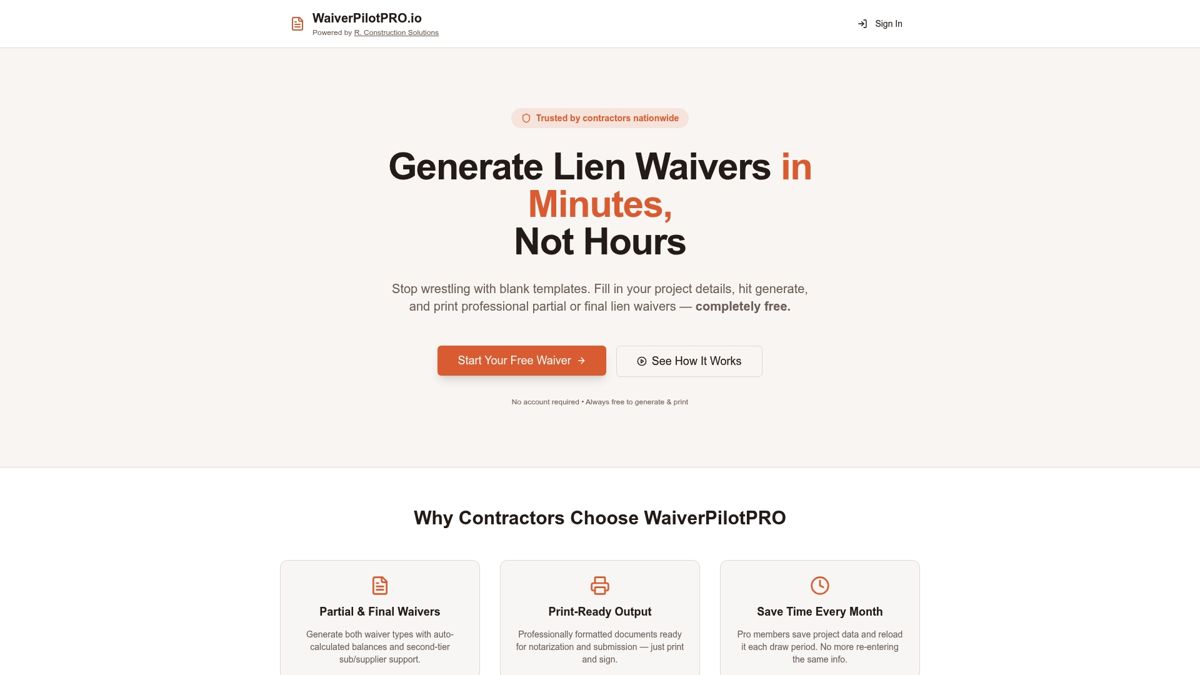
Waiverpilotpro offers a free lien waiver generator that produces professional, notarizable conditional and final waivers without account creation or complex templates. The platform integrates with Procore and QuickBooks, so your waiver documentation stays connected to your project records. Auto-calculated balances and multi-subcontractor support reduce the administrative work that slows down payment cycles. If you want to understand the difference between conditional and unconditional waivers before you sign anything, Waiverpilotpro has plain-English guides for that too.
FAQ
What is the material supplier lien definition in simple terms?
A material supplier lien is a legal claim recorded against a property’s title to secure payment for construction materials that were incorporated into that property. It is a type of mechanic’s lien available to suppliers under state statute.
How long does a supplier have to file a material lien?
Deadlines vary by state and typically run from 60 to 120 days after the last date of furnishing materials. Missing the filing deadline permanently forfeits your right to lien the property.
Can a supplier file a lien on a public construction project?
No. Mechanic’s liens do not apply to public projects due to sovereign immunity. Suppliers on public projects must file a claim against the project’s payment bond, which has its own separate notice and deadline requirements.
What happens if a material lien is not enforced?
If the supplier does not file a foreclosure lawsuit within the state’s enforcement deadline, the lien expires automatically and is removed from the title. The supplier loses the secured claim and must pursue payment through other legal channels.
Do I need a notary to file a material supplier lien?
Approximately 35 states require the lien document to be notarized before it can be recorded at the county recorder’s office. Check your state’s specific requirements, as filing an unnotarized lien in a state that requires notarization will result in rejection.