
Avoid Losing Retainage: Fill Massachusetts Lien Waivers Lines 1–12
Massachusetts law voids any contract clause that broadly bars you from filing a notice of contract or enforcing a mechanics lien, but it carves out a specific statutory Partial Waiver and Subordination of Lien form for progress payments. If you’re signing waivers on a Massachusetts job, use that statutory form, sign it under penalties of perjury, and never release retainage, pending change orders, or disputed claims until you’re actually paid in full.
TL;DR:
- Massachusetts law voids broad lien waivers unless they are executed through the specific statutory partial waiver form, signed under penalties of perjury, and not on final or unconditional terms.
- The statutory form only releases lien rights for work completed and paid within the current payment period, leaving retainage, pending change orders, and disputed claims unaffected.
- Proper completion of the form requires precise matching of project details, amounts, and dates to recorded notices of contract, with a focus on avoiding errors that could jeopardize lien rights.
- Lenders require the form before releasing progress payments because of the 25-day subordination window, which prioritizes their advances over lien claims during that period.
- Using a compliant, project-specific template or automated tools like WaiverPilotPRO reduces mistakes, ensures legal enforceability, and simplifies the waiver process during multiple progress draws.
Table of Contents
- What Massachusetts Lien Waiver Law Actually Requires
- Who Uses the Statutory Partial Waiver, and When
- What the Partial Waiver Actually Gives Up
- How to Fill Out the Statutory Partial Waiver, Line by Line
- Common Mistakes That Cost Contractors Their Lien Rights
- Notarization, Recording, and the Lender’s 25-Day Window in Practice
- Getting a State-Compliant Massachusetts Lien Waiver Form
- Why Template Discipline Beats Speed on Massachusetts Draws
- A Faster Way to Generate Massachusetts-Compliant Waivers
- Sources
What Massachusetts Lien Waiver Law Actually Requires
M.G.L. c. 254 § 32 sets the baseline: any contract term that tries to stop you from filing a notice of contract or enforcing a Chapter 254 lien is void as a matter of public policy. A general contractor can’t slip language into a subcontract that quietly kills your lien rights before you’ve even started work. That protection has teeth, but it isn’t absolute.
The statute lists narrow exceptions where a waiver actually holds up:
- A written waiver by a principal on a lien bond.
- The statutory Partial Waiver and Subordination of Lien form, filled out and signed correctly.
- A written statement of the amount actually due and paid, signed by the party entitled to payment.
Everything else that looks like a broad “no lien” clause buried in a boilerplate subcontract is unenforceable. The Mass confirms the same principle from the state’s side: contractors and subcontractors keep their statutory lien remedy unless they use one of these specific, sanctioned tools. That’s the whole point of the exception list. Massachusetts doesn’t let parties bargain away lien rights casually. It requires a specific, traceable document for it.
Who Uses the Statutory Partial Waiver, and When
The statutory partial form is built for a specific player: the general contractor (or any party) who has filed a notice of contract under Section 2 of Chapter 254. That filing establishes the priority and scope of the lien in the first place, and the partial waiver form exists to adjust that priority as progress payments go out.
Practically, this plays out in a few recurring situations:
- A GC has recorded a Section 2 notice of contract and now needs to waive lien rights tied to a specific progress payment period, often at the lender’s request.
- The waiver gets signed and delivered around each draw, not just once at project closeout.
- Subcontractors and suppliers who haven’t filed a notice of contract typically aren’t the intended users of this exact statutory form, though many still use similar partial waiver language as a matter of industry practice when a GC or owner asks for one.
If you’re a subcontractor being handed this specific form to sign, read it closely. It was written with Section 2 filers in mind, and the fields should reflect that.
What the Partial Waiver Actually Gives Up
The statutory form has two operative clauses, and understanding the difference between them is the entire risk calculation. Clause (a) is the waiver itself: it releases lien rights only through the stated payment period, and only for the amount you’ve actually received. It does not touch retainage, unpaid change orders still pending approval, or any disputed claim you’ve flagged.
Clause (b) is the subordination piece. It subordinates certain lien rights to lender advances made through the 25th day after the end of that payment period.
Statistically, that 25-day window is the single most misunderstood mechanic in the form. It doesn’t waive anything outright. It tells the lender: your advances during this specific window get priority over my lien claim, which is why lenders push hard for this document before releasing draw funds. Retainage sits outside that subordination entirely, per the statutory text itself.
A few things the partial waiver never touches, regardless of how it’s worded:
- Retainage held back from the payment in question.
- Change orders that are pending, unpaid, or unapproved.
- Any claim you’ve already flagged as disputed.
Sign clause (a) and (b) accurately, and you keep leverage on everything that hasn’t been resolved yet.
How to Fill Out the Statutory Partial Waiver, Line by Line
Getting the header right matters as much as the numbers. Start there before touching a single dollar figure.
- Owner and property description. Match these exactly to the recorded notice of contract, not to whatever shorthand appears on your invoice.
- County and contractor name. Confirm spelling against the deed or mortgage on file at the registry, since mismatches can break the chain of title reference later.
- Lender name. If there’s no construction lender involved, write “N/A” rather than leaving it blank.
- Line 1: Original contract amount. The base contract value before any changes.
- Line 2: Approved change orders. Only changes formally approved, not proposed.
- Line 3: Adjusted contract amount. Line 1 plus Line 2.
- Line 4: Completed to date. The value of work actually performed through the payment period.
- Line 5: Less retainage. Subtract whatever percentage the contract withholds.
- Line 6: Total payable to date. Line 4 minus Line 5.
- Line 7: Less previous payments. Everything already received before this draw.
- Line 8: Current amount due. Line 6 minus Line 7. This is the number the waiver is actually releasing.
- Lines 9 and 10: Pending change orders and disputed claims. List these specifically. Vague language here is how contractors accidentally waive things they meant to keep.
Before you sign, confirm the signer has actual authority to bind the company, and that the signature block includes the “under penalties of perjury” language the statute requires. Skipping that language, even on an otherwise correct form, can undercut its enforceability.
Pro Tip: Keep a running spreadsheet that mirrors Lines 1 through 10 for every payment period. When the next draw comes due, you’re filling in updated numbers against a clean audit trail instead of reconstructing the math from old invoices.
Common Mistakes That Cost Contractors Their Lien Rights
The most expensive mistake in Massachusetts lien practice isn’t a math error. It’s signing a final, unconditional waiver in exchange for what’s actually a progress payment. Because Massachusetts doesn’t have a full conditional/unconditional waiver system the way many other states do, contractors sometimes import that language from out-of-state templates without realizing it strips protections the statutory partial form was designed to preserve.
A short list of habits worth building into your process:
- Never sign a document labeled “final” or “unconditional” unless the payment you’ve received is genuinely the last one owed.
- Stick close to the statutory form’s exact wording. Material deviations invite disputes over enforceability.
- Log retainage, pending change orders, and disputed claims on every waiver, even when the amounts are small.
- Keep copies of every pay application alongside the waiver it corresponds to.
- Route every waiver through someone with signature authority before it goes out the door.
Managing change orders well upstream makes this whole process cleaner. Resources like this field guide on the change order process walk through the documentation habits that keep pending changes visible instead of buried in email threads.
Pro Tip: If a GC or owner hands you a waiver that looks unfamiliar, compare it line by line against the statutory text before signing. A waiver that “looks close enough” to the Massachusetts form but adds broader release language is where most avoidable disputes start.
Notarization, Recording, and the Lender’s 25-Day Window in Practice
Massachusetts doesn’t require notarization on lien waivers. What it requires instead is a signature made under penalties of perjury, which carries its own legal weight without a notary stamp attached.
A few practical logistics worth knowing:
- Keep an executed copy of every waiver in your project file, even though recording it at the registry of deeds isn’t always mandatory for the waiver itself.
- Lenders request these forms because the 25-day subordination window gives them a clean priority window for advances tied to that specific payment period.
- Expect lenders to request the waiver before releasing draw funds, so build a few days of buffer into your draw schedule to avoid payment delays over paperwork.
Getting a State-Compliant Massachusetts Lien Waiver Form
The safest starting point is the statutory language itself, laid out in Section 32 of Chapter 254, cross-checked against the state’s own mechanic’s lien guidance. Any template you use should mirror that wording closely rather than paraphrasing it.
From there:
- Pull a template that’s been checked against the current statutory text, not one recycled from a general national form set.
- Save a signed copy of every waiver alongside its corresponding pay application, since that pairing is what auditors and courts will want to see if a dispute surfaces later.
- Double-check that names, amounts, and dates on the form match your recorded notice of contract exactly, since small mismatches are a common source of registry confusion.
Massachusetts also offers a broader library of free construction forms and lien waiver templates if you’re managing pay applications alongside waivers.
Why Template Discipline Beats Speed on Massachusetts Draws
Most lien disputes trace back to a rushed signature, not a misunderstanding of the law. Contractors who treat the statutory partial form as a fill-in-the-blank formality, rather than a document that actually shifts legal rights, are the ones who lose retainage or pending change orders they never meant to give up.
Tools built around the actual statutory fields, like WaiverPilotPRO’s Massachusetts generator, reduce that risk by auto-calculating the payment math and syncing project data from platforms like Procore and QuickBooks, so names and amounts match what’s already on file instead of being retyped from memory each draw cycle.
— Rowena
A Faster Way to Generate Massachusetts-Compliant Waivers
Waiverpilotpro gives Massachusetts contractors a free way to produce statutory partial waivers without recreating the form from scratch every draw cycle. Instead of manually tracking Lines 1 through 10 in a spreadsheet, the Massachusetts lien waiver generator auto-populates the statutory fields, calculates the current amount due, and keeps retainage and pending change orders separated from the payment being released.
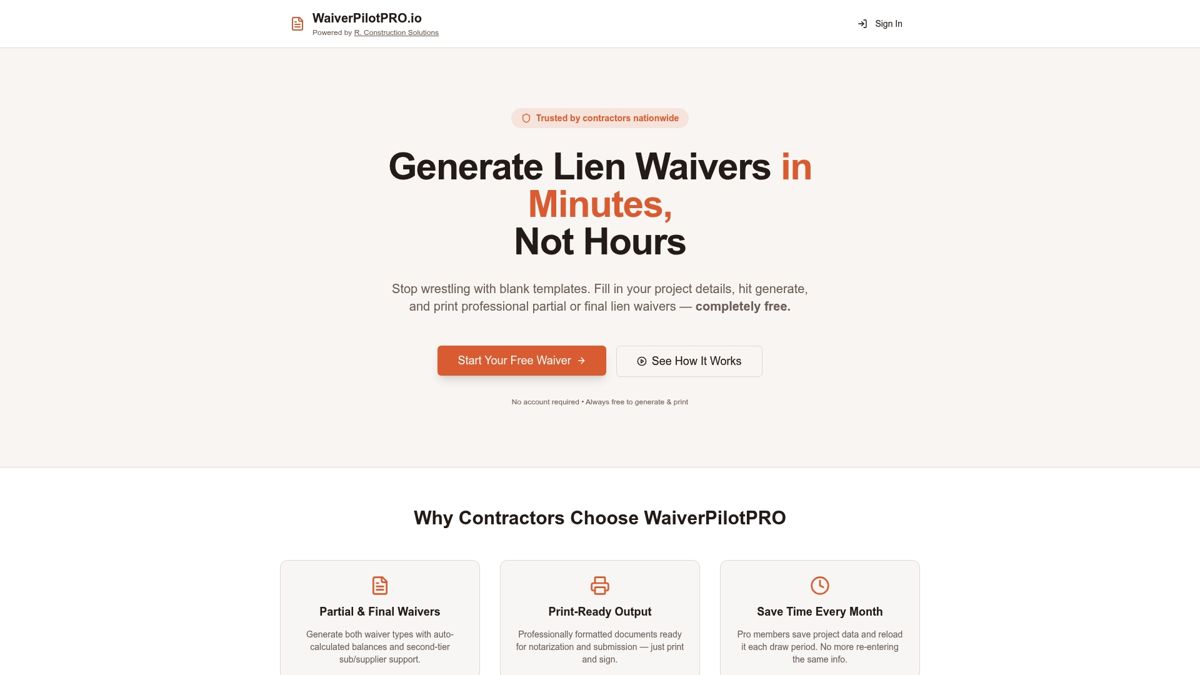
Use it at each progress draw, not just at project closeout, so the waiver you sign always matches the payment period it’s tied to. Some platforms support multiple subcontractors on the same project, which matters when a GC is collecting waivers from many trades before releasing a single draw. Generating the document directly from project details in construction management or accounting software can cut down the back-and-forth over mismatched names and amounts. Start with the free lien waiver generator before your next draw is due.
This article is general information, not a substitute for advice from a qualified lawyer. Consult a qualified legal professional about your own circumstances before acting on anything here.