
Lien Waivers in GC Payments: A 2026 Guide
A lien waiver is a legal document a contractor signs to give up the right to file a mechanic’s lien in exchange for payment. Think of it as a receipt that also surrenders a powerful legal remedy. The role of lien waivers in GC payments goes well beyond paperwork. They act as a financial gating mechanism, preventing double payments and giving owners and lenders assurance that no hidden claims will surface after funds change hands. General contractors sit at the center of this process, collecting waivers from every subcontractor and supplier before pay applications move forward. Get this wrong, and payments stall, liens get filed, and project financing can collapse.
What are the types of lien waivers and how do they work?
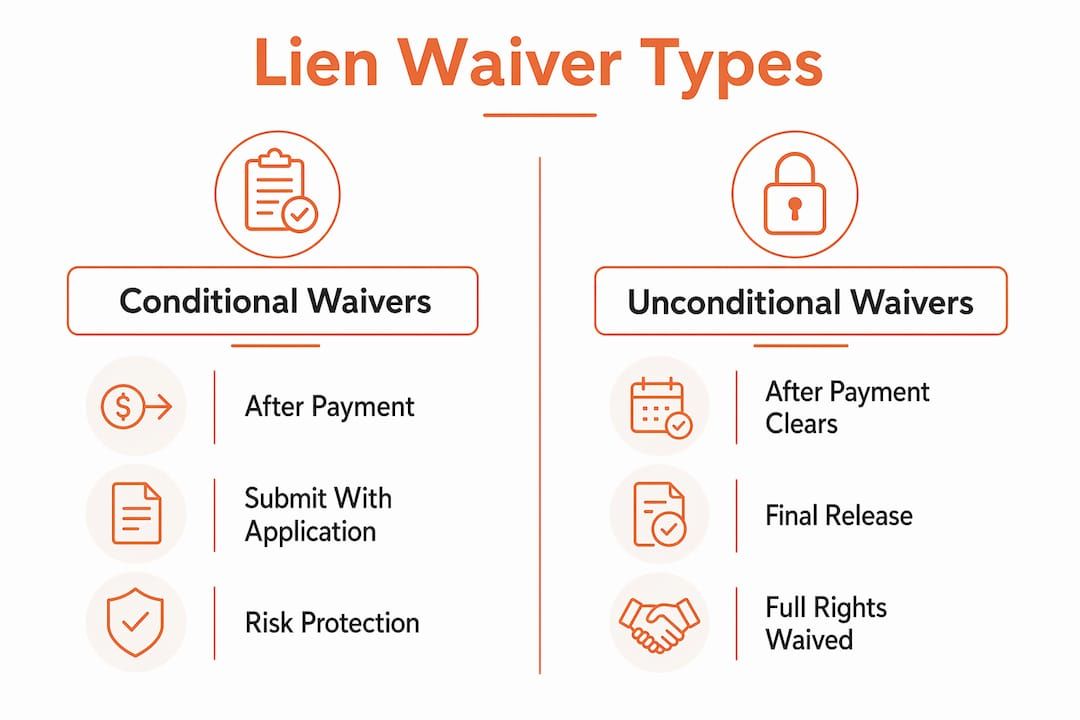
The construction industry recognizes four standard lien waiver types, organized along two axes: conditionality and payment stage. Understanding both axes is the foundation of sound waiver management.
Conditionality determines when the waiver takes legal effect.
- A conditional waiver takes effect only after payment clears. If the check bounces or the wire fails, the lien right survives. This is the safer document to sign before funds arrive.
- An unconditional waiver takes effect the moment you sign it, regardless of whether payment actually arrives. Sign unconditional waivers only after confirmed, cleared funds. Signing one prematurely eliminates your lien rights with no recourse.
Payment stage determines the scope of the waiver.
- A partial (progress) waiver covers work completed and billed through a specific pay period. It leaves future lien rights intact for work not yet billed.
- A final waiver covers all work on the project. Signing one closes out your lien rights entirely, so it belongs at the end of the job after the final payment clears.
The standard industry workflow follows a clear sequence: submit a conditional waiver with the pay application, wait for payment to clear, then deliver an unconditional waiver confirming receipt for that period. Skipping steps in this sequence is where most lien problems begin.
| Waiver type | When it takes effect | Best used |
|---|---|---|
| Conditional progress | After payment clears | With each progress pay application |
| Unconditional progress | Immediately upon signing | After each progress payment clears |
| Conditional final | After payment clears | With final pay application |
| Unconditional final | Immediately upon signing | After final payment is confirmed |

Pro Tip: Always match the waiver type to the payment status. Conditional before payment, unconditional after. No exceptions.
How do general contractors manage lien waiver chains?
The role of the GC in lien waiver distribution is to act as the central control point for the entire payment chain. You are responsible for collecting waivers not just from your direct subcontractors, but from their sub-tier subs and suppliers as well. Missing signatures or incomplete waiver chains can stall payments and create financing problems that ripple across the whole project.
Here is how effective GCs manage this process:
- Bundle waivers with every pay application. Never submit a pay app without attaching the corresponding conditional waivers from all parties who worked or supplied materials in that period.
- Track by tier. Your direct subs owe you waivers, but so do their subs and suppliers. A first-tier sub’s waiver does not cover a second-tier supplier’s lien rights.
- Reconcile amounts. Lien waivers should match the pay application dollar-for-dollar and period-for-period. A waiver for $80,000 attached to a $95,000 pay app leaves a $15,000 lien exposure gap.
- Verify before releasing payment. Confirm that every required waiver is in hand and correctly executed before you release funds to subs or approve their invoices.
- Maintain an audit trail. Keep executed waivers organized by pay period and party. Owners and lenders will request them, and a clean file speeds up pay application approvals.
Proper waiver management builds trust with owners and lenders. When your pay application arrives with a complete, organized waiver package, it signals low project risk and accelerates approval. That directly affects your cash flow.
Pro Tip: Create a waiver checklist for every pay cycle that lists every sub and supplier by tier. Check off each waiver as it arrives. Do not release payment until every box is checked.
What are the most common lien waiver mistakes in GC payments?
Most lien waiver errors fall into a handful of predictable patterns. Knowing them in advance is the best way to avoid them.
-
Signing unconditional waivers before payment clears. This is the most damaging mistake. Owners and GCs who treat waivers as formalities risk losing payment leverage and facing lien claims with no legal remedy remaining.
-
Failing to collect from all tiers. A GC who only collects waivers from direct subs leaves second and third-tier suppliers free to file liens against the owner’s property. The owner then looks to you for resolution.
-
Using non-compliant forms in statutory states. About a dozen states, including California, Texas, and Nevada, mandate specific statutory lien waiver forms. Using a non-compliant form in those states can render the waiver unenforceable.
-
Mismatching waiver amounts and pay periods. Accurate reconciliation at the job and cost code level is necessary to ensure waivers precisely correspond to paid work. A waiver that covers the wrong period or amount creates disputes and potential lien exposure.
-
Ignoring the fine print. Waiver language can inadvertently waive rights beyond mechanic’s liens, including other legal claims. Review every waiver before signing. Overly broad language can strip away legal remedies you did not intend to give up.
-
Letting incomplete packages delay payment. A single missing waiver from one supplier can hold up the entire pay application. Build your collection process early in each pay cycle, not the day before submission.
How does technology improve lien waiver management for GCs?
Manual waiver tracking breaks down fast. On a project with 20 subcontractors across three tiers, you can easily be managing 60 or more waiver documents per pay cycle. Multiply that across a portfolio of active projects and the administrative load becomes a real risk factor.
Contractors with larger portfolios adopt systematic processes rather than manual tracking to maintain control over lien exposure. Automation addresses this directly. Here is what a well-built waiver management system does for you:
- Alerts on missing waivers. The system flags any sub or supplier who has not submitted a waiver before the pay application deadline, giving you time to follow up.
- Matches waiver amounts to pay applications. Automated matching catches dollar discrepancies before they become disputes or lien exposure.
- Supports state-specific compliance. A good platform knows which states require statutory forms and generates the correct document automatically.
- Integrates with your existing workflow. Platforms that connect with construction management tools like Procore or accounting tools like QuickBooks eliminate duplicate data entry and reduce errors.
- Creates a permanent audit trail. Every executed waiver is stored, timestamped, and retrievable. Lenders and owners can access complete waiver histories without you hunting through email threads.
Automating lien waiver collection and tracking reduces payment delays and helps manage project risk across diverse state laws. The time savings alone justify the switch. The reduction in lien exposure makes it a financial necessity for any GC running multiple projects simultaneously.
Waiverpilotpro is built specifically for this workflow. It generates both conditional and unconditional waivers for free, supports multi-subcontractor projects, and integrates with platforms like Procore and QuickBooks. Documents are professional-grade and notarizable, ready for submission without additional formatting.
Key takeaways
Lien waivers are the primary financial control in GC payments, and managing them correctly protects your cash flow, your lien rights, and your relationships with owners and lenders.
| Point | Details |
|---|---|
| Match waiver type to payment status | Use conditional waivers before payment clears; switch to unconditional only after funds confirm. |
| Collect from every tier | GCs must gather waivers from direct subs and all sub-tier parties to close lien exposure gaps. |
| Reconcile amounts precisely | Waiver dollar amounts and pay periods must match the pay application exactly to avoid disputes. |
| Review waiver language carefully | Broad waiver language can waive rights beyond lien claims, creating unintended legal consequences. |
| Automate for scale | Manual tracking fails on multi-project portfolios; systematic tools reduce delays and lien risk. |
What I’ve learned after years of watching GCs get this wrong
Most GCs do not think seriously about lien waivers until a lien gets filed. By then, the damage is done. A supplier who never got paid by a sub files against the owner’s property, the owner calls you, and suddenly you are untangling a mess that a proper waiver chain would have prevented entirely.
The negotiation piece is harder than people admit. Subs push back on conditional waivers. They want payment first, waiver second. That is understandable, but it is backwards from a risk management standpoint. The right answer is to educate your subs on why the sequence matters for everyone. A conditional waiver protects them too. If your check bounces, their lien right survives. That is the conversation worth having.
What I have found is that GCs who invest in waiver education for their subs and suppliers run smoother projects. Subs who understand the process submit waivers faster, with fewer errors, and with less friction. That speeds up your pay application cycle and keeps owners happy.
The lien waiver process is also evolving. State legislatures continue to update statutory form requirements, and the push toward digital, notarizable documents is accelerating. GCs who build a systematic waiver process now, rather than patching it together project by project, will be far better positioned as compliance requirements tighten. The lien waiver guide from Waiverpilotpro is a solid starting point if you want to get your team aligned on the fundamentals.
— Rowena
Waiverpilotpro makes lien waiver management straightforward
Managing lien waivers across multiple projects and subcontractor tiers does not have to be a manual, error-prone process. Waiverpilotpro gives general contractors a free, professional-grade tool to generate conditional and unconditional waivers in minutes, with auto-calculated balances and multi-subcontractor support built in.
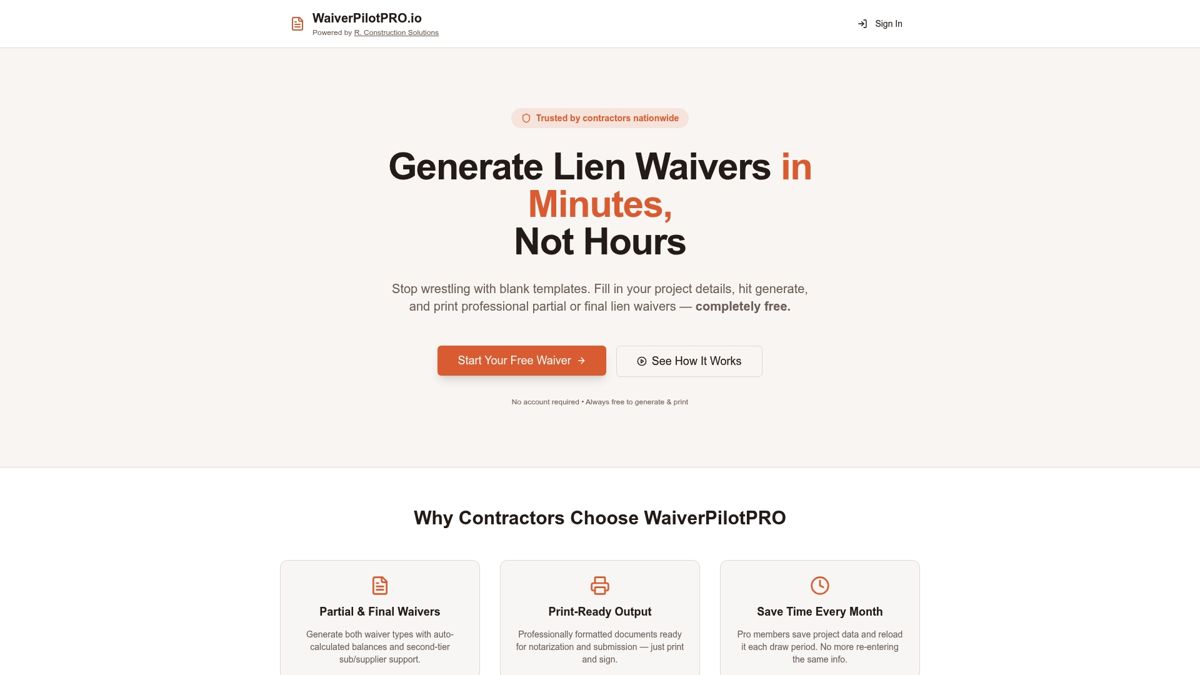
The platform integrates directly with Procore and QuickBooks, so your waiver workflow connects to the tools you already use. Documents are notarizable and ready for immediate submission. Whether you need a free lien waiver generator for a single project or a system that scales across your entire portfolio, Waiverpilotpro is built for the way GCs actually work. No account creation required to get started.
FAQ
What is the role of lien waivers in GC payments?
Lien waivers serve as a financial gating mechanism in GC payments, confirming that payment has been or will be received and releasing the right to file a mechanic’s lien for that amount. They protect owners from undisclosed liens and give GCs leverage to control payment flow across the subcontractor chain.
When should a GC use a conditional vs. unconditional lien waiver?
A conditional waiver belongs with the pay application, before payment clears. An unconditional waiver should only be signed after funds have fully cleared, because it takes effect immediately upon signing regardless of payment status.
What happens if a GC fails to collect lien waivers from all subcontractor tiers?
Sub-tier subcontractors and suppliers who did not receive payment retain the right to file a mechanic’s lien against the owner’s property. The GC is typically responsible for resolving those claims, which can delay project completion and damage the owner relationship.
Do lien waiver forms need to match state requirements?
Yes. States including California, Texas, and Nevada require specific statutory lien waiver forms. Using a non-compliant form in a statutory state can make the waiver unenforceable, leaving lien rights intact despite the signed document.
How do lien waivers affect pay application approvals?
A complete, accurate waiver package submitted with a pay application signals low project risk to owners and lenders. Incomplete or mismatched waivers are a leading cause of pay application delays, directly affecting GC cash flow.