
Indiana Lien Waivers: 4 Waiver Types, Checklist, and Free Generator
Indiana law voids any contract clause that forces you to waive lien rights before you get paid, and the state has no required waiver form. Indiana Code § 32-28-3-16 protects that timing, and notarization isn’t required either. A few exceptions apply to Class 2 structures and certain utility projects, covered below, so check those before you sign anything unusual.
TL;DR:
- Indiana law prohibits requiring contractors to waive lien rights before receiving payment, and notarization is not mandated, simplifying the waiver process.
- Contractors should use conditional waivers linked to verified payments and keep proper documentation to avoid disputes and enforce their lien rights effectively.
- Projects involving Class 2 structures or utility infrastructure have recording requirements that can affect lien claims and must be checked carefully.
- Using state-specific waiver templates that include precise details such as amounts, dates, and project identifiers reduces the risk of unintentional releases.
- Signers should beware of common mistakes like signing unconditional waivers prematurely or vague wording that can be interpreted broadly, risking loss of claims.
Table of Contents
- Indiana Lien Waiver Checklist: What to Verify Before You Sign
- What Are the Types of Lien Waivers Used in Indiana?
- Indiana Lien Waiver Law: What §32-28-3-16 Actually Says
- How Do You Fill Out an Indiana Lien Waiver Correctly?
- Where to Find Indiana-Ready Lien Waiver Templates
- Common Lien Waiver Mistakes and How to Enforce Your Rights
- What I’ve Learned About Indiana Waivers From Watching Them Go Wrong
- Generate Compliant Indiana Waivers Without the Guesswork
- Sources
Indiana Lien Waiver Checklist: What to Verify Before You Sign
Before you sign or request an Indiana lien waiver, run through this list. It’s short on purpose, because the mistakes that cost contractors money are almost always simple ones that got skipped in a rush, as contractors managing their safety documentation understand from using SWMS vs JSEA guidelines.
- No prepayment waivers. Indiana voids any clause requiring you to waive lien rights before payment on covered projects.
- Match the amount and date. The waiver should name the exact dollar amount and a “through date” tied to the actual payment, not a future estimate.
- Favor conditional wording. Use conditional waivers until funds clear the bank, since Indiana statutes don’t define when “payment” legally happens.
- Check for exceptions. Class 2 structures and certain utility projects follow different recording rules, detailed further down.
- Keep your paper trail. Save invoices, canceled checks or bank confirmations, and copies of every signed waiver.
That last habit matters more than it sounds. A waiver without a matching payment record is nearly impossible to dispute later if a general contractor or owner claims you already released a claim you never got paid for.
What Are the Types of Lien Waivers Used in Indiana?
Indiana recognizes the same four waiver categories used across most states, but the sequence you use them in matters more here because the anti-waiver statute limits when a waiver can legally take effect.
- Conditional partial waiver. Signed in exchange for a progress payment, but only takes effect once that specific check clears. This is the default choice for most invoice cycles.
- Unconditional partial waiver. Confirms a progress payment already cleared and releases lien rights for that amount only, with no strings attached.
- Conditional final waiver. Used at project closeout, contingent on the final payment actually landing in your account.
- Unconditional final waiver. Signed only after the final payment has cleared, releasing all remaining lien rights on the project.
In practice, most Indiana contractors run conditional waivers on every draw and save unconditional language for after the money is confirmed. Industry practice in Indiana favors conditional waivers since the statute leaves “payment” undefined, making conditional waivers the common approach. If a general contractor asks for an unconditional waiver on a progress payment you haven’t been paid for yet, that’s a request worth pushing back on.
Indiana Lien Waiver Law: What §32-28-3-16 Actually Says
The statute at the center of Indiana lien waiver law does two specific things. First, it voids any contract provision requiring a person to waive lien rights or payment bond claims before payment is made. Second, it voids any agreement barring a claimant from filing a notice of intention to hold a lien. FindLaw’s reproduction of the code confirms both provisions, and they apply to contracts entered after the mid-1999 cut-off date, according to a summary of the statutory scope.
The law doesn’t ban waivers outright. It bans forcing someone to sign away lien rights before the money is actually in hand.
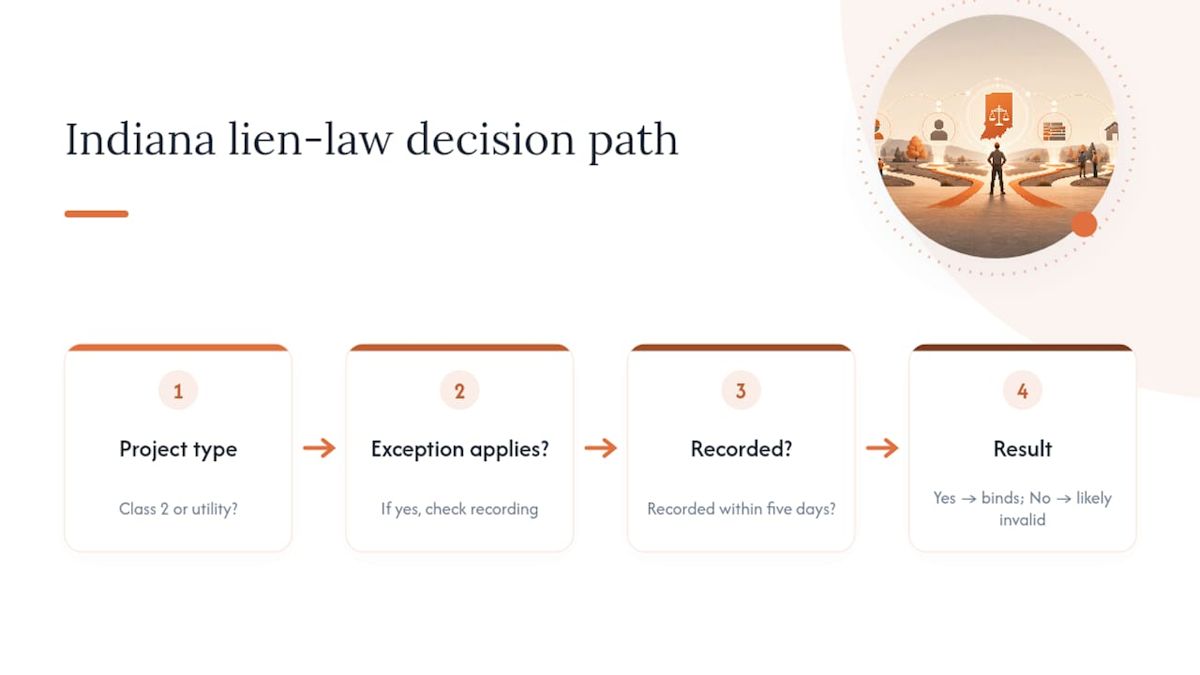
Two categories fall outside that protection: Class 2 structures and certain public-utility property. Owners on these projects can use “no-lien” clauses, but only if the clause is acknowledged like a deed and recorded within five days to bind subcontractors, according to county-level guidance on the recording requirement.
The statute leaves real gaps. It doesn’t define what counts as “payment,” and it doesn’t dictate any specific waiver wording. That ambiguity is exactly why conditional language has become standard practice statewide. To find out if your project qualifies for either exception, ask whether it’s a Class 2 structure under the building code or involves utility infrastructure, and confirm whether any no-lien clause was properly recorded within that five-day window. If it wasn’t, the clause likely doesn’t bind you.
How Do You Fill Out an Indiana Lien Waiver Correctly?
A valid waiver needs specific information, and vague wording is the fastest way to lose rights you didn’t mean to give up.
Every waiver should include the exact amount being waived, a through date tied to a real payment, a project identifier, a description of the work or materials covered, and the signer’s name and authority to sign on behalf of the company. Skip any of these and you’ve created a document that’s either unenforceable or dangerously open to interpretation.
Watch for wording that tries to do more than it should:
- Blanket releases that waive rights to “any and all claims” instead of a specific invoice amount.
- Cross-project language that could be read to cover work on a different job entirely.
- Retroactive dating that covers a period before the payment being made.
Pro Tip: Read the through date against your own invoice, not the date on the waiver form itself. Contractors lose rights by signing waivers where the through date silently extends past the payment they actually received.
Notarization isn’t required under Indiana law, but some lenders or title companies request it anyway for their own file requirements. If someone asks you to notarize a waiver, that’s not a red flag by itself, just an extra step that doesn’t change your underlying lien rights.

Where to Find Indiana-Ready Lien Waiver Templates
Indiana has no official statutory waiver form, so the wording is up to the parties, which means the template you use matters. A generic form pulled from another state can include language that doesn’t match Indiana’s conditional-waiver practice or that accidentally waives more than intended.
- Conditional partial waiver for routine progress payments, tied to a specific invoice number.
- Unconditional partial waiver for confirming a progress payment that already cleared.
- Conditional final waiver for closeout, contingent on the last check landing.
- Unconditional final waiver signed only once that final payment clears your account.
For Class 2 or utility projects with a recorded no-lien clause, customize the template to reference that clause and confirm the recording date. WaiverPilotPRO’s Indiana waiver templates are built around this exact structure, and a broader set of downloadable construction forms covers related paperwork you’ll need alongside them. Whatever template you use, keep it consistent with your invoice numbering so a waiver and its matching payment record always line up.
Common Lien Waiver Mistakes and How to Enforce Your Rights
The most expensive mistakes with Indiana lien waivers happen fast, usually under deadline pressure from a general contractor who wants paperwork signed before a draw goes out.
- Signing an unconditional waiver before payment clears. This is the single most common error, and it’s the one the anti-waiver statute exists to prevent when done under contractual pressure.
- Leaving scope language vague. A waiver that doesn’t tie to a specific invoice or work description can be argued to cover more than intended.
- Missing the recording window on exception projects. Class 2 and utility no-lien clauses that aren’t recorded within five days generally don’t bind subcontractors, so failing to check this cuts both ways.
If a dispute surfaces after signing, document everything in writing immediately, including payment records and any communication about the waiver’s scope. Indiana lien enforcement runs on strict deadlines tied to filing a notice of intention and a limited window to file suit after the lien is recorded, detailed in Husch Blackwell’s state summary. Those deadlines are unforgiving, so talk to a construction attorney as soon as a payment dispute looks likely to escalate rather than waiting until the lien window is closing.
What I’ve Learned About Indiana Waivers From Watching Them Go Wrong
The waivers that cause real damage almost never look dangerous at first glance. They’re the ones where the through date quietly outlasts the payment, or where “amount waived” gets left blank because everyone assumed it would match the invoice.
Recordkeeping is the boring part of this job that actually protects you. Match every through date to a cleared payment, not a promised one, and keep your invoices next to your signed waivers, not in separate folders. The contractors who get burned aren’t careless. They’re just busy, and busy is exactly when broad, ambiguous wording slips through.
— Rowena
Generate Compliant Indiana Waivers Without the Guesswork
There are services available that can provide a faster path to correct paperwork than building templates from scratch or editing a generic form that wasn’t written for Indiana’s conditional-waiver practice.
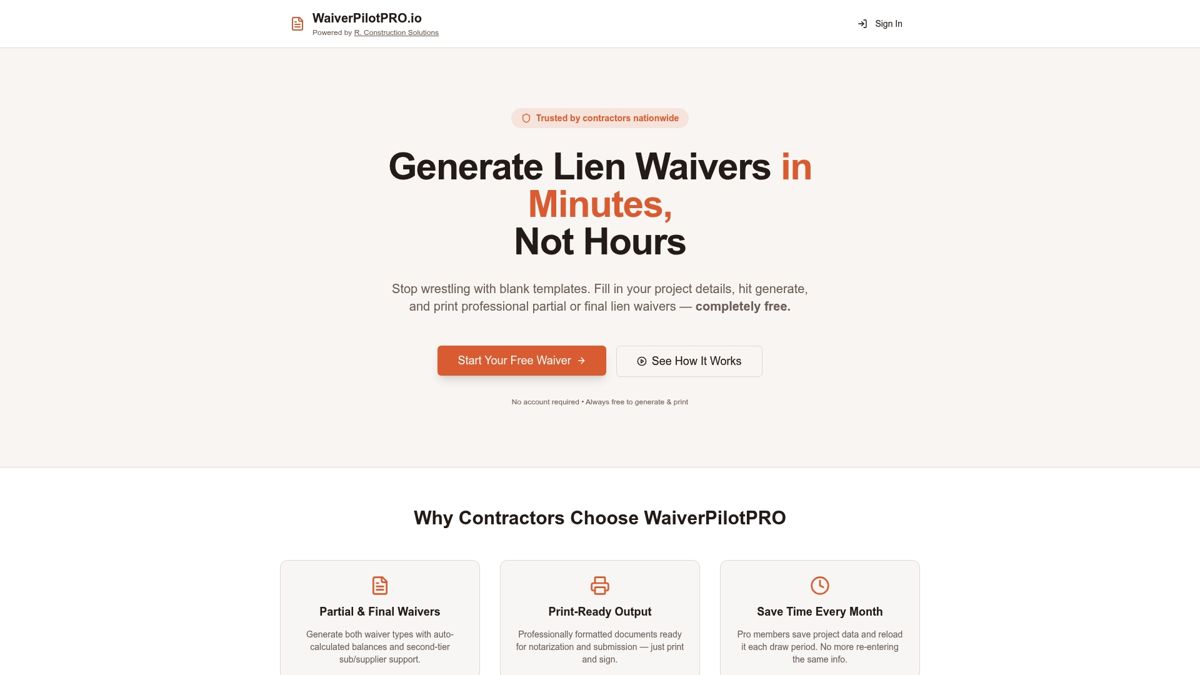
Some platforms auto-calculate balances so the through date and amount waived match the invoice, and support multi-subcontractor projects without rebuilding a spreadsheet for every draw. It also connects with Procore, QuickBooks, JobTread, and Buildertrend, so your waiver data stays lined up with the project management or accounting system you already run. If you want to compare waiver types before you generate one, the conditional versus unconditional breakdown walks through the practical differences. Start with the free Indiana lien waiver generator to produce a properly worded, state-appropriate document in minutes.
Sources
- Indiana Code § 32-28-3-16. Waiver of Right to a Lien Voiding Contract :: 2024 Indiana Code :: Justia
- Indiana Code § 32-28-3-16 — FindLaw
- Indiana: State-by-State Summary of Construction Liens — Husch Blackwell