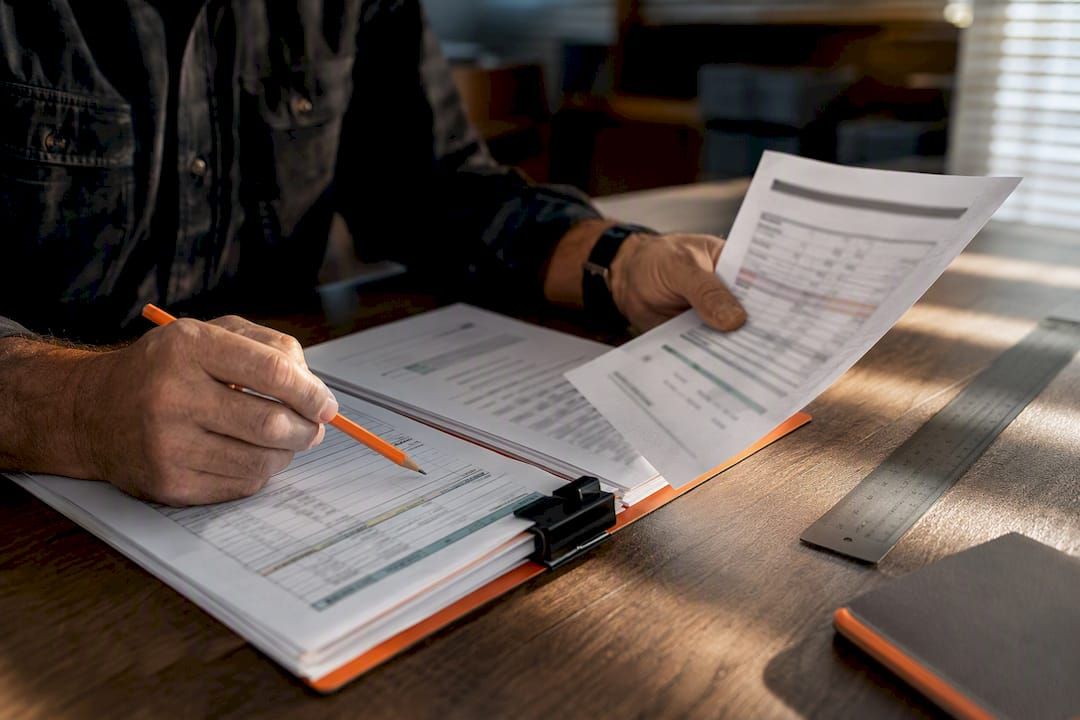
Florida Lien Waiver: 6 Step Filling Checklist for Contractors, §713.20
Advance lien waivers are unenforceable in Florida. Under Florida Statute § 713.20, you can only waive lien rights for labor, services, or materials you have already furnished, and any waiver tied to a payment must use the state’s statutory form language. You can still condition that waiver on actually getting paid, whether by check, wire, or electronic funds transfer.
TL;DR:
- Florida law requires lien waivers to be tied to work already performed and must strictly use the statutory forms with blanks for specific details.
- The updated statutes now demand exact matching of waiver forms to the law, including condition clauses linked to actual receipt of electronic funds transfers or checks.
- Properly filling out waivers involves selecting the correct form type, accurately listing the “through” date, property description, and confirming signer authority.
- Conditional language tied to payment receipt is critical to prevent waivers from unintentionally releasing lien rights before payment clears.
- Using non-statutory or improperly completed forms can lead to disputes, and automated tools are recommended to ensure compliance and accuracy.
Table of Contents
- What Florida Statute § 713.20 Actually Says
- Where to Find the Official Florida Lien Waiver Forms
- How to Fill Out a Florida Lien Waiver Without Losing Your Rights
- Payment-Time Checklist for Signing or Accepting a Waiver
- What SB 658 Changed for Florida Lien Waivers in 2026
- Common Mistakes That Put Your Lien Rights at Risk
- How Lien Waiver Rules Differ by Project Role
- What Happens When a Lien Waiver Is Misused or Falsified
- Best Practices for Managing Lien Waivers Across a Project
- Real-World Scenarios Where Lien Waivers Make or Break a Project
- Where Contractors Get Lien Waivers Wrong Most Often
- Generate Compliant Florida Waivers Without the Guesswork
- Sources
What Florida Statute § 713.20 Actually Says
Section 713.20 is the backbone of every Florida lien waiver, and it starts by closing a loophole that used to hurt subcontractors. Subsection (2) blocks any waiver signed before you’ve performed the work it covers. An owner or general contractor cannot make you sign away lien rights for materials you haven’t delivered yet or labor you haven’t performed. You can only waive what you’ve actually furnished.
Subsections (4) and (5) go further and supply the exact statutory language for two waiver types: the progress payment waiver and the final payment waiver. These aren’t suggested templates. They’re the wording Florida law recognizes, complete with blanks for the amount, the “through” date, and the property description.
Subsections (6) through (8) protect that structure. A general contractor or owner cannot force you to sign a different form just because it’s their standard paperwork. If a waiver strays from the statutory language and isn’t “substantially similar,” courts have more room to question whether it actually released anything. That’s the legal teeth behind using the right Florida lien waiver form instead of whatever document lands in your inbox.
Where to Find the Official Florida Lien Waiver Forms
Florida law names two specific templates: the Waiver and Release of Lien Upon Progress Payment and the Waiver and Release of Lien Upon Final Payment. Each one lives directly in the statute text at Section 713.20 on Online Sunshine, and that’s the version you want to compare against anything you’re asked to sign.
Both templates share a handful of required blanks: the payment amount, the “through” date marking the cutoff of work covered, a legal description of the property or job, and the names of both the lienor and the party paying. Get any of those wrong and the waiver may not cover what everyone assumes it covers.
Because subsection (6) bars anyone from requiring a non-statutory substitute, a contractor pushing a custom “release” with extra clauses, indemnification language, or broader waivers than the law allows is on shaky ground. You’re not obligated to sign it as written. A conditional lien waiver built on the statutory language protects you better than a customized form that adds risk you never agreed to.
How to Fill Out a Florida Lien Waiver Without Losing Your Rights
Getting the form right matters as much as using the right form. A statutory template filled in carelessly can still cost you money you’re owed.
- Pick the correct waiver type. A progress waiver covers work through a specific date; a final waiver covers the entire project. Mixing them up can release more (or less) than you intend.
- Set an accurate “through” date. This date defines exactly what work the waiver covers. Anything performed after it stays protected by your lien rights.
- Copy the legal property description exactly. Pull it from the Notice of Commencement or the contract, not from memory or a mailing address.
- Confirm signer authority. Whoever signs should have the actual authority to waive lien rights on behalf of the company, and their title should appear next to their signature.
- Add conditional language tied to actual receipt of funds. Under updated rules, that condition can reference check clearance, wire transfer, or EFT.
- Keep records. Save proof of payment, a signed copy of the waiver, and the date you executed it.
Pro Tip: Never backdate a waiver to match a payment date. If a dispute arises later, a mismatched signature date can undercut your conditional language and make an unconditional waiver look intentional.
Payment-Time Checklist for Signing or Accepting a Waiver
Before anyone signs a lien waiver, run through this list. It takes two minutes and prevents most of the disputes that end up in front of a construction attorney.
- Confirm the waiver type matches the payment (progress vs. final) and the dates line up with the work performed.
- Verify the payment method and whether the waiver is conditioned on funds actually clearing, not just being sent.
- Double-check the property description and every party’s legal name against the contract.
- Keep a signed copy along with proof of payment, whether that’s a bank record or a wire confirmation.
- Only record a waiver or release with the county when the transaction actually calls for it. Most progress waivers never need to be recorded.
That last point trips people up. A notary generally isn’t required for the waiver form itself, though a recorded satisfaction of lien later in the project may need one. Confusing the two steps wastes time and sometimes money.
What SB 658 Changed for Florida Lien Waivers in 2026
SB 658 tightened up a statute that had left too much room for interpretation, and the bill text from the 2025 session makes two changes worth knowing.
- Forms must now match the statutory language exactly. The old “substantially similar” standard gave some wiggle room; the update narrows that gap and reduces arguments over whether a waiver counted as compliant.
- Payment conditioning explicitly covers electronic transfers. Waivers can now be conditioned on receipt of EFTs and wires, not just paper checks, which matches how most construction payments actually move today.
For contractors and subs, the practical effect is fewer form disputes and cleaner escrow or title workflows once a waiver is signed. It also means anyone still using an old template built around “substantially similar” language should update it. Practitioners recommend building conditional language and EFT acceptance directly into your standard operating procedures rather than treating it as a one-off fix.
Common Mistakes That Put Your Lien Rights at Risk
Most lien waiver problems in Florida trace back to a handful of repeat mistakes.
- Signing an unconditional waiver before payment clears. If the check bounces or the wire never arrives, you’ve already given up your leverage.
- Using a vague or incorrect property description. This can cloud title or make the waiver unenforceable for the parcel you meant to cover.
- Accepting a non-statutory form under pressure. Courts scrutinize forms that stray from the statutory language, and subsection (6) means you don’t have to accept one anyway.
- Skipping documentation. No proof of payment means no leverage if a dispute over what was actually waived ends up in court.
The fix is consistent: condition every waiver on actual receipt of funds, keep the paperwork, and push back on custom forms that go beyond what § 713.20 requires.
How Lien Waiver Rules Differ by Project Role
Florida’s statutory waiver language applies the same way regardless of who’s signing, but the practical exposure changes a lot depending on where you sit on the project.
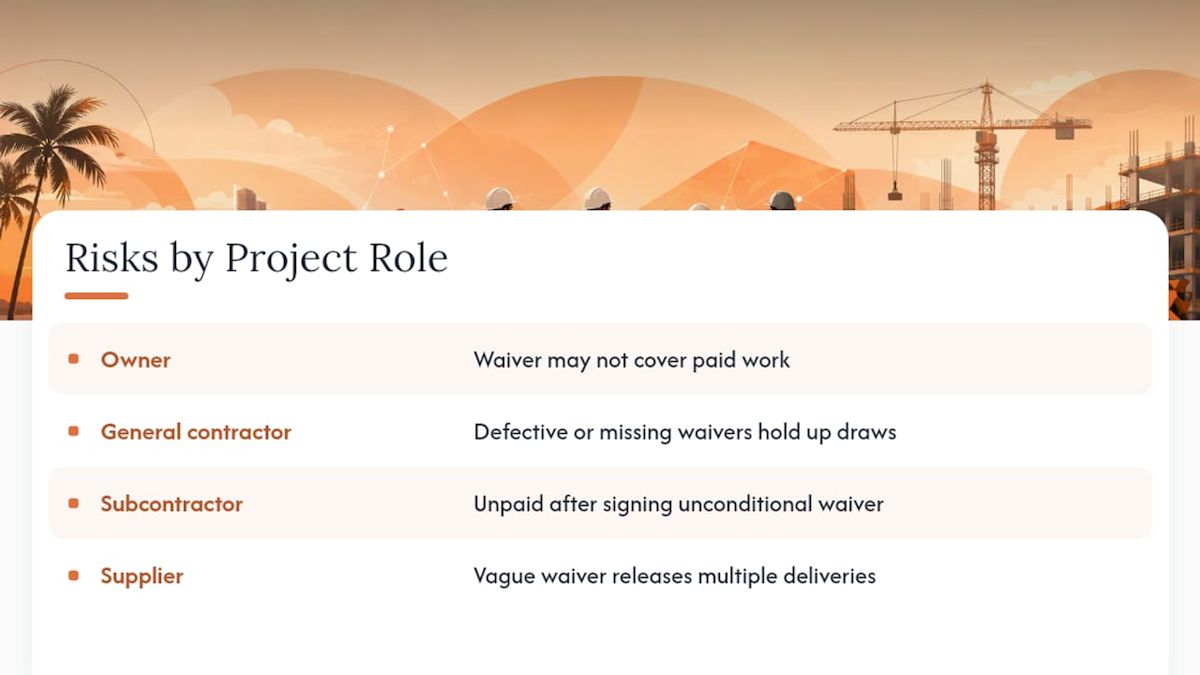
Owners typically request waivers before releasing payment, and their main risk is accepting a waiver that doesn’t actually cover the work paid for, leaving them exposed to a lien later from a party they thought was satisfied. A property description error or a missing “through” date is an owner’s problem just as much as a contractor’s.
General contractors sit in the middle. They collect waivers from every subcontractor and supplier before drawing down payment from the owner, and a single missing or defective waiver in that stack can hold up an entire draw request. Contractors juggling multiple subs on one job often deal with waivers piling up fast, which is exactly where multi-subcontractor tracking becomes more than a convenience.
Subcontractors face the sharpest version of the risk § 713.20 was written to address: pressure to sign broad or unconditional waivers before payment actually lands. A sub who signs an unconditional progress waiver and then doesn’t get paid has effectively lost the fastest remedy available.
Suppliers face a narrower but still real risk. Their lien rights depend on proper notice under Chapter 713, and a waiver that’s vague about which delivery or invoice it covers can accidentally release more material than intended. Suppliers dealing with multiple job sites need waiver language that’s specific to each delivery, not a blanket form reused across projects.
What Happens When a Lien Waiver Is Misused or Falsified
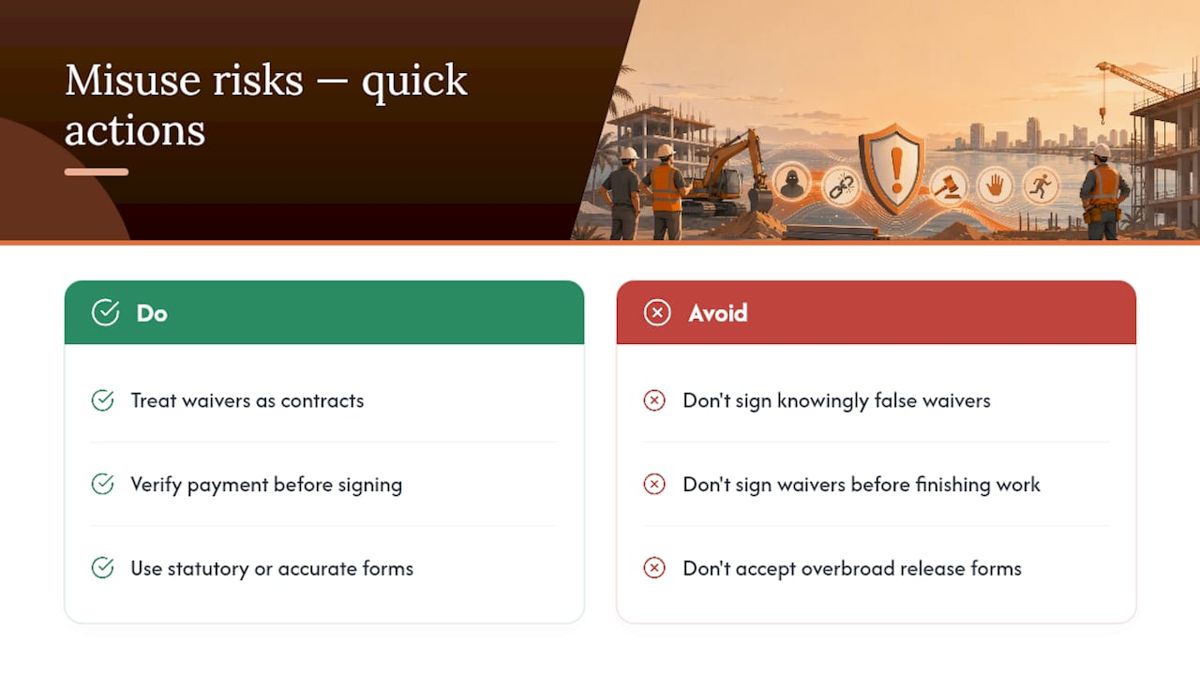
Signing a lien waiver you know is false, such as swearing you’ve received payment when you haven’t, creates exposure well beyond a contract dispute. Florida’s lien law is built around the idea that waivers accurately reflect what’s been paid, and a knowingly false waiver can expose the signer to fraud claims separate from any lien issue.
There’s also a subtler risk: coercion. If an owner or general contractor conditions payment on signing an unconditional waiver before the work is done, that waiver runs into the exact prohibition in subsection (2). A subcontractor who signs it under pressure and later doesn’t get paid may still have an argument that the waiver was invalid from the start, since Florida law doesn’t let parties waive lien rights in advance regardless of what the document says.
Improper use cuts the other way too. A contractor who requires a non-statutory form loaded with extra releases, indemnification clauses, or waivers broader than what’s actually owed risks having a court refuse to enforce the excess language. Munizzi Law Firm’s analysis of the 2025 updates points out that mismatched forms and inaccurate property descriptions are among the most common sources of title and escrow disputes once a project closes out.
The practical lesson is simple: a lien waiver is a legal instrument, not paperwork to rubber-stamp. Treat it with the same care as a contract amendment, because in a dispute, that’s exactly how it gets read.
Best Practices for Managing Lien Waivers Across a Project
The contractors who avoid lien disputes aren’t the ones who never run into payment problems. They’re the ones who treat waiver management as a system instead of a one-off task.
Start by standardizing on the statutory forms across every project and every sub, rather than letting different waivers float around depending on who’s asking. Consistency makes it much easier to spot a document that doesn’t match what your team normally uses.
Build conditional language into your default waiver template rather than treating it as an exception. Every progress waiver should be tied to actual receipt of funds unless there’s a specific reason to sign unconditionally, and even then, that decision should be a deliberate one, not a default.
Track waivers against payments in one place. On a project with a dozen subcontractors, matching each waiver to the correct payment, date range, and amount by hand invites errors. A tool like WaiverPilotPRO can auto-calculate balances and flag mismatches before they become a signed document.
Finally, keep every executed waiver alongside proof of payment for the life of the project, and longer if your contracts call for it. Florida’s lien deadlines mean a waiver dispute can surface months after the money changed hands, and the paperwork you kept is the only thing that settles it quickly.
Real-World Scenarios Where Lien Waivers Make or Break a Project
Scenario one: the bounced check. A subcontractor signs an unconditional progress waiver in exchange for a check, then the check bounces. Because the waiver wasn’t conditioned on actual receipt of funds, the subcontractor has already given up lien rights for that portion of work, even though no money ever arrived. Conditional language would have prevented this outright.
Scenario two: the mismatched property description. A general contractor collects final waivers from every sub on a multi-building development, but one waiver copies an outdated legal description from an earlier phase of the project. When a dispute surfaces later, the waiver’s coverage for that unit becomes a genuine legal question, delaying a closing that had nothing to do with the actual payment issue.
Scenario three: the custom form pushback. An owner asks a supplier to sign a broad release that goes well beyond the statutory waiver, including language releasing claims unrelated to the payment at hand. The supplier, aware of subsection (6), declines and requests the statutory form instead. The payment still goes through, and the supplier avoids signing away rights the owner had no legal basis to ask for.
Each of these plays out on real projects every month, and none of them are hypothetical edge cases. They’re the direct, predictable result of the statute’s own risk points: unconditional waivers, careless property descriptions, and non-statutory forms.
Where Contractors Get Lien Waivers Wrong Most Often
The most common error I see isn’t a legal one. It’s a records problem. Teams sign waivers correctly but don’t tie them back to the specific payment that triggered them, so six months later, nobody can say with certainty which waiver covered which invoice. That gap is what turns a routine payment dispute into a drawn-out argument.
The second most common mistake is treating every waiver like a formality once the statutory language is in place. It isn’t. The “through” date, the property description, and the payment amount all have to match reality, not just the template. WaiverPilotPRO was built around that exact problem, generating state-correct forms so contractors aren’t hand-editing statutory language and introducing errors in the process. Its auto-calculated balances and multi-subcontractor support also cut down on the manual matching that causes most of the confusion I mentioned above.
My advice for any Florida contractor: build conditional language into every progress waiver by default, and map out how your team handles EFT and wire confirmations now that the statute explicitly recognizes them. Waiting until a dispute forces the issue is the expensive way to learn this.
— Rowena
Generate Compliant Florida Waivers Without the Guesswork
Getting a Florida lien waiver right means matching the exact statutory language, the correct “through” date, and the right conditional terms every single time, across every sub and every payment. Doing that by hand on a project with multiple subcontractors is where most of the mistakes covered above actually happen.
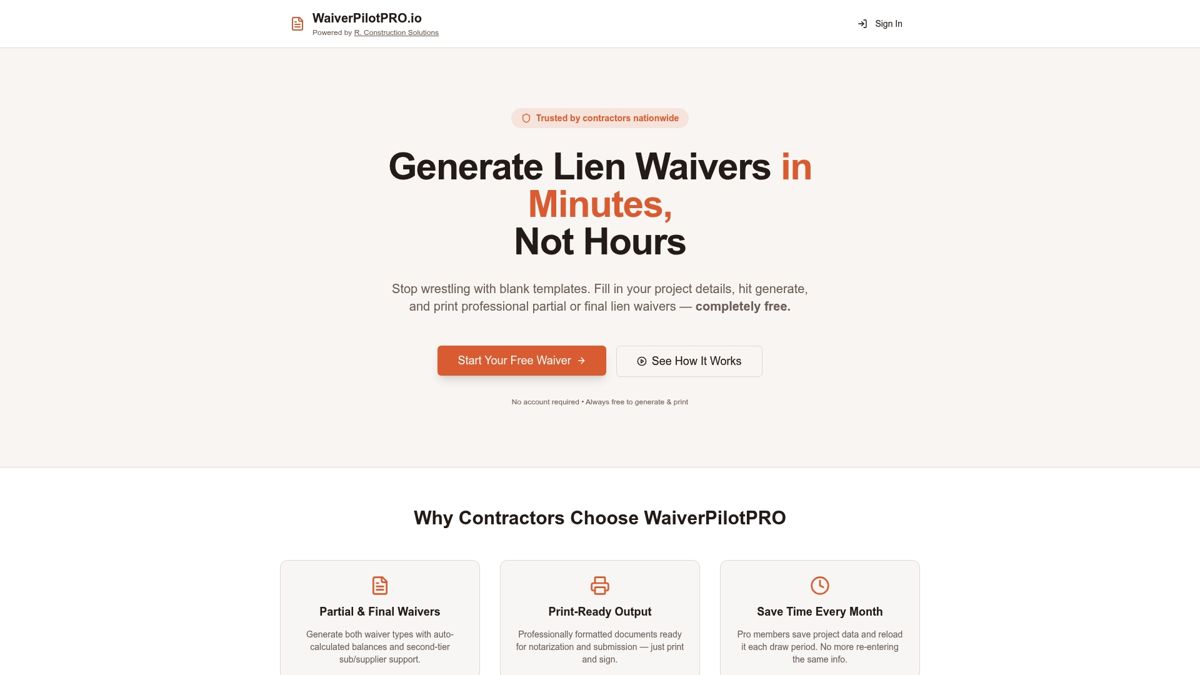
Waiverpilotpro’s free lien waiver generator builds Florida-compliant progress and final waivers using the statutory templates required under § 713.20, with auto-calculated balances so the numbers match what’s actually owed. It supports multi-subcontractor projects, so a general contractor collecting multiple waivers before a draw request isn’t retyping the same fields repeatedly, and connects with tools like Procore and QuickBooks to pull project details from where a team already works. The output is a professional document ready to send, not a blank template you have to interpret yourself.
If you’re managing waivers on an active Florida project right now, start with the free lien waiver generator and generate your next progress or final waiver in a few minutes.
Sources
- Chapter 713 Section 20 - 2026 Florida Statutes - The Florida Senate
- Statutes & Constitution : View Statutes : 713.20 Waiver or release of liens - Online Sunshine
- Navigating Florida’s Updated Construction Lien Waiver Forms (2025) - Munizzi Law Firm