
Does a Lien Release Need to Be Notarized?
Most lien waivers do not require notarization, but a lien release that removes an encumbrance from public record almost always does. County recorders typically reject unnotarized releases, which keeps the lien on title and can derail a closing. Two quick checks before you do anything else: find out whether your state uses a mandatory statutory form with a notary block, and confirm whether you plan to record the document.
The practical rule: If the document stays between parties, a notary is usually optional. If it touches the public record or satisfies a vehicle title, plan to notarize.
Here is a short action list to get you oriented:
- Check your state’s statutory waiver form for a notary block.
- Confirm whether your county recorder or DMV requires an acknowledgment.
- Read your subcontract or prime contract for any notarization clause.
Table of Contents
- When is notarization actually required for a lien release?
- What is the difference between a lien waiver and a lien release?
- How do you notarize a lien release or lien waiver?
- What happens if a lien release or waiver isn’t notarized?
- Quick state examples that show how rules vary
- What documents do you need when filing a notarized lien release?
- When should you notarize a waiver even if the state doesn’t require it?
- How Waiverpilotpro helps you produce notarizable documents
- Key Takeaways
- The part most contractors get wrong
- Waiverpilotpro makes notarization-ready waivers fast and free
- Useful sources to verify requirements in your state
When is notarization actually required for a lien release?
The general rule is that notarization is not legally required for a lien waiver in most states. But several categories flip that default, and missing any one of them can cost you a rejected filing or a delayed payment.
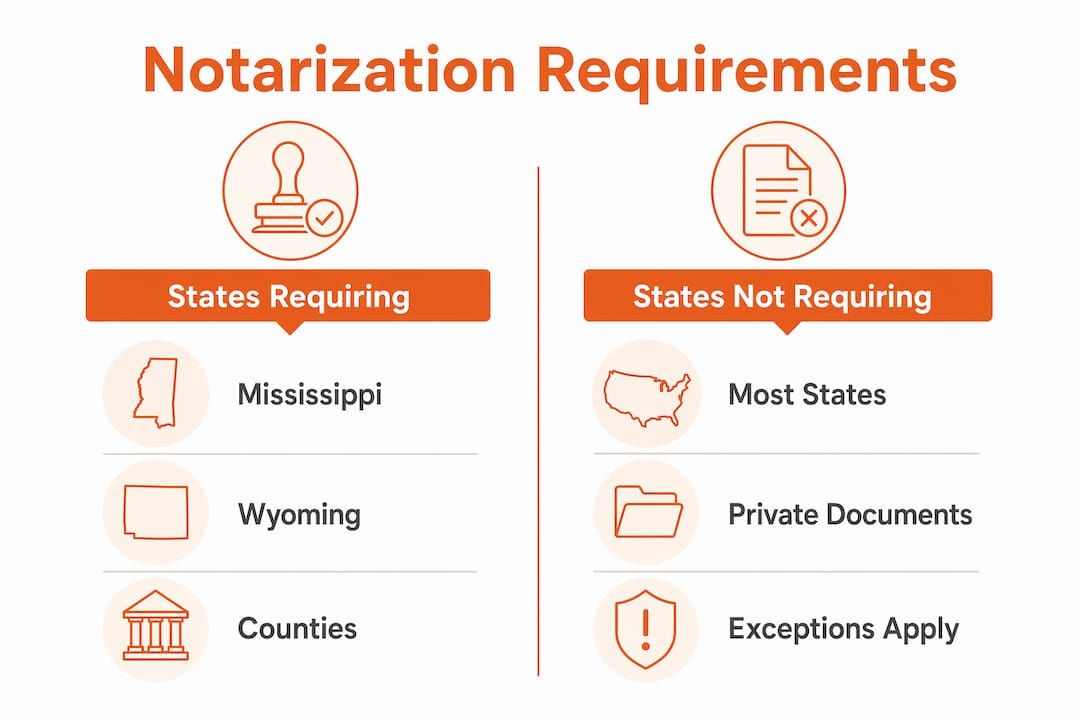
Statutory mandatory-form states. Mississippi and Wyoming stand out. Mississippi’s Miss. Code § 85-7-433 and Wyoming’s Wyo. Stat. § 29-10-101 both require notary acknowledgments on their statutory waiver forms. Using those forms without a notary block makes them non-compliant, not just informal.
County recorder and registrar rules. When a lien release affects real property, the county recorder is the gatekeeper. Recorders expect an acknowledgment by a notary on releases affecting title. Without it, the public record stays unchanged and the lien lives on.
Motor vehicle and DMV requirements. Vehicle title satisfactions follow a different rulebook. Some states require a notarized satisfaction from an individual lienholder before the DMV will update the title. New Jersey is a clear example, covered in the state examples section below.
Contractual and lender clauses. Your subcontract may require notarization even when state law does not. Contract clauses commonly override state defaults; if your subcontract requires notarization, you must comply to avoid rejected pay applications. Lenders financing a project often add the same requirement in their loan documents.
- Statutory mandatory-form states: Mississippi, Wyoming
- County recorders: real property releases affecting title
- DMV/motor vehicle: individual lienholder satisfactions in certain states
- Contracts and lenders: any clause that makes notarization a condition of payment or acceptance
Pro Tip: Read your subcontract’s “lien waiver” clause before the first pay application. If it says “notarized,” that requirement applies to every waiver you submit, regardless of what state law says.
What is the difference between a lien waiver and a lien release?
These two documents are often used interchangeably in conversation, but they are legally distinct, and that distinction determines whether notarization rules for recorded instruments apply to you.

A lien waiver is a private promise. You sign it to tell the owner or general contractor that you are giving up your right to file a mechanics lien for a specific payment. It stays between the parties and does not get recorded in the public land records. In most states, no notary is needed.
A lien release (sometimes called a lien satisfaction or release of mechanics lien) removes an existing, already-recorded encumbrance from the property’s title. Because it changes the public record, the county recorder treats it like any other recorded instrument and typically requires a notarized acknowledgment before accepting it.
Think of it this way: A lien waiver is a receipt that also surrenders a powerful legal remedy. A lien release is the formal paperwork that erases a lien from the county’s books. One lives in a file folder; the other lives in the public record.
A concrete example: a subcontractor on a commercial build signs a conditional progress waiver when the GC pays for the month. That waiver is private, no notary required in most states. Later, if the subcontractor had filed a mechanics lien and the owner now wants it removed, the subcontractor must execute a notarized release and record it with the county. Treating the waiver as a substitute for the release is a common mistake that leaves the lien on title.
For a deeper look at the conditional vs. unconditional waiver distinction, Waiverpilotpro’s guide walks through both types with state-specific notes.
How do you notarize a lien release or lien waiver?
Getting a document properly notarized is straightforward when you know what to bring and which notarial certificate to request. Practical notarization steps include leaving the signature blank, bringing a government ID, and confirming whether a jurat or an acknowledgment is required.
Before you see the notary:
- Leave the signature line blank. Signing before you arrive invalidates the notarization in most states.
- Gather a government-issued photo ID (driver’s license or passport).
- If the waiver is conditional, bring proof of payment (check copy, wire confirmation, or pay app).
- Confirm the exact notarial wording required by the county recorder or your contract. Most recorders want an acknowledgment, not a jurat.
- Download or print the correct statutory form if your state mandates one.
What the notary does:
- Verifies your identity against your ID.
- Watches you sign the document.
- Completes the notarial certificate (jurat or acknowledgment) and affixes their seal and commission information.
- Does not validate the document’s legal accuracy or the truth of its contents.
Jurat vs. acknowledgment. A jurat certifies that you signed under oath in the notary’s presence. An acknowledgment certifies that you appeared before the notary and acknowledged the signature as your own. County recorders recording a lien release almost always require an acknowledgment, because it confirms voluntary execution rather than sworn truth.
Remote online notarization (RON). Remote notarization is permitted in most states, but counties and recorders differ on accepting remotely notarized releases for recording. Before using a remote notary for a release you plan to record, call the county recorder’s office and confirm they accept RON documents. An e-signature alone is not the same as an e-notarization.
What happens if a lien release or waiver isn’t notarized?
Skipping the notary does not automatically void a document, but the practical consequences can be serious depending on how the document is used.
Between the parties. A signed lien waiver or release can still be enforceable as a contract between the parties who signed it, even without notarization. The problem is evidentiary: without a notary’s acknowledgment, the signer can later claim the signature was forged or coerced, and you have no independent witness to counter that claim. Notarization verifies signer identity, not the substance of the document, but it does prevent signature-dispute defenses.
Recording risk. This is where the real damage happens. County recorders typically require a notarized signature before accepting a lien release for recording. A rejected filing means the lien stays on title. That can delay or kill a property sale, block refinancing, and create friction with title companies.
Third-party trust. Buyers and lenders typically insist on a notarized and recorded release to clear title; otherwise the lien may continue to be treated as unresolved. A title company will not issue a clean title policy over an unrecorded or unnotarized release.
- Re-execution: Have the original signer re-sign a corrected, notarized version and re-record it.
- Affidavit of release: In some states, a notarized affidavit from the lienholder can substitute for a re-recorded release.
- Indemnity agreement: Title companies sometimes accept a written indemnity from the lienholder while the corrected release is being processed.
- Re-recording: Once a corrected release is notarized, record it promptly and keep the stamped receipt.
Pro Tip: If a closing is approaching and a release was filed without a notary, contact the lienholder immediately. Re-execution is faster than litigation, and most title companies will hold a closing in escrow for a few days while the corrected document is recorded.
Quick state examples that show how rules vary
No two states handle notarization requirements exactly the same way. These examples cover the most common patterns you will encounter.
| State | Document Type | Notarization Required? | Notes |
|---|---|---|---|
| Mississippi | Statutory lien waiver | Yes | Miss. Code § 85-7-433 requires notary acknowledgment on statutory form |
| Wyoming | Statutory lien waiver | Yes | Wyo. Stat. § 29-10-101 includes notary block on mandatory form |
| Texas | Lien waiver | No (post-2022) | HB 2237 removed the notary requirement for contracts signed on or after January 1, 2022 |
| California | Mechanics lien release | Yes | Releases must be notarized and recorded with the County Recorder |
| New Jersey | Vehicle lien satisfaction | Yes (individuals) | NJ MVC requires notarization from individual lienholders; financial institutions may use company letterhead instead |
A few notes worth calling out:
- Texas transition: Waivers under contracts signed before January 1, 2022 may still require notarization under the old statute. Check the contract date before assuming the new rule applies.
- California county recorders: Until a notarized release is recorded, the mechanics lien remains on title. The California mechanics lien release process requires both notarization and recording to fully clear the encumbrance.
- New Jersey MVC alternative proof: Financial institutions can provide company letterhead or transactional proof in place of a notarized satisfaction letter. Individual lienholders do not have that option.
- Missouri: The Missouri Department of Revenue’s guidance document (DOR-4809) covers perfecting and releasing liens on motor vehicles, including the notarization and signature requirements for title satisfactions.
For state-specific waiver requirements in New Jersey, Waiverpilotpro’s New Jersey lien waiver guide covers the MVC rules alongside construction waiver requirements.
What documents do you need when filing a notarized lien release?
Getting the notarization right is only half the job. Showing up at the recorder’s office or DMV with incomplete paperwork causes the same delays as skipping the notary entirely. Reviewing common permit submission mistakes can help you avoid the most frequent filing errors before you get to the window.
For a real property lien release:
- Full legal names of all parties (lienholder and property owner)
- Legal description of the property and the recording number of the original lien
- Proper notary acknowledgment with the notary’s seal, commission expiration date, and signature
- Signed release form (statutory form if your state requires one)
- County-specific cover sheet (many counties require this for any recorded instrument)
- Recording fee (varies by county; confirm the current amount before you go)
For a vehicle lien satisfaction:
- Vehicle Identification Number (VIN)
- Title number
- Lienholder’s full legal name and address
- Notarized satisfaction letter (for individual lienholders) or institution-stamped paperwork
- Original title certificate if required by the state DMV
Filing mechanics:
- Confirm whether your county accepts e-recording; many do, and it is faster than in-person filing.
- If mailing, use certified mail and keep the return receipt as proof of submission.
- Request a stamped or certified copy of the recorded release for your files.
| Filing Method | Typical Turnaround | Best For |
|---|---|---|
| In-person at recorder | Same day to 2 days | Urgent closings |
| E-recording | 1–3 business days | Most standard releases |
| Certified mail | 5–10 business days | Rural counties without e-recording |
When should you notarize a waiver even if the state doesn’t require it?
State law sets the floor, not the ceiling. There are several situations where notarizing a waiver costs you fifteen minutes and saves you a significant headache.
- Lender or owner requirements: If the construction loan documents or the prime contract require notarized waivers, you must comply. Submitting an unnotarized waiver can result in a rejected pay application.
- Planned recording: Any waiver or release you intend to record to remove a lien from title needs a notary. Do not wait until the recorder rejects it.
- Title company or buyer requests: If a property sale is in progress and the buyer’s title company asks for a notarized release, provide one. Holding up a closing over a notary fee is not worth it.
- Interstate projects: If your project spans state lines or involves a GC headquartered in a stricter state, their standard forms may include notary blocks regardless of where the work was performed.
- High-dollar or disputed payments: When a payment is large or the relationship is strained, a notarized waiver is harder to challenge later.
The small-project heuristic: if there is any chance the waiver or release will be shown to a title company, used to clear an encumbrance, or referenced in a future dispute, notarize it. The cost is minimal.
Pro Tip: Scan every notarized document immediately after signing and store the PDF in your project folder. Keep the recording receipt or stamped filed copy alongside it. If a title issue surfaces months later, you will have everything you need in one place.
How Waiverpilotpro helps you produce notarizable documents
Generating a lien waiver that is technically correct is one thing. Generating one that is ready to hand to a notary or submit to a county recorder is another. Waiverpilotpro is built for the second standard.
The platform provides state-specific templates that match statutory form requirements, including the notary acknowledgment blocks required in states like Mississippi and Wyoming. When you generate a document through Waiverpilotpro, the output is a professional PDF or Word file with the correct notarial language already in place. You bring it to the notary, sign in their presence, and the document is ready to record or submit.
Key features that matter for notarization compliance:
- State-specific statutory forms with pre-formatted notary acknowledgment blocks
- PDF and Word outputs formatted for signing in front of a notary or submitting to a recorder
- Auto-calculated payment fields that reduce errors on conditional waivers
- Multi-subcontractor support for managing waivers across a full project team
- Integration with Procore, QuickBooks, Jobtread, Sage, and Buildertrend to pull project data directly into the form
Waiverpilotpro’s role: The platform does not replace a notary or an attorney, but it eliminates the document-preparation errors that cause recorders to reject filings or counterparties to dispute signatures. A correctly formatted document is the first requirement for a valid notarization.
For contractors who need to understand notary requirements by state, Waiverpilotpro’s guide covers the full picture alongside the free generator.
Key Takeaways
Most lien waivers do not require notarization, but any release affecting the public record or a vehicle title almost always does, and contract clauses can impose the requirement regardless of state law.
| Point | Details |
|---|---|
| Waivers vs. releases | Lien waivers are private documents; lien releases affect public record and almost always require notarization for recording. |
| Statutory state exceptions | Mississippi and Wyoming require notary acknowledgments on their mandatory statutory waiver forms. |
| Texas post-2022 rule | Texas removed its notarization requirement for contracts signed on or after January 1, 2022; older contracts may still require it. |
| Recording rejection risk | County recorders typically reject unnotarized releases, leaving the lien on title and potentially blocking closings. |
| Waiverpilotpro | Generates state-specific, notarization-ready PDF and Word documents with pre-formatted acknowledgment blocks for compliant filing. |
The part most contractors get wrong
Contractors tend to treat notarization as a bureaucratic formality, something to worry about only when a title company asks. That mindset creates problems at the worst possible moment, usually the week a property is supposed to close.
The more useful framing is this: notarization is a risk-management decision, not just a legal checkbox. A notarized waiver is harder to dispute. A notarized release gets recorded without rejection. A properly recorded release clears title cleanly. Each step in that chain depends on the one before it, and the chain breaks most often at document preparation, not at the notary’s desk.
What I see consistently in construction workflows is that the document itself is the problem. Forms pulled from generic template sites often lack the correct notarial language for the state, or they use a jurat when the recorder expects an acknowledgment. The notary signs what is in front of them, the recorder rejects it anyway, and the contractor has to start over. Using state-specific templates with the correct acknowledgment language built in removes that failure point entirely.
Waiverpilotpro makes notarization-ready waivers fast and free
Generating a lien waiver that passes a notary’s desk and a county recorder’s review takes the right template, not just any template. Waiverpilotpro’s free lien waiver generator produces state-specific, notarization-ready PDFs and Word documents in minutes, with the correct acknowledgment language already included.
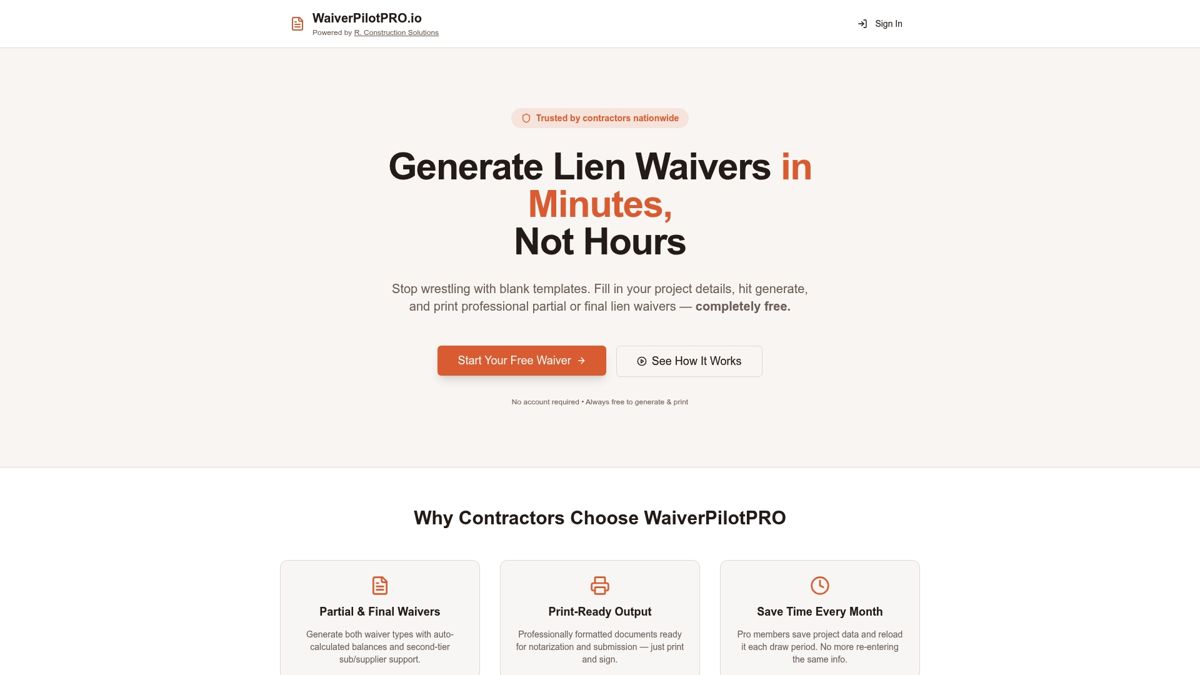
Fill in your project details, select your state, and download a professional document formatted for signing in front of a notary or submitting directly to a recorder. The free tier covers unlimited basic waiver generation with no account required. The Pro tier adds project saving, contract uploads, AI-powered form auto-fill, and multi-subcontractor management for teams handling volume. If you use Procore, QuickBooks, Jobtread, Sage, or Buildertrend, Waiverpilotpro connects directly to pull your project data into the form.
Generate your state-specific waiver now at waiverpilotpro.io and have a notarization-ready document ready before your next pay application.
Useful sources to verify requirements in your state
- Missouri DOR (DOR-4809): Perfecting and Releasing Liens — Missouri Department of Revenue guidance on motor vehicle lien releases, including notarization and signature requirements.
- California DMV: Notarized Lienholder Signatures for Duplicate Certificates of Title — official DMV guidance on when notarized lienholder signatures are required for vehicle title documents.
- New Jersey MVC: Vehicle Liens — covers notarization requirements for individual lienholders and alternative proofs accepted from financial institutions.
- LegalClarity — Lien Release Notarization: Does a Lien Release Need to Be Notarized? — practitioner-level breakdown of when notarization is required and the consequences of skipping it.
- LegalClarity — Lien Waivers and Notarization: Do Lien Waivers Need To Be Notarized? — covers Mississippi, Wyoming, Texas, and the contract-clause override rule.
- eNotaryOnCall: Notarize Lien Release Online — practical guide to remote online notarization for lien releases, including jurat vs. acknowledgment guidance.
- USA Notary — Texas Rule: Does a Lien Waiver Need to Be Notarized? — details on HB 2237 and the 2022 Texas statutory change.
- Northwest Lien Service — California: How to Release a Mechanics Lien in California — step-by-step process for notarizing and recording a mechanics lien release in California.
This article is general information, not legal advice. Notarization requirements vary by state, county, document type, and contract terms. Confirm the current rules with your county recorder, state DMV, or a qualified construction attorney before submitting documents.