Construction Release Form Types: A 2026 Contractor Guide
Construction release forms are legal documents that waive a contractor’s, subcontractor’s, or supplier’s right to file a mechanics lien against a property in exchange for payment. The industry term is “lien waiver,” and understanding construction release form types is the difference between protecting your cash flow and accidentally giving up your legal rights. These forms split along two axes: conditional versus unconditional, and progress payment versus final payment. Choosing the wrong form at the wrong time can void your lien rights entirely. States like California, Texas, and Florida mandate specific statutory language, and industry standards like AIA and ConsensusDocs forms govern non-statutory states.
1. The four main construction release form types explained
Construction lien waivers fall into four types based on two variables: whether payment has cleared, and whether the project is ongoing or complete. Each type carries a different legal effect and applies at a different stage of the payment cycle.
Conditional waiver and release on progress payment
This form waives lien rights only after a specific progress payment actually clears. You submit it with a draw request, and it becomes effective only when the check clears or the wire confirms. This is the safest form to use during active construction because your lien rights stay intact until funds are verified. Think of it as a receipt you write in pencil: it only becomes permanent once the money arrives.
Unconditional waiver and release on progress payment
This form takes effect the moment you sign it, regardless of whether payment has arrived. You use it after a progress payment has already cleared your account and you need to confirm that payment in writing. Signing this form before funds clear is one of the most common and costly mistakes in construction finance.
Conditional waiver and release on final payment
This form waives all remaining lien rights tied to the project, but only after the final payment clears. It is the correct form to use at project closeout when you are still waiting on the last check. It protects you through the final billing cycle without permanently surrendering your rights prematurely.
Unconditional waiver and release on final payment
This form permanently waives all lien rights the moment you sign it. It is the correct document to execute after final payment has confirmed in your account. Once signed, there is no recourse if a dispute arises later, so timing is everything.
Pro Tip: Never sign an unconditional waiver until you have confirmed the funds in your account. A cleared check, not a promised check, is the trigger.
2. Statutory requirements and state-specific rules
At least 12 U.S. states require specific statutory lien waiver forms to be used verbatim for enforceability. Those states include California, Texas, Florida, Arizona, Nevada, Massachusetts, Michigan, Mississippi, Missouri, Utah, Wyoming, and Georgia. This is not a technicality. Using a generic or modified form in these states renders the waiver void and unenforceable, even if payment was actually made.
California and Texas are the strictest examples. Both states publish exact statutory language that must appear in the waiver. Contractors who use a GC-supplied template that deviates from that language lose their lien rights without any legal remedy. The payment may have cleared, but the waiver is worthless in court.
Non-statutory states give contractors more flexibility, but flexibility creates risk when left unmanaged. In non-statutory states, AIA or ConsensusDocs forms are the best practice over ad-hoc templates because they carry legal predictability and are accepted by lenders and title companies without question.
Lenders and title companies on commercial projects often dictate which forms they will accept. Unfamiliar or non-standard waiver language from a general contractor should be treated as a red flag by subcontractors, since overbroad language can waive rights beyond what the payment covers.
Pro Tip: Before you sign any waiver on a new project, look up your state’s requirements. Waiverpilotpro maintains state-specific guides for California lien waiver rules, Texas lien waiver rules, and Florida lien waiver rules so you can verify compliance in minutes.
3. Best practices for managing construction release forms
The correct sequence for managing lien waivers is non-negotiable. The safe workflow is to collect conditional waivers during draw requests and unconditional waivers only after payment clears. Deviating from this sequence is the fastest way to lose lien rights without recourse.
Distinguish lien waivers from lien releases
A lien waiver is proactive. You sign it before or during payment to waive future lien rights. A lien release is reactive. You file it after a mechanics lien has already been recorded, to remove that lien from public property records. Mechanics liens can be filed 60–90 days after project completion, so the window for confusion is real. Using the wrong document at the wrong stage creates title problems that delay project closeout and financing.
List disputed amounts as exceptions
If you have a payment dispute on any line item, list those amounts explicitly as exceptions on the waiver before you sign. Signing a waiver without noting disputes waives your right to claim those amounts later. This single step protects your lien rights on contested work while still allowing the undisputed payment to proceed.
Collect waivers from every tier
General contractors must collect waivers not just from direct subcontractors but from every material supplier and sub-subcontractor on the project. A lower-tier supplier who was not paid can still file a lien against the property even if the GC paid the subcontractor. Tier-by-tier waiver collection closes that gap.
Summary comparison of the four form types
| Form type | When it takes effect | When to use it |
|---|---|---|
| Conditional progress waiver | After payment clears | With each draw request |
| Unconditional progress waiver | Immediately on signing | After progress payment confirms |
| Conditional final waiver | After final payment clears | At project closeout, before final payment |
| Unconditional final waiver | Immediately on signing | After final payment confirms in your account |
Pro Tip: Audit your waiver sequence at every draw cycle. If you find an unconditional waiver in your files that was signed before the corresponding payment cleared, consult a construction attorney immediately.
4. How release form types affect cash flow and legal compliance
Proper use of conditional and unconditional waivers directly controls how fast you receive draws. Owners and lenders release funds faster when they receive properly executed conditional waivers with each draw package. A missing or incorrect waiver stalls the entire payment cycle, which compounds across multiple subcontractors on large projects.
The risks of signing the wrong form type are concrete and permanent:
- Premature unconditional waiver: You sign an unconditional progress waiver before the check clears. The check bounces or is stopped. You have no lien rights to enforce because you already waived them.
- Generic form in a statutory state: You use a downloaded template in California. The statutory language is missing. The waiver is void. If the owner disputes payment later, you cannot file a lien.
- Missing final waiver exceptions: You sign an unconditional final waiver without noting a disputed change order. That dispute is permanently closed against you.
- Incomplete tier collection: A material supplier files a lien because the sub did not pay them. The GC collected a waiver from the sub but not the supplier. The property title is clouded.
Well-drafted, industry-standard forms reduce payment disputes and delays in construction financing. That is not a theoretical benefit. It shows up as faster draw approvals and cleaner project closeouts.
Partial versus final waivers also align with project milestones in a practical way. Use partial lien waivers at each draw to cover work completed through a specific date. Use final waivers only at true project completion, after all retainage is released and all change orders are settled. Mixing these up delays title clearance and can hold up a property sale or refinance.
Key takeaways
The most effective approach to construction release forms is to match each form type to the exact payment stage it covers, because timing determines whether your lien rights survive.
| Point | Details |
|---|---|
| Four form types govern all waivers | Conditional and unconditional forms each apply to either progress or final payment stages. |
| Statutory states require exact language | At least 12 states void waivers that deviate from prescribed statutory text, even after payment. |
| Sequence protects lien rights | Collect conditional waivers with draw requests; collect unconditional waivers only after funds clear. |
| Exceptions preserve disputed claims | List any disputed amounts on the waiver before signing to keep those lien rights intact. |
| Tier-by-tier collection closes gaps | GCs must collect waivers from all subcontractors, sub-subcontractors, and material suppliers. |
What I’ve learned from watching contractors get this wrong
I have reviewed enough payment disputes to see a clear pattern. The contractors who lose lien rights almost never do so because they misunderstood the law. They lose them because they were in a hurry. A GC sends over an unconditional waiver with a payment promise, and the sub signs it to keep the relationship smooth. The payment never comes. The lien rights are gone.
The second pattern is statutory non-compliance. A contractor in Texas downloads a generic lien waiver template, fills it in correctly, and files it. The form lacks the statutory language Texas requires. When a dispute arises, the waiver is unenforceable. The contractor did everything right except use the right form.
My recommendation is to treat waiver management as a financial control, not a paperwork task. Build a checklist into your draw process. Verify payment before signing unconditionals. Train your project managers on the four form types so the decision is never left to guesswork in the field. And if you work across multiple states, do not assume one template covers all of them. It does not.
The contractors who protect their cash flow best are the ones who slow down for 10 minutes at each draw cycle to get the waiver right. That 10 minutes is worth more than any legal fee you will pay to fix a mistake later.
— Rowena
Waiverpilotpro makes compliant waivers fast and free
Generating the right lien waiver for the right state used to mean hunting down statutory forms, reformatting templates, and hoping the language held up. Waiverpilotpro removes that friction entirely.
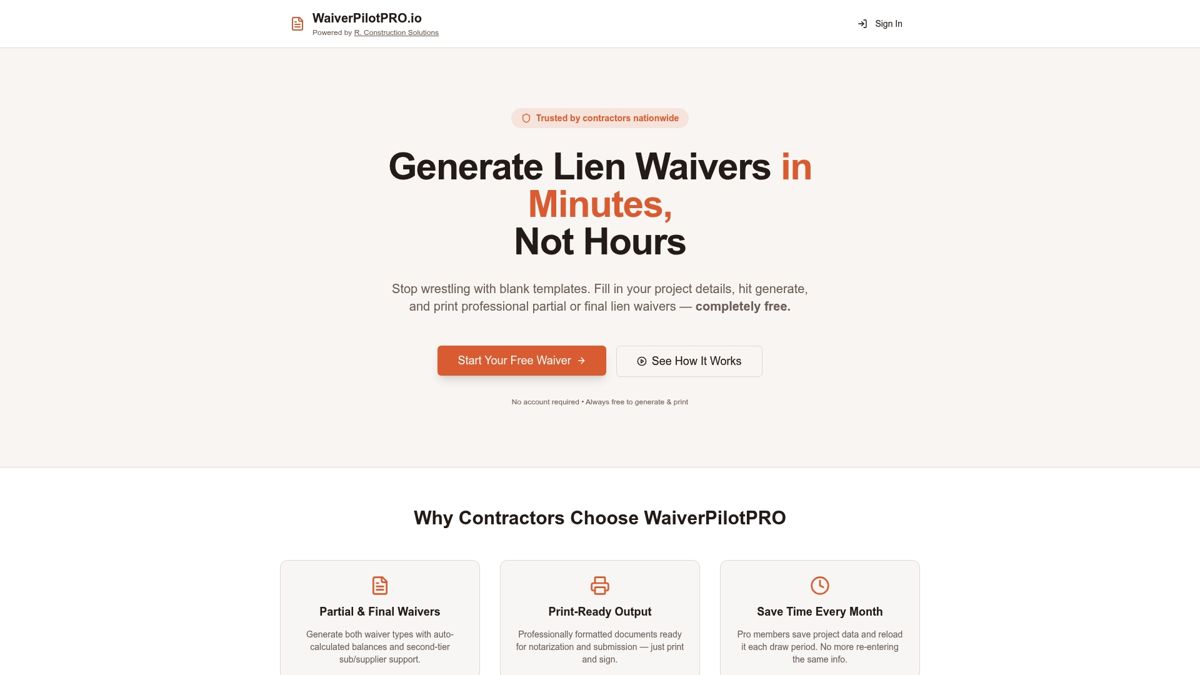
The free lien waiver generator covers all four form types, including state-specific statutory language for California, Texas, Florida, and 12+ other states. You fill in the project details, and Waiverpilotpro produces a professional, notarizable document ready for submission. The platform integrates with Procore and QuickBooks, so your waiver workflow fits inside the tools you already use. Auto-calculated balances and multi-subcontractor support mean fewer errors and faster draw approvals. No account creation required to get started.
FAQ
What are the four types of construction lien waivers?
The four types are conditional progress waiver, unconditional progress waiver, conditional final waiver, and unconditional final waiver. Conditional waivers take effect only after payment clears; unconditional waivers take effect immediately on signing.
What is the difference between a lien waiver and a lien release?
A lien waiver is signed proactively during the payment process to waive future lien rights. A lien release is filed after a mechanics lien has already been recorded, to remove it from public property records.
Which states require specific statutory lien waiver forms?
At least 12 states mandate statutory forms, including California, Texas, Florida, Arizona, Nevada, and Georgia. Using a non-compliant form in these states voids the waiver even if payment was made.
When should I use a conditional versus an unconditional waiver?
Use a conditional waiver when you are requesting payment and funds have not yet cleared. Use an unconditional waiver only after you have confirmed the payment is in your account.
How do I fill out a construction release form correctly?
Enter the project name, property address, payment amount, and the date through which work is covered. If any amounts are disputed, list them as exceptions before signing. Waiverpilotpro’s step-by-step lien waiver guide walks through each field to prevent common errors.