
Construction Project Funding Process Explained for Pros
Construction project funding is the process by which contractors, developers, and project stakeholders secure and manage financing to cover costs throughout a build’s lifecycle, using structured loan disbursements tied to verified progress milestones. Unlike a standard mortgage, construction financing releases funds in stages rather than as a lump sum. That structure protects both the lender and the borrower by tying money to real, inspected work. Understanding the construction project funding process explained here gives you a clear map from loan application to final disbursement, so you can plan cash flow, meet lender requirements, and avoid the documentation errors that delay draws.
What steps are involved in the construction project funding process?
Construction financing follows a defined sequence. Each phase builds on the last, and skipping steps is the fastest way to stall your project.
-
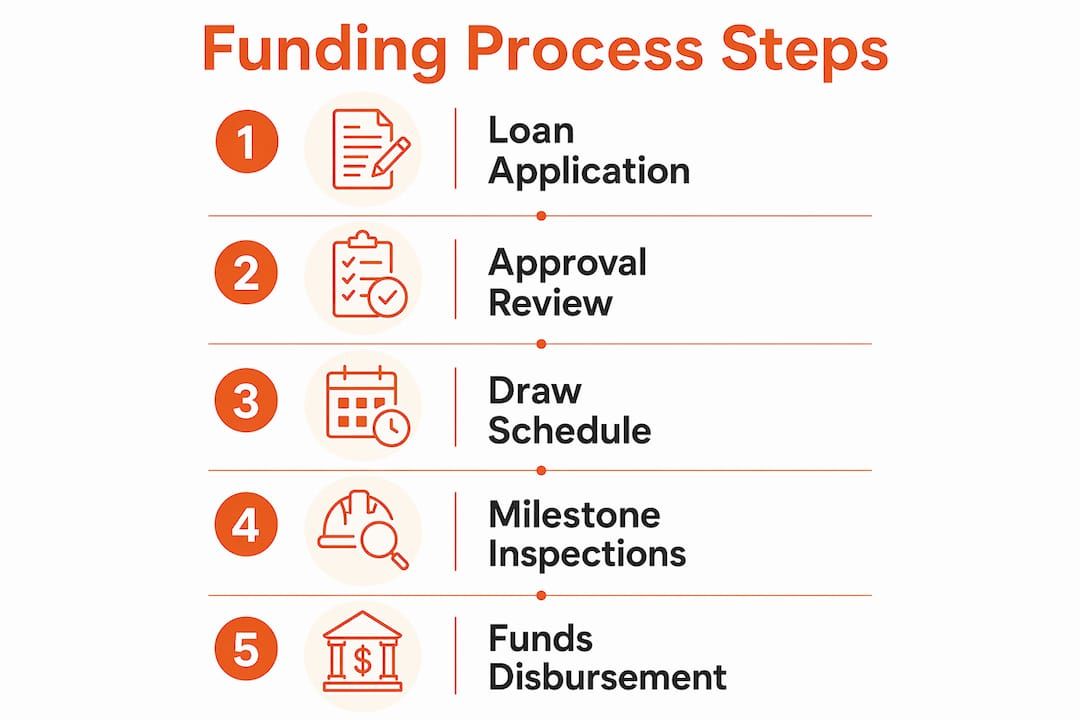
Application and documentation. You submit architectural plans, a detailed project budget separating hard and soft costs, proof of zoning approvals, and personal or business financial statements. Lenders also require evidence of your equity contribution, typically 10–25% of total project costs. That equity requirement signals your financial commitment and reduces lender exposure.
-
Underwriting. The lender evaluates your credit profile, the project’s feasibility, and the strength of your contractor team. They assess execution risk using detailed schedules of values and contingency reserves. A weak contingency budget is one of the most common reasons lenders reduce loan amounts or decline applications outright.
-
Loan approval and closing. Once underwriting clears, you sign loan documents and establish the draw schedule. The draw schedule is a written agreement that maps each funding request to a specific construction milestone.
-
Monthly draw requests. You submit pay applications, typically on AIA G702/G703 forms, along with lien waivers from your contractors and subcontractors. The lender orders a third-party inspection to verify work in place before releasing funds.
-
Conversion to permanent financing. At project stabilization or certificate of occupancy, the construction loan converts to a permanent loan. Single-close loans handle this administratively; two-close loans require a separate closing.
Pro Tip: Build your draw schedule before you break ground. Lenders fund in arrears, meaning you pay for work first and get reimbursed after inspection. Knowing your cash gap at each milestone lets you plan bridge funding or line-of-credit coverage in advance.
What financing options are commonly used for construction projects?
Construction project capital sources vary by project size, borrower profile, and risk tolerance. The right structure depends on how much equity you control and how much execution risk the lender is willing to absorb.

Traditional construction loans
Standard construction loans carry terms of 12–36 months, are interest-only during the build, and are priced at SOFR plus 275–400 basis points. Senior debt typically covers 60–75% of total project costs. That leaves a meaningful gap you must fill with equity, mezzanine debt, or a combination of both.
Single-close vs. two-close loans
Single-close construction-to-permanent loans merge the construction phase and the permanent mortgage into one transaction. They save time and eliminate refinance risk, but they often carry higher upfront fees. Two-close loans use separate closings for each phase. They offer more flexibility on permanent loan terms, but they expose borrowers to interest rate risk and a second appraisal at the permanent financing stage. If market conditions shift between closings, you may face unexpected equity injections.
Mezzanine debt and equity contributions
Mezzanine debt fills the gap between senior debt and your equity contribution. It carries higher interest rates than senior debt because it sits lower in the capital stack and absorbs losses first. Equity buffers and contingency reserves protect against cost overruns and delays, and lenders view them as a sign of project discipline.
Here is a quick comparison of the most common funding structures:
| Funding type | Term | Cost | Best use |
|---|---|---|---|
| Traditional construction loan | 12–36 months | SOFR + 275–400 bps | Ground-up commercial or residential builds |
| Single-close construction-to-perm | Build + 30 years | Slightly higher upfront fees | Borrowers who want rate certainty |
| Two-close loan | Build phase only | Lower upfront, rate risk at conversion | Borrowers expecting rates to fall |
| Mezzanine debt | Matches construction term | Higher than senior debt | Filling equity gap in larger projects |
What documentation and lender requirements must borrowers meet?
Lenders require a specific set of documents before they approve a construction loan and before they release each draw. Missing a single item can freeze funding for weeks.
Before loan approval, you need:
- Architectural plans and engineering drawings stamped by a licensed professional
- A full project budget with hard costs (labor and materials) and soft costs (permits, fees, and financing costs) itemized separately
- Proof of zoning approvals and building permits
- Personal and business financial statements for the past two to three years
- Evidence of your equity contribution, with minimum equity of 10–25% of total project costs
For each monthly draw, you need:
- Completed AIA G702/G703 pay applications from your general contractor
- Conditional and unconditional lien waivers from contractors and subcontractors covering the work billed
- A third-party inspection report confirming work in place matches the pay application
- Updated project schedule and budget-to-actual cost comparison
Lenders rely on independent third-party inspections at each milestone because the collateral is incomplete and not generating income during construction. That makes the inspection the lender’s primary risk control. A failed or delayed inspection stops the draw entirely.
Pro Tip: Prepare a draw package checklist and share it with your general contractor at project kickoff. When your GC knows exactly what documents you need and in what format, you cut the back-and-forth that adds days to every funding cycle.
How does the draw process work, and what challenges arise?
The draw process is where most funding delays actually happen. Understanding the mechanics helps you anticipate problems before they affect your cash flow.
Construction loan funds are disbursed monthly in arrears after a lender verifies work in place. That verification requires completed pay applications and lien waivers from every contractor and subcontractor on the draw. The typical funding cycle runs 30–45 days from submission to cash in your account. In practice, the lag from work completion to actual cash arrival can stretch to 30–60 days when documentation is incomplete or inspections are delayed.
The most common draw challenges include:
- Missing or mismatched lien waivers. Lien waivers are mandatory for each draw, and a single missing waiver from a subcontractor can hold the entire disbursement. Disputes over waiver amounts trigger covenant defaults in some loan agreements.
- Retainage holdbacks. Lenders typically hold 10% retainage until substantial completion. That withheld amount affects your subcontractors’ cash flow and can create pressure on your payment relationships.
- Inspection timing. Third-party inspectors schedule visits on their own timelines. If your inspector is delayed, your draw is delayed. Build buffer time into your monthly cash flow projections.
- Budget-to-actual variances. If your actual costs exceed the approved budget line items, the lender may require a budget amendment before releasing funds. That amendment process adds time.
The most effective way to accelerate draw approvals is to submit complete, accurate documentation every time. One missing lien waiver or an AIA form with arithmetic errors resets the clock. Knowing how to fill out a lien waiver correctly before your first draw is not optional. It is the difference between a 30-day cycle and a 60-day one.
Key Takeaways
Successful construction financing depends on matching your capital structure to project risk, submitting complete documentation at every draw, and planning for the cash gap that arises because lenders fund in arrears.
| Point | Details |
|---|---|
| Equity is non-negotiable | Lenders require 10–25% equity contribution before approving any construction loan. |
| Draws fund work already done | Funds are released in arrears after inspection, so plan for a 30–60 day cash gap. |
| Lien waivers control disbursements | A single missing waiver from any subcontractor can freeze the entire draw. |
| Loan type affects long-term risk | Single-close loans reduce refinance risk; two-close loans expose you to rate changes at conversion. |
| Documentation errors cost money | Errors on AIA G702/G703 forms or mismatched lien waivers restart the funding clock. |
What I’ve learned about construction funding after years in the field
Most contractors treat the funding process as a finance problem. It is actually a documentation problem. The lenders I have worked with are not trying to slow down your draws. They are responding to what you give them. When the package is clean, the money moves. When it is not, everything stops.
The single biggest mistake I see is treating lien waivers as an afterthought. Contractors collect them at the end of the month in a rush, discover a subcontractor used the wrong form or left a field blank, and then spend a week chasing corrections. That week costs real money in a project running on a tight interest reserve.
My honest recommendation is to build your documentation workflow before you pull the first permit. Know which waiver type you need at each payment stage, whether conditional or unconditional, and make sure every subcontractor on your project understands the format your lender requires. Capital stack misalignment is a primary reason projects fail to secure funding despite economic merit. But documentation failure is the reason funded projects stall mid-construction. Those are two very different problems, and only one of them is within your direct control.
Plan for your interest reserve to cover at least two months of unexpected delay. Lenders price that buffer into their underwriting. You should price it into your project budget.
— Rowena
How Waiverpilotpro supports your draw documentation
Every draw cycle puts your lien waiver process under pressure. One incomplete form or a mismatched amount delays your funding and strains your subcontractor relationships.

Waiverpilotpro gives contractors a free lien waiver generator that produces both conditional and unconditional waivers in minutes, with auto-calculated balances and multi-subcontractor support. No account creation required. The platform integrates with Procore and QuickBooks, so your waiver data stays consistent with your project management records. Documents are professional-grade and notarizable, ready to drop into your monthly draw package. When your lien waivers are accurate and complete, your draw approvals move faster.
FAQ
What is the construction project funding process?
The construction project funding process is the sequence of steps by which borrowers secure a construction loan, submit monthly draw requests tied to verified milestones, and convert the loan to permanent financing at project completion.
How long does a construction loan draw take?
Draw funding typically takes 30–45 days from submission, but the lag from work completion to cash receipt can reach 30–60 days when documentation or inspections are delayed.
What lien waivers are required for construction draws?
Lenders require both conditional and unconditional lien waivers from the general contractor and all subcontractors for each monthly draw. A missing waiver from any party can hold the entire disbursement.
What is the difference between a single-close and two-close construction loan?
A single-close loan converts administratively from construction to permanent financing without a second closing, reducing refinance risk. A two-close loan requires separate closings, which exposes the borrower to interest rate and appraisal risk at the permanent financing stage.
How much equity do I need for a construction loan?
Most lenders require a minimum equity contribution of 10–25% of total project costs before approving a construction loan.