
Construction Payment Waterfall: A Complete 2026 Guide
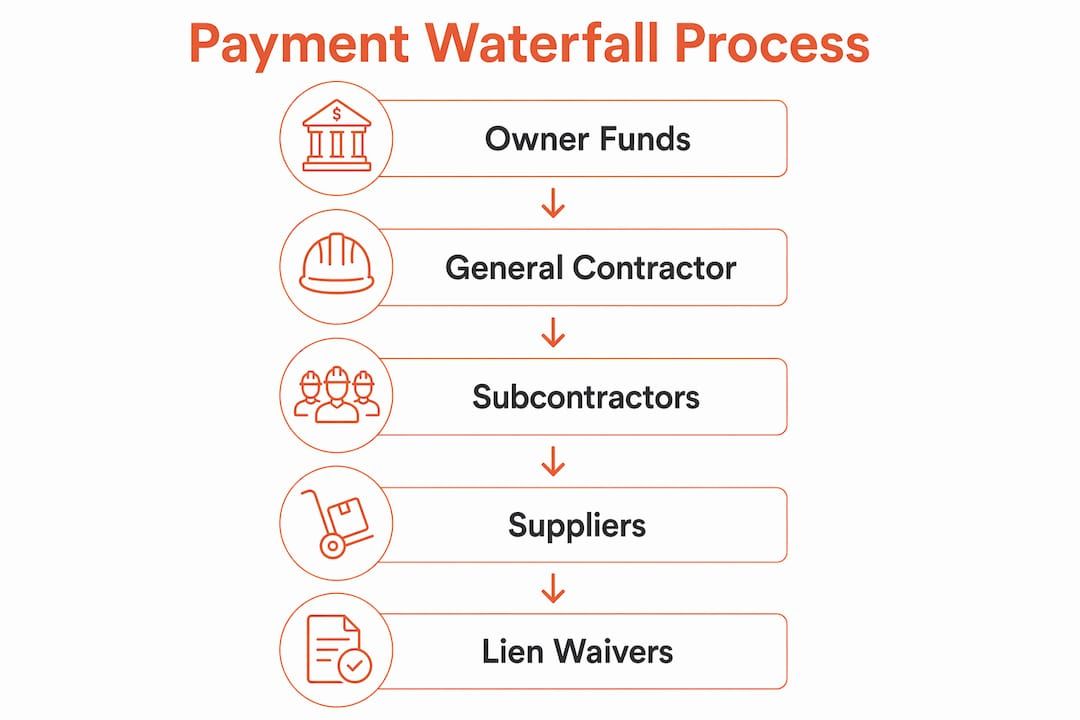
A construction payment waterfall is defined as the hierarchical flow of project funds from the owner through the general contractor to subcontractors, and finally to suppliers and labor. This four-tier structure is the industry standard for payment distribution, governing the sequence and priority of every dollar released on a project. Each tier receives payment only after the tier above it approves and releases funds, creating a chain of financial accountability. Understanding this system is not optional for construction professionals. It determines your cash flow timing, your legal exposure, and your ability to keep a project moving without disputes or liens.
What is a construction payment waterfall?
A construction payment waterfall is the structured, sequential release of funds through four defined tiers: project owner, general contractor (GC), subcontractors, and suppliers or labor. The term “payment waterfall” is borrowed from finance, where it describes the priority order in which parties receive money. In construction, the industry equivalent is sometimes called the construction payment hierarchy or payment chain, and both terms describe the same concept.
Each tier has a distinct role:
- Project owner: Holds the contract with the GC and releases funds based on approved pay applications. The owner’s lender may also require inspection before any disbursement.
- General contractor: Receives funds from the owner, then distributes payments to subcontractors according to their individual subcontracts.
- Subcontractors: Pay their own lower-tier subs, specialty trades, and direct labor from the funds they receive.
- Suppliers and labor: The final tier, receiving payment last and carrying the most financial risk if the chain breaks above them.
The Schedule of Values (SOV) is the foundation of this entire billing structure. The SOV, approved by the architect at project start, translates the full scope of work into individual line items with assigned dollar values. Every pay application references the SOV to establish what percentage of work is complete and how much money is owed at each tier. Without a clear SOV, the entire payment chain becomes a guessing game.
Pro Tip: Submit your SOV for architect approval before the first pay application goes out. Any dispute over line items at that stage is far easier to resolve than mid-project disagreements over percent complete.

How does the construction payment process work?
The payment cycle in construction follows a predictable sequence, but timing varies significantly depending on the tier and the contract terms.
- Pay application submission: The GC or subcontractor submits a pay application, typically using AIA G702 and G703 forms, referencing the SOV and documenting work completed during the billing period. You can review the AIA G702 and G703 process in detail to understand what each form requires.
- Architect or owner certification: The architect reviews the application and certifies the amount they agree is owed. This step is where most delays occur. The certification gap typically runs 7–14 days and frequently involves disputes over completion percentages.
- Lender inspection (if applicable): On financed projects, the owner’s lender may require an independent inspection before releasing draw funds. This adds another 7–10 business days to the cycle.
- Owner payment to GC: Under optimal conditions, payment processing runs 7–10 business days from application to payment. When certification and lender inspections stack up, total cycle times routinely exceed 30 days.
- GC payment to subcontractors: The GC releases funds to subs after receiving payment from the owner, subject to contract terms.
- Subcontractor payment to suppliers and labor: The final tier receives payment last, completing the waterfall.
Automation changes this picture meaningfully. Digital payment platforms can compress processing to 3–5 days by eliminating manual data entry, routing approvals electronically, and flagging documentation errors before submission. That reduction matters most at the subcontractor and supplier level, where cash flow pressure is highest.
| Payment stage | Typical duration | Common delay cause |
|---|---|---|
| Pay app to certification | 7–14 days | Disputes over percent complete |
| Lender inspection | 7–10 days | Scheduling and site access |
| Owner to GC transfer | 1–3 days | Bank processing |
| GC to subcontractor | 7–30 days | Pay-when-paid clauses |
| Total cycle (manual) | 30+ days | Stacked delays at each stage |
Pro Tip: Track your pay application submission dates and certification deadlines in a shared log. When a certification dispute arises, a documented timeline is your strongest negotiating tool.
What legal and financial risks come with the payment waterfall?
The payment waterfall carries real legal weight. Disrupting the chain, even unintentionally, creates liability that can follow a project long after completion.
Prompt payment laws set mandatory timelines for each tier. One widely referenced framework requires owners to pay GCs within 28 days of a valid application, with each subsequent tier paying within 7 days of receiving funds. Dispute notices must be issued within 14 days to be valid under these rules. These timelines are not suggestions. Failing to meet them can trigger interest penalties and lien rights.
The most dangerous move an owner can make is paying a subcontractor directly, bypassing the GC. Direct owner-to-sub payments are only legally protected when the subcontractor holds a registered lien and the proper parties have been notified. Without those conditions, the owner risks paying twice for the same work.
Key legal risks in the payment waterfall include:
- Pay-when-paid clauses: The subcontractor’s payment clock starts only after the GC receives funds from the owner. This means a subcontractor’s net-30 payment window does not begin until the owner pays the GC, which can push actual payment out to 90–120 days from work performed.
- Pay-if-paid clauses: Even more restrictive, these clauses can eliminate the GC’s obligation to pay subs if the owner never pays the GC. Enforceability varies by state.
- Lien rights: Every tier below the owner holds the right to file a mechanics lien against the property if they are not paid. Lien rights are the primary financial protection for subcontractors and suppliers.
- Retainage: Owners typically withhold 5–10% of each payment as retainage until project completion. This compounds cash flow pressure at every tier below the GC.
“Chain payment culture causes lower-tier suppliers to face disproportionate financial strain, with payment delays typically running 90–120 days due to their lack of leverage compared to general contractors. The financial burden concentrates at the bottom of the waterfall, where parties have the least ability to absorb it.” — ASCE Library research on payment delays
This dynamic is not accidental. It reflects the leverage imbalance built into the waterfall structure. Suppliers and lower-tier subcontractors absorb the cumulative delays from every tier above them.
What are the best practices for managing payment waterfalls?
Managing a construction payment waterfall well requires treating each tier as its own financial workflow, not just a downstream consequence of the tier above it.
Common challenges that stall payments:
- Documentation errors in pay applications, such as incorrect SOV line items or missing lien waivers
- Certification disputes where the architect and contractor disagree on percent complete
- Retainage withholding that reduces available cash at every tier
- Slow internal approvals within the GC’s accounts payable process
- Missing or incorrect lien waiver documentation at handoff points between tiers
Best practices that actually move the needle:
- Standardize your paperwork handoffs. Treating each tier as an independent process with defined service-level agreements (SLAs) reduces friction and prevents delays from compounding down the chain.
- Use a detailed SOV from day one. The SOV is the backbone of construction billing. A well-structured SOV prevents disputes over completion percentages and gives every tier a clear reference point.
- Collect lien waivers at every payment milestone. Conditional lien waivers should accompany every progress payment request. Final waivers should be collected before releasing retainage. Using free construction forms that match your state’s requirements eliminates formatting errors.
- Define SLAs for each payment workflow. Construction payment management covers four distinct workflows: subcontractor payments, materials and suppliers, crew expenses, and change orders. Each needs its own approval timeline and documentation checklist.
- Adopt automation where possible. Digital tools that auto-calculate balances, route approvals electronically, and flag missing documentation before submission can cut processing time significantly.
Pro Tip: Send a lien waiver request to every subcontractor and supplier at the same time you submit your pay application to the owner. Collecting waivers in parallel, not sequentially, removes a major bottleneck from your payment cycle.
Key Takeaways
A construction payment waterfall is a four-tier financial chain where each level receives funds only after the tier above it approves and releases payment, making documentation accuracy and timing compliance the two most critical factors in project cash flow.
| Point | Details |
|---|---|
| Four-tier structure | Funds flow from owner to GC to subcontractors to suppliers, with each tier dependent on the one above. |
| Certification gap is the main delay | Architect or owner review of pay applications takes 7–14 days and is where most disputes occur. |
| Legal timing rules are mandatory | Prompt payment laws require owners to pay GCs within 28 days, with downstream tiers paying within 7 days of receipt. |
| Pay-when-paid clauses extend delays | Subcontractors’ payment clocks start only after the GC receives owner funds, pushing real payment to 90–120 days. |
| Standardized paperwork reduces friction | Using consistent lien waivers and pay applications at every tier prevents documentation errors that stall payments. |
What I’ve learned from watching payment waterfalls break down
The certification gap is the single most underestimated problem in construction finance. Every contractor I’ve talked to assumes their pay application will sail through review. In practice, the 7–14 day architect certification window is where projects quietly lose weeks. The dispute is almost never about the money itself. It’s about whether 73% or 81% of a concrete package is complete, and neither side has documented their position clearly enough to resolve it fast.
The other pattern I keep seeing is the false confidence that comes from having a signed contract. Pay-when-paid clauses are legal in most states, and they mean your net-30 doesn’t start when you finish the work. It starts when your GC gets paid. If the owner is slow, you are slow. If the owner disputes the pay app, you wait. Knowing this before you sign changes how you negotiate retainage terms and payment milestones.
The practical fix is not complicated. Document everything at the time it happens, not after a dispute starts. Submit your SOV early and get it approved in writing. Collect lien waivers in parallel with pay applications, not after. And if you are a subcontractor or supplier, understand your lien rights in your state before you need them. The waterfall protects everyone when it runs correctly. When it breaks, the damage flows downhill.
— Rowena
Waiverpilotpro makes lien waivers faster at every tier
Lien waivers are required at nearly every handoff point in the payment waterfall, and missing or incorrect waivers are one of the top reasons payments stall. Waiverpilotpro gives contractors a free lien waiver generator that requires no account creation and no complex templates. You fill in your project details, and the platform generates both conditional and final waivers instantly, with auto-calculated balances and multi-subcontractor support.
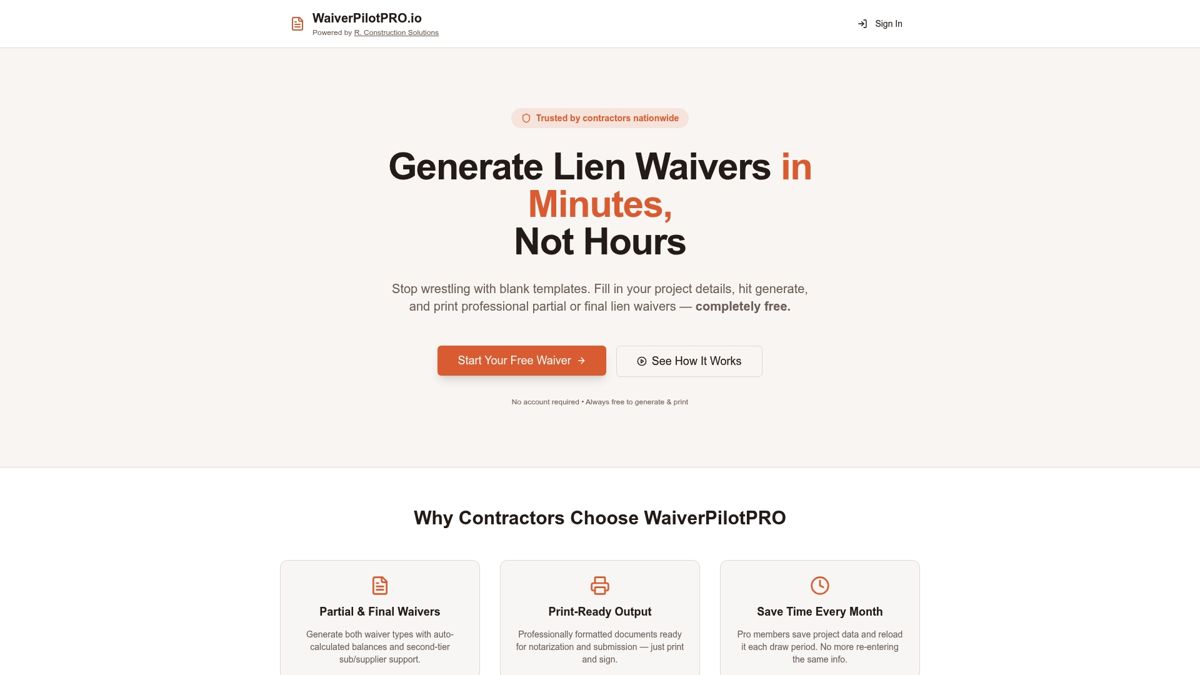
Waiverpilotpro integrates with Procore, QuickBooks, and other construction management platforms, so your waiver workflow fits directly into the payment process you already use. The documents are professional-grade and notarizable, ready for submission without reformatting. If lien waiver paperwork is slowing down your payment cycle, Waiverpilotpro removes that friction at no cost.
FAQ
What is a construction payment waterfall?
A construction payment waterfall is the four-tier hierarchy through which project funds flow from the owner to the general contractor, then to subcontractors, and finally to suppliers and labor. Each tier receives payment only after the tier above it approves and releases funds.
How long does a construction payment cycle typically take?
Under optimal conditions, payment processing takes 7–10 business days from application to payment. When architect certification and lender inspections are included, total cycle times regularly exceed 30 days.
What is a pay-when-paid clause and how does it affect subcontractors?
A pay-when-paid clause means a subcontractor’s payment period starts only after the general contractor receives funds from the owner. This can push actual payment to 90–120 days from the date work was performed.
Why are lien waivers important in the payment waterfall?
A lien waiver is a document that releases a contractor’s or supplier’s right to file a mechanics lien in exchange for payment. Collecting conditional waivers at each progress payment and final waivers at project close protects every tier from future lien claims.
What happens if an owner pays a subcontractor directly, bypassing the GC?
Direct owner-to-subcontractor payments are legally protected only when the subcontractor holds a registered lien and the proper parties have been notified. Without those conditions, the owner risks double payment liability for the same work.