
Conditional Final Waiver: What Contractors Must Know
A conditional final waiver is a signed document that releases all remaining lien rights on a project, but only if the final payment is actually received and cleared. Think of it as a receipt you write in advance: it hands over your legal remedy the moment the money arrives, not before. According to the California Contractors State License Board, this form is only binding when there is evidence the claimant was actually paid, which is exactly the protection it is designed to provide.
Before you sign anything, check for these red flags:
- Unconditional wording: If the document says rights are released “upon signing” rather than “upon receipt of payment,” it is not conditional. Stop and request the correct form.
- Amount or retainage mismatch: The dollar figure on the waiver must match your final invoice plus any retained funds. A waiver covering more than you are owed can release rights to money you have not yet collected.
- Missing evidence-of-payment trigger: A valid conditional waiver must state a clear condition, such as “conditioned upon receipt of the check” or “effective only upon payment clearing.” No condition, no protection.
Pro Tip: Never sign an unconditional final waiver until your bank confirms the funds have cleared. Log every conditional waiver in your tracking system the same day you submit it, and set a follow-up date to convert it to unconditional once payment lands.
Table of Contents
- What are the four main types of lien waivers?
- When should you submit a conditional final waiver?
- What does a conditional final waiver actually release?
- How do state laws affect your conditional final waiver?
- What are the biggest risks and how do you avoid them?
- A practical checklist and sample language for final waivers
- How to manage conditional final waivers at scale
- How waiver treatment differs by construction role
- Generate and track your conditional final waivers with Waiverpilotpro
- Sources
What are the four main types of lien waivers?
Two axes define every lien waiver you will encounter on a job: whether it is conditional or unconditional, and whether it covers a progress payment or the final payment. CFMA explains that conditional final waivers are submitted with the final pay application and only take effect after payment clears, while unconditional final waivers are submitted after payment is received and permanently waive all remaining lien rights.
The table below maps the four types to their correct submission timing.
| Waiver Type | Conditional or Unconditional | When to Submit |
|---|---|---|
| Conditional progress | Conditional | With each progress pay application, before payment |
| Unconditional progress | Unconditional | After a progress payment has cleared your bank |
| Conditional final | Conditional | With the final pay application, before final payment |
| Unconditional final | Unconditional | After final payment and retainage have fully cleared |
The conditional column is your safe lane when payment has not yet arrived. The unconditional column is for after the money is in your account. Mixing these up is one of the most common and costly mistakes in construction payment administration.
Pro Tip: Never rely on the document’s title alone. Read the operative language inside the form. A document titled “Final Waiver” can still be unconditional if the body text says rights are released “upon execution.” The title does not control; the conditioning clause does.
When should you submit a conditional final waiver?
Timing a conditional final waiver correctly protects your lien rights through the entire closeout process. Here is the sequence to follow on every project:
- Prepare the final pay application. Confirm the amount matches your contract balance plus any approved change orders and outstanding retainage.
- Attach the conditional final waiver. Submit it alongside the pay app, not before and not separately. The waiver should reference the pay app number and the exact dollar amount being requested.
- State the condition clearly. The waiver must include language such as “conditioned upon receipt of payment in the amount of $[X]” so there is no ambiguity about when it takes effect.
- Wait for payment to clear. The waiver is not yet effective. Do not treat it as a closed matter until funds are confirmed in your account.
- Verify clearance and convert. Once the check clears or the wire posts, issue the unconditional final waiver. This is the document that permanently closes out your lien rights on the job.
For each conditional final waiver you submit, log these fields in your tracking system:
- Pay application number and through-date
- Gross amount requested and retained amount
- Expected payment date (as stated in the contract or agreed with the owner)
- Actual payment receipt date and confirmation method (wire confirmation, check number, bank statement)
- Follow-up date to convert to unconditional (set this at submission, not after)
Pro Tip: Link your pay application workflow directly to your waiver log. When a pay app is submitted, the conditional waiver entry should be created at the same time. That way nothing slips through at project closeout.
What does a conditional final waiver actually release?
A conditional final waiver typically releases your mechanic’s lien rights against the property, as well as related claims such as bond claims and stop-payment notices, all tied to the specific payment amount and period stated in the document. Once the condition is met and payment clears, those rights are gone for the covered amount.
That scope is broad, which is why the exceptions matter as much as the release itself. Claims that contractors commonly negotiate to preserve include:
- Pending change orders: Any change order not yet approved and paid should be explicitly carved out by number or description.
- Disputed or unresolved claims: If you have an active dispute over extras, delays, or differing site conditions, name it in the waiver or exclude it by reference.
- Retainage: If retainage is being held and is not included in this final payment, the waiver should state that retainage rights are preserved until a separate retainage release.
- Warranty and punch list obligations: Some broad waivers attempt to release warranty claims. Resist this; your warranty obligations and any associated remedies should survive the payment waiver.
The difference between narrow and broad waiver language is significant. Compare these two approaches:
Narrow (safer): “Claimant conditionally releases and waives all lien rights and claims against the property arising from labor and materials furnished through [date], in the amount of $[X], conditioned upon receipt and clearance of that payment. This release does not apply to retainage of $[Y], Change Order No. [Z], or any claims arising after [date].”
Broad (risky): “Claimant releases all claims of any kind arising from or related to the project, including but not limited to lien rights, bond claims, contract claims, and any other claims, whether known or unknown.”
The broad version can extinguish rights you did not intend to give up, including future warranty claims and unresolved disputes. Always push for the narrow form.
How do state laws affect your conditional final waiver?
Waiver rules are not uniform across the country, and the differences can be significant. Some states mandate specific statutory forms that must be used word-for-word; others allow custom language as long as it meets minimum legal standards. A few key variations to know:
- Statutory forms: California, Texas, Arizona, Nevada, and several other states require contractors to use state-prescribed waiver forms. Using a non-compliant form in these states can render the waiver unenforceable or, worse, leave your lien rights in an ambiguous state. The CSLB’s guidance on conditional and unconditional forms is a good example of how a state board publishes the required language.
- Notarization: Some states require notarization for a waiver to be valid. Others do not. Check your state’s lien statute before assuming your form is complete without a notary seal.
- Retainage rules: Certain states have specific statutory provisions governing how retainage is handled in final waivers, including timing requirements for when retainage must be released and whether a separate waiver is required.
- Timing deadlines: States set different deadlines for filing mechanics liens. Your conditional final waiver must be submitted and tracked within those windows, or you may lose the underlying right the waiver is protecting.
Where to check your state’s requirements:
- Your state’s lien statute (search “[state name] mechanics lien statute” on your state legislature’s website)
- AIA Contract Documents guidance and G-form references (G901, G902, G903, G904)
- Practical Law by Thomson Reuters for jurisdiction-specific summaries
- Your state contractor licensing board’s published forms
Pro Tip: Log the project’s jurisdiction on every waiver record from day one. On multi-state work, it is easy to apply the wrong state’s form or miss a notarization requirement. A single jurisdiction field in your tracking system prevents that mistake.
What are the biggest risks and how do you avoid them?
The three risks that cause the most real-world payment losses are signing the wrong waiver type too early, covering the wrong dollar amount, and failing to preserve claims for extras.

Accidental unconditional release. Built’s industry summary makes the core distinction plain: an unconditional waiver takes effect immediately upon signing, even if the payment never arrives. Signing an unconditional form before funds clear can permanently extinguish your lien rights with no recourse.
Overbroad dollar coverage. If the waiver covers more than the amount you are being paid, you may be releasing rights to money you are still owed. AIA’s guidance on waiver types confirms that a waiver covering more than what is owed can cause the signer to waive rights to unpaid amounts. Always verify the dollar figure matches your final invoice exactly.
Unpreserved change order claims. A blanket final waiver can sweep in approved-but-unpaid change orders and pending extras if they are not explicitly excluded. By the time you notice, the lien right may be gone.
Operational controls that reduce these risks:
- Designate one person on your team who is authorized to sign final waivers. Not every project manager or field supervisor should have that authority.
- Require written bank confirmation before converting any conditional waiver to unconditional. A verbal “the check is in the mail” is not clearance.
- Build a pre-signature checklist: verify the waiver type, confirm the dollar amount, check for retainage carve-outs, confirm the conditioning language is present, and confirm no open change orders are being swept in.
- Set a hard rule: the unconditional final waiver goes out only after the bank statement or wire confirmation is in your file.
Pro Tip: Insist on payment-contingent language in every final waiver you sign, and set a calendar trigger at submission to follow up in 30 days. Subcontractor Audit’s compliance checklist recommends exactly this window as a standard follow-up deadline to convert conditional waivers or escalate non-payment.
A practical checklist and sample language for final waivers
Run this checklist on every conditional final waiver before you sign:
- [ ] The document is clearly labeled and worded as conditional, not unconditional
- [ ] The dollar amount matches your final invoice, including all approved change orders
- [ ] Retainage is either included in the payment amount or explicitly carved out
- [ ] The waiver references the specific pay application number and through-date
- [ ] An evidence-of-payment trigger is present (“conditioned upon receipt and clearance of payment”)
- [ ] Open change orders and unresolved claims are excluded by name or number
- [ ] The jurisdiction is correct and the form meets that state’s statutory requirements
- [ ] You know who is authorized on your team to sign this document
For filling out the form correctly, the step-by-step guide from Waiverpilotpro walks through each field and common mistakes to avoid.
Here is the contrast between safe and risky language in practice:
Safe conditional final clause: “This release is conditioned upon claimant’s receipt of a check in the amount of $[X] and shall become effective only upon the clearance of said check. Claimant expressly reserves all rights with respect to retainage in the amount of $[Y] and Change Order No. [Z], which are not covered by this release.”
Risky clause to reject: “Claimant hereby releases and forever waives any and all claims, liens, and rights of any nature whatsoever against the property, the owner, and the general contractor, arising from any work performed or materials supplied on the project.”
The risky version has no conditioning language, no dollar limit, and no carve-outs. It is effectively an unconditional, unlimited release. If a payer presents this form, request a replacement that includes the conditioning clause and specific exclusions before you sign.
If the payer’s form is overbroad, ask them to:
- Insert a retention carve-out referencing the specific retainage amount
- Reference the pay application number and through-date
- Add a bank confirmation requirement before the waiver becomes effective
How to manage conditional final waivers at scale
Manual waiver handling on a project with multiple subcontractors adds up fast. AIA recommends centralizing lien waiver management to a select group that understands waiver types and suggests automation to reduce manual review time on projects with many subcontractors.
A practical workflow for teams managing multiple waivers:
- Preparation: The project administrator generates the conditional final waiver using a state-specific template, auto-populated with the pay app number, dollar amount, and retainage figure.
- Review: A designated senior team member checks the conditioning language, dollar amounts, and exclusions before the document goes out.
- Logging: Every conditional waiver is entered into the tracking system with the expected payment date and a 30-day follow-up trigger.
- Conversion: When bank confirmation arrives, the unconditional final waiver is generated and sent. The conditional waiver record is closed.
- Audit: At project closeout, every waiver record is reviewed to confirm all conditional waivers have been converted or escalated.
Waiverpilotpro supports this workflow directly. The platform generates state-specific conditional and unconditional waiver templates, auto-calculates payment balances, and integrates with Procore, QuickBooks, Jobtread, Sage, and Buildertrend. For teams managing multiple subcontractors, the multi-subcontractor support means you can generate a full set of waivers in one session rather than one at a time.
Pro Tip: Use a tool that produces notarizable output from the start. Some states require notarization, and discovering that requirement at the last minute before a filing deadline creates unnecessary pressure. Waiverpilotpro’s documents are formatted for notarization, so you are covered regardless of jurisdiction.
How waiver treatment differs by construction role
The same conditional final waiver document works differently depending on where you sit in the payment chain, and understanding those differences helps you protect your rights more precisely.
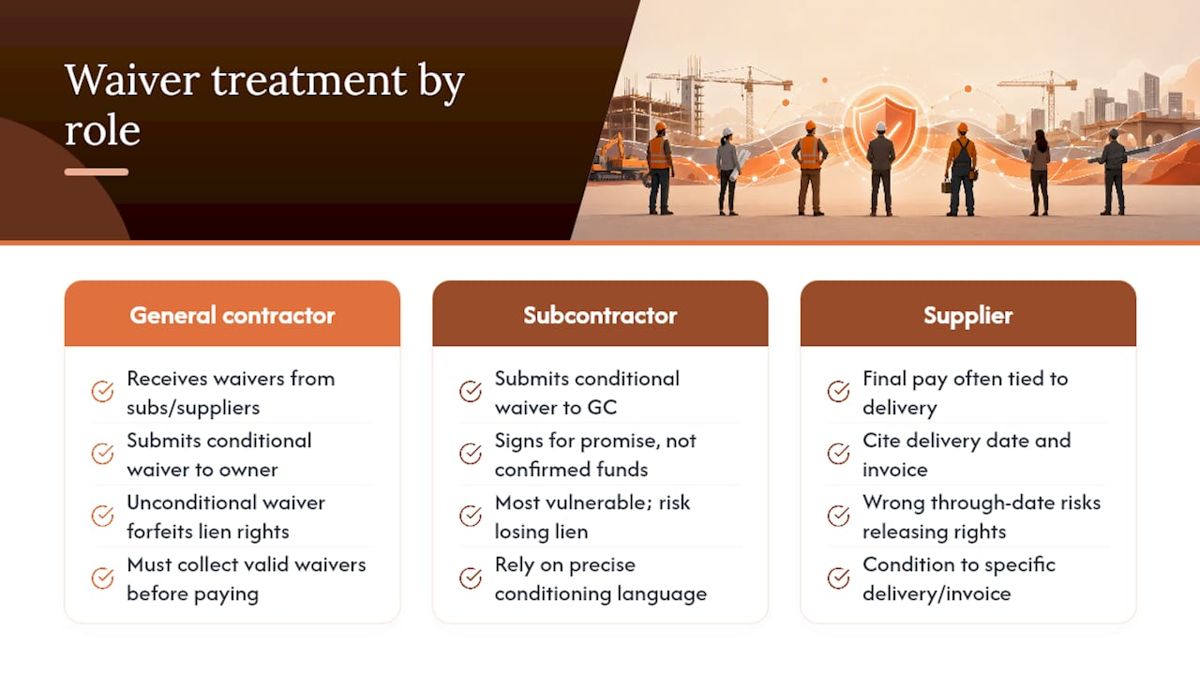
General contractors typically receive conditional final waivers from their subcontractors and suppliers as part of the pay app package, and they submit their own conditional final waiver to the owner. Their exposure is two-directional: they need to collect valid waivers from every tier below them before releasing payment, and they need to submit their own correctly worded waiver to the owner to receive final payment. A GC who submits an unconditional final waiver to the owner before collecting waivers from all subs has closed out their own lien rights while still carrying downstream liability.
Subcontractors are often in the most vulnerable position. They are typically required to submit a conditional final waiver to the GC before the GC will process their final payment, which means they are signing away their lien rights in exchange for a promise of payment rather than confirmed funds. The conditioning language is their only protection. A subcontractor who signs an unconditional form at this stage, or who signs a conditional form with overbroad release language, may lose their lien rights before the money arrives. Understanding the difference between conditional and unconditional waivers is particularly critical at this tier.
Suppliers and material dealers face a slightly different timing challenge. Their final payment is often tied to the last delivery rather than project completion, and their waiver should reflect the specific delivery date and invoice number rather than a broad project-completion date. A supplier who submits a conditional final waiver referencing the wrong through-date may inadvertently release rights for deliveries that were never paid.
For subcontractors working on projects in Canada, understanding subcontractor payment workflows and legal obligations in that jurisdiction adds useful context, though U.S. lien law governs domestic projects.
The common thread across all three roles: the conditional final waiver is only as protective as its conditioning language. Whoever you are in the payment chain, verify that the form you are signing is genuinely conditional, covers the right amount, and excludes any claims you have not yet resolved.
The habit that actually protects your payment at closeout
Payment closeout is where most lien right losses happen, and they almost always follow the same pattern: someone on the team signs an unconditional waiver too early, or a conditional waiver sits untracked until the lien deadline passes. Both outcomes are preventable with one habit.
Make bank confirmation a hard gate. Not a verbal confirmation, not an email from the GC saying “payment is processing,” but an actual bank statement or wire confirmation showing the funds in your account. Until that document exists, no unconditional final waiver leaves your office. That single rule eliminates the most common and most expensive mistake in construction payment administration.
The practical takeaway for next month’s project closeout: build the conversion trigger into your waiver submission process, not as an afterthought. When you submit the conditional final waiver, set the follow-up date immediately. Thirty days is a reasonable default. If payment has not cleared by then, escalate before the lien deadline arrives.
Generate and track your conditional final waivers with Waiverpilotpro
Generating a correctly worded conditional final waiver for every project, in every state, without errors in the dollar amounts or conditioning language, is exactly the kind of task that benefits from a purpose-built tool.
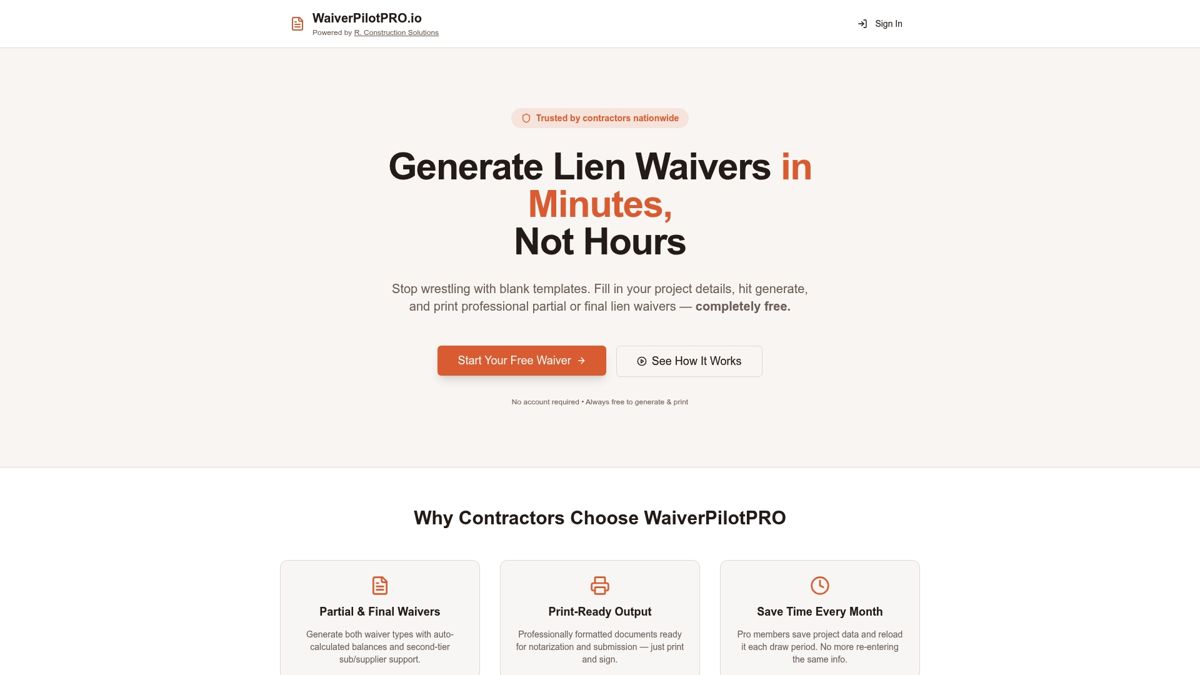
Waiverpilotpro’s free lien waiver generator produces state-specific conditional and unconditional waiver templates with auto-calculated payment balances, so the amounts on your waiver always match your pay application. The platform supports all four waiver types, generates notarizable PDF and Word output, and integrates with Procore, QuickBooks, Jobtread, Sage, and Buildertrend. For teams managing multiple subcontractors, the multi-subcontractor feature lets you generate a full set of waivers in one session. The Pro tier adds AI-powered contract field auto-fill, project saving, and bulk management for high-volume closeouts.
Start generating conditional and unconditional final waivers for free at Waiverpilotpro. No account creation required to get your first document.
Key Takeaways
A conditional final waiver only releases your lien rights when final payment is actually received and cleared, making the conditioning language the most critical element of the document.
| Point | Details |
|---|---|
| Conditioning language is everything | Verify the form says “conditioned upon receipt of payment,” not “upon signing.” |
| Match amounts precisely | The waiver dollar figure must equal your final invoice plus retainage, or you risk releasing unpaid rights. |
| Log and set a follow-up trigger | Record every conditional waiver with an expected payment date and a 30-day conversion deadline. |
| State rules vary significantly | Check your state’s lien statute and use statutory forms where required before signing. |
| Waiverpilotpro automates the process | Generate state-specific conditional and unconditional waivers with auto-calculated balances, free, at waiverpilotpro.io. |
Sources
These primary sources are the most reliable references for waiver templates, statutory language, and management best practices:
- What Is a Lien Waiver? How To Manage Construction Payment Risk
- Lien Waiver Essentials: Types, Timing & Best Practices for Subcontractors - Articles - CFMA
- Conditional and Unconditional Waiver and Release Forms
- Lien Waivers: Conditional vs Unconditional Types | Built
Before signing any final waiver, check your state’s specific lien statute and confirm whether a statutory form is required. AIA and Practical Law summaries are a reliable starting point for that research.