
Don’t Sign Away Rights: Colorado Lien Waivers and a Free Generator
Colorado lien waivers are enforceable, but only between the parties who sign them. C.R.S. § 38-22-119 binds a waiver to its own contracting parties, and on covered private projects, C.R.S. § 38-46-104 limits any required waiver to amounts actually paid. Your first move on any job: use conditional waivers until the check or wire clears.
TL;DR:
- Colorado lien waivers are only enforceable between the signing parties and must include specific language, especially regarding third-party debts and payment confirmation.
- Use conditional waivers until funds are confirmed to have cleared, and avoid signing unconditional waivers based on promises rather than verified payments.
- Proper form fields must include the exact dollar amount, property description, through date, and retainage status to withstand legal challenges.
- Courts often invalidate blanket or ambiguous waivers, so precise matching of the invoice, payment, and waiver details is critical for enforceability.
- Automating waiver generation with tools like WaiverPilotPRO reduces drafting errors and supports compliance with Colorado-specific statutory requirements.
Table of Contents
- Colorado Statutes That Govern Lien Waivers
- The Four Waiver Types You’ll Actually Use
- What Belongs in a Colorado Lien Waiver Form
- Why Waivers Get Challenged in Colorado Courts
- Timing: Payments, Retainage, and Filing Deadlines
- A Practical Workflow for Exchanging Waivers
- How WaiverPilotPRO Helps You Avoid Drafting Mistakes
- A Conservative Approach Pays Off on Colorado Projects
- Generate Your Colorado Waiver in Minutes, Not Hours
- Where to Verify Colorado Lien Waiver Law
- Sources
Colorado Statutes That Govern Lien Waivers
Two statutes do the heavy lifting in Colorado, and they don’t always get equal attention.
C.R.S. § 38-22-119 says a waiver agreement binds only the people who signed it. If a subcontractor signs away lien rights, that waiver doesn’t automatically wipe out a supplier’s separate lien claim on the same job. The statute also requires a statement confirming that debts owed to third parties (laborers, material suppliers) tied to the work have been paid or will be paid promptly. Skip that language and you’ve weakened the waiver.
C.R.S. § 38-46-104 applies to covered private construction projects, generally those valued at $150,000 or more, with certain exclusions. When a contract requires a lien waiver as a condition of payment, that waiver can only cover amounts actually paid, not amounts promised or invoiced.
- A private commercial build over the statutory project threshold triggers Article 46’s amounts-paid rule.
- A residential remodel below the statutory project threshold typically falls outside that specific limitation.
The Four Waiver Types You’ll Actually Use
Colorado contractors work with four practical waiver forms, and mixing them up is one of the fastest ways to get burned.
- Conditional partial waiver. This is the workhorse of any active project. It says lien rights are waived only once the stated payment clears, protecting you if a check bounces or a wire never lands.
- Unconditional partial waiver. Sign this only after funds are confirmed in your account. It waives rights immediately, with no strings attached, for the amount received.
- Conditional final waiver. Used at project close, this waives all remaining lien rights contingent on the final payment actually clearing.
- Unconditional final waiver. The last document in the chain, signed once the final payment is verified as settled.
A typical cycle looks like this: invoice submitted, conditional partial waiver exchanged for the check, funds verified, unconditional partial waiver signed. Repeat until the project wraps, then swap in the final versions.
Pro Tip: Never sign an unconditional waiver based on a promise to pay. Wait for confirmed funds in your account, even if that means a short delay in paperwork.
What Belongs in a Colorado Lien Waiver Form
Colorado has no state-mandated form, which means the burden of clear drafting falls on you. A solid lien waiver form needs specific fields to hold up if it’s ever challenged.
- The required third-party-debt statement under § 38-22-119(2), confirming related debts are paid or will be paid on time.
- Full legal names of the claimant and the payer.
- A clear property description matching the job address or legal parcel.
- The exact dollar amount being waived.
- A “through date” tied to the invoice or billing period, not a vague range.
- Explicit treatment of retainage: is it included, withheld, or addressed separately?
- Signature from someone with actual authority to bind the company.
Optional but useful: invoice numbers, payment method, and a line addressing notary requests, since some lenders or title companies ask for one even though Colorado law doesn’t require it.
Why Waivers Get Challenged in Colorado Courts
Most disputes trace back to sloppy drafting, not bad faith. A handful of patterns show up again and again.
Blanket or advance waivers, the kind that try to waive lien rights for future, unbilled work, rarely hold up cleanly. Courts tend to construe ambiguous waiver language narrowly, and a waiver that oversteps its actual payment can be found unenforceable against parties who never signed it, according to analysis from Bradley. Third parties who never agreed to the waiver generally aren’t bound by it, no matter how broadly the document is worded.
Two other recurring problems:
- Omitting the § 38-22-119 third-party-debt statement, which can invalidate the waiver’s protective effect.
- Misreporting or omitting retainage, creating a mismatch between what was waived and what was actually withheld.
Pro Tip: Match your waiver’s dollar amount and through date exactly to the invoice it corresponds to. Courts and title companies look for that direct link when deciding whether a waiver actually covers the payment in dispute.
To draft defensibly, keep the payment period specific, the retainage line explicit, and the third-party statement intact every time.
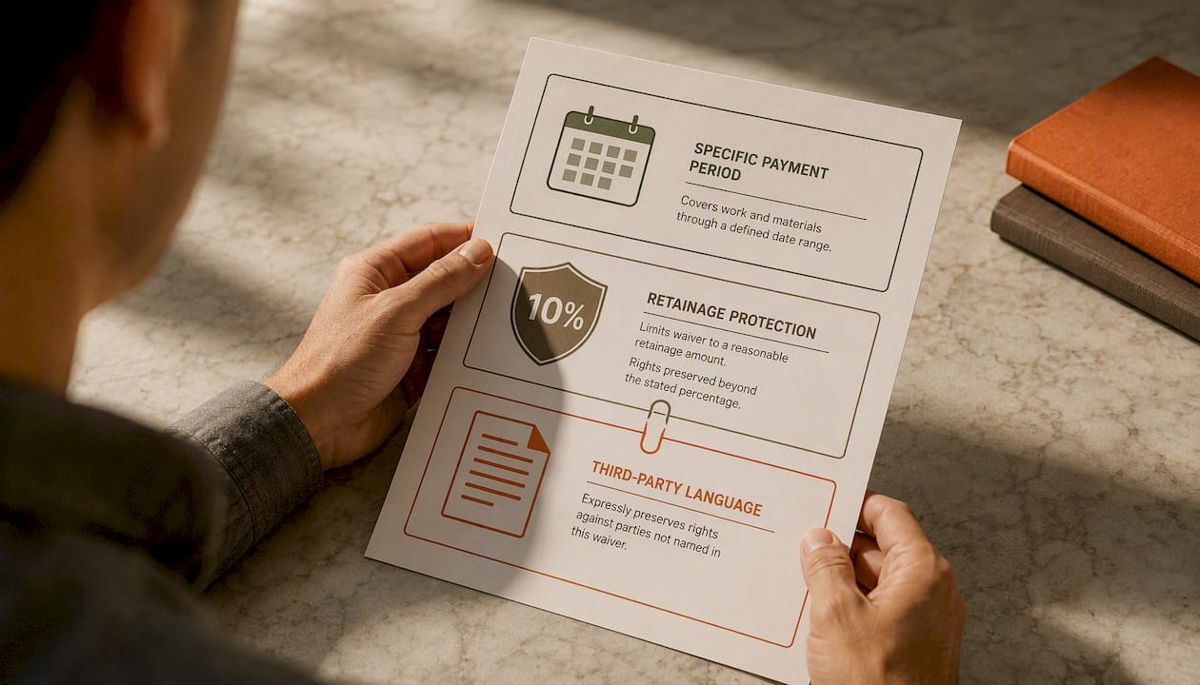
Timing: Payments, Retainage, and Filing Deadlines
“Amounts actually paid” under Article 46 means funds that have cleared, not a check sitting in a drawer or a wire still in transit. That distinction is exactly why conditional waivers exist: they protect you from waiving rights over money you haven’t received yet.
- Itemize retainage separately in every partial waiver, and hold it out until it’s actually released and paid.
- Track mechanic’s lien filing deadlines closely. Laborers paid by the piece generally have two months after completion to file, while contractors, subcontractors, and suppliers typically have four months after their last labor or material was furnished.
- Once a final waiver is signed and payment clears, confirm whether a recorded lien release is also needed, since a waiver and a recorded release aren’t the same document.
A Practical Workflow for Exchanging Waivers
Here’s a sequence that keeps everyone protected without slowing down payment.
- Contractor submits an invoice for completed work.
- Payer requests a conditional waiver matching that invoice amount and period.
- Payment is issued, and the claimant confirms funds have actually cleared, not just been sent.
- Once verified, the claimant signs and delivers the unconditional waiver.
- At project close, the same tiered process repeats with conditional and unconditional final waivers.
Before signing anything unconditional, verify three things: payment cleared, retainage is accurately accounted for, and third-party debts tied to the work are covered.
Pro Tip: Keep signed waivers, proof of payment, and email confirmations in one project file. If a dispute surfaces months later, that paper trail is what settles it.
How WaiverPilotPRO Helps You Avoid Drafting Mistakes
Every field flagged in this article, the third-party-debt statement, retainage line, through date, property description, has to be filled in correctly every single time. That’s tedious work when you’re managing multiple subcontractors across several jobs.
WaiverPilotPRO offers a free, Colorado-specific waiver generator built around these exact requirements, so you’re not reconstructing the statutory language from scratch on every job.
- Auto-calculated balances reduce math errors that lead to retainage disputes.
- Integrations with Procore and QuickBooks help match actual payment records to the waiver before you sign, cutting the risk of issuing an unconditional waiver before funds have cleared.
- Multi-subcontractor support keeps large projects organized when you’re collecting waivers down the entire payment chain, not just from your direct contractor.
A Conservative Approach Pays Off on Colorado Projects
If there’s one habit worth adopting, it’s defaulting to conditional waivers until money is verified in the bank, and collecting waivers from everyone down the payment chain on larger jobs, not just your direct contractor. That extra step costs you almost nothing and closes most of the gaps this article covers. When a dispute involves real money, ambiguous contract language, or a payer who’s gone quiet, that’s the point to call a construction attorney rather than lean on a template.
— Rowena
Generate Your Colorado Waiver in Minutes, Not Hours
Retyping the same statutory language, the third-party-debt statement, the retainage line, the through date, on every invoice cycle is exactly the kind of task that eats an afternoon for no good reason. WaiverPilotPRO is the alternative to building your own waiver templates from scratch: it’s a free, Colorado-aware generator that fills in the required fields automatically and produces a document ready to send.
The platform covers all four waiver types, conditional and unconditional, partial and final, with retainage fields built in and no account required to get started. If your team already runs on Procore, QuickBooks, or JobTread, the integrations sync payment details directly into the waiver so you’re not double-entering numbers. Before your next invoice goes out, verify your contractor insurance is current too, since confirming coverage before work starts is a smart companion step to collecting clean waivers.
Start with a free lien waiver generator built for Colorado projects, and use a conditional template for your next payment cycle until the funds clear.
Where to Verify Colorado Lien Waiver Law
- C.R.S. § 38-22-119: party-only binding rule and third-party-debt statement requirement.
- C.R.S. § 38-46-104: amounts-actually-paid rule and $150,000 project threshold.
- FindLaw’s annotated version of § 38-22-119 for historical notes and cross-references.
This article is general information, not a substitute for advice from a qualified lawyer. Consult a qualified legal professional about your own circumstances before acting on anything here.
Sources
- C.R.S. § 38-22-119 (Agreement to waive) — Colorado public law
- C.R.S. § 38-46-104 — Law.justia
- Colorado lien waiver requirements, types, and deadlines — LegalClarity